4.2.5 Case Study 5: Rural EV Infrastructure and Innovation: The Dingle
4.2.5 Case Study 5: Rural EV Infrastructure and Innovation: The Dingle Project
This strategy document focuses on providing a national EV charging network that caters for all of Ireland’s citizens and that allows everyone, no matter where they live, to grasp the opportunities and benefits that electric-vehicle technologies can offer. In Dublin, EV infrastructure provision is supported by large populations, short travel distances, easier access to the electricity grid, and the presence of businesses and universities. Although the range of electric vehicles is increasing, the provision and availability of charging infrastructure is seen as a key concern for EV drivers in rural areas66. In rural areas, Government development policy is focused on the installation of public charging points at remote working hubs, community centres, and enterprise centres67.
part of a rural electricity transmission grid. It also demonstrated the effectiveness of EVs over longer distances and across more challenging rural landscapes. The EV trial also fed into wider questions of how communities engage with the low-carbon energy transition. MaREI researched how energy citizenship behaviours can spread across communities and the factors that encourage people to adopt new technologies.
Some of the key findings were:
MRetrofitting (as well as the deployment of heat
pumps, solar PV panels, and electric vehicles) can lead to significant emissions reductions (up to 50%) for homes, businesses, and transport.
MElectric vehicles can be used for daily driving in
rural communities without disruption to normal patterns.
In Ireland, one of the most innovative projects to address the urban/rural divide is the ESB Networks Dingle Project68, which arose out of the pioneering work of the Corca Dhuibhne/Dingle Peninsula 2030 initiative. The initiative is a multipartner project partnership that was established in 2018 by four organisations: Dingle Creativity and Innovation Hub, ESB Networks, North East West Kerry Development (NEWKD), and MaREI (the SFI Centre for Energy, Climate and Marine)69. The overall goal of the initiative is to transition the Dingle Peninsula into a low-carbon society with a more environmentally and economicallysustainable future70.
MRange, cost to charge, and performance are
perceived more positively following the users’ experiences.
MFor long-distance driving, EVs are deemed
to be less practical than internal combustion engine alternatives.
The project recommended that the successful national rollout of EVs requires an increase in public charging facilities.
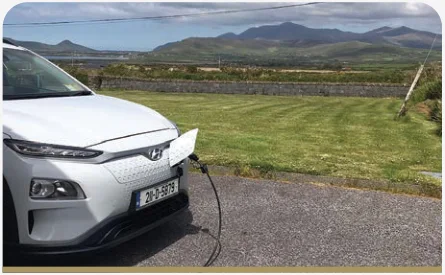
Figure from page 42
Part of the initiative’s work was to deploy and assess a range of new technologies to develop a resilient, low-carbon electricity network. Over the course of three years, ESB Networks worked with local people to trial renewable and clean-energyenabling technologies at their properties. These included EVs and 15 smart EV charge points, five of which were replaced with bidirectional (V2G) charge points. The trial allowed the impact of V2G to be assessed as a possible tool to balance
66 https://www.agriland.ie/farming-news/going-electric-are-evs-a-runner-for-rural-drivers/
67 Govt of Ireland (2021) Our rural future: rural development policy 2021-2025, p. 71
68 ESB Networks’ Dingle Project
69 https://dinglepeninsula2030.com/wp-content/uploads/2020/07/Dingle-Peninsula-2030-Brochure_Final.pdf
70 https://dinglepeninsula2030.com/

Figure from page 43
Pages 42–43 · View in original PDF