4.2.2 Case Study 2: Vehicle-to-Grid Charging System in Oslo Car Park
4.2.2 Case Study 2: Vehicle-to-Grid Charging System in Oslo Car Park
As the number of EVs connected to the electricity distribution network increases, the potential for EVs to act as back-up electricity storage, allowing demand to be spread across the grid, also increases. Innovative technology such as bidirectional cabling is being piloted to test the future feasibility of Vehicle-to-Grid (V2G) charging.
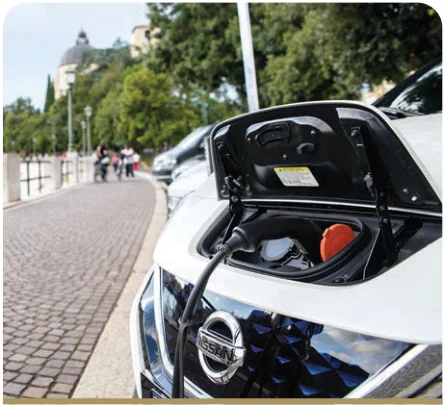
Figure from page 39
In Oslo, the possibility that larger electric vehicle hubs with V2G technology could balance local55 peak electricity demand was examined through a pilot project. This was carried out by the municipality in partnership with a local real estate company56 and a charging service provider57. Support for the pilot, which started in 2017, was provided by the European Regional Development Fund (Interreg North Sea Region). The project involved building an electric-car charging facility of over 100 flexible 22 kW charge points at the Vulkan parking garage in central Oslo. A battery reserve was installed in the garage to balance power loads. This avoided straining the power grid during times of high usage. The trial examined the feasibility of setting up large EV charging facilities in garages without having to make expensive and time-consuming upgrades to their power grid58.
Photo: V2G charge point
garage during the day. Parking charges relating to the use of the facility are paid separately from EV charging, with further differences in charging for residents at off-peak times59. This also supports the city’s policy of removing a number of onstreet parking spaces in the neighbourhood.
A number of interesting findings emerged from the pilot. For example, the battery electric storage system (BESS) did appear to reduce the grid demand within a given month. In addition, the pilot discovered that this reduction could have been improved by also using smart charging. This addition could provide extra savings at times of peak demand. The trial allowed the development of commercial charging products and technology, and provided access to residential-type charging opportunities for local EV owners. It also provided the Oslo municipal authority and commercial partners with data and insights to feed into the future possible deployment of V2G charging.
By 2019, the numbers of charging sessions from the 100 flexible 22 kW charging stations had tripled since the project launch in February 2017, with use and turnover increasing by the day. EV charging is free at night-time for residential parking, with Oslo City Council paying Aspelin Ramm to provide this service. This relieves the pressure on on-street public EV charging stations. Several car-sharing companies, an EV-to-go provision, some van-based logistics service companies, and electric taxis also use the parking
55 For example, Roks et al. (2019) Vehicle-to-everything (V2X) in the Netherlands, Utrecht University report for the Netherlands Enterprise Agency.
57 https://www.fortum.com/media/2017/11/innovative-charging-facility-electric-vehicles-oslo-norway.
59 Dai et al (2020) European Regional Development Fund Interreg North Sea Region SEEV4-City: Final report – Oslo operational pilot.
Page 39 · View in original PDF