4.2.1 Case Study 1: On-Street Kerbside Charge Points in European Cities
4.2.1 Case Study 1: On-Street Kerbside Charge Points in European Cities
On-street charging is generally deployed in residential areas. It offers EV users without offstreet charge points the closest alternative to home charging. It allows drivers who park on the street near their residence to charge overnight. With more people buying EVs and seeking to charge them at home, at work, and on the go, kerbside charge points will become an increasingly familiar part of our streetscapes. A range of different on-street charge point technologies is emerging to meet different user needs and to fit into a range of streetscapes and spaces. Of these, lamppost and bollard charge points are the most commonly available, with other innovative kerbside charge point solutions emerging.
As can be seen from Table 2 below, the main considerations for kerbside charge point installation are how much space they take up, how they relate to and can be integrated with existing street furniture, and whether they require extensive groundworks and technology to allow them to connect to the electricity supply network. These considerations can help to guide the choice of the most appropriate kerbside charging technology for a particular location. Accessibility impacts are also a key consideration for kerbside charging technologies. Such charge points should not impact negatively on the mobility and access of the wider public.
Table 2: Summary of On-Street Charging Technologies (Source: Element Energy)
| Technology | Charging Speed | Electricity Supply | Groundworks | Kerbside Street Furniture | Electrical Box above Ground |
|---|---|---|---|---|---|
| Lamppost charge points | Up to 5.8 kW | Connected to lamppost power supply | No groundworks | No additional Street furniture | No electrical box |
| Lamppost with satellite bollard | Up to 5.8 kW | Minor groundworks | Minor street furniture | ||
| Bollard charge points | Up to 5.8 kW | New power supply needed | Significant groundworks | Significant street furniture | Small electrical box |
| Slim bollard charge points | 7-22 kW | Minor street furniture | |||
| Pop-up charge points | 7 kW | Semi- permanent, additional street furniture while charging | Electrical box | ||
| Lance and socket charge points | Up to 22 kW | Electrical box – one box can supply 15 charge points | |||
| Electric vehicle charging channels | Speed of home charge point 5-7 kW | Connected to home power supply | Minor groundworks | No street furniture | No additional electrical box |
| Wireless charging | Range of speeds (early stages) | New power supply needed | Significant groundworks | Electrical box |
For example, lamppost charge points (such as those installed in the London boroughs of Hackney51 and Westminster52) allow all charging hardware to be installed within the lamppost column without any extra groundworks such as ducting or cabling (so long as the ducting is of sufficient quality). This means that rather than having to install an extra piece of street furniture on already-crowded urban streets, charge points can be inserted into existing features that are already present in large numbers and connected to the electricity distribution network.
However, bollard charge points do pose accessibility challenges. Where they are installed, the project must be appropriately designed to mitigate these impacts.
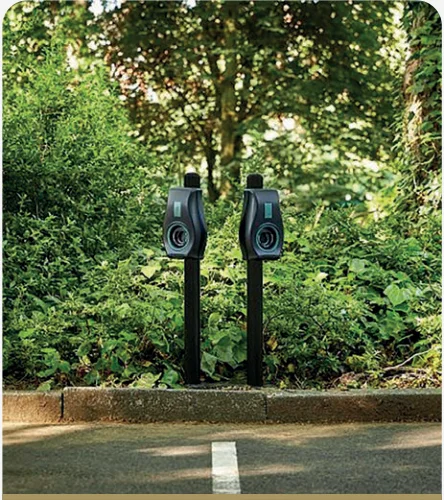
Figure from page 38
Bollard charge points are also becoming an increasingly familiar sight in cities across Europe. They offer higher charging speeds than lamppost charge points but require more space for installation.
Many different operators have developed their own proprietary versions of these types of charge points, each with a different design and size of their above-ground hardware53. As bollard charge points can be relatively bulky, manufacturers have focused on reducing their size and diameter, with most of the hardware deployed underground. For example, Connected Kerb offers one of the smallest bollard designs and is in the early deployment phase in Kent in the United Kingdom. This design offers the possibility of 7-22 kW AC charging from single or paired charge-point sockets, with a smart-grid trial underway54.
Photo: Connected Kerb bollard charge points in Kent, United Kingdom
53 https://www.westminster.gov.uk/parking/electric-vehicles
53 For example, Vattenfall Amsterdam, Amsterdam City.
54 Connected Kerb Kent, Agile Streets project,

Figure from page 39
Pages 37–39 · View in original PDF