8.8 Biodiversity
DAFM plays an active role in developing biodiversity policy for agriculture, translating wider environmental policy and strategies for the agricultural sector and implementing relevant environmental legislation such as the Environmental Impact Assessment (Agriculture) Regulations. DAFM works closely with other Government Departments, multi-agency working groups and steering committees to deal with a wide range of issues regarding the conservation, enhancement and promotion of biodiversity in the agricultural sector and wider environment.
Nationally, the Department of Housing, Local Government and Heritage (DHLGH) is the Government Department responsible for natural heritage with the goal to conserve and manage Ireland’s heritage. However, DAFM plays a key role by contributing to a significant number of national environmental policies and strategies led by DHLGH such as contributing to the development of the National Biodiversity Action Plan.
DAFM provides input into EU technical expert groups and negotiations on legislative instruments. The importance of this has increased in recent years as a result of increasing focus and public demand for environmental sustainability in agriculture, reflected in the EU Green Deal and associated Biodiversity and Farm to Fork Strategies. DAFM is partaking in ongoing negotiations on the EU Nature Restoration Regulation and the forthcoming EU Soil Monitoring Law. Representatives from DAFM also contribute to EU technical expert groups, including EU CAP Network Thematic Group on Landscape Features and Biodiversity, the EU Working Group on Pollinators and the EU Soil Expert Working Group. To support the development of scientific and technically robust policy, DAFM provides financial support to small scale studies which can deliver relevant outputs that support our role as policy advisors/developers. An example of such support is the BirdWatch Ireland Farmland Bird Hotspot Mapping Project which was co-funded by DAFM and The Heritage Council.
Case Study
Farmland Bird Hotspot Mapping
In 2021, DAFM and the Heritage Council, co-funded BirdWatch Ireland data analysis project of farmland birds. BirdWatch Ireland gathered 29 existing datasets of bird records which contained 2.5 million observations, of which 130,000 scientifically validated records were extracted. This data related to 27 red and amber listed birds of conservation concern. Records within the datasets were scored and weighted to produce maps highlighting significant locations for these species which are reliant on farmland. Figure 1 is the primary hotspot map produced.
Case Study
From the primary analysis, it is possible to generate species or group of species specific maps, such as the example in Figure 2 for breeding waders. The two images reflect the fact that nationally, hotspots can vary depending on the target species or group of species under consideration.
Figure 2 Breeding Farmland Wader Hotspots at 1km resolution
The outputs of this analysis were used in 2022 to inform selection procedures for the national agri-environment scheme “ACRES”. Breeding wader and Geese and Swans hotspot maps were used for identifying Tier 1 priority areas. The information was also used to optimise delivery of actions in ACRES, for example, individual datasets were used for information purposes on mapping systems used by agricultural advisors to identify beneficial areas for certain actions such as grass margins and winter bird food strips.
Environmental Impact Assessment (Agriculture) Regulations The Environmental Impact Assessment (EIA) (Agriculture) Regulations were introduced in 2011 and were amended in 2013 and 2017. The Regulations apply to three different types of onfarm activities and provide for an assessment of the environmental impact of certain projects before they can proceed. The thresholds for screening applications are:
Restructuring of rural land holdings M
Length of field boundary to be removed above 500 metres, or M
Field size greater than 5 hectares following removal of field boundaries, or M
Recontouring (within farm holding) of an area above 2 hectares. M
Commencing to use an area above 5 hectares of uncultivated land or semi-natural areas for M intensive agriculture.
Land drainage works in lands used for agriculture above 15 hectares. M
Screening is also required in the following circumstances:
If the proposed activity may have a significant effect on the environment. M
If the proposed activity is within, is near, or may affect, a proposed Natural Heritage Area M or nature reserve.
If the proposed activity is identified as ‘requiring consent’ or is a ‘notifiable action’ in a M European site (Special area of conservation (SAC) or Special Protected Area (SPA) or National Heritage Area (NHA).
If the proposed activity may have an impact on an archaeological monument. M
In addition to screening, there are thresholds where mandatory Environmental Impact Assessment (also referred to as Consent) is required, which include restructuring by removal of field boundaries above 50 hectares or 4 kilometres, re-contouring (within farm-holding) above 5 hectares, commencing to use uncultivated land or semi-natural areas for intensive agriculture above 50 hectares and land drainage of any lands used for agriculture above 50 hectares.
Where a landowner intends to undertake any of these activities, and the proposed works exceed the threshold for screening as set out in the Regulations, then there is a requirement to submit a screening application to DAFM for screening approval before any works can proceed. All screening applications are assessed by DAFM ecologists and inspectors to assess the criteria set out under Article 8 of the Regulations. If the application is rejected for screening the applicant can then apply for consent.
A review of the Environmental Impact Assessment Regulations commenced in quarter two 2023, with a view to updating the regulations.
LIFE programmes The LIFE Programme is the EU’s funding instrument for the environment and climate action. DAFM are an associated beneficiary to several LIFE programmes currently in action in Ireland. A number of the projects have biodiversity and/or water quality as a primary focus. DAFM suport these projects in the form of development of results based or knowledge exchange elements, contributions to steering and working groups and additional inputs as required for such projects. Among the current list of projects which have biodiversity and/or water quality as a primary focus are:
Wild Atlantic Nature LIFE IP M
Corncrake LIFE M
LIFE on Machair M
Lough Cara LIFE M
Waters of LIFE M
LIFE Peatlands and People M
Pollinators In response to the current threat to our pollinators, and the importance of their role for agriculture, DAFM is taking a proactive approach to support pollinators through policy development and increasing awareness among farmers and the general public.
DAFM has been fully supportive of the EU Pollinator Initiative which was adopted in 2018. It set out strategic objectives and a set of actions to be taken by the EU and its Member States to address the decline of pollinators in the EU and contribute to global conservation efforts. The initiative has been an integral part of the EU biodiversity strategy. It is also fully supportive of the revised Pollinators Initiative objectives set for 2030.
Irelands’ All-Ireland Pollinator Plan (AIPP) is implemented by the National Biodiversity Data Centre with joint funding from several stakeholders including DAFM. In publishing the All- Ireland Pollinator Plan (AIPP) in September 2015, Ireland became one of the first countries in Europe to address this issue. The second All-Ireland Pollinator Plan 2021-2025 builds on the first plan by providing a further road map that aims to provide further help for bees, other pollinating insects and our wider biodiversity. DAFM is providing funding for the role of a Farmland Pollinator Officer to support the implementation of farmland actions under the Plan.
Monitoring of bee and pollinator populations is key to their conservation and to the design of successful actions to improve population trends. The need for improved monitoring forms a key part of the EU Pollinators Initiative and Ireland is one of the leading countries in this area with a Pilot National Monitoring Scheme in place. Ireland’s Pilot National Pollinator Monitoring Scheme was launched in July 2021 and is jointly funded by DHLGH and DAFM with the implementation coordinated by the National Biodiversity Data Centre (NBDC). The aim of the Pilot National Monitoring Scheme is to detect status and trends of wild pollinators. During 2022 monitoring took place at 36 sites including farmland sites.
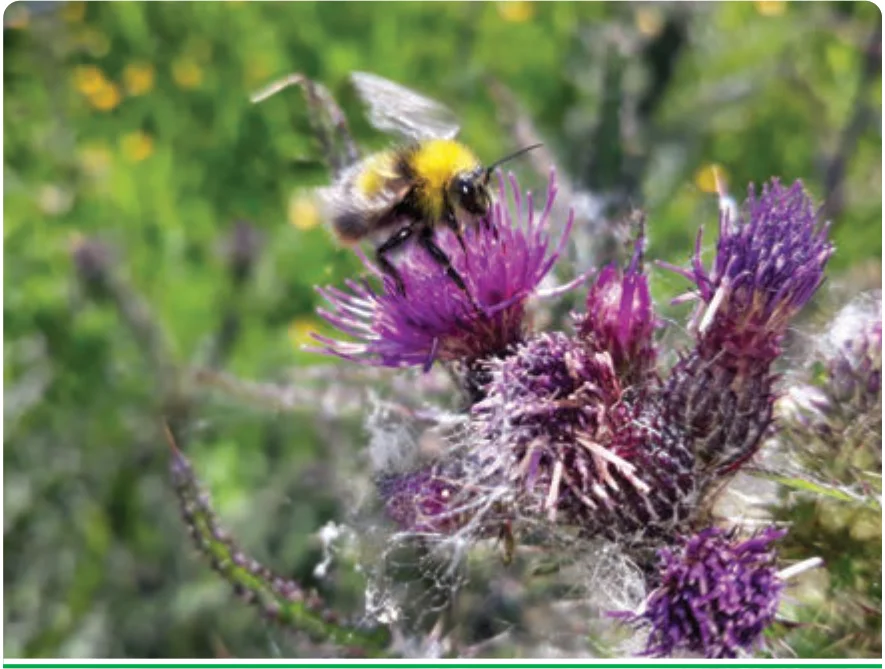
Figure from page 258
As part of the EIP funding stream under the Rural Development Programme, DAFM awarded funding to the Protecting Farmland Pollinators EIP. This National Biodiversity Data Centre-led project, which began in 2019, will be completed in 2023. The project aims to develop a flexible mechanism that encourages all farmers to make their whole-farm more pollinator friendly in a way that is measurable and will not impact agricultural productivity.
Under EIP call five, two further Pollinator EIPs were funded for 2021-2022. The Great Yellow Bumblebee project and The Farmer Moth Monitoring EIP.
The Department is currently an associated beneficiary in a number of EU LIFE projects that focus on the conservation of threatened habitats and species, through which pollinators benefit from habitat improvement. The LIFE on Machair project in particular has a pollinator focus.
Pilot National Soil Sampling and Analysis Programme The pilot National Soil Sampling and Analysis Programme was launched in late 2021. The objective of the programme is to develop a baseline national dataset at farm level for macro and micronutrients and a soil pathogen assessment. This pilot is also examining soil carbon levels which will guide future actions and could support carbon farming.
The €10 million pilot programme is co-funded by the EU and the national exchequer under the Rural Development Programme (RDP) 2014-2022. A further €10m is committed for 2023 for this ambitious programme.
Farmer participation in the pilot Programme was voluntary and open to all farms that submitted a 2021 BPS application. Applicants were accepted on a first come, first serve basis ensuring maximum spread over geographic regions and farm enterprise types.
Approximately 7,800 farmers and partnerships were notified of acceptance into the programme in November 2021, with soil sampling and the associated analysis commencing thereafter. Work under the pilot programme was completed in early 2023. The pilot is intended to inform a further roll out of the measure in 2023.
Information about our soils will provide opportunities for environmental and climate balance and is the foundation for natural and agricultural systems to achieve both economic and environmental sustainability. The results from the programme will assist farmers, advisors and policy makers in applying the ‘right measure, right place, right time’ approach to reaching our overall goals.
Pilot National Farm Environmental Study (FES) The pilot Farm Environmental Study (FES) measure will begin the process of developing a national baseline database of farm-scale habitat and biodiversity data along with additional environmental parameters. This measure was launched in late 2021 and over 6,300 applicants were approved for the measure in 2022. The information gathered will enhance farmer knowledge of habitat and biodiversity on their farms, while also providing information to DAFM which could be used to target future Agri-environment and Climate Measures as part of the next Common Agricultural Policy. This €5 million pilot Programme is co-funded by the EU and nationally under the Rural Development Programme (RDP) 2014-2022.
Pilot Multi-species Sward Measure Research has shown that multi-species swards can have a positive impact from a climate, biodiversity, and water quality perspective, as well as supporting improved livestock productive efficiency, while also reducing dependence on expensive chemical nitrogen.
Building on the increased interest in multi-species swards, and to capitalise on their climate and environmental benefits, provision was made in budget 2022 for a pilot Multi-Species Swards Measure which was launched in March 2022.
The pilot Multi-Species Sward Measure was operated through Agri-retailers/Co-ops who discounted the price of the approved multi-species seed mix by €50/bag and were then re-
imbursed by DAFM. The pilot programme facilitated establishment of an additional 4,400ha of multi-species swards during 2022. This was a significant achievement given the overall increase in input and reseeding costs during 2022, as well as a significant summer drought which affected certain areas of the country.
Further funding of €1.5m has been provided in budget 2023 for the Multi-species Sward measure to expand the area already established in the pilot programme. The measure opened in spring 2023, with a payment rate of up to €300/ha.
An action relating to establishment of multi-species swards is also included as an Eco-Scheme option applicable under the CAP Strategic Plan from 2023.
Pilot Red Clover Silage Measure: Red clover is a high yielding legume which converts atmospheric nitrogen into a plant usable form. Due to its nitrogen fixing ability, red clover silage is higher in protein than conventional silage and, combined with its ability to yield over 14 tonnes of dry matter per hectare, should allow farmers to reduce their concentrate feed costs while also reducing their chemical fertiliser costs and greenhouse gas emissions.
The Pilot Red Clover Silage Measure was launched in spring 2022. Similar to the pilot Multi- Species Swards Measure, the measure was operated through Agri-retailers/Co-ops who discounted the price of a 12kg bag of the approved red clover seed mix by €50/bag. The Agriretailers/Co-ops were then re-imbursed by DAFM.
Based on a standard seeding rate of 30kgs per hectare, approximately 3,200 hectares was sown under the Pilot Red Clover Silage Measure in 2022. This represented an almost 400% increase on the cropping area of 787 hectares declared by farmers as red clover in 2021.
Further funding of €1million has been provided in budget 2023 for the Red Clover Silage Measure and the measure was opened in Spring 2023.
Liming Programme. Funding of €8 million was announced for a National Liming Programme as part of budget 2023. The Liming Programme was introduced by DAFM to incentivise the use of ground limestone which acts as a natural soil conditioner that corrects soil acidity by neutralising the acids present in the soil. This in turn allows for an improvement in the overall health of the soils. Currently a significant proportion of Irish soils have a sub-optimal pH and soil protection is an important aspect of the Department’s policy. Research has also shown that liming can release nitrogen (N), phosphorous (P) and potassium (K) in the soil, thereby reducing the requirement for chemical fertilisers.
The Liming Programme 2023 was opened in spring 2023, with almost 41,000 applications received seeking support in respect of over 4.5 million tonnes of lime.
Results-Based Schemes Land used for agriculture covers approximately 64% of the land area of the Republic of Ireland. Many species of plants and animals rely on low-input agricultural management. The parallel processes of agricultural intensification and abandonment in the Irish landscape in the 20th century has resulted in a steep decline in farmland biodiversity. Balancing food security and sustainability, while minimising agriculture’s negative environmental impact is one of the greatest challenges faced by Ireland, and agriculture globally.
The Common Agriculture Policy (CAP) provides a policy framework for agriculture in Europe and is the largest source of funding for nature conservation in the EU. In particular, Pillar Two of the CAP requires the implementation of agri-environment schemes. However, the effectiveness of such schemes when applied through a prescription-based, short-term, untargeted and unmonitored model has been questioned. The new CAP programme (2023-2027) calls for greater consideration and inclusion of environment and climate priorities throughout Member
Figure from page 261
States’ interventions. It also shifts the focus from prescription-based to result-based approaches to drive environmental improvements.
The key element of results-based methodologies regarding biodiversity is that the financial support paid to the farmer reflects the quality of biodiversity that is being delivered. This facilitates a key shift in the perception of farmland biodiversity, focusing on purposefully produced environmental outputs, alongside food production, rather than considering biodiversity as an occasional coincidental by-product.
The European Innovation Partnership (EIP) Scheme, financed through Ireland’s Rural Development Programme, supports innovation, competitiveness and sustainability in agriculture and forestry. Several of the EIP programmes currently active in Ireland are based on a results-based model.
The EIPs are locally-led, farmer-centred, results-based and adaptable. These principles are considered to be the key to their successful engagement and delivery to date. The success of these programmes and similar programmes such as RBAPS (Results Based Agri-environmental Payment Schemes) and EU LIFE funded projects, including the Corncrake LIFE project and Wild Atlantic Nature programme, has resulted in a significant commitment from DAFM to implement the results-based approach at a national scale.
The Results Based Environment Agri Pilot Programme (REAP) was launched during 2021. REAP is a pilot project that provides financial supports to farmers to maintain and improve the environmental condition of their land using a results-based scoring system to indicate payment rates. Building on this, Ireland’s CAP Strategic Plan (2023-2027), introduced results-based elements as part of the new national scale Agri-Climate Rural Environment Scheme (ACRES). This will see implementation of a results-based approach across eight ACRES Co-Operative Project areas, and through targeted actions in ACRES General areas. These actions will build on the learnings of the EIPs and use a habitats-based approach to contribute significantly to long-term environmental improvement.

Figure from page 262
Pages 254–262 · View in original PDF