8.5 Greenhouse Gas Emissions and Air Quality & Targets
According to the latest emissions data from the Environmental Protection Agency (EPA) issued in July 2023, Ireland’s GHG emissions in 2022 are estimated to be 60.76 million tonnes carbon dioxide equivalent (Mt CO2eq), which is 1.9% lower than emissions in 2021. This follows a 5.1% increase in emissions reported for 2021. Emissions are 4.6% below pre COVID, 2019 figures. In 2022, the energy industries, transport and agriculture sectors accounted for 74.1% of total GHG emissions.
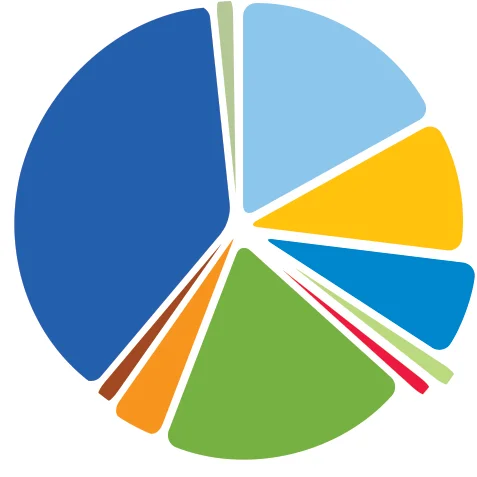
Figure 8.1 Greenhouse Gas Emission share by sector in Ireland 2022
n Energy Industries: 16.6
n Residential: 10
n Manufacturing Combustion: 7.1
n Commercial Services: 1.3
n Public Services: 1.1
n Transport: 19.1
n Industrial Process: 3.8
n F-gases: 1.2
n Agriculture: 38.4
n Waste: 1.4
Source: EPA
Agriculture emissions in 2022 decreased by 1.2% or 0.29 Mt CO2eq, compared to 2021 figures. This reduction was based on a 14% decrease in nitrogen use, despite a 0.9% and 0.7% increase in cow numbers and milk production. Red and white clover, in addition to other multispecies swards being established on livestock farms, played a role in the reduction.
With the continued use of these actions and the increased uptake of nitrogen inhibitor based fertilisers, it is anticipated that emissions from chemical nitrogen usage will decline over the decade, which will have a positive impact on the inventory. In addition, increased uptake in the use of low emissions slurry spreading technology and its continued funding under the Targeted Agricultural Modernisation Scheme (TAMS) will also reduce chemical nitrogen demand.
Figure 8.2 Distribution of Irish Agricultural Emissions 2022
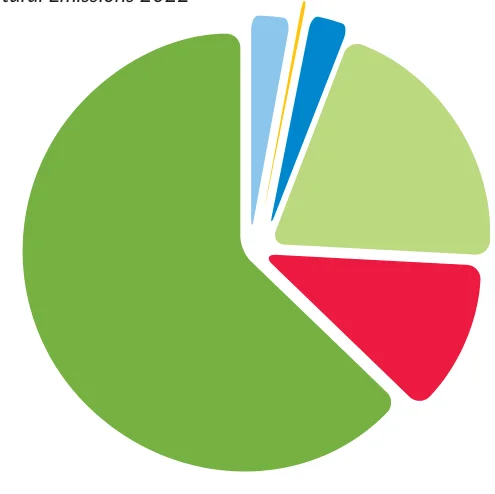
Figure from page 252
n Fuel combustion: 2.8
n Urea application: 0.5
n Liming: 2.7
n Agricultural soils: 19.9
n Manure management: 11.5
n Enteric fermentation: 62.6
Source: EPA
The Gothenburg Protocol and NEC Directives Ireland is a Party to the Convention on Long Range Transboundary Air Pollution (CLRTAP) under which certain transboundary air pollutants, such as ammonia, are controlled. As a Party to the United Nations Economic Commission for Europe Convention (UNECE) on CLRTAP, Ireland is required to annually report emission data for a wide range of air pollutants and other substances released into the atmosphere. As a member of the EU, implementation of the Gothenburg protocol (a daughter protocol of the CLRTAP) is achieved through limits set out in the National Emissions Ceilings Directive (NECD) 2001/81/EC, subsequently updated in 2016 by Directive 2016/2284.
The NECD sets maximum emission ceilings for each Member State per year for the five main pollutants namely (i) fine particulate matter (PM2.5), (ii)sulphur dioxide, (iii)nitrogen oxides, (iv) non-methane volatile organic compounds and (v)ammonia. In terms of ammonia, Ireland must comply with the targets set out within the NECD. Beginning in 2020, the NECD set out new national emission reduction commitments for each EU Member State for the years 2020 to 2029 and 2030 onwards. Ammonia emissions must be reduced by 5% below 2005 levels from 2030 onwards.
Irelands current National Air Pollution Control Programme (NAPCP) was submitted to the European Commission in March 2021. The NAPCP is a technical document which outlines the pathway Ireland will follow to achieve compliance with its commitments under the NECD.
Pages 251–252 · View in original PDF