8.10 Organic Farming
Organic farming is a sustainable production system. It provides the opportunity of an alternative farming system based primarily on balancing inputs and outputs in a ‘closed’ system. Increased consumer awareness of food safety issues and environmental concerns has contributed to the growth in organic farming over the last few years.
Organic farming requires: the consideration and application of production methods that do not damage the environment; a more respectful use of the countryside; concern for animal welfare and the production of high-quality agricultural products. It is a farming system which relies on crop rotations, the recycling of farm-produced organic materials, that is, crop residues, animal manure, legumes, green manure and off-farm organic wastes and on a variety of nonchemical methods for the control of pests, diseases and weeds. Synthetically compounded fertilisers, pesticides, herbicides, growth regulators and livestock feed additives are excluded. GMO products and methods of genetic engineering are also strictly prohibited. This is a sector which has a central role to play in increasing future well-being and reducing the harmful effects of the climate and biodiversity crises.
Organic Standards A major factor that distinguishes organic farming from other approaches to sustainable farming is the existence of internationally acknowledged standards and certification procedures. The standards for organic production within the European Union are defined and enshrined in law by Regulation (EU) 2018/848 of the European Parliament and of the Council and associated secondary legislation - Implementing and Delegated Acts.
Regulation (EU) 2018/848 and its associated secondary legislation, create a framework defining in detail the requirements for agricultural products or foodstuffs bearing a reference to organic production methods. The rules not only define the methods of production for organic crops and livestock, but it also regulates the labelling, processing, inspection and marketing of organic products within the European Community and the importation of organic products from nonmember countries.
In Ireland DAFM is the competent authority for regulating the organic sector and ensuring that the obligations and requirements of Regulation (EU) 2018/848 and its associated secondary legislation are maintained. EU legislation allows Member States to use private certification bodies to carry out the inspection and licensing system of organic operators. Currently two Organic Certification bodies are approved to carry out this work in Ireland, namely the Irish Organic Association (IOA) and the Organic Trust Limited (OT).
Organic Schemes Implemented by DAFM The Organic Processing Investment grant scheme aids organic processors who wish to invest in developing facilities for the processing, preparation, grading, packing and storage of organic products. Aid is available for off-farm projects and processors who can apply for grant-aid of up to €700,000.
The Organic Capital Investment Scheme, under the umbrella of TAMS, provides support specifically for organic farmers with the aim of ensuring a regular supply of high-quality organic produce for the market. It enables farmers to apply for grant aid for investment in buildings and machinery at a rate of 60% for organic registered farmers up to maximum of €90,000. The scheme also aims to provide an incentive to eligible organic young farmers to upgrade their agricultural buildings and equipment by providing them with an increased level of support to meet the considerable capital costs associated with the establishment of their enterprises.
The Organic Farming Scheme’s overall objective is to deliver enhanced environmental and animal welfare benefits and to encourage producers to respond to the market demand for organically-produced food. Under the Scheme, a farmer receives per hectare payments as well as a participation payment to cover additional administrative costs annually. The participation rate of €2,000 for year 1 of conversion, and €1,400 thereafter, is available to mitigate the cost of organic licensing and increased administration, removing what was a financial impediment to potential participants.
Table 8.1 Organic Farming Scheme Payment Rates per Hectare
| Year 1-2 Year 3-5 | ||||
|---|---|---|---|---|
| 1-70 hectares | >70 hectares | 1-70 hectares | >70 hectares | |
| Drystock | €300 | €60 | €250 | €30 |
| Tillage | €320 | €60 | €270 | €30 |
| Dairy | €350 | €60 | €300 | €30 |
| Horticulture | €800 | €60 | €600 | €30 |
Source: DAFM
Policy Developments There was a 100% increase in applications to join the Organic Farming Scheme, with a contract start date of 1 January 2023, resulting in an expected 200,000 hectares being farmed organically in Ireland. This equates to approximately 4% of the utilisable agricultural area. The Programme for Government included a target of 7.5% of land farmed organically, while the revised target under the Climate Action Plan is to achieve 10% by the end of 2030. It is proposed that the organic farming scheme will reopen in late 2023.
Tonnes of
Nutrient
250,000
4,500
4,000
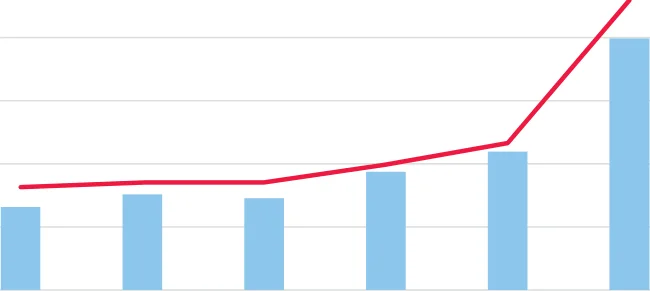
Figure 8.3 Area Under Organics and Number of Participants 2018 - 2023
200,000
3,500
3,000
150,000
2,500
100,000
2,000
1,500
50,000
500
2018 2019 2020 2021 2022 2023
Organic area in Hectares (Left hand side) Number of Participants (Right hand side)
Source: DAFM
National Organic Strategy
The implementation of the National Organic Strategy 2019-2025 continues apace. It sets out ambitious growth targets for the sector by aligning it closely with the market opportunities.
Bord Bia have appointed a dedicated Organic Sector Manager and they are currently undertaking work to bring clear definition to the value proposition of organic food. This messaging will form the basis of agreed consumer campaigns to build awareness and understanding of Irish organic food during the second half of 2023.
For the years 2023 – 2027 an allocation of €256 million under the new CAP Strategic Plan will continue the development and growth of the organic sector.
DAFM has provided funding to the Agricultural Consultants Association to increase advisory support in the sector. Teagasc are also committed to continuing their support of organic farming through their advisory service, which will ensure farmers have access to professional advice to aid in the important decision-making process.
The Organic Strategy Forum was established by Minister of State Pippa Hackett and tasked with developing a strategy for the further development of the organic sector in Ireland. The forum is comprised of a range of stakeholders including from the farming and food processing sectors, organic certification bodies and relevant state agencies. Forum members have been selected to include a broad range of expertise across all organic farming sectors, and this group will be the forum for discussion on all relevant issues to help the development of the Irish organic sector.
The priorities are to further increase participation in organic farming over the coming years to capitalise on the significant uptake recorded in 2022, Including: -
The co-ordination of organic supplies and reducing leakage M
Developing the market for Irish organic food M
Green procurement M
Education M
Infrastructure and the capturing of accurate organic production data. M
Case Study
NESC - Just Transition in Agriculture
and Land Use report July 2023
The Just Transition in Agriculture and Land Use report drafted by NESC fulfils an action in Climate Action Plan 2021, to conduct research and engage on how to support climatejust transition in agriculture, informed by a Working Group chaired by Professor Thia Hennessy. Engagement among the working group highlighted a shared sense that this is a moment of opportunity, where opinions are shifting and a way forward could be within reach. The report argues that the agriculture and land use sector can increasingly be a part of the solution to addressing urgent climate change and biodiversity loss and can contribute to national objectives.
The report seeks to find ways to further support stakeholders to positively engage in constructing a sustainable future. The report argues that tackling the environmental challenge must be addressed together with the intersecting economic and social challenges, and that a just transition process focuses on transition within, not out of, agriculture. The report frames interventions to help as:
‘low hanging fruit’ – measures that are low-cost or cost-beneficial that have positive M impacts on the wider environment and are broadly positively received by farmers;
‘uncertain measures’ – more widespread adoption would be possible if certainty M provided
‘hard-to-do’ – measures with potentially high-costs and income reductions for some M farmers.
The report acknowledges the work underway and how this will provide the foundation for further progress and outlines four areas of action:
-
Socially and Farmer-Inclusive Processes – Dialogue and participation are central to success, with clear communication to develop a shared direction for transition.
-
Enabling People to Benefit – Must be opportunities led and needs to account for natural capital and ecosystem services. Need to ensure knowledge, skills and capacity is in place, provide rewards for action and address barriers to bring more coherence to transition and reduce uncertainty around opportunities for diversification.
-
Sharing and Mitigating the Costs – Need to have a fair distribution of costs. Should be shared across the supply chain, further research into effort-sharing mechanisms, more robust standards and certification, targeted supports to the ‘hard-to-do’ type of interventions and guarding against unintended consequences for the environment and communities impacted.
-
Co-ordinating Action – Need to co-ordinate and govern the transition to ensure it is balanced and just. Multi-level oversight, facilitating ‘learning-by-doing’, clear communication and development of mechanisms on scale comparable to LEADER needed.
The report makes 20 recommendations across the four areas of accelerated action needed to deliver a fair and effective transition. These point to firstly, coordinating and governing the transition so it can deliver real change in a balanced, inclusive and just way. Secondly, having socially inclusive participation is critical to ensure a fair process of transition; thirdly, action is needed to ensure that the transition can be opportunities-led; and fourthly that a fair and sustainable distribution of the effort to bring about transition is needed to ensure no one is left behind.”

Figure from page 269
Pages 264–269 · View in original PDF