7.4 Food Systems & International Development
7.4 Food Systems & International Development
International Development DAFM has responsibility for some of the elements of Ireland’s international development programme and works closely with Irish Aid in the Department of Foreign Affairs and Trade in this regard. Specifically, DAFM leads on Ireland’s engagement with two United Nations agencies, the Food and Agriculture Organisation (FAO) and World Food Programme (WFP).
UN- Food and Agriculture Organisation (FAO) The FAO of the United Nations is mandated to help eliminate hunger, food insecurity and malnutrition; make agriculture, forestry and fisheries more productive and sustainable; enable inclusive and efficient agricultural and food systems; and increase the resilience of livelihoods to threats and crises. DAFM leads on the Irish Government’s relationship with FAO and ensured that Ireland’s position on agricultural and development matters is well represented at various FAO meetings throughout the year. Taking a food systems approach, Ireland and FAO are finding new and better ways to promote sustainable agriculture. Some €3.36 million was provided by DAFM to FAO in 2022, including the assessed contribution of €1.61 million and discretionary project funding of €1.75m in areas of strategic importance. Project funding is allocated in line with the priorities as per Ireland’s development aid strategy, A Better World, including within the key strategic footprint of the Sahel and Sub-Saharan Africa. Emergency and resilience building projects, as well as support to projects that fight the spread of animal and zoonotic diseases and insect infestation, are also considered. Project funding in 2022 was €1.75 million.
| Food and Agriculture Organisation (FAO) Funding 2022 € | |
|---|---|
| Ireland - FAO Assessed Contribution 2022 | 1,609,107 |
| Emergency livelihood support to rural households in conflict- afef cted Ukraine | 750,000 |
| Building resilient communities through climate smart and market driven production for improved food and nutrition security in Sierra Leone | 500,000 |
| Protecting the diets of the most vulnerable people as part of COVID-19 response and recovery programme in Kenya and Malawi | 120,000 |
| Supporting Livelihoods of Rural Women in the mountainous regions in the north of Vietnam | 100,000 |
| Global Bioeconomy Alliance (Scoping Study) | 80,000 |
| Empowering the Youth to co-develop innovative solutions food system transformations – Food Systems Transformation Hub | 50,000 |
| Livestock Environmental Assessment and Performance Partnership (LEAP) | 40,000 |
| Global Alliance for Climate Smart Agriculture Facilitation Unit (GACSA) | 40,000 |
| Global Agenda for Sustainable Livestock (GASL) | 40,000 |
| Support funding to support the work of the FAO Commitet e on Agriculture (COAG) Sub-Commitet e on Livestock | 30,000 |
| FAO Total | 3,359,107 |
Aligned with a commitment in Food Vision 2030 of enhancing youth engagement in the agri-food sector, DAFM supported the participation of a seven-person youth delegation to the World Food Forum in October 2022, which was hosted by FAO in Rome.
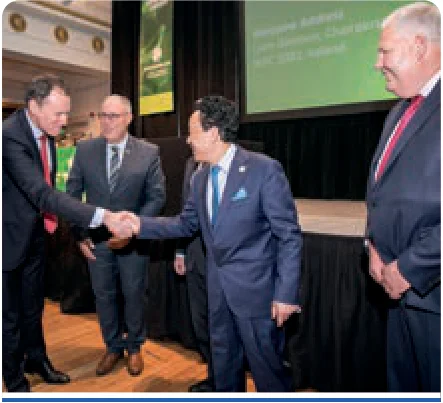
Figure from page 229
In May 2022, Minister McConalogue opened the 11th World Potato Congress (WPC) under the theme ‘The Changing World of the Potato’ at the RDS. He welcomed FAO Director-General, QU Dongyu as one of the speakers and also held bilateral talks with him on worsening food security and the need to transform global food systems.
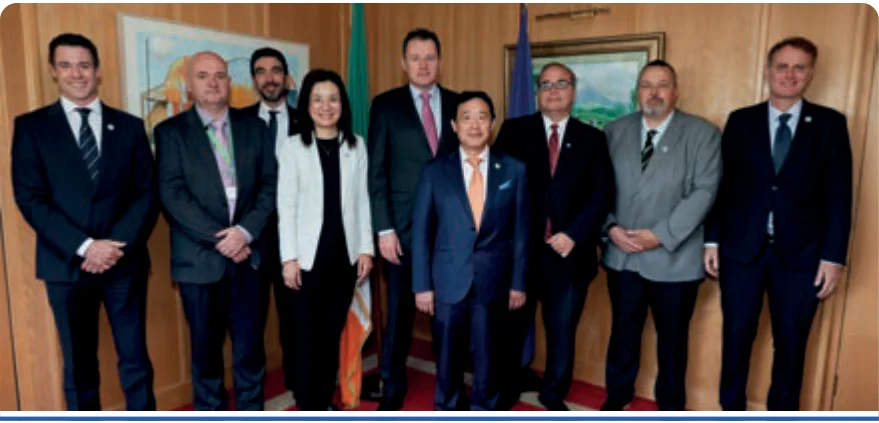
Figure from page 229
The World Food Programme (WFP) The World Food Programme (WFP) is the United Nations organisation responsible for the delivery of food assistance to the poorest and most vulnerable people in the world. It is the largest humanitarian agency saving lives in emergencies and using food assistance to build a pathway to peace, stability and prosperity for people recovering from conflict, disasters and the impact of climate change. Ireland’s commitment to the WFP, expressed through threeyearly Strategic Partnership Agreements, is €75 million for the period 2022-2024. It reaffirms Ireland’s role as one of WFP’s most engaged partners. Following a direct request to Minister McConalogue from WFP Executive Director David Beasley in December, an advance payment of €25 million in respect of Ireland’s 2023 funding commitment was made to contribute to saving lives, supporting food security and nutrition, and rebuilding livelihoods in fragile settings.
Ireland’s partnership approach with WFP, whereby funding is given in the form of untied cash donations, gives them the flexibility to plan and target its funding in the most strategic, efficient, and effective manner. The 2022-2024 Strategic Partnership Agreement again includes €8 million per annum to those countries effected by the on-going crisis in Syria, as well as €5 million per annum to the WFP hunger related climate change trust fund.
Ireland has taken a seat on the WFP Executive Board for the two-year term commencing 1 January 2023 and will focus on food systems transformation; anticipatory action (resilience); nutrition; and the Humanitarian & Development / Peace nexus.
Case Study
Ireland’s Support to Vulnerable Small-Family Farms in Ukraine
In December 2022, DAFM provided funding in the amount of €750,000 to a UN FAO project to provide support to 1,000 vulnerable small-family farms in Ukraine. The project aims to rebuild agricultural capacity, increase household food security, and improve rural livelihoods in regions in rural areas impacted by the illegal Russian war in oblasts in eastern Ukraine.
The funding was allocated to a project that focuses on rebuilding agricultural capacity in poultry and egg production activities which had been impacted by significant losses of productive assets, mainly of small-holder farmers and households due to the ongoing war. The poultry sector, a vital contributor to rural livelihoods and household food security in Ukraine, has experienced a 20% loss of production capacity in the egg industry due to the conflict. The vulnerable small-holder households in frontline oblasts were the primary beneficiaries of the project. The main objectives of the FAO project funded by Ireland were:
To provide immediate support to highly M vulnerable small-holder farmers and households affected by the conflict.
To help these households meet their immediate food needs by resuming food M production activities that have been disrupted by military activity and occupation.
To contribute to building back agricultural capacity in the affected areas. M
To increase the resilience of farms and households impacted most by the illegal Russian M aggression.
FAO, who are overseeing the implementation of the project from Kyiv, provided support to impacted communities in the form of poultry production kits, including thirty one-dayold chicks, animal feed, and supplements for starter stages; and supports to purchase supplemental feed, medicines, feeders, and vacuum drinkers on the local market. This assistance has enabled rural families to resume production for their household consumption and, in turn, meet their immediate food needs.
The FAO project’s focus on the poultry sector aligns with Ireland’s leading role in sustainable livestock production and advocacy for the importance of animal protein in sustainable healthy diets. By providing support to vulnerable small-family farms in Ukraine, the project aims to rebuild agricultural capacity, increase household food security, and improve rural livelihoods in the affected regions. The collaboration between Ireland, Ukraine, and the FAO highlights the importance of international solidarity in addressing food security challenges in conflict-affected regions.

Figure from page 231
Pages 228–231 · View in original PDF