1.8 Agri-Food Strategy – Food Vision 2030
1.8 Agri-Food Strategy – Food Vision 2030
Background Food Vision 2030, Ireland’s shared stakeholderled strategy for the agri-food sector, has the potential to transform our agriculture, food, forestry and marine sectors, with environmental, economic and social sustainability at its core. Food Vision 2030 aims for Ireland to be “A World Leader in Sustainable Food Systems”. Food Vision 2030’s goals are grouped around four high-level Missions for the sector:
1
n
io
V
ia
ss
e
t,
Mi
bl
a
ar
n
ai
m
st
u
S
E
n
r
S
o
e
t
ly
at
c
e
al
S
m
t
d
n
i
o
Cl
e
o
m
F
A
n
ri
o
g
r
A
vi
n
Food Vision
E
a
2030
A
n
D
n
d
ri
I
R
n
v
e
Mission 1 is to progress “A Climate Smart, Environmentally Sustainable Agri-Food Sector” with an overall target of climate-neutrality by 2050, with verifiable progress to be achieved by 2030. There are seven goals in this mission encompassing emissions reductions, carbon sequestration, improvements in air quality, restoration and enhancement of biodiversity, improvements in water quality, development of diverse forests, enhanced seafood sustainability, exploring the bioeconomy and strengthening Origin Green.
n
e
si
o
n
v
li
b
a
e
ti
y
n
v
t
Te
e,
A
c
C
gr
h
o
i-
m
n
F
p
ol
o
e
w
ti
o
o
d
ti
o
d
v
o
g
e
F
S
y
e
Mi
d
ct
a
n
o
a
n
r,
d
ss
Ta
al
le
V
nt
io
n
4
Mission 2 aims for “Viable and Resilient Primary Producers, with Enhanced Wellbeing”. This mission places primary producers, Irish farmers, fishers and foresters, at the centre of the strategy, improving the competitiveness and productivity of primary producers; increasing the creation of value and distributing it fairly; introducing greater diversification in production systems and incomes; and improving the social sustainability of primary producers across areas such as generational renewal, gender balance, health and safety, mental health and wellbeing and wider rural development.
Mission 3 is for “Food which is Safe, Nutritious and Appealing, Trusted and Valued at Home and Abroad”, with a particular focus on the importance of trade. Food Vision 2030 looks to protect and build on Ireland’s global reputation as a trusted supplier of high quality, safe, sustainable food to consumers at home and abroad, built on sustainable, steady value growth. This mission aims to prioritise coherent food and health policies for better health outcomes, to enhance consumer trust in our food system, to create value add through insight, innovation and product differentiation.
Mission 4 is for an “Innovative, Competitive and Resilient Agri-Food Sector, Driven by Technology and Talent”, with key enabling goals around research, innovation and talent. There are seven goals in this mission, which are relevant to all other missions and will act as key enablers. They include moving to a challenge-focused innovation system, having a strategic approach to funding R&D, developing dynamic knowledge exchange practices, enhancing the use of technology and data, improving competitiveness and resilience, attracting and nurturing diverse and inclusive talent, and improving policy coherence in Sustainable Food Systems between Ireland’s domestic policy and its development cooperation and foreign policy.
Food Vision 2030 envisages a more output-focussed collaborative innovation system by 2030, with private R&D to reach 1% of turnover. The agri-food sector should be more competitive and resilient, and seen as attractive by a young, diverse and talented workforce.
Ireland will advocate for Sustainable Food Systems (SFS) internationally and for the development of a recognised SFS measurement or index to supplement and strengthen the Vision for 2030. Ireland’s advocacy for SFSs is an important part of the deepening strategic relationship between Africa and the EU, and within Ireland’s overall relationship with Africa.
More information on Food Vision 2030 can be found at gov.ie - Food Vision 2030 – A World Leader in Sustainable Food Systems (www.gov.ie).
Monitoring and Implementation of Food Vision 2030 The success of Food Vision 2030 will depend on effective implementation and oversight. For this reason, a Monitoring and Implementation Framework is included in the Strategy and highlights areas for collaboration and partnership within the sector but also with key external stakeholders. It also details oversight and monitoring mechanisms for implementation.
A High Level Implementation Committee (HLIC) monitors progress on the delivery of the four Missions. The HLIC is chaired by the Minister for Agriculture, Food and the Marine, Charlie McConalogue, TD, and includes Senior Management from DAFM, Senior Officials from Other Government Departments (Department of Environment, Climate and Communications, Department of Enterprise, Trade and Employment and Department of Public Expenditure, NDP Delivery and Reform) and the CEOs of the relevant State Agencies (Bord Bia, Teagasc, BIM, EI, EPA and FSAI).
Minister McConalogue, TD, chaired four meetings of the HLIC during 2022 and the minutes of the meetings can be found at Food Vision 2030 - A World Leader in Sustainable Food Systems.
The immediate priority identified by the HLIC in the context of climate, was to commence work on the important actions to determine the sustainable environmental footprint of the dairy and the beef sectors. Work on these actions has progressed.
The Food Vision 2030 Dairy Group was established in late January 2022 and tasked with M producing a detailed plan to manage the sustainable environmental footprint of the dairy sector. The Final Report was submitted to the Minister on the 25th of October 2022 and sets out a list of 19 recommended actions for the sector. This is published on the Gov.ie website. The report was prepared through a process of collaboration and cooperation and represents a broad consensus on the key actions in the Group’s view that are required in the context of the Climate Act 2021 and the specific ceiling set for emissions from the agriculture sector in July 2022. The Report can be found at gov.ie - Food Vision 2030 – A World Leader in Sustainable Food Systems (www.gov.ie).
The report is being considered by the Minister and many of the actions have already been included in the Climate Action Plan 2023 implementation process. The Group will now move on to progressing the other important actions for the dairy sector set out in Food Vision 2030.
The Food Vision 2030 Beef and Sheep Group was established in June 2022 and tasked M with producing a detailed plan to manage the sustainable environmental footprint of the beef sector. The Final Report was submitted to the Minister on the 30th of November 2022 and sets out a list of 21 recommended actions for the sector. The Report can be found at Food Vision 2030- Beef and Sheep Group Final Report.
The report is being considered by the Minister and many of the actions have also been included in the Climate Action Plan 2023 implementation process. The Group will now move on to progressing the other important actions for the drystock sector set out in Food Vision 2030.
The Food Vision 2030 Tillage Group convened for the first time in May 2023, highlighting M the significant role the tillage sector plays in Ireland’s food and feed security and the ambition to grow the tillage area. Tillage is recognised as one of the most carbon efficient sectors in Irish agriculture, as set out in Food Vision 2030 and in the Climate Action Plan 2023, with a target tillage area of 400,000 hectares by 2030.
Food Vision 2030 Implementation Plan A formal Food Vision 2030 Implementation Plan was published in May 2022. This identifies stakeholders, deliverables and a timeframe for each of the 218 actions under the 22 goals. On a biannual basis, DAFM collates updates from across the various stakeholders. This process allows DAFM to monitor the implementation, examine areas where progress is not being made and to review as necessary.
The Implementation Plan can be found at Food Vision 2030 - A World Leader in Sustainable Food Systems - Implementation Plan.
Food Vision 2030 Event On the 13th October 2022, a Food Vision 2030 Event was held in The Printworks, Dublin Castle. The event was opened by An Taoiseach Micheál Martin who gave the keynote address and said, “Food Vision 2030 is a landmark strategy for creating sustainability in all its forms, environmental, economic and social. It is an ambitious strategy for the sector, by the sector, and outlines a strong and sustainable future for our farmers, fishers, foresters, and food & drink companies. The Irish agri-food industry has shown, through the challenges over the past number of years, that it can be agile and responsive when change is required – and Food Vision 2030 is an important element of this transition”.
The Food Vision 2030 Event consisted of:
Presentations - International Perspective on Sustainable Food Systems M
Panel Discussion - Developing Food Vision 2030 and its Potential M
Panel Discussion - Implementation Food Vision 2030: Delivering for the Environment and M for Primary Producers (Missions 1 and 2)
Panel Discussion - Implementing Food Vision 2030: Update on Food Vision 2030 Dairy and M Beef and Sheepmeat Groups
Panel Discussion – Implementation Food Vision 2030: Delivering High-Value, Safe M Nutritious Food and the Role of Research and Innovation (Missions 3 and 4)
There were also speeches from Minister of State, Senator Pippa Hackett, Minister of State Martin Heydon and closing remarks from the Secretary General Brendan Gleeson on the day. The event was recorded and all details can be found here Food Vision Event - 13 October 2022.
Food Vision 2030 Annual Report The Food Vision 2030 Strategy was launched in August 2021 and implementation of the strategy is well underway with important work ongoing on many of its actions. While the detailed actions are important, just as importantly, Food Vision 2030 provides a framework of four missions and 22 goals, within which the sector can progress towards better economic, environmental and social sustainability.
The aim of the Food Vision 2030 Annual Report is to give an overview of progress to date and highlight some of the key achievements within each of the four missions. A more detailed report, describing progress on each of the 218 actions contained within the Strategy, was submitted to the High-Level Implementation Committee (HLIC) in November 2022, and is published on gov.ie - Food Vision 2030 – A World Leader in Sustainable Food Systems (www.gov.ie).
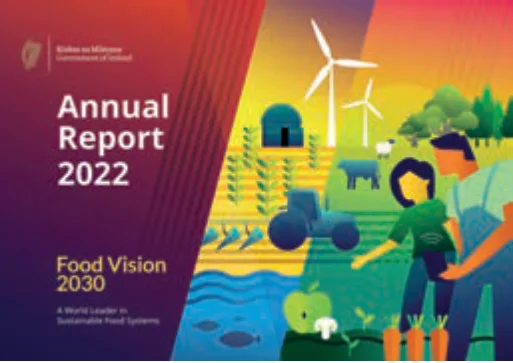
Figure from page 28
The Annual Report provides an update on the implementation and monitoring framework, including the work of the HLIC, the work of the Environmental Working Sub-Group (EWSG), key achievements across each of the four Missions as well as an overview of the Food Vision 2030 Event in October 2022.
The significant environmental challenges facing the sector are highlighted by the EWSG and the Environmental Protection Agency and finally, this report provides some of the many examples of how Food Vision 2030 was the focus of international engagements since its launch.
In terms of overall progress, 6 actions are now complete, 64 actions have substantial action undertaken, 142 actions have commenced and are progressing and 6 actions have not yet commenced.
Figure 1.7 Progress on Actions Contained in Food Vision 2030
3%
29%
Substantial
Target Achieved
Action Undertaken
3%
65%
Action Commenced
Action Not Yet Commenced
and Progressing
The Annual Report is published on gov.ie - Food Vision 2030 – A World Leader in Sustainable Food Systems (www.gov.ie).
Case Study
Ireland’s Support to Vulnerable Small-Family Farms in Ukraine
The Department of Agriculture, Food, and the Marine (DAFM) provided funding of €450,000 to a UN Food and Agriculture Organisation (FAO) project supporting potato farming in Ukraine in April 2023. The funding for this project came from DAFM’s international cooperation budget.
The main objective was to provide support to small-holder farmers in Ukraine, specifically focusing on potato production, and complementing the previous assistance provided to smallholder poultry production in Ukraine earlier in 2023. The project involved the transport of five hundred tonnes of certified seed potatoes to Ukraine. FAO Ukraine distributed these seed potatoes (50 kg per farmer) to 10,000 highly vulnerable small-holder farmers in rural areas at the frontline of the illegal Russian war in eastern and southern Ukraine.
Prior to 2022 Ukraine imported between 10,000 – 15,000 tonnes of certified seed per annum from other European countries. Since the outbreak of war, the normal structures of seed potato supply in Ukraine have been broken and the imports of certified seed input stocks has been severely hampered. With minimal importation of fresh seed, the overall quality of seed potato stocks in Ukraine will be degraded which will lead to a significant reduction of potato yields over time.
To maintain access to healthy seed stocks and boost the yields of ware crops, it is imperative that farmers have access to imported certified seed potatoes to replenish their own planting material. Irish company IPM Potato Group facilitated this process, securing large volumes of seed potato from growers in Europe. These varieties are cultivars grown by IPM Potato Group specifically to thrive in Ukraine’s agro-ecological conditions. The utilisation of these carefully selected seed potatoes lays the foundation for a successful and sustainable potato cultivation in the next few years.
To maintain access to healthy seed stocks and boost the yields of ware crops, it is imperative that farmers have access to imported certified seed potatoes to replenish their own planting material. The volume of quality seed potatoes acquired through this initiative serves a dual purpose. Firstly, it anticipates that approximately 10% of the harvest will be preserved as seed potatoes for subsequent seasons, ensuring the continuity of potato production and long-term sustainability for small-holder farmers.
Secondly, the remaining volume of seed potatoes, estimated to be capable of producing up to 7,000 tonnes of ware potatoes, presents an opportunity to address food security concerns. This quantity of ware potatoes has the potential to meet the average annual consumption needs of 45,000 to 50,000 individuals. The project aligns with the FAO’s efforts to rebuild agricultural capacity and assist rural families in resuming production for their household consumption, thereby fulfilling their immediate food requirements.
| 2 CHAPTER | Farm Income and Structures | |||
|---|---|---|---|---|
| According to the Census Average family farm In 2022, direct payments of Agriculture in 2020, income for 2022 was accounted for an average of there were €45,809 40% of Family , 135,037 farms a record year, up by 32% Farm Income in Ireland. . on 2021. |
Pages 26–31 · View in original PDF