Smart mobility
Promote smart and integrated mobility through innovative technologies and development of appropriate regulation
GOAL
10 Goal 10 aims to make the use of sustainable mobility and the interchange between different modes easier through investment in smart digital solutions. Alongside better integrated land use and transport planning, technological advances in transport can enable people to move seamlessly from one mode to another and support a whole of journey approach.
The focus of our sustainable mobility regulatory framework is to protect the passenger, ensure safety and enable the effective operation of sustainable mobility services and networks. This will continue to be central to how the sustainable mobility sector is operated and regulated. There is also a need to evolve and be open to new technologies and innovation which can present opportunities for better and enhanced services and offer the potential to bring positive social and environmental benefits. In line with applicable EU and Irish legislative frameworks, the NTA is the statutory regulator of public transport
services, with additional statutory responsibilities across the State with regard to integrated ticketing, fares and the provision of certain bus and cycling infrastructure.
In our cities, like many international cities, mobility is showing a trend towards shared mobility such as shared cars, bikes, ride-hailing and other forms of micro mobility. We already have successful examples of shared car and bike schemes in Ireland, mainly in the five cities. Shared mobility has a role to play in changing how we think about our daily travel and facilitating
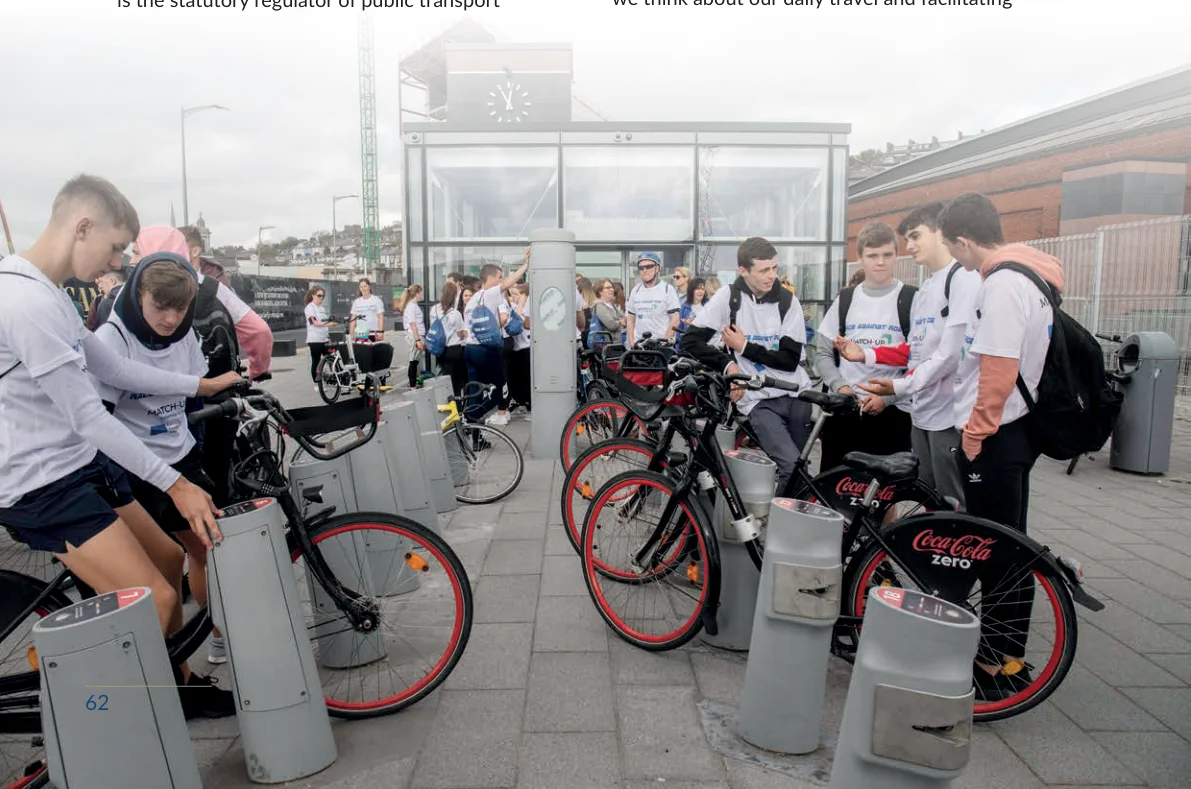
Figure from page 64
National Sustainable Mobility Policy | Principle 3: Better Integrated Mobility
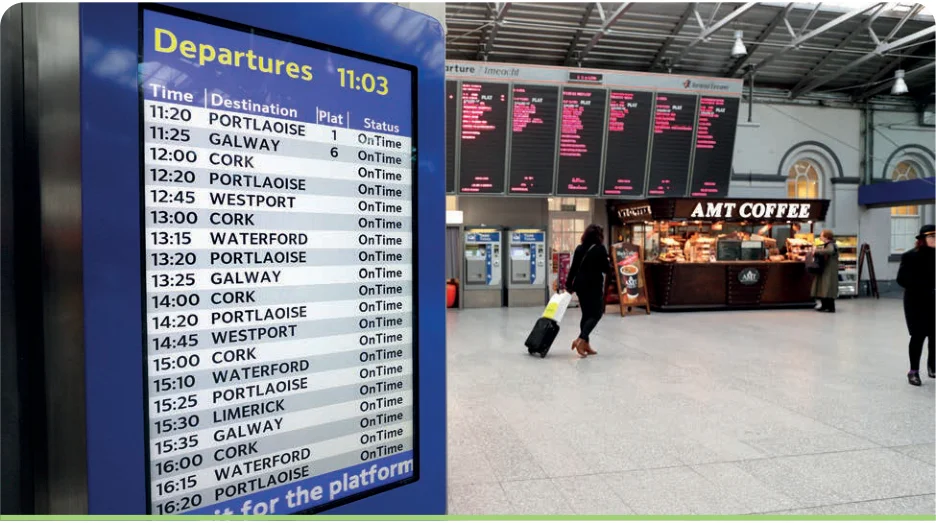
Figure from page 65
that change but appropriate regulation is crucial to guarantee safety, protect our environment and ensure consumer protection.
an upgraded National Journey Planner app. A governance framework will be defined by the NTA for the implementation and operation of MaaS in Ireland to encompass all transport modes nationally. In developing this framework, we need to be careful that any MaaS system does not add to urban congestion. Micro and shared mobility should complement and integrate with our public transport system, not replace it.
Newer forms of mobility such as electric scooters and electric bikes have also become very popular in recent years. Alongside the introduction of legislation to permit the safe use of electric scooters, other forms of powered personal transporters, and electric bikes on public roads, the Road Safety Authority will implement specific educational measures around the use of scooters and e-scooters.
With the introduction of additional operators providing bus transport services and the introduction of the 90 minute fare in the Dublin region, which allows the opportunity to transfer between services without additional cost, there is a need to better integrate customer contact centres and create a better communication arrangement for passengers. Without such integration, customers may have to engage with multiple contact centres in order to obtain information and resolve issues. It is intended to develop a consolidated customer contact centre which can deal seamlessly with all public transport customer contact issues. This will simplify customer experience and interaction by providing a single point of contact for public transport customers.
The Mobility as a Service (MaaS) concept has also emerged in recent years as a tool to encourage modal shift by offering customised information and integrated transport for users. The term MaaS is often used to describe apps or digital platforms that bring a range of transport options into one place for the user, or to subscriptions which give a user access to transport for a single annual or monthly fee.
A number of projects are being developed by the NTA which will lay the foundations for a MaaS system in Ireland including Next Generation Ticketing, Automated Vehicle Location and
National Sustainable Mobility Policy | Principle 3: Better Integrated Mobility
Case Study | Next Generation Ticketing
“Next Generation Ticketing” is one of the nine initiatives that form the overall BusConnects Programme in the five cities. An upgraded ticketing system will facilitate a variety of payment methods, including mobile phones and debit cards, and complement a simpler fare structure that removes penalties for multiple trips. Cashless, self-service ticketing will reduce time consuming interactions with drivers and help cut boarding times. Passengers won’t need a pre-purchased card or ticket to pay. They will be able to use their choice of media to tap and go making public transport easily accessible and more attractive.
The ticketing equipment that is procured for BusConnects will be required to be capable of being used anywhere. It will act as a foundation to introduce modern payment methods across all modes of public transport and enable the provision of seamless integrated ticketing. Next Generation Ticketing offers a platform for any subsequent extensions into MaaS, enabling the NTA to offer a single user account from which customers can access complementary transport services such as bike and car sharing.
List of Abbreviations
National Sustainable Mobility Policy | List of Abbreviations
Pages 64–68 · View in original PDF