and transport planning
Better integrate land use and transport planning at all levels
GOAL
9 Goal 9 aims to support compact growth and transport-orientated development through better integrated land use and transport planning.
The Housing for All Plan recognises that transport infrastructure and access to public transport services are a critical enabler of new housing supply. A transport-orientated housing development approach will allow for the emergence of sustainable and well-connected communities where active travel is feasible and attractive for many localised journeys and good quality public transport is available to facilitate longer journeys into the major urban centres.
Sustainable Compact Settlement Guidelines will be published by the Department of Housing, Local Government and Heritage and will supersede the 2009 Sustainable Residential Development in Urban Areas Guidelines for Planning Authorities. The new guidelines will place a renewed emphasis on compact growth, including priorities relating to brownfield and infill development, and sustainable urban extension. Guidance on density will be tailored to reflect different types of settlement and contexts, and there will be renewed emphasis on achieving a greater intensity of uses in central locations and in close proximity to high quality public transport services.
To further improve land use and transport planning to meet the NPF objective of compact growth, a working group has been established to consider opportunities for transport-orientated development in major urban areas This working group will be jointly chaired by the Department of Transport and the Department of Housing, Local Government and Heritage.
While the NPF sets the national spatial and development strategy, the three regional assemblies have a key role in delivering the national strategic outcomes of the NPF at a
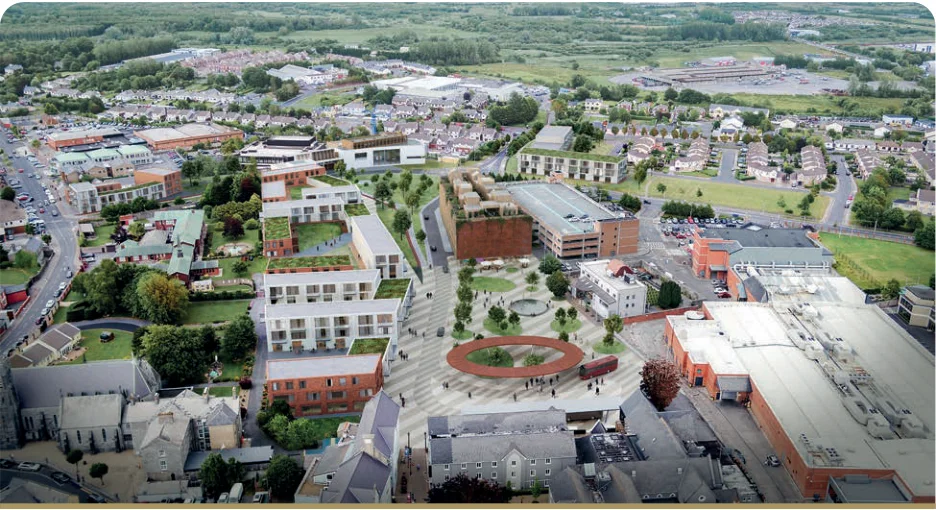
Figure from page 60
National Sustainable Mobility Policy | Principle 3: Better Integrated Mobility
Figure from page 61
regional scale. Central to this are the Regional Spatial and Economic Strategies as developed for each region, to promote their sustainable development and identify the policies and initiatives to enable the delivery of national planning policy at a regional level. The Regional Spatial and Economic Strategies in turn set the framework for development plans at local authority level. As the three Regional Spatial and Economic Strategies are reviewed in line with the relevant statutory framework, the NTA will work with each regional assembly to provide an analysis of land use development potential based on accessibility to the core public transport network as proposed for the region for the relevant period. This analysis should identify the housing delivery areas within a 1 km distance of public transport stops with the best potential to grow. The NTA will make recommendations to each regional assembly with regard to the appropriate locations for development in the region and any supporting measures it believes are appropriate to be adopted by the regional assembly in its Regional Spatial and Economic Strategy.
active travel and public transport systems and supporting amenities. This transport investment will be guided by the metropolitan area transport strategies, which have been developed, or are in development, for the five cities and which set out programmes of proposed transport investment in active travel, bus and rail for each metropolitan area over a 20-year period. This evidence based, plan-led transport planning is in line with international best practice and will allow our cities to grow in a sustainable and compact manner, as informed by the NPF and the Regional Spatial and Economic Strategies. The metropolitan area transport strategies are developed in line with the EU guiding principles for sustainable urban mobility plans.
We recognise that the statutory basis on which the metropolitan area transport strategies are developed differs currently, with an explicit statutory basis to the transport strategy in the GDA and a specific statutory role for the NTA. Outside the GDA, the NTA develops the metropolitan area transport strategies on a nonstatutory basis in co-operation with the relevant local authorities and other agencies, including TII. In line with the commitment in the NPF, we
Urban compact growth will be supported through investment in high quality integrated
National Sustainable Mobility Policy | Principle 3: Better Integrated Mobility
will extend the statutory arrangements that are already in place for transport planning in the GDA to all of Ireland’s cities to strengthen the levels of integration between spatial planning and transport planning.
within existing or planned communities where they are easily accessible.
NIFTI sets out the framework for investment in Ireland’s transport system over the next 20 years to support the NPF. NIFTI’s investment priorities clearly set out the key areas for investment in Ireland’s transport network to address future challenges and facilitate the NPF’s national strategic outcomes. The modal and intervention hierarchies identified in NIFTI set out how we intend for the necessary infrastructure to be developed efficiently and sustainably.
Outside of the cities, local transport plans for the regional growth centres and key towns will allow for local implementation of national and regional level land use and transport policies. These plans will be prepared based on the Area Based Transport Assessment Guidance produced by the NTA and TII.
Both the metropolitan area transport strategies and the local transport plans are key for coordinating the delivery of multi-modal transport infrastructure and the integration of land use and transport planning at metropolitan and local level. They support the concept of 10 minute/15 minute neighbourhoods and the Town Centre First approach for the regeneration, repopulation and development of rural towns and villages. In this regard it is critical that shops, employment opportunities, local services (such as schools and health centres) and amenities are centrally located
As well as ensuring that we invest in the right things and that transport planning is integrated with land use planning, it is important that transport investment is correctly sequenced. Developing a sustainable transport network and delivering compact growth are complementary objectives. Limited urban space means active travel and public transport are necessary to deliver compact growth. This is mutually reinforcing, with higher densities of people due to compact growth increasing the viability of these types of transport modes.
Figure 9: Policy hierarchy and Sustainable Mobility Policy
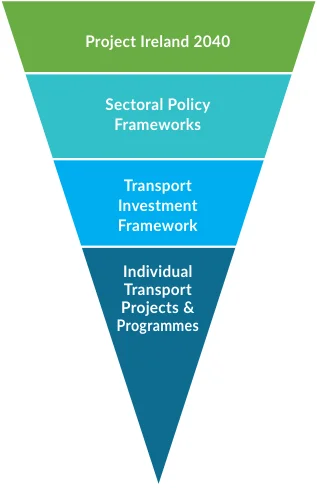
Figure from page 62
National Planning Framework
National Development Plan
Project Ireland 2040
Our Rural Future Climate Action
Sectoral Policy
Sustainable Housing for All Mobility Policy
Frameworks
Plan
Town Centre First
Transport Investment Framework
National Investment Framework for Transport in Ireland
Individual Transport Projects & Programmes
Regional Spatial and Economic Strategies
Metropolitan Area Transport Strategies
Local Transport Plans
National Sustainable Mobility Policy | Principle 3: Better Integrated Mobility
While good transport planning is necessary to deliver spatial plans and vice versa, without careful planning, investments which help achieve certain objectives can inadvertently have a detrimental impact on others. For example, investments which have a transformative impact on interurban connectivity can lead to urban sprawl. Unintended consequences such as this can be avoided through appropriate planning and zoning, and by ensuring that transport and spatial planning are correctly ‘sequenced’ - that is, ensuring that the order in which investments are made drives the desired spatial planning
outcomes. This means ensuring that development planning is coordinated and integrated across transport and other sectors. The Department of Transport, in consultation with the Department of Housing, Local Government and Heritage, will consider how transport appraisal requirements around assessing spatial and land use considerations can be strengthened in our sectoral guidance. This is likely to encompass considerations such as sequencing, parking availability and how potential adverse impacts of a given investment on the NPF’s national strategic outcomes will be mitigated.
Case Study | 10-minute towns initiative
The Southern Regional Assembly’s (SRA) Regional Spatial and Economic Strategy (RSES) and Metropolitan Area Strategic Plans for Cork, Limerick-Shannon, and Waterford, set a vision for the Southern Region to become one of Europe’s most “Creative”, “Innovative”, “Liveable” and “Greenest” regions.
for cities and towns providing the necessary empirical evidence to support funding applications for sustainable mobility initiatives and in support of local transport plans and metropolitan area transport strategies.
Through Interreg Europe’s MATCH-UP Project19, the SRA with ARUP developed a “10 Minute Towns Framework20” to implement the RSES’s Regional Policy 176 “10-Minute Cities and Towns”. The concept promotes permeable mobility where access to all essential services is within a 10-minute walk/cycle or public transport connection from people’s homes with benefits including lower emissions, improved health, placemaking and quality of life. The framework provides a step-by-step methodology for local authorities to map their cities and towns, providing guidance for catchment mapping, modelling walking/cycling networks, identifying constraints and required infrastructure improvements. Local authorities can use the framework in sustainable planning
The SRA continues disseminating the attributes of 10 Minute Cities and Towns, increasingly supported through city and county development plans. The SRA will host learning workshops, in association with the Department of Transport and the NTA, to increase knowledge of transport policy support, guidance tools including the 10 Minute Cities and Towns Framework and funding streams for sustainable mobility actions in 2022 in the Southern Region.
19 www.southernassembly.ie/eu-projects/MATCH-UP
20 www.southernassembly.ie/regional-planning/rses-implementation/10-minute-towns
National Sustainable Mobility Policy | Principle 3: Better Integrated Mobility
Pages 60–64 · View in original PDF