Infrastructure design
Design infrastructure according to Universal Design Principles and the Hierarchy of Road Users model
GOAL
7 Goal 7 aims to support enhanced permeability and ensure that the universal design principle and Hierarchy of Road Users model is used to inform future investment decisions to reduce inequalities, support a whole of journey approach, and prioritise sustainable mobility.
Sustainable mobility should serve all sectors of society, and people’s access to opportunities to work, get an education or partake in other activities should not be compromised by the design of the walking, cycling and public transport infrastructure or vehicles.
Updated DMURS guidance was issued in 2020 following increased funding to local authorities to deliver improved walking and cycling infrastructure across the country, in response to the COVID-19 pandemic. This guidance advised that designers should ensure that such infrastructure align with the principle of universal design.
We are committed to implementing a universal design approach in the design of walking, cycling and public transport infrastructure and in the retrofitting of older infrastructure. Universal design is defined by the National Disability Authority as the design and composition of an environment so that it can be accessed, understood and used to the greatest extent possible by all people regardless of their age, size, ability or disability.
DMURS will be updated to take account of changes in recent years and training will be provided to designers and project managers on the delivery of safe and effective designs. We will continue a joint approach between the Department of Transport and the Department of Housing, Local Government and Heritage to ensure more widespread and consistent implementation of DMURS in the design of both new and retrofitted infrastructure.
The Design Manual for Urban Roads and Streets (DMURS) seeks to put well-designed streets at the heart of sustainable communities and supports government policy on the environment, planning and transport. DMURS is a joint initiative of the Department of Transport and the Department of Housing, Local Government and Heritage and emphasises the importance of a multidisciplinary approach to street design to ensure a holistic approach is taken. DMURS provides the practical measures to achieve:
DMURS advocates the internationally recognised ‘pedestrian first’ Hierarchy of Road Users model to encourage more sustainable travel patterns
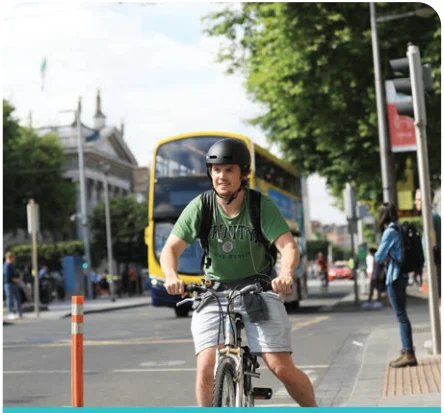
Figure from page 50
MHighly connected streets which allow people
to walk and cycle to key destinations in a direct and easy-to-find manner.
MA safe and comfortable street environment for
pedestrians and cyclists of all ages.
MStreets that contribute to the creation of
attractive and lively communities.
MStreets that calm traffic via a range of design
measures that make drivers more aware of their environment.
National Sustainable Mobility Policy | Principle 2: People Focused Mobility
| Walking and wheeling | ||
| Cycling | ||
| Public transport | ||
| Taxis & shared transport | ||
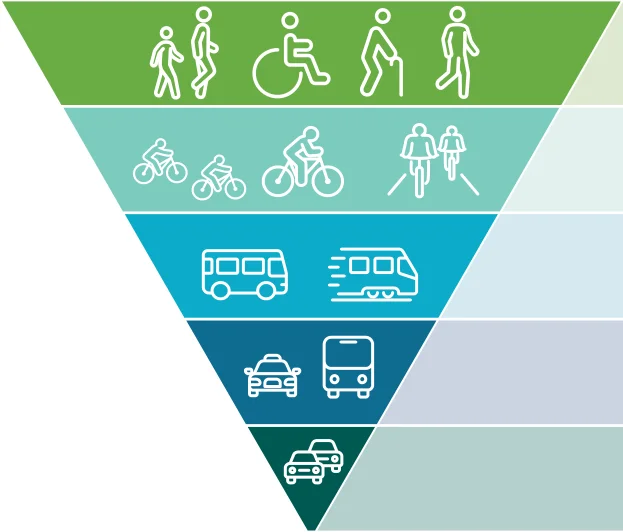
Figure 8: Hierarchy of Road Users model
and safer streets. This model recognises that by prioritising design for pedestrians first, the number of short journeys taken by car can be reduced and public transport made more accessible. DMURS recognises that the need for more walkable communities is also an issue of social equity as it is the poorest and most vulnerable in society, including children, older people and people with disabilities for whom car travel is less of an option.
The NTA’s National Cycle Manual has guided the design of cycle infrastructure since 2011. An updated manual will be published to take account of changes to design standards and to complement the guidance in DMURS. It will also consider issues such as personal security needs which is particularly important for offroad infrastructure. Emerging personal mobility modes are another important factor to consider in the design of cycle infrastructure. In recent years there has been growth in the use of electric bikes, cargo bikes and tricycles, multiseat family cycles, plus hand cycles and adapted cycles catering for users with a range of mobility limitations. Cycling infrastructure, both old and new, should be capable of accommodating all users and bike types and infrastructure design should not unintentionally impede accessibility and dissuade greater uptake of active modes of travel. The updated manual will be complemented with a series of training sessions for relevant stakeholders.
The Hierarchy of Road Users model prioritises cyclists after pedestrians. DMURS notes that trips by bicycle have the potential to replace motor vehicles as an alternative means of transport for short to medium range trips, and in some cases longer range trips. Electric bikes, which are an increasing share of the market, have been shown to extend the reach of active travel trips to longer distances17.
17 www.sciencedirect.com/science/article/pii/S0967070X21003401?via%3Dihub
National Sustainable Mobility Policy | Principle 2: People Focused Mobility
Public transport is placed after cyclists in the road user hierarchy and should be prioritised over other motorised vehicles. By designing accessible walking and cycling infrastructure that easily connect to bus and rail options, we can support ‘first’ and ‘last-mile’ active travel journeys from public transport stops to education, workplaces, and for retail, leisure and recreational trips. We will review, develop and update existing guidelines, standards and supporting legislation, where necessary, to allow for a range of solutions to be developed for the reallocation or redesign of road space use to prioritise walking, cycling and public transport use.
It is important that the Hierarchy of Road Users model is adopted, and implemented, not just for new roads and streets but is also applied retrospectively to existing roads and streets to ensure village, town and city centres across the country become much more people-centric and less dominated by the private car.
Units are being established in local authorities to implement active travel schemes in accordance with best practice and national design guidance. An infrastructure audit team will also be established within the NTA to review compliance with national design guidance, including DMURS and the National Cycle Manual, and assess value for money approaches in design and construction.
The aim is to update and develop guidelines and standards to better align with sustainable mobility, climate change and road safety considerations in a co-ordinated manner. This requires improved co-ordination and collaboration between the Department of Transport, other government departments, agencies such as the NTA and TII as well as local authorities. A co-ordination and oversight group has been established, involving all the main stakeholders, to support this work. This group will not only seek to address the design of infrastructure, but also its maintenance and its quality and consistency.
It is also important to ensure that the right skills base is in place for urban design and transport planning, particularly in local authorities who have a key role in this area. This will be supported through the expansion of continuous professional training for key design skills and application of national standards.
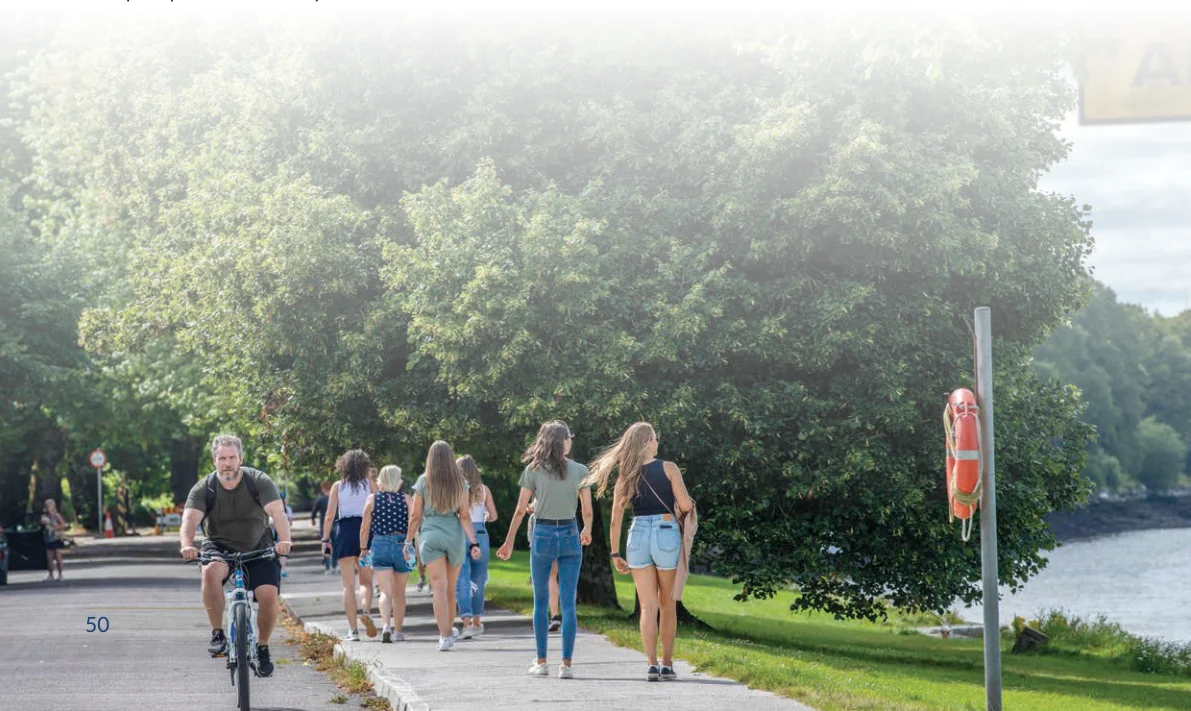
Figure from page 52
National Sustainable Mobility Policy | Principle 2: People Focused Mobility
Case Study | Travelling in a Woman’s Shoes
The Travelling in a Woman’s Shoes report18 was published by TII in 2020. It highlighted key insights and findings from a study to better understand women’s travel patterns and needs in an Irish context, and to inform future sustainable transport policy and design.
Further measures will be put in place to support many of the policy opportunities identified in the report including initiatives that support:
Ma “15 minute city” that is accessible by
walking and cycling
The study found that women in Ireland rely heavily on car transport and highlighted significant caregiving responsibilities, safety concerns and equality of access as drivers of this car dependency. It found a strong desire among women to use more sustainable modes of transport and identified policy opportunities to support this modal shift.
Msafe cycling lanes and lessons
Mbetter public transport coverage
Msolutions for end-to-end mobility
Mbetter real-time information
Mjoined-up solutions and partnering
Meffective incident reporting
Msafety audits
Mdesign for range of disabilities and age and
health related issues
By addressing the barriers that women face in the access and use of transport, we can better support the travel needs of all users and ensure that sustainable mobility is safe, accessible, reliable, convenient, comfortable and inclusive for everyone – including women, children, older people and people with disabilities.
Mdiversity and inclusion through
communications
Mlocal neighbourhood transport needs
Mintegrated approach to land use
Mimproved walking and cycling infrastructure
and amenities
Mmulti-modal travel
18 www.tii.ie/technical-services/research/TII-Travelling-in-a-Womans-Shoes-Report_Issue.pdf
National Sustainable Mobility Policy | Principle 2: People Focused Mobility
Pages 50–54 · View in original PDF