demand management
Encourage people to choose sustainable mobility over the private car
GOAL
5 Goal 5 aims to encourage modal shift to more sustainable options across all ages through behavioural change and demand management measures.
elements of shortlisted demand management measures and developed a set of user-friendly toolkits to enable stakeholders, such as local authorities, to quickly identify appropriate demand management measures for their areas. Phase two quantified and predicted the impact of certain measures and provided a series of evidence based demand management recommendations for each city (ranked in order of effectiveness) along with a national roadmap for delivery. The findings and recommendations from the study will inform the implementation of demand management policy measures at national and local level over the coming years.
Travel choices can depend on personal characteristics such as age, gender and income. It can also depend on where people live, work, availability of transport, convenience and the built environment. People travel for a wide range of reasons – for work, education, shopping and leisure. This Policy aims to deliver the necessary supports, investment, infrastructure and information so that travelling by sustainable mobility is easy, practical and appealing. Changing people’s travel behaviour to more sustainable options will have a substantial impact on our environment, as well as health and well-being.
A key challenge is getting people to change their travel behaviour both in terms of reducing travel demand and how they travel. Creating viable alternatives to the private car is not enough. In order to change habits, we need to both incentivise the use of active travel and public transport but also introduce measures to reduce the attractiveness of private car movements where sustainable mobility options exist.
As part of the study, a wide range of measures were identified and assessed in terms of their impact in reducing emissions, tackling congestion, improving air quality and improving the overall urban environment of the five cities. This includes measures such as reallocating road space from cars to prioritise walking, cycling and public transport; delivering safer walking and cycling options; reducing parking provision; and introducing the concept of 15 minute neighbourhoods – where all the daily travel needs of a city’s population can be reached by a short walk, cycle or public transport journey. The Department of Transport will engage with the regional assemblies and local authorities to identify a pathway for the implementation of demand management measures in the coming years taking account of the recommendations of the Five Cities Demand Management Study. A new Demand Management Unit will be established within the Department of Transport to carry out this work. As a first step, a demand management scheme for the GDA will be developed by the NTA.
Demand management is essential to promote a greater share of sustainable modes as well as creating more liveable urban environments. Demand management is also one of the key transport actions of the Climate Action Plan 2021 to reduce kilometres driven by internal combustion engine cars by a minimum of 10% by 2030. The Five Cities Demand Management Study was commissioned by the Department of Transport in 2019 to identify what drives transport demand and to assess ways to encourage a greater shift to more sustainable and healthier forms of travel in Ireland’s largest urban centres – Cork, Dublin, Galway, Limerick and Waterford. The study was developed in two phases. Phase one examined the qualitative
National Sustainable Mobility Policy | Principle 1: Safe and Green Mobility
Existing behavioural change programmes including the Green Schools Travel and Smarter Travel Workplaces and Campus programmes will continue and will support dedicated active travel infrastructure schemes such as the Safe Routes to School Programme and improved bike parking. Cycle training will be expanded across the country under the Cycle Right training programme for schools to encourage children and young people to adopt more sustainable travel patterns. We will also examine the potential of additional incentives to promote an increase in the use of active travel taking account of international best practice in this area.
on their routes; barriers to cycling (for those who do not cycle); and potential changes that would encourage non-cyclists to cycle more often. A second survey was carried out for the Dublin Metropolitan Area in 2021 which included an assessment of walking in the area and was renamed as the ‘Walking and Cycling Index’. The Walking and Cycling Index reports every two years and in future years the survey will be expanded to the Cork, Galway, Limerick and Waterford metropolitan areas.
In order to reinforce these measures, a large-scale impactful media campaign - informed by research and consumer information - will be needed to encourage the general public to make the switch to sustainable modes, whether walking, cycling and/or public transport. Such a campaign will need to acknowledge the wide variety of cohorts within the travelling public, their particular circumstances and transportation requirements. This will form part of a general public engagement initiative in support of the Policy.
In 2020, the NTA, in partnership with sustainable transport charity Sustrans, published the first ever ‘Bike Life’16 survey in Ireland for the Dublin Metropolitan Area. The aim of the standardised survey was to obtain a representative view of Dublin Metropolitan residents on incidence and frequency of cycling; reasons for cycling; attitudes towards cycling facilities in their area/
16 www.nationaltransport.ie/bike-life-2019-dublin-metropolitan-area/
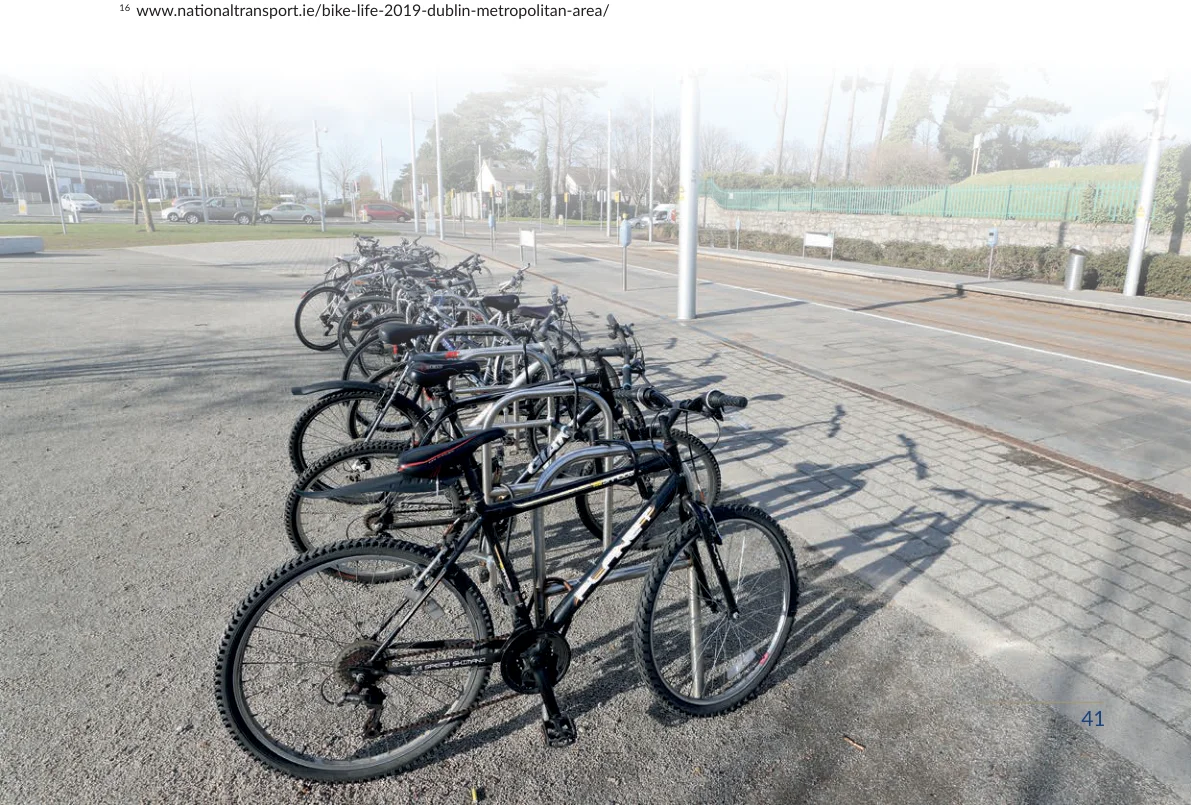
Figure from page 43
CHAPTER
Pages 42–44 · View in original PDF