Shared Mobility
Two Actions set out in the SMP concern the expansion of shared mobility options: Action 18 to ‘Expand the operation of bike share schemes (including electric bikes) in cities’, and Action 87 to ‘Expand shared car, bike and powered personal transporters (PPT) services at transport hubs and interchanges’. Action 31 also commits to the development of a model for bike share schemes (including the potential for electric bikes) in regional growth centres and key towns. More recent actions related to shared mobility, which are set out in Climate Action Plan 2024, commit the Department of Transport to working closely with shared mobility services providers and partnerships to develop more coherent policy and supports, to develop and publish a Policy Statement on Mobility Hubs, and to develop and roll out a ‘eMobility Hub’ model in the 5 Cities.
end of the process, circa 100 submissions were received by the Department. These submissions, along with outcomes from engagement with key interest groups, will help to inform overall direction on shared mobility, including the delivery of SMP Actions 18, 31 and 87, and to shape a new National Policy Statement on Shared Mobility Hubs which is due for completion later in 2024.
Additionally, the Department and NTA are seeking to progress the delivery of an initial network of mobility hubs on a pilot basis. While still at an early stage, it is hoped that the project will help to inform a future operating model for mobility hubs and a national roll-out of such services, particularly in large urban centres. In advance of this work being concluded, and to coincide with the making of regulations and recent launch of e-scooters as a legal mode for use on Irish roads, the department also prepared and published an advice note for local authorities on the issue of shared micromobility services in July 2024.6
In order to fulfil all of these actions and ambitions in a cohesive manner, the department launched a public consultation process on shared mobility hubs in March 2024 and published an Issues Paper to help elicit views on their development. By the
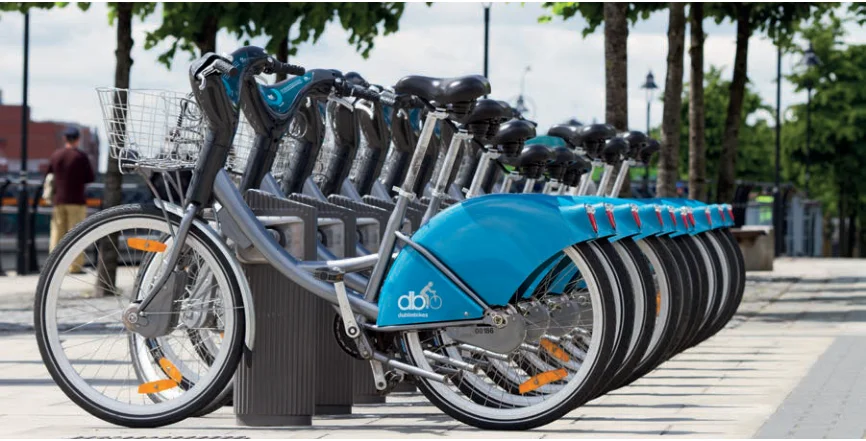
Figure from page 23
Case Study | Sligo Shared E-Bike Scheme
In 2023, as part of the Pathfinder Programme, Sligo County Council partnered with Bolt to extend a shared e-bike scheme which had initially commenced as a pilot project in July 2022. Part of the motivation for this project was to make Sligo a “3km Cycle Friendly Town”. The trial scheme includes 40 designated bike parking areas around Sligo Town, with 75 bikes. It was highly successful and was expanded with additional charging stations, and more than 8,300 unique users recorded as of June 2024.
and performance indicators are still being developed, the high uptake and usage suggests initial success and helped to justify the case for an active travel corridor connecting Carraroe, Sligo Town and Atlantic Technological University which is currently being developed.
The Sligo project has already demonstrated the value of utilising a pilot approach as a means of delivering modal shift in a short timeframe, and the approach taken can be easily replicated in continuation and broadening of current schemes. Additionally, shared mobility including e-bikes, scooters or on-demand shared transport offer the benefits of geocoding and GPS tracking to collect detailed trip data. This is helpful to understand where travel demand exists and has helped to inform plans to develop more sustainable infrastructure, as seen with the active travel corridor connection between Sligo Town and ATU.
The pilot sought to understand if a shared e-bike schemes could encourage the desired modal shift from private car towards sustainable transport within Sligo. Since its introduction, almost 150,000 trips have been taken on the e-bikes, travelling 280,000 kms. The average journey is 9 minutes and covers a journey of 1.9km. While key metrics
Pages 23–24 · View in original PDF