Structured Approach
In developing this Statement of Strategy, the NTA has followed a structured process, giving careful consideration to details including current policies and legislation, stakeholder feedback, the impact of climate change, current and forecast economic conditions, as well as international transport trends.
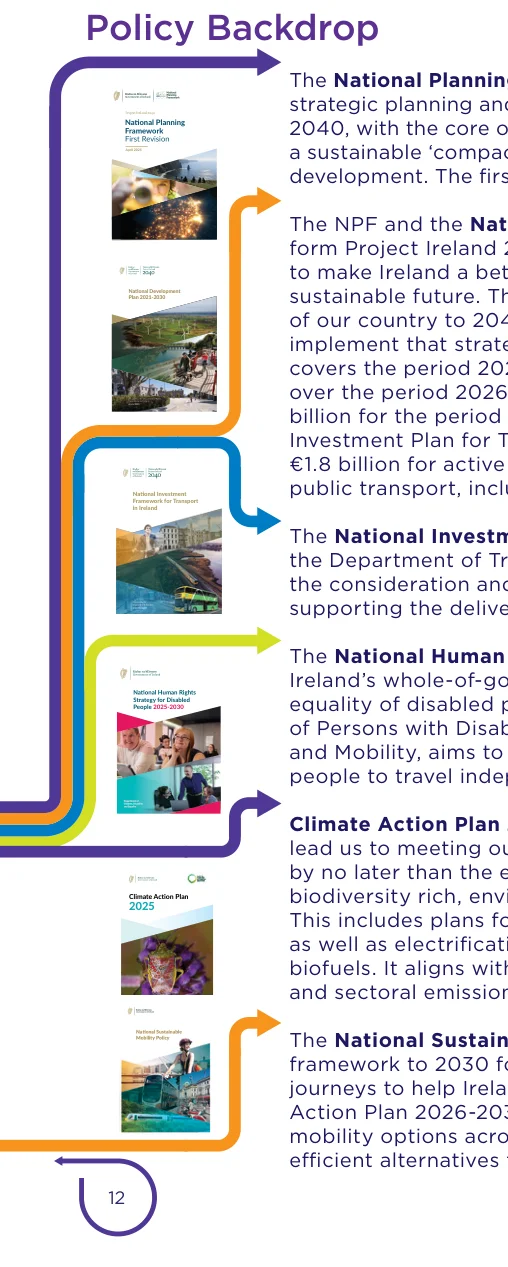
Figure from page 12
Policy Backdrop
• The National Planning Framework (NPF) is the long-term, 20-year strategy for strategic planning and sustainable development of our urban and rural areas to 2040, with the core objectives of securing balanced regional development and a sustainable ‘compact growth’ approach to the form and pattern of future development. The first revision of the NPF was completed in April 2025.
nning Framework
tional Pla
The NPF and the National Development Plan 2021-2030 (NDP) combine to form Project Ireland 2040, the government’s long-term overarching strategy to make Ireland a better country for all and to build a more resilient and sustainable future. The NPF sets the vision and strategy for the development of our country to 2040 and the NDP provides the enabling investment to implement that strategy. The recently updated National Development Plan covers the period 2026-2035 and sets out total investment of €275.4 billion over the period 2026 to 2035, with sectoral capital allocations of €102.4 billion for the period 2026 to 2030. The recently published Sectoral Investment Plan for Transport 2026-2030 contains an allocation of approx. €1.8 billion for active travel and greenways, plus approx. €12.1 billion for public transport, including a €2.0 billion allocation for MetroLink.

Figure from page 12
National Development Plan 2021-2030
National Investment Framework for Transport in Ireland
• The National Investment Framework for Transport in Ireland (NIFTI) is the Department of Transport’s high-level strategic framework to support the consideration and prioritisation of future investment in land transport, supporting the delivery of the NPF and NDP.
• The National Human Rights Strategy for Disabled People 2025–2030 is Ireland’s whole‑of‑government plan to advance the rights, inclusion, and equality of disabled people by implementing the UN Convention on the Rights of Persons with Disabilities (UNCRPD). Pillar 5 of the strategy, Transport and Mobility, aims to reduce or eliminate existing barriers to enable disabled people to travel independently and access the destinations of their choice.
Climate Action Plan 2 025
• Climate Action Plan 2025 (CAP25) lays out a roadmap of actions which will lead us to meeting our national climate objective of pursuing and achieving, by no later than the end of 2050, the transition to a climate resilient, biodiversity rich, environmentally sustainable and climate neutral economy. This includes plans for increased active travel and public transport use, as well as electrification of the public transport fleet and increased use of biofuels. It aligns with the legally binding economy-wide carbon budgets and sectoral emissions ceilings that were agreed by Government in July 2022.
Climate Action Plan 2025
• The National Sustainable Mobility Policy (NSMP) sets out a strategic framework to 2030 for active travel (walking and cycling) and public transport journeys to help Ireland meet its climate obligations. The accompanying NSMP Action Plan 2026-2030 contains actions to improve and expand sustainable mobility options across the country by providing safe, green, accessible and efficient alternatives to car journeys.
Climate Action Plan 20 25
Stakeholder Engagement
The NTA’s stakeholder engagement process ran for approximately four weeks during October/ November 2025. This process was designed to accommodate three distinct consultation strands, all running concurrently via the NTA’s online consultation portal. These strands consisted of the following:
• A survey designed for members of the public;
Feedback from this consultation process focused largely on the NTA’s indicative mission, goals and strategic objectives, details of which were circulated as part of the consultation process. The feedback received has now been addressed in this finalised version of the Statement of Strategy. The NTA greatly appreciates the time and effort involved by all who made submissions, which helped inform this strategy document.
• A survey designed for a broad range of stakeholders including Government Departments, State agencies, transport operators, local and regional authorities, the business sector and the wider community and voluntary sector; and
• A survey designed for NTA staff.
Climate Change
Ireland is already experiencing the impacts of climate change, including rising temperatures, more intense storms, increased river and coastal flooding, and rising sea levels, all impacting on transport infrastructure and services. However, through the Climate Action Plan, Ireland aims to achieve a climate-resilient, biodiversity-rich, and net-zero economy by 2050, while halving emissions by 2030.
For the transport sector to reduce its carbon emissions by 50% by 2030, the Climate Action Plan sets out major interventions including the following:
• Promotion of active and healthy travel for shorter journeys, enabled by a significant investment in active travel infrastructure.
• Enhanced integration of land use and transport planning, combined with measures to manage transport demand, helping improve efficiency and reduce congestion.
• Expansion of public transport infrastructure and services to provide a viable alternative to private car use.
• Significant electrification of the transport fleet which will leverage an ongoing decarbonisation of the Irish electricity grid, to greatly reduce carbon emissions.
• Increased use of biofuels where it’s not economically viable to electrify the transport fleet.
Economic Outlook
In the last decade or so, Ireland has experienced strong economic growth, with forecasts predicting continued expansion in the coming years. The economy is expected to be driven by strong employment, healthy tax revenues, and relatively low inflation. While global headwinds including potential trade tariffs are a concern, the overall outlook remains positive. In turn, the level of economic opportunity has led to strong population growth, also expected to continue in the coming years.
This presents challenges with regards to the provision of sustainable transport infrastructure and services, as ongoing expansion is required simply to keep up with population growth, before working to address needs that are currently unmet. The strong economy has resulted in high levels of employment that have led to labour supply issues, especially for major projects where high construction industry inflation also persists.
Reflective of a strong economy, the updated National Development Plan for 2026-2035 commits to a record €275.4 billion in public capital investment, to deliver the infrastructure that will help meet the economic and social needs of the Irish people for generations to come. The updated NDP sets out €102.4 billion in Exchequer capital allocations for the period 2026-2030, a 30% increase on the previous allocation for the same period. From the €102.4 billion, there is an allocation of €24.3 billion to Transport, including €2.0 billion committed to MetroLink.
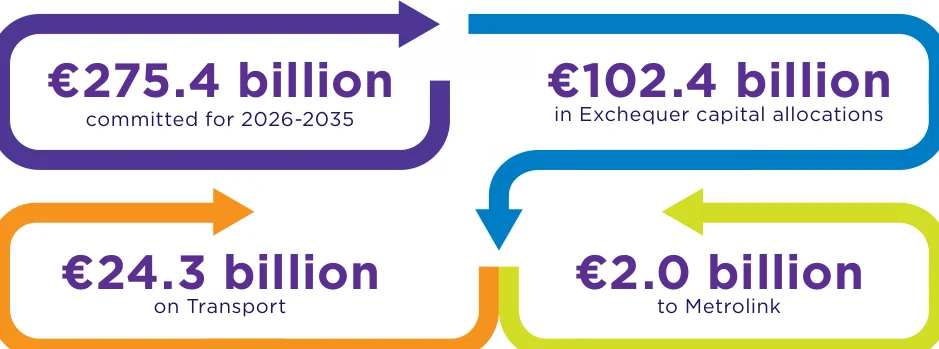
Figure from page 14
Pages 12–14 · View in original PDF