Executive Summary
Introduction
National Roads 2040 (NR2040) is TII’s long-term strategy for planning, operating, and maintaining the National Roads network. NR2040 has been developed to support the delivery of Project Ireland 2040 objectives and to align with the Department of Transport’s (DoT) National Investment Framework for Transport in Ireland (NIFTI, December 2021). NR2040 also aligns with commitments in wider policy including the Climate Action Plan and the DoT’s National Sustainable Mobility policy.
The provision of network improvements is still a key responsibility for TII. The management and operation of the National Roads network is expected to require greater resources into the future. The focus in the NR2040 strategy is on maintaining a functional, well-performing and evolving National Roads network, guiding the full range of TII’s National Roads activities over a 20-year period. NR2040 is a means to communicate TII’s strategic perspective; providing guidance to sponsoring agencies and local authorities, as to types of investments and areas where these will be made.
The National Roads network consists of almost 5,300 km of roads: National Primary roads (including motorways) and National Secondary roads. The network forms vital transport infrastructure for all sectors of society. The network facilitates movement of people and goods and a wide range of trip purposes including health, education, employment, tourism and access to key services.
NR2040 is a framework for investment in the face of social and environmental change. NR2040 is also an opportunity to communicate TII’s strategic perspective, providing guidance to Sponsoring Agencies and Local Authorities. It is important to note that as a framework, a list of national road projects is not included within the strategy and no specific future schemes are referenced. NR2040 will not be used as an internal operational plan or multi annual budget. However, it will influence the plans and development of schemes at a Sponsoring Agency/Local Authority level.
Supporting Policy
NR2040 was prepared in succession to NIFTI to ensure alignment between the departmental investment framework and the operational and functional needs of National Roads. Collaboration has taken place between DoT and TII, ensuring a common understanding of the network function, current and future users’ and infrastructure requirements on the network, to enable Project Ireland 2040.
NR2040 will have a key role in supporting policy at a national, regional and local level. Recent Government policy including Climate Action Plan 2023 (CAP) identifies the importance of modal shift to support decarbonisation. CAP2023 sets out a roadmap of actions in various sectors, including transport, to reduce greenhouse gas emissions by 51% by 2030 (relative to 2018 levels) and reach net zero emissions no later than 2050. NR2040 will support such targets by implementing NIFTI Intervention and Modal Hierarchies (reviewed in section 2.3) influencing schemes to focus on sustainable transport interventions including public transport and active travel.
v
Long Term Strategic Issues for the National Roads
To ensure that the future needs of the National Roads network and its customers are met, the context of how the network is used may change over the coming decades and must be understood. The following issues have been considered by TII in developing a strategy for National Roads.
»Future Demographic Growth Trends-
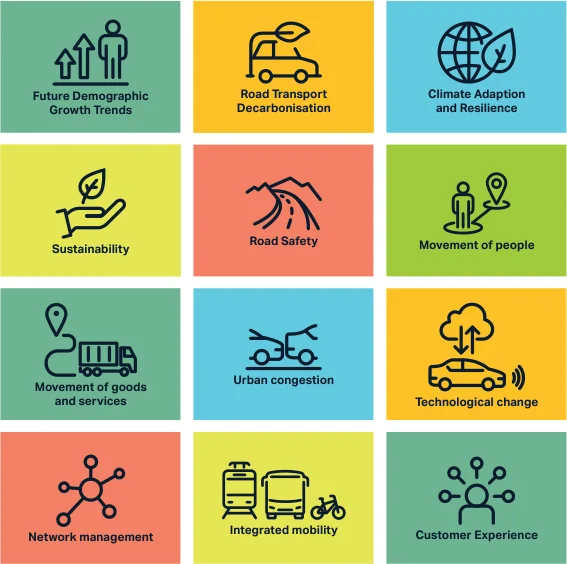
Figure from page 6
Demographic growth poses a challenge to maintaining and improving levels of service in road transport. »Road Transport Decarbonisation-
Adherence to Ireland’s decarbonisation goals poses a significant challenge for the road transport sector, including the National Roads network. »Climate Adaptation and Resilience-
The road network, and the people who rely on it, are vulnerable to a range of possible climate change effects. »Sustainability- Striking the appropriate
balance between investment in transport and sustainability impacts requires a continued effort. »Road Safety- Road Safety is at the heart
of every aspect of management of the National Roads network, on the way towards achieving Vision Zero. »Movement of People- The operation, maintenance, renewal, and development of National Roads
must focus on the movement of people, rather than vehicles. »Movement of Goods and Services- On National Roads a balance must be found between the
movement of people and the movement of goods. »Urban Congestion- We cannot build our way out of urban congestion challenges- the
management of National Roads must balance increasing mobility demands and finite road space. »Technological Change- The management and operation of National Roads must evolve to
support and manage the uptake in developing technologies to the benefit of customers. »Asset Management and Operations- The National Roads network is a valued state asset that
requires extensive investment for ongoing management and operations. »Integrated Mobility- is key to an inclusive, well connected, and sustainable transport system and
must be facilitated through the National Roads network. »Customer Experience- TII recognises the need for a customer-centric approach when planning
for the National Roads network.
NR2040 Vision and Objectives
NR2040 sets out TII’s long-term strategy for the maintenance, development, and management of Ireland’s National Roads network. NR2040 is fully aligned with NIFTI and Project Ireland 2040 and focuses on strategic issues for National Roads identified by TII.
Our vision is for the National Roads network to be:
“An evolving sustainable transport system focused on: safety; innovation; accessibility; mobility of people, goods, and services”
To support the vision, the following objectives have been defined.
»Safe and efficient transport network for people and goods »Environmentally, socially, and economically sustainable »Tailored for different customers in different places »Managed and improved as a key public asset
NR2040 sets out a strong commitment to provide a National Roads network that is:
»A network facilitating the safe and efficient movement of people, goods and services.
TII sees road safety as an integral part of every aspect of maintenance, development, and management of the National Roads network, in line with Ireland’s long-term goal of achieving Vision Zero by 2050. As the main conduit for economic productivity and social connectivity the National Roads network must be maintained and managed to cater for the efficient transport of people, goods and services.
»Environmentally, socially, and economically sustainable
1 Environmental – Environmental sustainability is the bedrock for social and economic sustainability in Ireland, avoiding and where unavoidable mitigating environmental impacts including climate change, air quality and noise as well as biodiversity impacts of National Roads.
2 Social – Integrated land use and transport network to connect communities, ensuring that our infrastructure supports safety and inclusivity and enables sustainable mobility and healthier transport choices. TII strives to enhance both urban and rural accessibility, supporting transport options for all sectors of society, particularly in hard-to-reach areas.
3 Economic – TII will continue to support the economy through the provision and management of infrastructure along the National Roads network that enables the efficient and sustainable movement of people, goods and services. »Tailored for different customers in different places.
National Roads must cater for all road users. Planning for the network must consider the unique needs of different customers and provide a network that allows more people to travel conveniently using public transport and active travel modes, for some or all of their trips, while also recognising that some of these options will not be suitable or available for everyone everywhere. The network must also be maintained for private modes of travel, especially in rural areas where communities are highly dependent on private modes for basic accessibility to jobs and services.
»Managed and improved as a key public asset.
The National Roads network is a key national asset that has received significant investment over the years, primarily related to the maintenance, the improvement and expansion of the network. In light of national targets associated with supporting decarbonisation and climate action, TII stewardship will evolve to manage, improve and enhance the National Roads network in line with these ambitions and as a key public asset.
vii
National Road Investment and Priorities
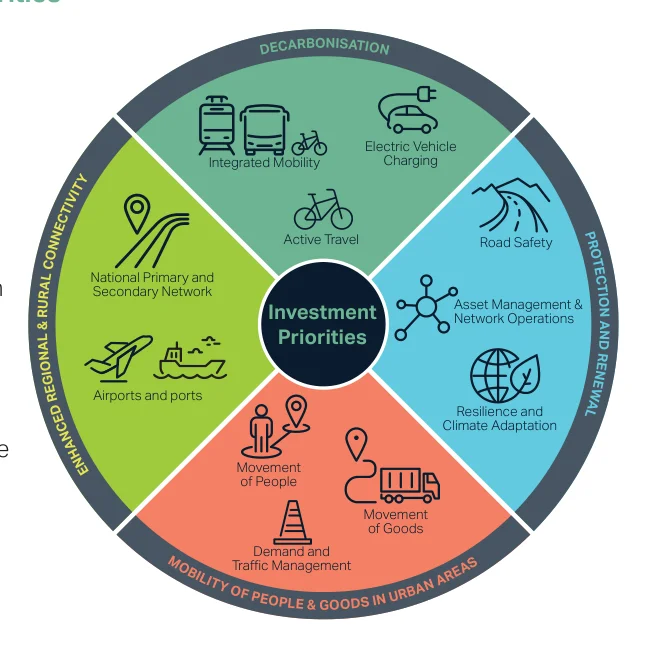
Figure from page 8
TII has assessed the need for the National Roads network to align with relevant National Strategic Outcomes (presented in section 2.1) and has also identified several strategic issues for the network. These considerations have influenced the NR2040 Investment Priorities.
The NR2040 Investment Priorities align with the four NIFTI Investment Priorities and are presented below.
AL
UR
R
L&
NA
IO
The Decarbonisation Investment Priority is the National Roads network’s greatest challenge. It encompasses three investment portfolio themes: Integrated Mobility; Electric Vehicle Charging; and Active Travel. The three portfolios will consider a wide variety of interventions including:
»Contribution to integrated mobility
by investing in measures such as Park and Ride, Park and Share and bus prioritisation, where appropriate along National Roads. Improving connections to major public transport hubs, could also form part of this portfolio of investment. »Work with the Department of Transport’s Zero Emissions Vehicles office to support the delivery
of the national EV charging infrastructure in line with its EV Charging Infrastructure strategy, currently under development. »Delivering improved active travel provision in all its projects, such as improving the safety of the
National Roads network for active travel users and reducing the severance caused by some National Roads in urban areas.
The protection and renewal of the National Roads network is where TII incurs its greatest proportion of expenditure. Protection and Renewal encompasses three investment portfolio themes: Road Safety; Asset Management & Network Operations; Resilience & Climate Adaptation. The three portfolios will consider a wide variety of interventions including:
»Delivery on TII’s actions in the Road Safety Strategy (2021-2030) and collaboration with partners
to deliver on supporting actions. »Use of asset management principles and development of smart infrastructure to manage
national roads’ assets safely, sustainably, efficiently, and effectively over their useful life. »TII is updating its ‘Strategy for Adapting to Climate Change on Ireland’s Light Rail and National
Road Network’ . The strategy is examining the impacts of climatic events on surface, groundwater resources and environmental measures as an integral part of the climate adaptation strategy.
The National Road network must facilitate both the movement of people and the movement of goods. Project Ireland 2040’s NSO4 relates to Sustainable Mobility, and the role of National Roads in a sustainable transport system is a key consideration. An essential function towards delivering this NSO is to connect people and places across the country, by various modes, on National Roads.
The National Roads network should also be fit for the transport of heavy vehicles, noting the high levels of wear and degradation of the carriageway under heavy loading; emissions originating from freight movement; and unique travel patterns.
The following are key considerations for this investment priority:
»TII will identify and address severance associated with busy urban National Roads through
provision of safe crossing infrastructure for cyclists and pedestrians. »The delivery of prioritised bus lanes on busy national radial routes approaching urban centres »The Department of Transport is currently developing its ten-year strategy for the haulage sector;
TII will implement actions arising for the National Roads network. »TII will work with the Department of Transport and partner agencies to explore traffic and demand
management measures to improve the journey time reliability required for the efficient movement of imports and exports.
The enhanced regional and rural connectivity investment priority encapsulates the social and economic importance of the National Roads network, in supporting and balancing the regional cities, key settlements, and rural areas’ prosperity and growth, towards achieving Project Ireland 2040 goals.
Government policy indicates the importance of maintaining and improving accessibility to and between the more peripheral areas of the state, for instance, the South and Northwest and identifies sections of the National Primary network that are prioritised for improvement. Any interventions brought forward will be developed in accordance with the NIFTI Investment Priorities and the Modal and Intervention Hierarchies.
The National Secondary Network must respond to a wide variety of needs, as it performs different functions in different locations. Certain National Secondary Roads provide inter-urban connectivity to the five cities and five regional centres as defined in the National Planning Framework. Other Secondary Roads form key transport links for surrounding areas and have an important function for the community. Interventions will be required to align with NIFTI Modal and Intervention Hierarchy, improving connectivity through a wider choice of transport options for the local community.
ix
Implementing NR2040
Implementing NR2040 will be undertaken in collaboration with Sponsoring Agencies and Local Authorities. The Implementation chapter within the main report outlines:
»TII commitments to addressing strategic issues »Provides a means of filtering future interventions »Defines TII investment portfolios »Concludes with TII’s commitment to collaboration, recognised throughout the strategy as a
necessary means for the successful implementation of identified interventions and achievement of national targets
The NR2040 Investment Priorities are reinforced by a series of TII commitments, further addressing the strategic issues facing the National Roads network in the coming years. Policy obligations, including NPF, NIFTI, the Road Safety Strategy, and internal TII analysis and plans inform these commitments.
The commitments (outlined in section 6.1) will influence the scope of projects on the National Roads network developed by Local Authorities and other Agencies.
A key to implementing NR2040 and delivering on the commitments will be the project development process. When developing a project on National Roads, the relevant Local Authority, third party and / or TII department will need to show that the proposed investment aligns with NIFTI, as set out in the Department of Transport (DoT) Common Appraisal Framework (CAF) and/or associated appraisal guidance documents as published by DoT, and address how to work towards achieving the NIFTI Investment Priorities.
When developing a project on National Roads, the following will need to be considered:
1 How the project objectives align with NIFTI investment priorities (reviewed in chapter 2)
2 Specific strategic issue(s) facing National Roads that the project resolves (reviewed in chapter 3)
3 How the project objectives align with NR2040 Vision and Objectives (reviewed in chapter 4)
4 How the project aligns with NR2040 Investment Priorities and the spatial context through guidance on the types of intervention for different regions and types of National Roads (reviewed in chapter 5)
5 How the project aligns to one or more of TII’s commitments (reviewed in section 6.1)
National Roads have a multi-modal integrated future that must be delivered by TII in collaboration with other government agencies and transport stakeholders. Early collaboration with third parties is vital to deliver on current and future policy.
Considering the new types of projects envisioned, TII recognises the need for a wide variety of skills and multi-disciplinary teams to ensure successful development and achievement of goals and objectives. A strong supply chain of land use and transport planners, engineers, contractors, technical advisors, public communication and engagement specialists, suppliers and operators is of vital importance, with an increasing emphasis on technology suppliers.
NR2040 is not a ‘predict and provide’ exercise, but a proactive policy-led strategy to maintain and develop a network that creates opportunities for the country, supporting economic growth whilst supporting our important goals around carbon reduction. NR2040 will support Sponsoring Agencies and Local Authorities to deliver projects on National Roads which align with government policy whilst supporting economic growth and local communities.
x
Pages 5–10 · View in original PDF