Executive Summary
Executive Summary
Organisational and Ownership Structure
Ports of National Significance (Tier 2) are ports that:
• are responsible for at least 2.5% of overall tonnage through Irish ports;
The port governance model in Ireland is broadly in line with that elsewhere in Europe. This model is one of publicly controlled port authorities with high levels of private-sector involvement in the provision of infrastructure and services.
• have the clear demonstrable potential to handle higher volumes of unitised traffic, and
• have the existing transport links to serve a wider, national marketplace beyond their immediate region.
The core objective of National Ports Policy is to facilitate a competitive and effective market for maritime transport services. The long-term international trend in ports and shipping is toward increased consolidation of resources in order to achieve optimum efficiencies of scale. This has knockon effects in terms of vessel size, the depths of water required at ports and the type and scale of port hinterland transport connections.
Two ports fulfil these criteria: the Port of Waterford Company and Rosslare Europort.
The remaining commercial ports are categorised as Ports of Regional Significance. This category includes the five smaller State-owned commercial port companies – Drogheda, Dún Laoghaire, Galway, New Ross and Wicklow – and all other ports that handle commercial freight.
Ports differ greatly in size, in current capability and future potential. The structure in place since 1996 and the laissez-faire policy where ‘one size fits all’ is no longer appropriate.
These five State-owned port companies collectively handle approximately just 3% of total tonnage in the State. It is clear that there is no longer a role for central Government in ports that fulfil a regional or local need. The longer-term development of these ports is best placed within their regional and local communities to allow both develop in a manner that is mutually beneficial.
National Ports Policy introduces clear categorisation of the ports sector into Ports of National Significance (Tier 1), Ports of National Significance (Tier 2) and Ports of Regional Significance.
Ports of National Significance (Tier 1) are ports that:
This is in line with broader Government reforms in respect of local government, which seek to ensure that functions of national significance are carried out at a national level, while those of a regional and local significance are carried out at that level.
• are responsible for 15% to 20% of overall tonnage through Irish ports, and
• have clear potential to lead the development of future port capacity in the medium and long term, when and as required.
It is intended therefore to introduce legislation to allow for the transfer of these smaller State commercial port companies to relevant local authority control.
Three ports fulfil these criteria: Dublin Port Company, the Port of Cork Company and Shannon Foynes Port Company.
Corporate Governance
Ports Policy and the Planning and Development System
The State-owned port companies are valuable assets and have important economic, social and environmental functions. Those entrusted with the management of these assets must ensure that the ports fulfil the expectations of the shareholder, the public interest and the economy at large.
The relationship and interaction between the commercial ports sector and the planning and development system is extremely important in ensuring continued sustainable development of the ports sector.
The Department intends to monitor the on-going development of port performance indicators at a European level with a view to determine how best to build on this work, incorporating work already undertaken by the Irish Maritime Development Office, and introduce a national port performance measurement system to aid Government’s evaluation of its shareholding in the Ports of National Significance.
The provision of adequate and efficient capacity into the future remains a crucial strategic objective; however, ports policy is not prescriptive as regards the location of future port capacity.
It is clear that there is no short-term pressure on national port capacity; however, the planning and development of large-scale infrastructure such as commercial port development demands a longterm vision.
It is important that the boards of the State commercial port companies be comprised of individuals with the appropriate mix of commercial, legal and accountancy skills required of any commercial company. In line with the recommendations of the Code of Practice for the Governance of State Bodies, the boards of the State commercial port companies should identify any gaps in competencies at board level and advise the Minister in due time ahead of any vacancies arising.
The planning, financing and development of largescale infrastructure projects, such as major port capacity proposals, require significant organisational, operational and financial resources. It is important that, in the State commercial ports sector, bodies bringing forward significant port capacity developments have the resources required to ensure that the State’s and the public’s interest is protected and enhanced.
All Ports of National Significance are expected to establish a clear financial dividend policy in line with broader Government policy. Where the Minister is not satisfied with the dividend policy adopted by a port company, consideration may be given to a Ministerial direction pursuant to section 41(4)(b) of the Harbours Act 1996.
Therefore, Government expects the Ports of National Significance (Tier 1) to lead the response of the State commercial ports sector to future national port capacity requirements. There is also a role in this regard for the Ports of National Significance (Tier 2) to develop additional capacity to aid competitive conditions within the unitised sectors in particular.
The policy outlined in the 2005 Ports Policy Statement that the ports sector should receive no further Exchequer funding for infrastructure development or otherwise will be maintained.
Environmental and Foreshore Issues
Shareholder support for major port capacity developments designed to address national capacity requirements will only be considered within this framework.
Ports are frequently located in estuaries or coastal zones which are recognised as being “among the most dynamic and complex ecosystems in the world” (Commission of the European Communities, 2011a). Development within such complex and sensitive areas is subject to stringent oversight at both a national and European level.
A number of our Ports of National Significance have completed or commenced port masterplanning exercises. These companies should engage with the relevant planning authorities to ensure that port masterplans and relevant planning and development strategies are complementary and consistent.
Recent initiatives at both national and EU levels have sought to provide stakeholders with greater clarity on the interplay between environmental legislation and proposed port development projects.
As part of the emerging revised European TEN-T network, the Department is seeking to ensure that a number of port hinterland access priorities are included as part of the proposed ‘core network’. These priorities encompass both road and rail links.
The Department has facilitated engagement between the Irish Ports Association and the Department of Arts, Heritage and the Gaeltacht with a view to establishing an administrative agreement as provided for by the European Communities (Birds and Habitats) Regulations 2011.
The issue of foreshore administration is another very important area for the commercial ports sector. The sector relies greatly on an effective and efficient system of foreshore administration to allow for clarity in procedure and certainty in timing.
The Programme for Government highlighted the need for a new planning and consent architecture for development on the foreshore, if Ireland is to leverage maximum value from its marine resource. The Department of the Environment, Community and Local Government is continuing to work on new legislation in this area.
Figure from page 13
The core objective of National Ports Policy is to facilitate a competitive and effective market for maritime transport services
section 1 Intro duction
Image Credit: Port of Waterford Company
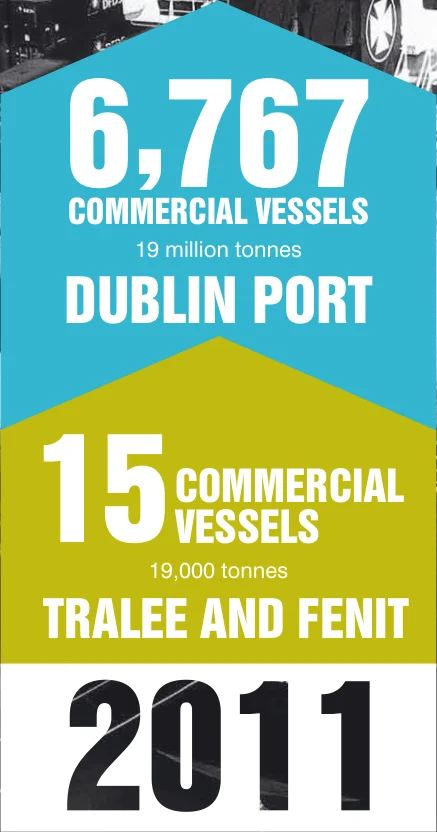
Figure from page 16
6,767 COMMERCIAL VESSELS 19 million tonnes
DUBLIN PORT
15 COMMERCIAL VESSELS
19,000 tonnes TRALEE AND FENIT
Pages 11–16 · View in original PDF