2.7 Ports of Regional Significance
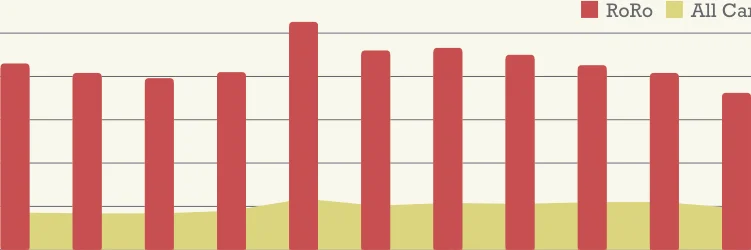
Figure 2.2: Rosslare Europort – traffic share as a percentage of total market
20
15
10
5
0
2001 2002 2003 2004 2005 2006 2007
(CSO, 1998–2011)
2.7 Ports of Regional Significance
A number of studies (including the High Level Review of the State Commercial Ports, 2003, and the Joint Committee on Transport’s Report on the Ports Sector, 2010) have highlighted the potentially inhibiting factor of the port’s unusual legislative and operational status, when compared to the other State-owned ports, and recommended its integration within the State commercial port governance framework.
While commercial shipping in Ireland is centred on the five Ports of National Significance referred to above, 14 other ports handle commercial traffic and function as important facilitators of trade for their regional and local hinterland. They collectively handle 8% of total commercial traffic in the State.
As seen in Table 2.8, of these 14 ports, five are Stateowned port companies: Drogheda Port Company, Dún Laoghaire Harbour Company, Galway Harbour Company, New Ross Port Company and Wicklow Port Company.
National Ports Policy is committed to ensuring that the full commercial and operational potential of Rosslare Europort is achieved. Therefore, external advice has been sought in order to analyse in depth the commercial and operational performance of the port, and if necessary to make recommendations as to any changes in its future corporate governance and/or operational structures.
Table 2.8: Ports of Regional Significance – ownership structure and tonnage handled, 2011
| Port | Structure | Tonnage (’000) |
|---|---|---|
| Bantry Bay | Harbour Authority | 1,403 |
| Fisheries Centre | ||
| Drogheda | Port Company | 489 |
| Port Company | ||
| Dún Laoghaire | Port Company | 12 |
| Port Company | ||
| Greenore | Private Ownership | 362 |
| Fisheries Centre | ||
| Kinsale | Local Authority | 111 |
| Port Company | ||
| Sligo | Local Authority | 46 |
| Local Authority | ||
| Wicklow | Port Company | 99 |
| Local Authority |
The five companies retain important but different roles. Galway Harbour Company is an important strategic regional hub for petroleum importation, storage and distribution. While Dún Laoghaire is currently the third largest passenger port in the State, the Company has ambitious plans in terms of marine leisure and maritime tourism. Drogheda Port Company retains an important role in regional freight distribution within the Greater Dublin Area while both Wicklow and New Ross ports remain important facilities for their local communities.
However, the National Ports Policy recognises the importance of these ports in serving their hinterlands and in supporting balanced regional development. With regard to certain specialised trades (e.g. oil/ petroleum import and storage/off-shore energy servicing) and maritime tourism, a number of these ports could play a more significant role in supporting Ireland’s national economic development.
In the European Union there are many instances of successful commercial ports whose ownership is vested in local or regional government. The review of port ownership structures published by the European Sea Ports Organisation in 2011 (Verhoeven, 2011) indicated that almost 41% of the ports surveyed were controlled by some level of government other than central government.
The remaining nine ports2 are operated by local authorities, are fishery harbour centres in which commercial freight traffic is incidental to their primary function, or are privately owned.
The volume of traffic handled at the five smaller State-owned port companies has declined in both absolute and relative terms over the past decade. Collectively, these five companies now handle just 3% of total tonnage.
In relation to the five smaller State commercial port companies, it is clear that, notwithstanding their continuing importance as regional ports, they are not facilities of national significance that would justify their control and oversight by the Department of Transport, Tourism and Sport. There are more appropriate local governance structures that are better placed to ensure that the maximum potential for the regional hinterland of each such port is best achieved. Integration within local governance structures would also facilitate examination of the potential role offered by local or regional privatesector interests in particular circumstances.
It is clear that there is no longer a need for central Government shareholding in those State commercial port companies that fulfil a regional or local need. The longer-term development of these ports is best placed within their regional and local communities to allow both develop in a manner that is mutually beneficial.
Some ports operated by local authorities, as well as the only privately owned and operated port, Greenore, handle similar or greater levels of commercial traffic than that handled by State commercial port companies such as Wicklow and Dún Laoghaire.
This policy is a continuation of past practice. All but one of the harbour authorities that previously operated under the Harbours Act 1946 have transferred to the control of local authorities from the Department of Transport, Tourism and Sport over the past five years. A number of these ports continue to handle commercial traffic, while also developing recreational and marine tourism-related activities.
To provide clarity for future developments in the ports sector, National Ports Policy recognises a third category of ports: Ports of Regional Significance. These are ports that serve an important regional purpose and/or specialised trades or maritime tourism. In the context of the long-term international trends in ports and shipping, these ports are limited in their future potential as centres of commercial shipping.
It is therefore considered necessary to provide a clearer framework that would allow for structural reconfiguration within the sector in order that the smaller State-owned commercial port companies develop in a manner most appropriate to their particular circumstances, as detailed below.
Table 2.9: Drogheda Port Company overview
| 1998* | 2010 | 2011 | |
|---|---|---|---|
| Tonnage (’000) | 958 | 499 | 489 |
| 1,468 | 1,998 | ||
| Operating Profit (€’000) | 546 | 418 | 569 |
| 458 | 161 | ||
| Employees | 20 | 13 | 10 |
- 1998 was the first full financial year as a commercial port company
2 Dundalk Port is an exception as in July 2011 Dundalk Port Company was dissolved and its functions transferred to Dublin Port Company.
Pages 27–28 · View in original PDF