Executive Summary
The population of Ireland is projected to grow by approximately one million people by 2040. The National Planning Framework is the government’s long-term spatial strategy for accommodating this growth in a sustainable manner and making Ireland a better country for all its people. The ten National Strategic Outcomes represent the priorities of the National Planning Framework, and include objectives relating to compact growth in our cities, enhanced accessibility, strengthened rural communities, sustainable mobility, and decarbonisation. The transport system will therefore be a key enabler of the National Planning Framework over the coming decades.
in travel demand, while the objective of delivering compact growth will place additional strain on our urban transport networks. It is therefore clear that more will need to be done, beyond the investment set out in the National Development Plan, for the transport network to facilitate the realisation of the National Planning Framework by 2040.
To cater for rising travel demand while decarbonising the transport sector, we will invest significantly in sustainable mobility. This will include major public transport schemes in our cities, improved access to sustainable mobility in our towns and rural areas, and major investment in cycling and walking throughout the country. We will seek to deploy sustainable solutions wherever they are feasible, including in rural areas that currently suffer from a lack of sustainable mobility provision. We will also decarbonise the sector by purchasing electric powered trains and buses and supporting the nationwide rollout of refuelling infrastructure for low-emission vehicles.
Alongside this, the Climate Action Plan establishes a pathway to half our national greenhouse gas emissions within the next decade. The transport sector accounts for one-fifth of our national greenhouse gas emissions and delivering our decarbonisation commitments will require breaking the link between transport activity and emissions and a fundamental transformation in how we travel.
We will protect and renew our existing transport assets to deliver a network that is safe and accessible, safeguard the value of our past investment, and ensure that our infrastructure is resilient to the impacts of climate change, shifting travel patterns and evolving industrial and economic uses.
The National Investment Framework for Transport in Ireland (NIFTI) is the Department of Transport’s framework for prioritising future investment in the land transport network to support the delivery of the National Strategic Outcomes. Through our investment we will contribute to Ireland’s decarbonisation efforts, support vibrant and successful communities, deliver a high-performing transport system, and promote a strong and balanced economy.
Beyond our cities, we will invest in our interurban and rural transport networks to deliver efficient and effective connectivity, including to our ports and airports. The COVID-19 pandemic has highlighted the vulnerability of transport planning when it comes to unanticipated shocks. We will therefore continue developing our transport planning tools to ensure that investment is robust to a range of future scenarios and is flexible to evolving travel patterns, network uses and behaviour.
To better understand the specific transport challenges to realising the National Strategic Outcomes, a wide range of supporting analysis was conducted for NIFTI which considered the context for this framework, protection and renewal of the existing network, and possible constraints and bottlenecks given potential future investment and projected population growth and distribution.
To address the challenges identified in the supporting analysis, NIFTI establishes four Investment Priorities: Decarbonisation, Protection and Renewal, Mobility of People and Goods in Urban Areas, and Enhanced Regional and Rural
The projected population growth between now and 2040 is likely to result in a significant increase
National Investment Framework for Transport in Ireland | Executive Summary
Connectivity. Future transport projects must align with these priorities to be considered for funding. Moreover, as the National Strategic Outcomes are embedded in NIFTI, future investment made in accordance with the priorities will support the delivery of the National Planning Framework over the coming decades.
To deliver future investment in a sustainable manner, NIFTI promotes the most appropriate solution to a given problem or opportunity. The four NIFTI Investment Priorities, which identify what we will invest in, are supplemented by Modal and Intervention Hierarchies, which set out how we will undertake investment.
Decarbonising the transport sector is an urgent priority in the context of our climate change targets. We will support sustainable mobility wherever it is feasible and encourage modal shift to these modes, namely active travel and public transport. This will include extending the reach of sustainable mobility in rural areas through investment in greenways, public transport and the strategic provision of integrated park and ride solutions. Where private transport remains necessary, our support for low-emission vehicles and associated infrastructure can help to decarbonise such trips.
For a given problem, these Hierarchies establish the types of solutions that are preferred from both an environmental and cost-effectiveness perspective. The framework encourages the use of active travel and public transport ahead of solutions reliant on private transport. Maintenance or optimisation of existing assets, including through demand management, is also preferred to extensive enhancements or outright new infrastructure.
To ensure the Investment Priorities of NIFTI are applied at the project level, we will update our sectoral project appraisal guidance—the Common Appraisal Framework for Transport Projects and Programmes—to ensure that individual transport projects are consistent with this framework. Among other things, the updated guidance will require the production of strategic assessment reports and preliminary and final business cases for potential projects. Project sponsors will be required to consider and demonstrate how their scheme aligns with the NIFTI Investment Priorities, including setting out how potential negative impacts against one or more of those priorities will be mitigated. With regard to the Hierarchies, the onus will be on project sponsors to demonstrate that a given option is the most environmentally sustainable and cost-effective solution for the issue at hand.
Given its scale and value, protecting and renewing the existing transport system is also a foremost priority. Many of the challenges the network faces can be addressed, at least partially, through protection and renewal. Adequate maintenance of infrastructure is necessary to ensure safety and accessibility, make sustainable modes an attractive option, and deliver connectivity. In the coming years, ensuring the resilience of the most strategically important parts of the network and lifeline links is likely to be a particular focus of protection and renewal in the context of climate adaptation.
To facilitate compact and sustainable growth in our towns and cities, the mobility of people and goods in urban areas is another priority. We will support projects that reduce urban congestion, particularly sustainable mobility measures which also promote decarbonisation. We will prioritise the optimisation of existing infrastructure to give sustainable modes greater priority and the development of new sustainable mobility infrastructure.
While NIFTI has been informed by extensive supporting analysis, the evidence base for policy and investment can always be improved. We will continue to carry out analysis and develop policy in a range of priority areas, such as electric vehicles and decarbonisation, urban congestion, demand management, the role of rail for both passenger and freight transport, protecting and renewing key infrastructure, and investing under uncertainty.
Beyond the urban areas, we will enhance regional and rural connectivity across the network by addressing priority bottlenecks and constraints wherever they are identified. This includes ensuring that all parts of the country are wellserved with access to our major ports and airports.
National Investment Framework for Transport in Ireland | Project Ireland 2040
National Investment Framework for Transport in Ireland Investment Priorities
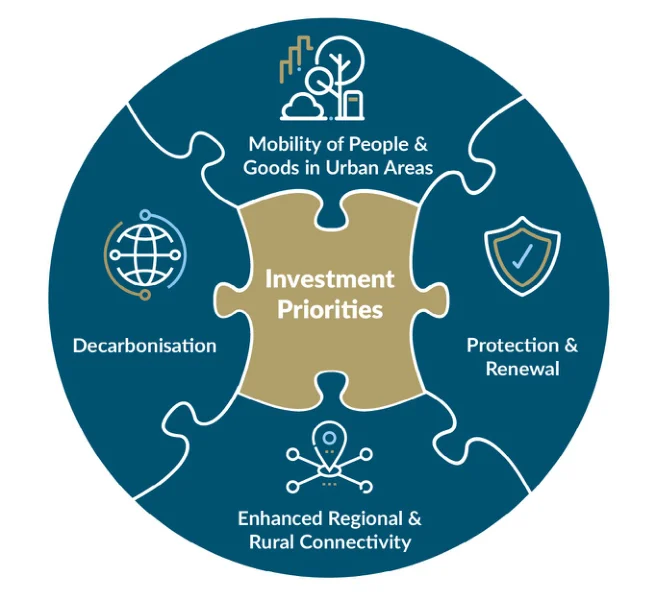
Figure from page 10
National Investment Framework for Transport in Ireland Modal Hierarchy
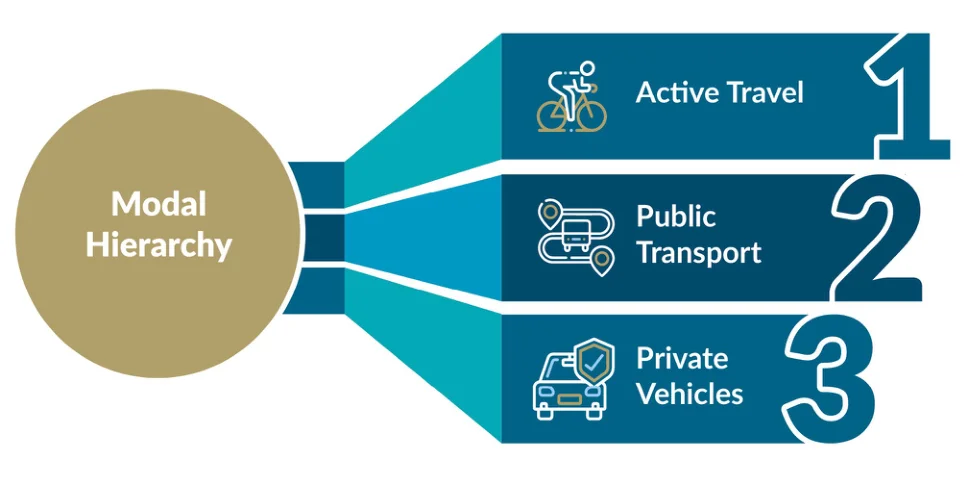
Figure from page 10
National Investment Framework for Transport in Ireland | Executive Summary
National Investment Framework for Transport in Ireland Intervention Hierarchy
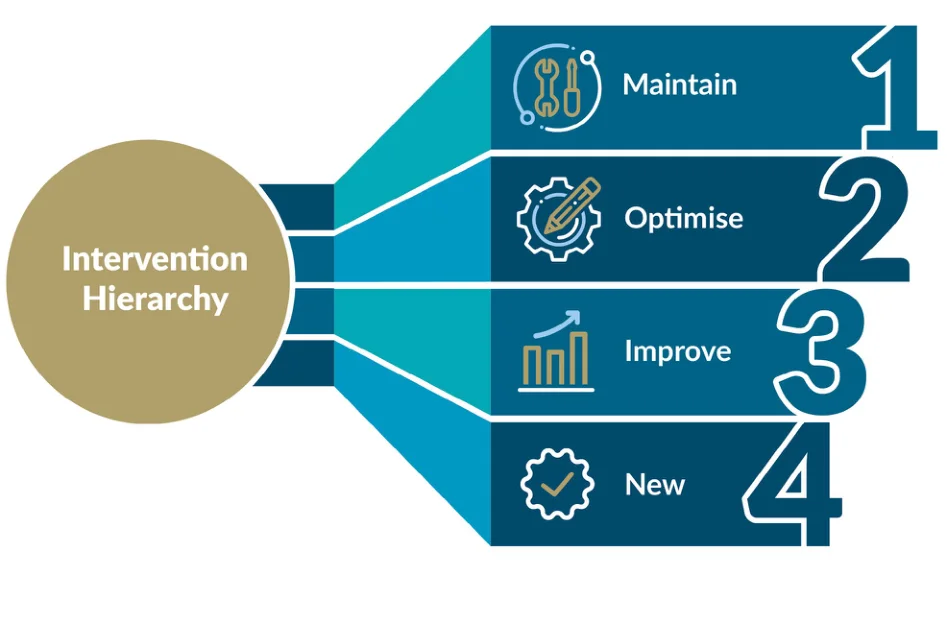
Figure from page 11
1 Overview
National Investment Framework for Transport in Ireland | Overview
Overview
The National Investment Framework for Transport in Ireland is the strategic framework for future investment decision making in land transport. It will guide transport investment in the years ahead to enable the National Planning Framework, support the Climate Action Plan, and promote positive social, environmental and economic outcomes throughout Ireland.
Pages 8–13 · View in original PDF