4.3.2 | Intervention
4.3.2 | Intervention Hierarchy
the greatest contribution to poor air quality and congestion. Providing infrastructure to cater for increased traffic volumes and improved journey conditions for these vehicles generally requires upgraded or new road infrastructure.
Addressing the challenges facing the Irish transport network, today and in the coming decades, will require a certain level of public investment and intervention. However, interventions can take many different forms, and what is appropriate will depend on the specific issue being addressed.
Future developments such as mobility as a service and alternative fuels or technologies such as electric vehicles may have a substantial impact on private travel in coming decades. Electric vehicles are an important part of the to decarbonisation of transport in Ireland. It is therefore worth differentiating between investments which will enable the transition to these and other innovations, and investments which primarily increase the capacity or capability of the network serving all private vehicles. However, while low-emission vehicles can contribute to decarbonisation and have a role to play in locations where a dispersed population makes sustainable mobility less feasible, they are not an effective solution to congestion compared to the development of a sustainable transport system.
In order to deliver the National Strategic Outcomes and address challenges faced by the transport system, it is necessary to invest according to the NIFTI Investment Priorities, ensure that our investments are financially sustainable over the lifetime of the infrastructure, and avoid investments which will have unnecessary negative environmental impacts.
A hierarchy of intervention types has been developed to ensure that investment is proportionate to the problem identified. The NIFTI Intervention Hierarchy (Figure 7; Table 3) sets out four high-level categories of investment.
While business cases for new transport projects tend to focus on passenger travel, the movement of goods is also a crucial use of the transport network and an important benefit to consider. While most internal freight movements take place on the road network today, the Modal Hierarchy can be a useful tool for project sponsors to consider alternatives where feasible. Examples might include rail freight or the use of cargo bikes in congested urban areas as part of last mile delivery.
These four categories of investment will be used to inform intervention decisions, both at the budgetary level and the project level. To support the delivery of the NPF, and to make best use of our existing assets, a hierarchy of these intervention types will be applied. Maintaining the existing transport network will be given first priority, followed by maximising the value of the network through optimising its use. Infrastructural investments will only be considered after these two categories have been assessed as inappropriate for the identified problem, with upgrades to existing infrastructure to be considered before new infrastructure.
Beyond the Hierarchy, which seeks to ensure that travel is undertaken in the most sustainable manner possible, behavioural shifts and emerging technologies in other sectors may also help mitigate the need for travel. A prominent example of this is the shift to home working for certain professions brought about by the public health response to the COVID-19 pandemic and facilitated by access to high-speed internet and information technology innovations. If remote working persists at an increased level, it has the potential to reduce travel demand and change travel patterns.
It will be important to consider the Intervention Hierarchy in the context of the specific problem being addressed. For example, when renewing infrastructure at the end of its life, optimising or improving infrastructure may meet more of the Investment Priorities and offer significantly greater value for money. Wider footpaths, reallocation of road space, retirement of infrastructure, segregated cycle infrastructure, and public transport priority on existing urban roads can all enable modal shift, which could reduce urban congestion and contribute to decarbonising the
National Investment Framework for Transport in Ireland | Investment Priorities
Table 3: NIFTI Intervention Hierarchy—Example Measures
| Description | Types of Measures | |
|---|---|---|
| MAINTAIN | ‘Maintain’ refers specifically to measures which protect the existing transport network, and keep it at the standard or capability at which it was designed. This includes all protection and renewal investment, and investments targeted at climate resilience. | • All protection and renewal investment for road, rail and active travel • Drainage works • Targeted maintenance and renewal measures where asset quality has reduced safety levels • Targeted maintenance and renewal measures to ensure asset accessibility • Climate resilience measures |
| OPTIMISE | ‘Optimise’ refers to measures which are targeted at increasing levels of service of transport infrastructure through enabling and encouraging more efficient behaviour and sustainable use of the network. | • Intelligent Transport Systems • Demand management, including user charging • Park and ride • Parking supply measures • Electric vehicle charging infrastructure • Rail signalling or track-relay enhancements • Integrated ticketing • Improved real-time information |
| IMPROVE | ‘Improve’ refers to measures which increase the capability of existing infrastructure, through increasing the standards of that infrastructure, or measures which shift existing capacity to more sustainable modes. | • Active travel improvements including wider footpaths, segregated cycleways, improved signalling • Railway line-speed or frequency improvements • Railway electrification • Targeted road safety improvements such as removing dangerous bends • Light/heavy rail station improvements to accommodate larger trains • Shifting modal shares of infrastructure through, e.g., dedicated bus corridors |
| NEW | ‘New’ encompasses all measures which entail significant increases to transport infrastructure capacity. | • New roads, rail, or active travel infrastructure • Major road capacity upgrades, including upgrading a road from single to dual carriageway • Major rail capacity upgrades such as upgrading from single to double track, or constructing infrastructure (e.g., loops) to accommodate greater frequency or speeds. |
National Investment Framework for Transport in Ireland |Project Ireland 2040
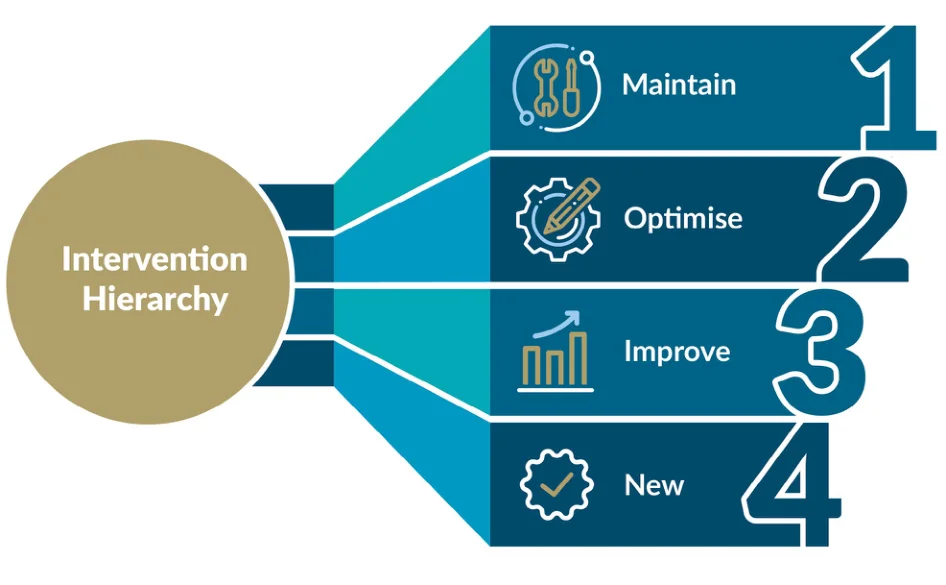
Figure 7: NIFTI Intervention Hierarchy
Pages 50–52 · View in original PDF