4.3.1 | Modal Hierarchy
4.3.1 | Modal Hierarchy
Connectivity ensures access to jobs, leisure and public services for everyone in Ireland, and is particularly important for people living in rural areas who are dependent on a small number of transport links.
To enable the National Strategic Outcomes, particularly around decarbonising the transport system and delivering compact growth, a significant shift from low-occupancy private vehicles to more sustainable modes of travel will be required. For this reason, future transport planning will prioritise sustainable modes, while acknowledging that the private car will remain an important mode of travel in much of Ireland.
It includes ensuring that vulnerable groups retain access to lifeline infrastructure, allowing them to access essential services, amenities and employment. For freight, connectivity means ensuring that goods can get to market and access ports and airports in a timely manner from everywhere in the State, and that the use of strategic links by traffic of high economic and strategic value is secure.
NIFTI sets out a hierarchy of travel modes to be accommodated and encouraged when investments and other interventions are made. Sustainable modes, starting with active travel (walking, wheeling and cycling) and then public transport, will be encouraged over less sustainable modes such as the private car.
International connectivity is an important dimension of this and, although NIFTI relates to the land transport network, future investment in regional and rural transport made in accordance with the framework can be a key enabler for international trade and travel by ensuring access to ports and airports.
The application of the Modal Hierarchy within transport planning will be flexible and pragmatic, and will help ensure that the most appropriate
National Investment Framework for Transport in Ireland | Investment Priorities
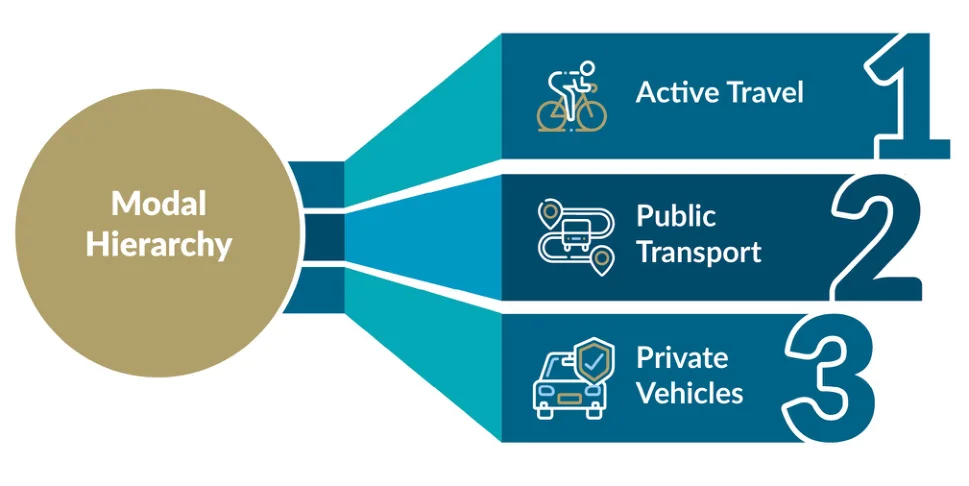
Figure 6: NIFTI Modal Hierarchy
solution to a given problem is implemented. It is acknowledged that some modes will not be appropriate to address some challenges—walking and cycling are not feasible modes of longer distance, interurban travel, and rural areas do not have the population density to make large-scale public transport an effective solution. Where more sustainable modes are feasible it will be the responsibility of the sponsoring agency to develop solutions involving those modes. Where more sustainable modes are unsuitable, the onus will be on project sponsors to demonstrate why they do not achieve the project objectives.
appropriate for addressing all of the challenges across the transport network.
Public transport refers to buses, light and heavy rail, and shared transport. Bus and rail, by design, are able to transport large volumes of people and increasing levels of usage can therefore have environmental benefits. While most bus and rail services are subsidised by the State, economies of scale mean that they are more cost-effective in or between areas of higher population density.
Shared transport is a subset of public transport and encompasses taxis, ride-sharing and other forms of shared mobility. On average, it should also have higher occupancy levels than private transport, though less than bus or rail.
Active travel is the most sustainable mode of travel. Increasing the share of active travel can reduce the carbon footprint of the transport sector, improve air quality, reduce urban congestion, and bring about positive health impacts as a result of increased physical activity. It is also important in enabling access to other mobility options, such as public transport. The attractiveness of this mode is dependent on infrastructure—for example, dedicated footpaths, segregated cycle lanes and the quality and priority of road crossing points all impact upon the number of people engaging in active travel. However, active travel, by itself, is less feasible over longer distances and therefore not
Encouraging a shift from private transport to these modes would mean fewer vehicles on the road per traveller and therefore environmental benefits and reduced congestion. As with active travel, the quality of the transport offering— across dimensions including journey times, safety, frequencies and comfort—is very important in attracting users.
Private transport includes cars, motorcycles and mopeds. These are low occupancy vehicles which occupy road space, and generally have
National Investment Framework for Transport in Ireland |Project Ireland 2040
Pages 48–50 · View in original PDF