4.2 | Investment Priorities
4.2 | Investment Priorities
Drawing on the Key Transport Challenges, four NIFTI Investment Priorities have been identified. These replace the three investment priorities established by SIFLT in 2015.
As discussed in Section 1, SIFLT was developed in a constrained fiscal context where the basic maintenance needs of the network were not being met. Consequently, achieving the required maintenance investment was its first priority. In contrast to SIFLT, the NIFTI Investment Priorities are not ranked hierarchically. Protecting and renewing the network
National Investment Framework for Transport in Ireland |Project Ireland 2040
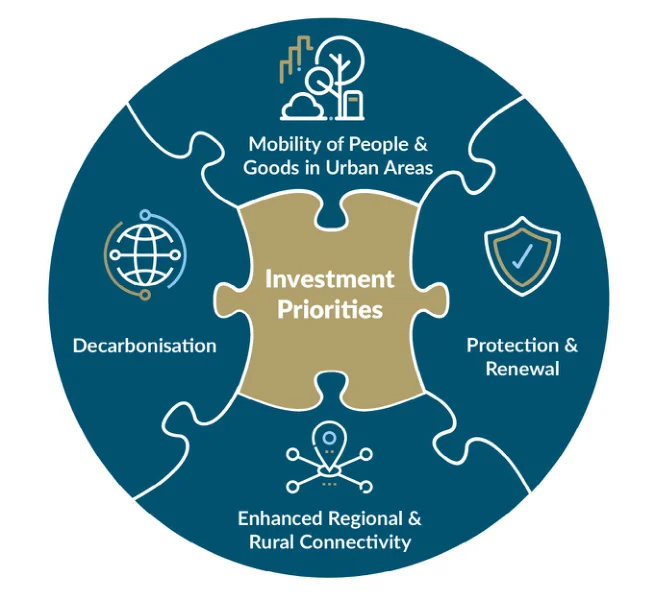
Figure 5: NIFTI Investment Priorities
remains a priority but there is also a need for new investment to help realise our other objectives for the transport system. In particular, the urgency of decoupling transport activity from greenhouse gas emissions will require the development of new infrastructure and services, and an ambitious investment programme to this effect has been set out in the revised NDP.
sector to the greatest extent possible while catering to the travel demand of a growing population. Aside from emissions, transport investment has a host of other environmental impacts which must be taken into consideration when developing infrastructure, such as on biodiversity, air quality and water pollution. Decarbonisation and protection of our natural environment will mean investing in sustainable modes so that transport users have safe, accessible, reliable and efficient alternatives to the private car.
Finally, it should be noted that investing to deliver one priority does not necessarily preclude supporting other priorities at the same time. In fact, many worthwhile transport investments will perform strongly across several of the NIFTI Investment Priorities.
The targets set out in the Climate Action Plan are ambitious, and delivery will require the participation of all parts of our society. Therefore, it is essential that sustainable mobility alternatives take account of the needs of transport users whose experience has not always been wellconsidered in the design of transport systems to provide viable alternatives to car travel that are accessible to all. It will also mean supporting the adoption of low-emission vehicles and related infrastructure so that emissions from trips that are taken by private car fall also.
Pages 45–46 · View in original PDF