1.5 | Sustainable Mobility
1.5 | Sustainable Mobility Policy Review
The Strategic Investment Framework for Land Transport (SIFLT) was published by the Department of Transport in 2015. In the context of constrained funding following the financial crisis, SIFLT established high-level priorities for future transport investment and the key principles to which investment proposals had to adhere.
In parallel with NIFTI, the Department has undertaken a review and plans to publish a new Sustainable Mobility Policy shortly. This will set out the policy framework for walking, cycling and public transport to support Ireland’s overall requirement to achieve a 51% reduction in greenhouse gas emissions by 2030. The new policy will primarily focus on measures to promote and facilitate active travel and public transport for all and, in doing so, encourage less private car usage nationally to support our climate commitment. It will set out a comprehensive set of actions to increase active travel infrastructure provision and improve public transport capacity and services across the country. These will be supported by behavioural change and demand management measures to make sustainable modes the preferred choice for as many people as possible. The Climate Action Plan sets out additional measures to promote other complementary transport mitigation measures such as the switch over to electric car usage and greater use of renewable fuels for transport.
Developed in the context of constrained investment as a result of fiscal consolidation, at the time of publication SIFLT noted that funding levels were insufficient to maintain the network and there was virtually no scope to invest in infrastructure improvements. The key transport investment challenge, therefore, was to “attain funding levels consistent with maintaining, renewing and improving” the network so that it could support the economic and social needs of the country.
SIFLT has successfully guided investment in the land transport network over recent years and its first investment priority of achieving steady state maintenance is prominent within the NDP and revised NDP. However, the SIFLT framework must be periodically reviewed to ensure it remains appropriate. With the launch of Project Ireland 2040 in February 2018, it is timely to undertake such a review.
The new policy will build on and replace the existing sectoral policy documents that were published in 2009: Smarter Travel, A Sustainable Transport Future 2009-2020, and the National Cycle Policy Framework.
NIFTI will replace SIFLT as the framework for future land transport investment (Figure 1). In the hierarchy of national and subnational frameworks, strategies and plans, the NPF has established the shared vision across Government for development in the coming decades, underpinned by the public capital investment programme set out in the NDP.
It will be underpinned by funding for sustainable mobility under the renewed National Development Plan, which provides €35bn in total for transport investment over the next decade.
National Investment Framework for Transport in Ireland | Project Ireland 2040
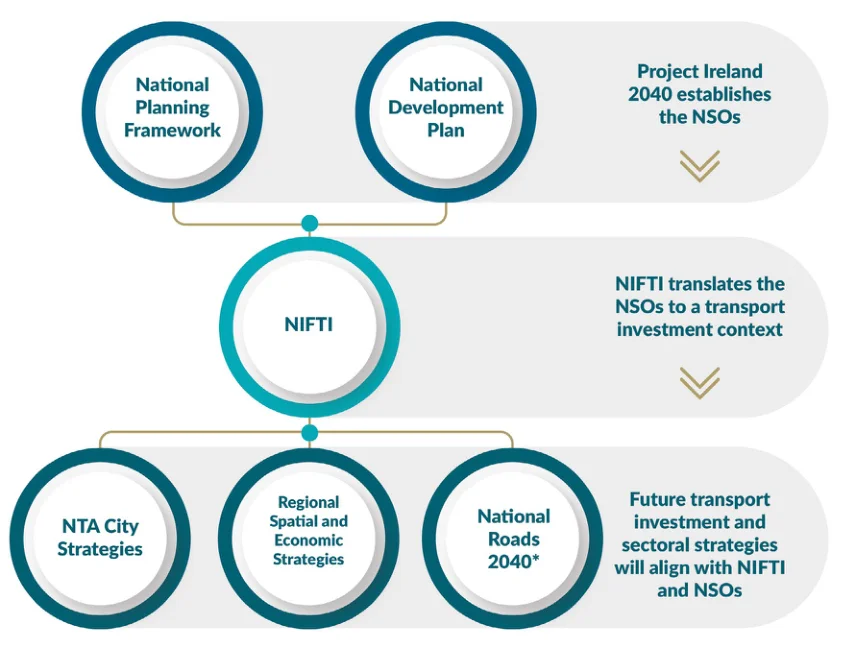
Figure 1: Where NIFTI sits in the hierarchy of Project Ireland 2040 strategies and plans
*Under development
The overarching sustainable mobility policy framework is centred around three principles— Safe and Green Mobility, People Focused Mobility, and Better Integrated Mobility—supported by ten high-level goals which together shape a wide range of supporting actions to be delivered by 2025.
budget represents the total amount of greenhouse gases that may be emitted in the State during each five-year period from 2021 to 2025, and 2026 to 2030.
The first set of carbon budgets was proposed by the CCAC in October 2021. The proposed carbon budgets will go to Government and then to the Oireachtas for approval. Once these overall, economy-wide carbon budgets are approved, the Minister for Environment, Climate and Communications will divide the overall carbon budgets into sectoral emissions ceilings and bring to Government for approval.
Pages 15–16 · View in original PDF