1.2 Governance Approach for NCN Plan Development
1.2Governance Approach for NCN Plan Development
To oversee development of the NCN Plan, a project governance structure was agreed including key stakeholders, as outlined in Figure 1.2.
The Project Board included representatives of TII and Department of Transport (DoT) and was responsible for the final approval of project documents and outputs. The Advisory Group included representatives of TII, DoT, the NTA and County and City Management Association (CCMA) members – representing local authorities. The Advisory Group’s role was to challenge the strategic direction of the project and review the various options at decision points during development of the NCN Plan.
The Technical Group included internal TII stakeholders who provided specialist expertise when reviewing project work and provided input and feedback at various stages including project vision statement and objectives, national and international best practice, network development, infrastructure requirement, integration with existing and planned networks, market research and survey questions
The Project Management Team was led by TII and supported by AECOM in day-to-day project delivery.
National Cycle Network Plan
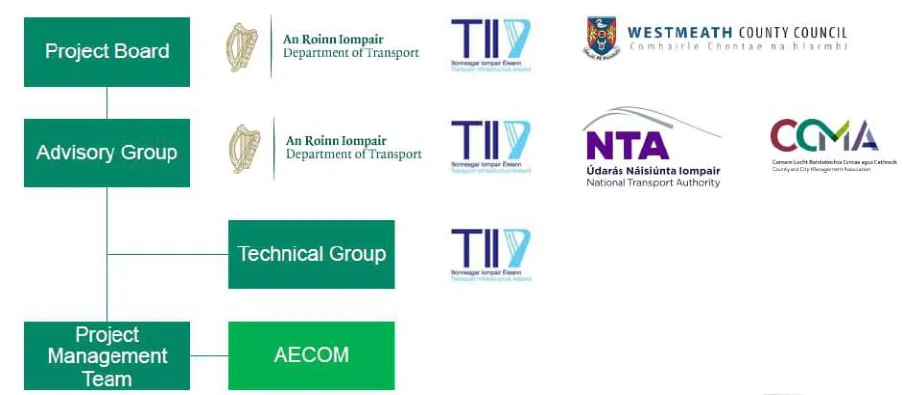
Figure 1.2: Project Governance Structure
1.3Methodology
The methodology for developing the NCN Plan consisted of a five-stage process, summarised in Figure 1.3 and outlined in further detail in Table 1.2. The approach incorporated multiple elements to provide key inputs, reference points and evidence to inform the development of the final plan, including:
Close and regular collaboration with stakeholders and a comprehensive public consultation.
Thorough assessment of existing and planned infrastructure.
Identification of potential environmental concerns and a full strategic environmental assessment.
Research on potential future user needs and behaviour.
International peer review and case studies.
A robust and tailored approach to network development and assessment.
As assessment of design standards and infrastructure requirement.
A monitoring framework.
Development of an implementation strategy.
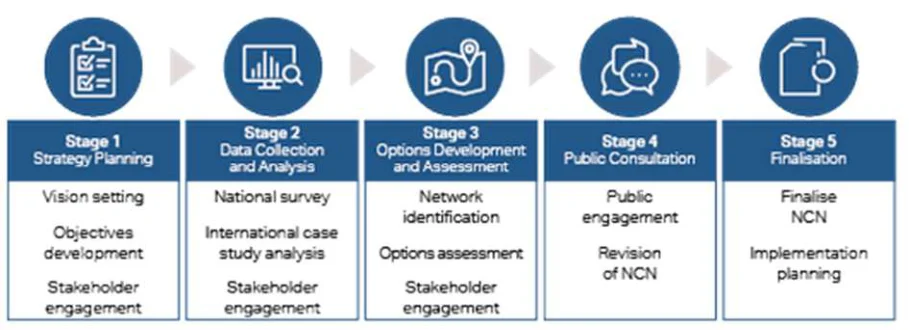
Figure 1.3: NCN Pan Development Process
National Cycle Network Plan
Table 1.2: NCN Plan Methodology
| Stage Overview | Key Tasks Undertaken | ||||
|---|---|---|---|---|---|
| Stage 1 – Strategy Planning Mobilisation of the project and agreement of approach through the development of the PEP (Project Execution Plan) and SMP (Stakeholder Management Plan) as well as commencement of critical tasks to delivery, such as the GIS dashboard and market research. The project vision and objectives were developed, and stakeholder engagement commenced. | Preparation of Project Execution Plan Development of project vision statement Development of project objectives Development of Project Logo and Collateral Preparation of Stakeholder Management Plan Market Research Development of NCN GIS Dashboard Strategic Environmental Assessment (SEA) and Appropriate Assessment (AA) Screening Initial engagement with stakeholders Stakeholder engagement | ||||
| Stage 2 – Data Collection and Analysis Analyses to inform the identification of the NCN corridors and development of an inventory of the existing and planned infrastructure. Investigation of international case studies and engagement. Market analysis including a nationally representative sample survey to define the criterion for development of the NCN. A detailed review of the network proposed in the 2010 NCN Scoping Report was also undertaken to investigate how it aligns with current objectives and requirements. | Inventory of the existing and planned cycle network Benchmarking of international case studies Identification of key destinations and attractions NCN Market Analysis Stakeholder engagement Review of 2010 NCN Scoping Study recommendations Development of assessment framework | ||||
| Stage 3 – Plan Development and Appraisal Entailed the identification and refinement of the proposed NCN corridors. The NCN Plan defines a set of corridors connecting Primary and Secondary nodes which combined make up the network. Stakeholders were engaged at key points to review work and provide feedback as the network was developed and assessed. | Policy and sustainability review Identification of NCN Corridors Stakeholder Engagement Design case studies Identification of implementation requirements Strategic Environmental Assessment (SEA) Appropriate Assessment (AA) | ||||
| Stage 4 – Public Consultation Public consultation was completed via an online website with widespread publicity and stakeholder engagement. The consultation period was open from 6th of May until the 7th of June 2022 after which an analysis of the feedback was undertaken. Feedback from both the public and stakeholders was then used to determine any amendments to the proposed plan. | Public consultation Stakeholder workshops Definition of monitoring framework Summary of feedback | ||||
| Stage 5 – Finalisation The draft NCN proposals were finalised based on the feedback received and an agreed approach to implementation and monitoring. | Preparation of Final NCN Plan |
National Cycle Network Plan
Pages 16–19 · View in original PDF