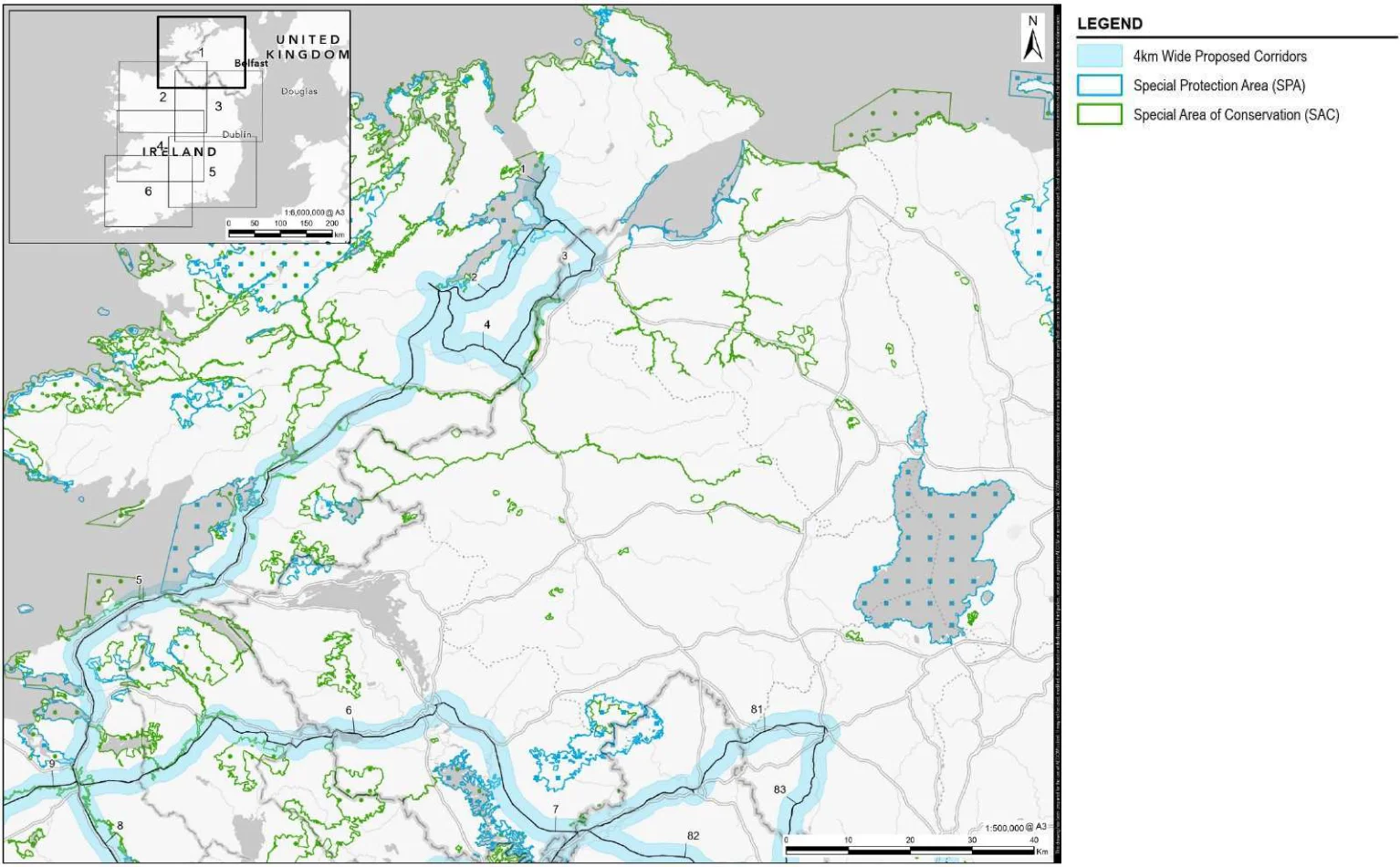
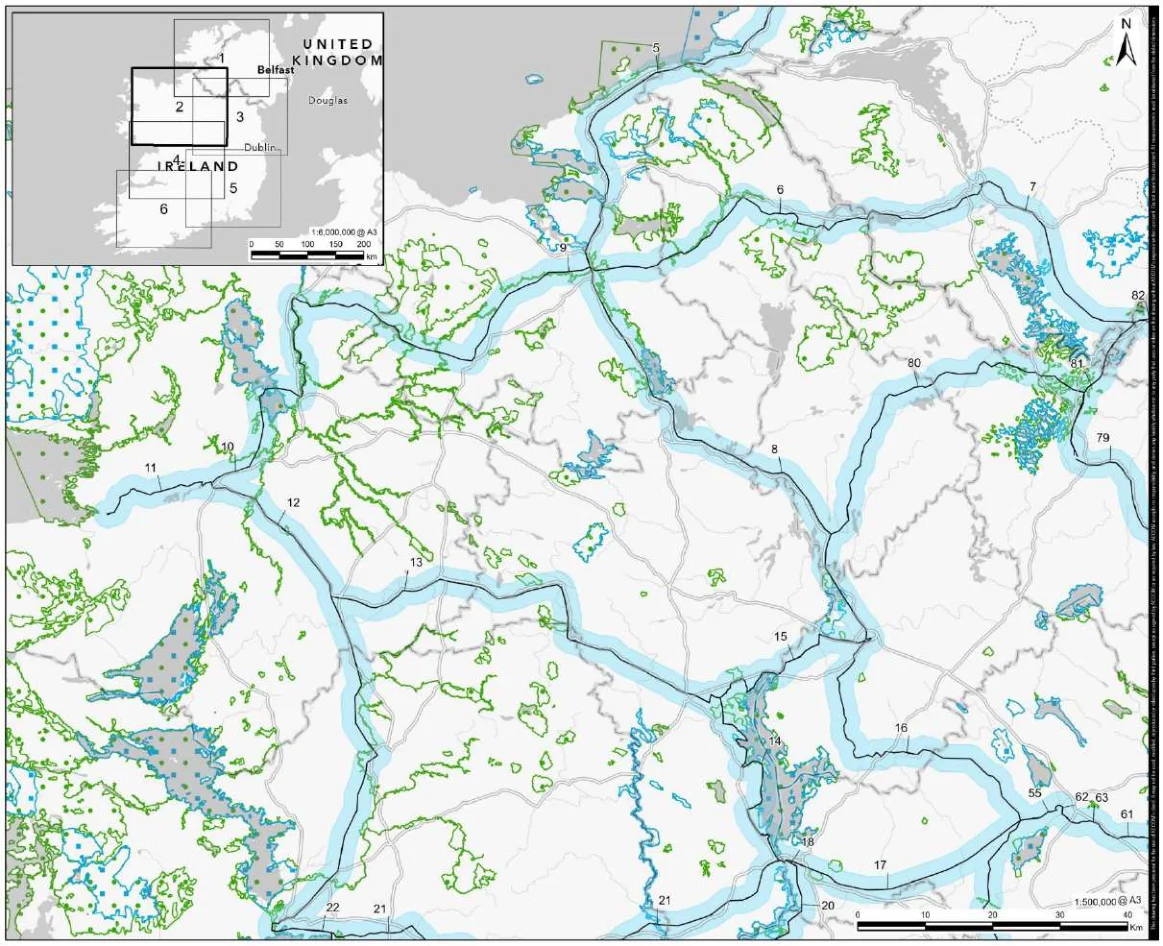
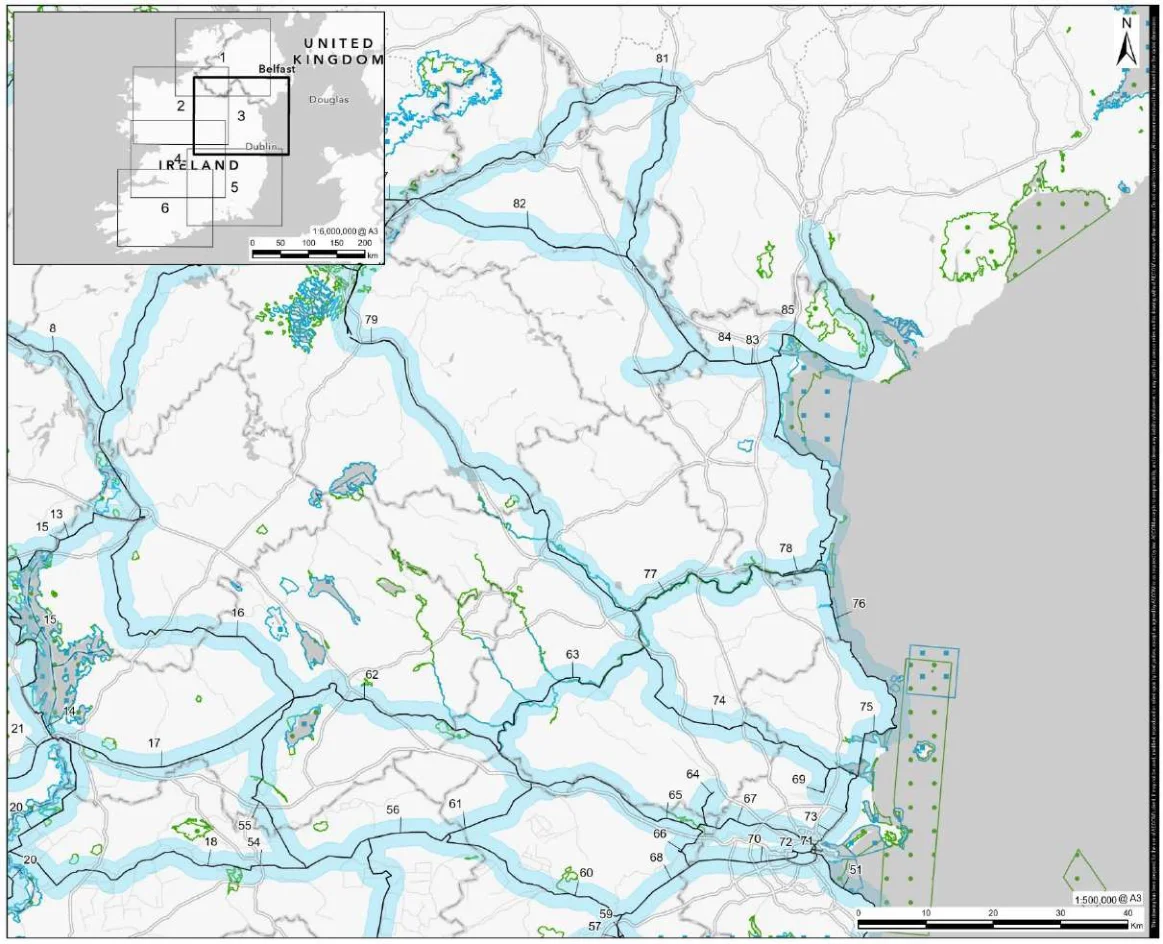
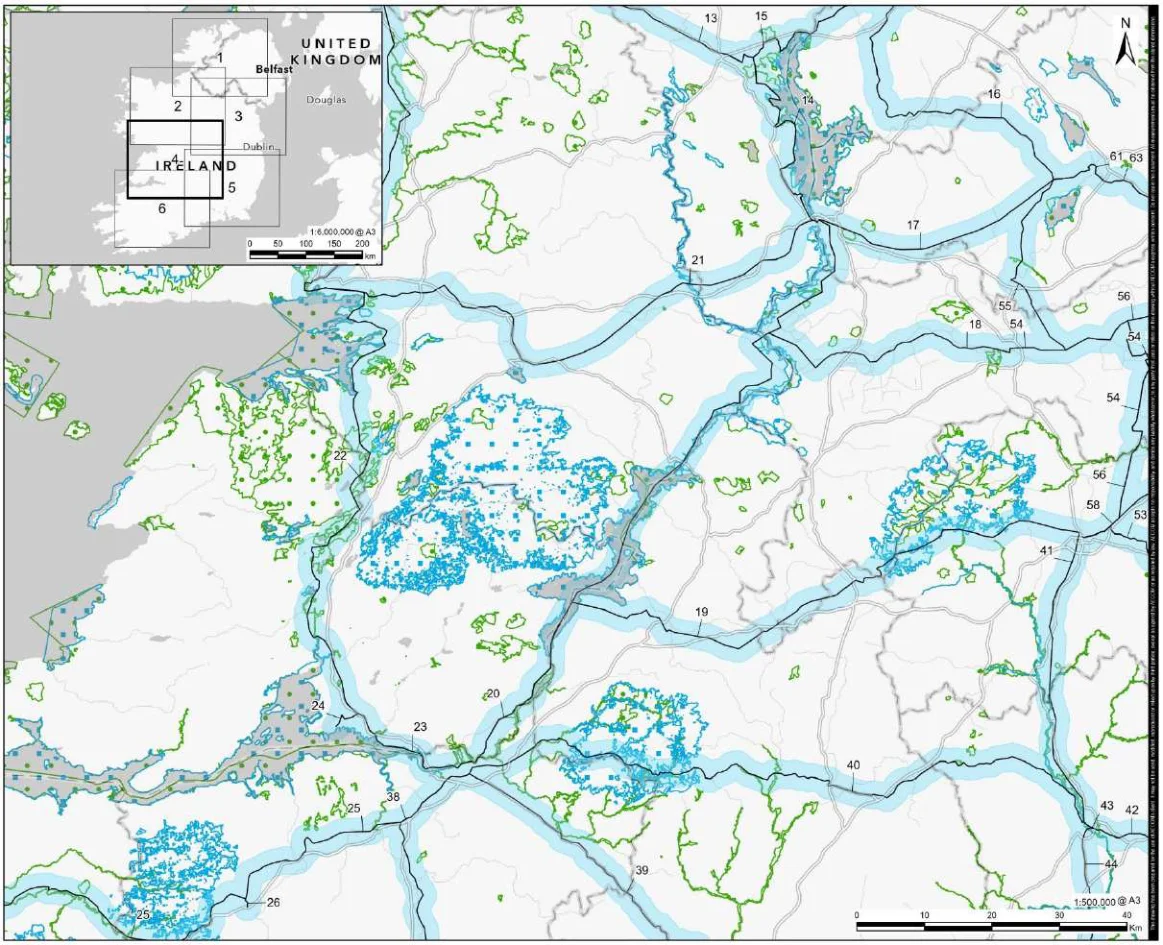
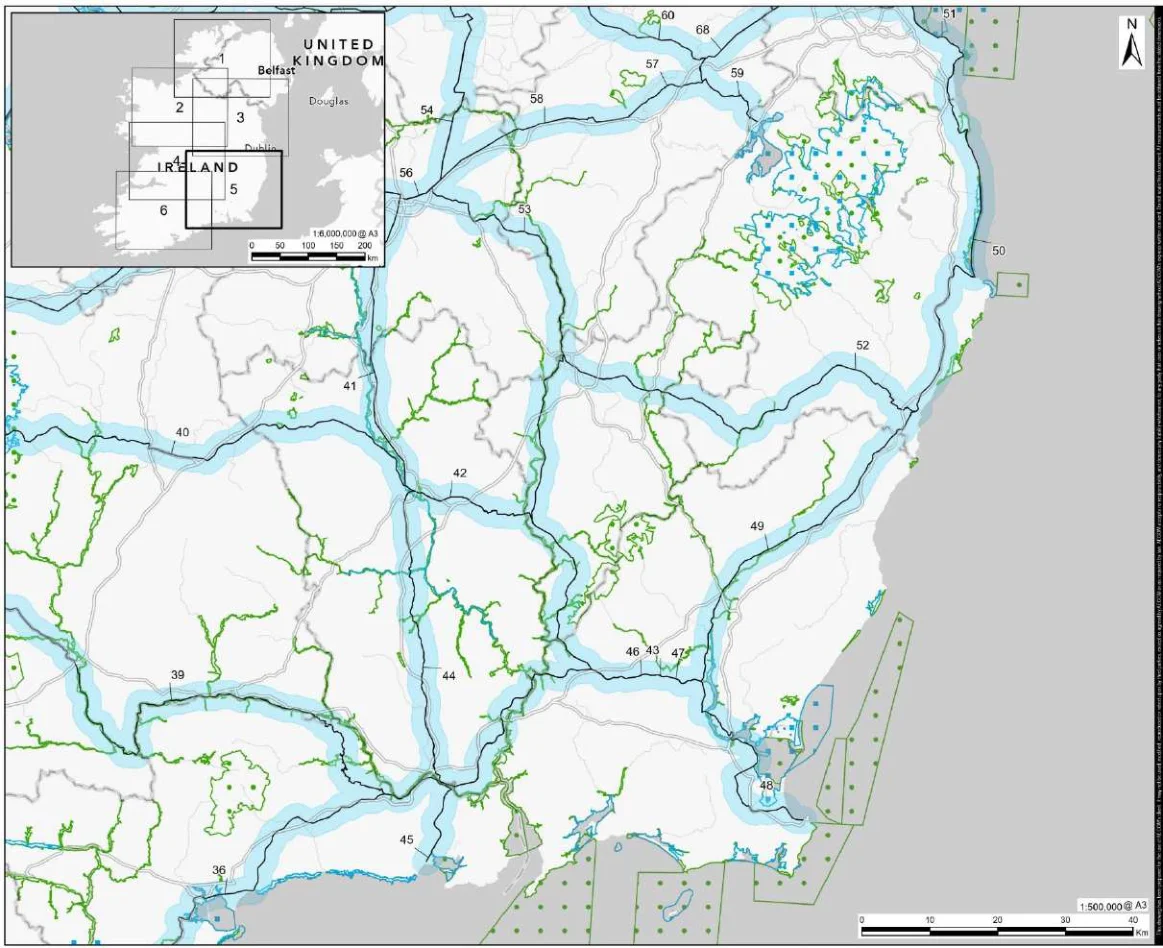
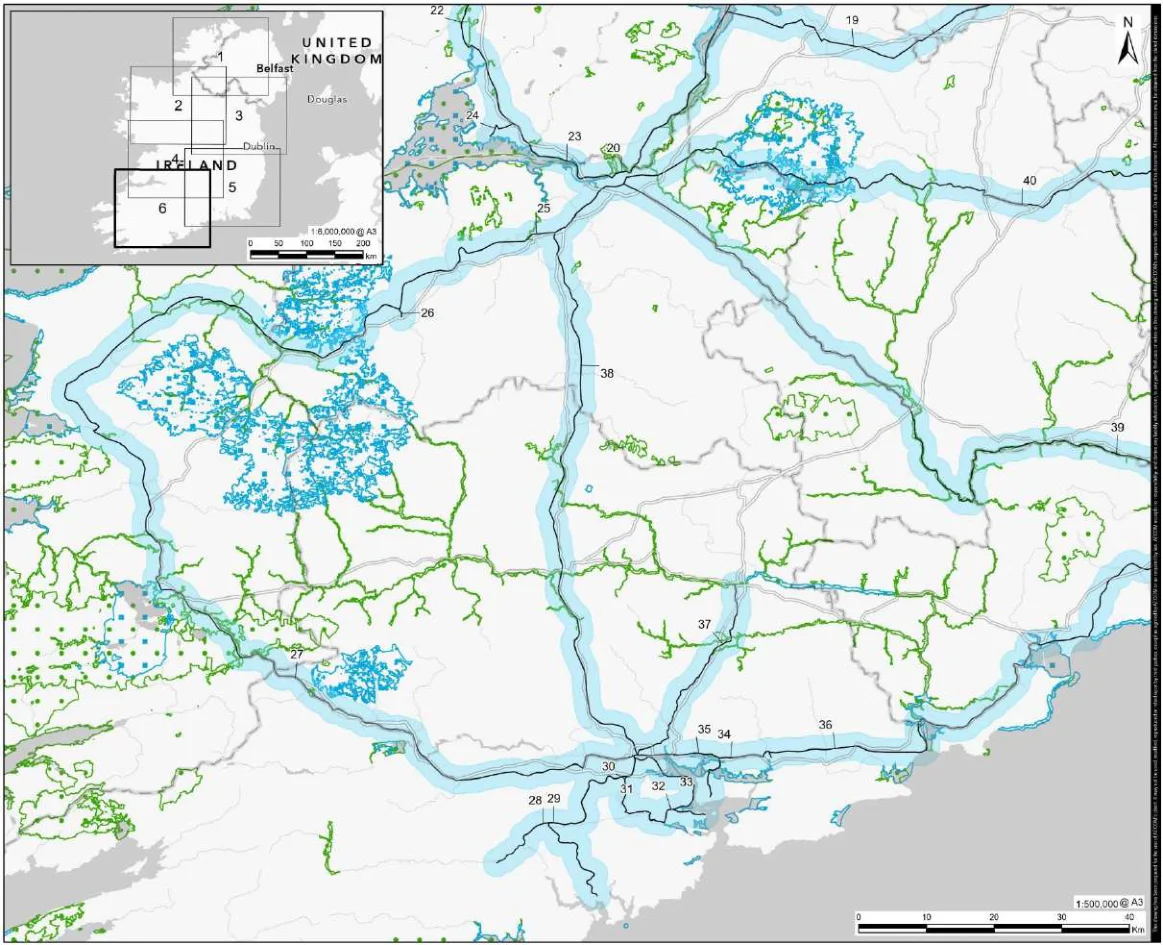
European Sites wholly or partially within the 4km NCN Proposed Corridor
Consideration of potential impacts
Mitigation approach for Corridor
River SAC,Union Wood SAC,Killala Bay/Moy Estuary SAC,Turloughmore (Sligo) SAC,Lough Hoe Bog SAC, Ballysadare Bay SPA,Cummeen Strand SPA
located lie within 2km of Ballysadare Bay SPA and Cummeen Strand SPA. Since these sites are designated for mobile species that may make use of habitat outside the SPA boundary there is potential for any new cycle route construction in this location to affect functionally- linked land for SPA birds outside the SPA boundary. At Ballisodare and again at Collooney the entire 4km corridor
construction within 200m is needed to create the cycle route a noise and air quality assessment (and potentially noise and air quality mitigation) will be required to ensure there is no construction-related disturbance that could significantly affect SPA birds or significant air pollution impacts on sensitive habitats. Parts of the 4km corridor lies within 2km of several SPAs. There will therefore need to be consideration of any potential for loss of functionally-linked habitat for SPA birds once the actual cycle route is determined. This will only be required if new construction is required within natural habitats and loss of habitat is greater than trivial; this is relevant because very little land is required for a cycle route. In such a situation wintering bird surveys to determine use of the habitats by SPA birds may be required and, if necessary, appropriate mitigation provided to ensure no adverse effect on the integrity of the European site before the works are consented. The approach to delivering the crossing of the Unshin River should be as follows: 1. Where feasible the crossing will be made using existing road bridges; 2. Where engineering works to a road bridge would be required to render it suitable, any permanent works must remain out of the water column, unless it can be demonstrated this would not affect site integrity, and must not hinder potential for otter passage along the riverbanks. If any temporary ‘in river’ works were to be necessary, studies (including but not limited to underwater noise and hydrodynamic studies), and potentially mitigation, would be required to ensure the works could be delivered without an adverse effect on the SAC habitats or salmon population; 3. If a new bridge crossing the Unshin River SAC is required, the following general requirements must be followed in designing and assessing the structure: a. Any abutments must be located outside the SAC boundary and/or must involve no loss of qualifying SAC habitat; b. Any abutments must be located outside the river channel and must be set sufficiently far back from the bank top to ensure passage of otter along the banks is not prevented; c. The soffit of the bridge should be sufficiently high that significant shading impacts on the water column and in river vegetation will not arise. Research suggests this would
Corridor Number and Name
European Sites wholly or partially within the 4km NCN Proposed Corridor
Consideration of potential impacts
Mitigation approach for Corridor
traverses the Unshin River SAC. The SAC is designated for its water courses of plain to montane levels with the Ranunculion fluitantis and Callitricho- Batrachion vegetation, its semi-natural dry grasslands and scrubland facies on calcareous substrates, its Molinia meadows on calcareous, peaty or clayey- silt-laden soils, its alluvial forests with Alnus glutinosa and Fraxinus excelsior and its populations of
require a soffit height: deck width ratio of 0.7 or above. d. A noise impact assessment of bridge construction regarding salmon and otter will be required, and potentially mitigation (such as seasonal restrictions on working, alternative construction methods or noise control techniques) to ensure no significant effect on the population of either species. e. Water quality protection measures will be required as well as a hydrological study to confirm any new construction would not affect special interest features that are hydrologically sensitive (e.g. alluvial woodland). f. Lighting should be avoided in areas that are currently unlit unless it can be demonstrated that there would be no adverse effect on site integrity. If detailed design work indicates that a new crossing of the Unshin River is required but it is not possible to deliver such a crossing over the SAC without an adverse effect on site integrity, the Corridor should be revised (such as to not to connect to Sligo) to demonstrate no adverse effect on site integrity.
Corridor Number and Name
European Sites wholly or partially within the 4km NCN Proposed Corridor
Consideration of potential impacts
Mitigation approach for Corridor
salmon and otter. It would not be possible to make the connection to Sligo from the south without crossing the Unshin River SAC due to the length of the river.
1 0
Ballina to Castlebar
River Moy SAC,Killala Bay/Moy Estuary SAC, Lough Conn and Lough Cullin SPA
The 4km corridor is sufficiently wide that direct impacts on any European sites can be avoided if necessary. Therefore, while noise and visual disturbance impacts, and air quality impacts (if construction was required)
The final route alignment should avoid any new construction within 200m of any European sites as a first preference. Where European sites are to be traversed existing roads and bridges should be used to carry the cycle route where feasible and there should be no new lighting introduced in areas that are currently unlit unless it can be demonstrated that there would be no adverse effect on site integrity. If any new construction within 200m is needed to create the cycle route a noise and air quality assessment (and potentially noise and air quality mitigation) will be required to ensure there is no construction-related disturbance that could significantly affect SPA birds or significant air pollution impacts on sensitive habitats. Parts of the 4km corridor lies within 2km of several SPAs. There will therefore need to be consideration of any potential for loss of functionally-linked habitat for SPA birds once the actual cycle route is determined. This will only be required if new construction is required within natural habitats and loss of habitat is greater than trivial; this is relevant because very little land is required for a cycle route. In such a situation wintering bird surveys to determine use of the habitats by SPA birds may be required and, if necessary, appropriate mitigation provided to ensure no adverse effect on the integrity of the European site before the
Corridor Number and Name
European Sites wholly or partially within the 4km NCN Proposed Corridor
Consideration of potential impacts
Mitigation approach for Corridor
could arise if the final route ran within 200m of a European site, these impacts are avoidable through either routing decisions or decisions regarding how the relevant sections of cycle route will be created (e.g. utilising existing infrastructure rather than creating new infrastructure in the most constrained sections, or using standard mitigation methods). Parts of the 4km corridor lie within 2km of
works are consented. The approach to delivering the crossing of the River Moy should be as follows: 1. Where feasible the crossing will be made using one of existing road bridges across the River Moy; 2. Where engineering works to a road bridge would be required to render it suitable, any permanent works must remain out of the water column, unless it can be demonstrated this would not affect site integrity, and must not hinder potential for otter passage along the riverbanks. If any temporary ‘in river’ works were to be necessary, studies (including but not limited to underwater noise and hydrodynamic studies), and potentially mitigation, would be required to ensure the works could be delivered without an adverse effect on the SAC habitats or white-clawed crayfish, salmon or lamprey populations; 3. If a new bridge is required, the following general requirements must be followed in designing and assessing the structure: a. Any abutments must be located outside the SAC/SPA boundaries and/or must involve no loss of qualifying SAC habitat or supporting habitat for SPA birds; b. Any abutments must be located outside the river channel and must be set sufficiently far back from the bank top to ensure passage of otter along the banks is not prevented; c. The soffit of the bridge should be sufficiently high that significant shading impacts on the water column and in river vegetation will not arise. Research suggests this would require a soffit height: deck width ratio of 0.7 or above. d. A noise impact assessment of bridge construction regarding SPA birds, salmon, lamprey and otter will be required, and potentially mitigation (such as seasonal restrictions on working, alternative construction methods or noise control techniques) to ensure no significant effect on the population of either species. e. Water quality protection measures will be required as well as a hydrological study to confirm any new construction would not affect special interest features that are hydrologically sensitive (e.g. alluvial woodland). f. Lighting should be avoided in areas that are currently unlit unless it can be
Corridor Number and Name
European Sites wholly or partially within the 4km NCN Proposed Corridor
Consideration of potential impacts
Mitigation approach for Corridor
Lough Conn and Lough Cullin SPA. Since these sites are designated for mobile species that may make use of habitat outside the SPA boundary there is potential for any new cycle route construction in this location to affect functionally- linked land for SPA birds outside the SPA boundary. West of Foxford the entire 4km corridor traverses the River Moy SAC/ Lough Conn and Lough Cullin SPA. The SAC is designated for
demonstrated that there would be no adverse effect on site integrity. If detailed design work indicates that a new crossing of the River Moy SAC or Lough Conn and Lough Cullin SPA would not be possible without an adverse effect on site integrity, the Corridor should be revised, such as to make the 20km eastwards detour to avoid the River Moy to demonstrate no adverse effect on site integrity.
Corridor Number and Name
European Sites wholly or partially within the 4km NCN Proposed Corridor
Consideration of potential impacts
Mitigation approach for Corridor
its lowland hay meadows, active raised bogs, degraded raised bogs still capable of natural regeneration, depressions on peat substrates of the Rhynchosporion , alkaline fens, old sessile oak woods with Ilex and Blechnum in the British Isles, alluvial forests with Alnus glutinosa and Fraxinus excelsior and its populations of white clawed crayfish, sea lamprey, brook lamprey, salmon and otter. It would be
Corridor Number and Name
European Sites wholly or partially within the 4km NCN Proposed Corridor
Consideration of potential impacts
Mitigation approach for Corridor
possible to divert around the SPA but due to the length and large area covered by the River Moy it would not be possible to deliver this corridor without a crossing of the River Moy SAC without a c. 20km detour and back.
1 1
Westport to Castlebar
Clew Bay Complex SAC
The 4km corridor is sufficiently wide that direct impacts on any European sites can be avoided if necessary. Therefore, while noise and visual disturbance impacts, and air
No constraints or mitigation needed
Corridor Number and Name
European Sites wholly or partially within the 4km NCN Proposed Corridor
Consideration of potential impacts
Mitigation approach for Corridor
quality impacts (if construction was required) could arise if the final route ran within 200m of a European site, these impacts are avoidable through either routing decisions or decisions regarding how the relevant sections of cycle route will be created (e.g. utilising existing infrastructure rather than creating new infrastructure in the most constrained sections, or using standard mitigation methods). The
Corridor Number and Name
European Sites wholly or partially within the 4km NCN Proposed Corridor
Consideration of potential impacts
Mitigation approach for Corridor
western-most part of the corridor at Westport lies within 2km of Clew Bay Complex SAC. However, this constitutes an area of open water that is a very small part of the overall corridor and this SAC is not designated for mobile species that would use the land around the cycle route.
1 2
Galway to Castlebar
Lough Corrib SAC,Galway Bay Complex SAC,River Moy SAC,Balla Turlough SAC,Inner Galway Bay SPA
The 4km corridor is sufficiently wide that direct impacts on any European sites can be avoided if necessary. Therefore, while noise and
The final route alignment should avoid any new construction within 200m of any European sites as a first preference. Where European sites are to be traversed existing roads and bridges should be used to carry the cycle route where feasible and there should be no new lighting introduced in areas that are currently unlit unless it can be demonstrated that there would be no adverse effect on site integrity. If any new construction within 200m is needed to create the cycle route a noise and air quality assessment (and potentially noise and air quality mitigation) will be required to ensure there is no construction-related disturbance that could significantly affect SPA birds or significant air pollution impacts on sensitive habitats. Parts of the 4km corridor lies within 2km of several SPAs. There will therefore need to be consideration of any
Corridor Number and Name
European Sites wholly or partially within the 4km NCN Proposed Corridor
Consideration of potential impacts
Mitigation approach for Corridor
visual disturbance impacts, and air quality impacts (if construction was required) could arise if the final route ran within 200m of a European site, these impacts are avoidable through either routing decisions or decisions regarding how the relevant sections of cycle route will be created (e.g. utilising existing infrastructure rather than creating new infrastructure in the most constrained sections, or
potential for loss of functionally-linked habitat for SPA birds once the actual cycle route is determined. This will only be required if new construction is required within natural habitats and loss of habitat is greater than trivial; this is relevant because very little land is required for a cycle route. In such a situation wintering bird surveys to determine use of the habitats by SPA birds may be required and, if necessary, appropriate mitigation provided to ensure no adverse effect on the integrity of the European site before the works are consented. The approach to delivering the River Moy crossing should be as follows: 1. Where feasible the crossing will be made using one of existing road bridges across the River Moy; 2. Where engineering works to a road bridge would be required to render it suitable, any permanent works must remain out of the water column, unless it can be demonstrated this would not affect site integrity, and must not hinder potential for otter passage along the riverbanks. If any temporary ‘in river’ works were to be necessary, studies (including but not limited to underwater noise and hydrodynamic studies), and potentially mitigation, would be required to ensure the works could be delivered without an adverse effect on the SAC habitats or white-clawed crayfish, salmon or lamprey populations; 3. If a new bridge is required, the following general requirements must be followed in designing and assessing the structure: a. Any abutments must be located outside the SAC boundary and/or must involve no loss of qualifying SAC habitat; b. Any abutments must be located outside the river channel and must be set sufficiently far back from the bank top to ensure passage of otter along the banks is not prevented; c. The soffit of the bridge should be sufficiently high that significant shading impacts on the water column and in river vegetation will not arise. Research suggests this would require a soffit height: deck width ratio of 0.7 or above. d. A noise impact assessment of bridge construction regarding salmon, lamprey and
Corridor Number and Name
European Sites wholly or partially within the 4km NCN Proposed Corridor
Consideration of potential impacts
Mitigation approach for Corridor
using standard mitigation methods). The southern-most part of 4km corridor within which the final cycle route will be located lies within 2km of Inner Galway Bay SPA. Since this site is designated for mobile species that may make use of habitat outside the SPA boundary there is potential for any new cycle route construction in this location to affect functionally- linked land for SPA birds outside the SPA boundary. In
otter will be required, and potentially mitigation (such as seasonal restrictions on working, alternative construction methods or noise control techniques) to ensure no significant effect on the population of either species. e. Water quality protection measures will be required as well as a hydrological study to confirm any new construction would not affect special interest features that are hydrologically sensitive (e.g. alluvial woodland). f. Lighting should be avoided in areas that are currently unlit unless it can be demonstrated that there would be no adverse effect on site integrity. If detailed design work indicates that a new crossing of the River Moy SAC would not be possible without an adverse effect on site integrity, the Corridor should be revised, such as to make the 20km eastwards detour to avoid the River Moy to demonstrate no adverse effect on site integrity.
Corridor Number and Name
European Sites wholly or partially within the 4km NCN Proposed Corridor
Consideration of potential impacts
Mitigation approach for Corridor
the vicinity of Lakeland Lower the entire 4km corridor traverses the River Moy SAC. Due to the length and large area covered by the River Moy it would not be possible to deliver this corridor without a crossing of the River Moy SAC without a c. 20km detour and back.
1 3
Castlebar to Longford
River Moy SAC,Lough Ree SAC,Balla Turlough SAC,Cloonchambers Bog SAC,Brown Bog SAC,Corliskea/Trien/Cloonfelliv Bog SAC,Lough Forbes Complex SAC, Corbo Bog SAC, Ballykenny- Fisherstown Bog SPA
The southern- most part of 4km lies within 2km of Lough Ree SPA. Since this site is designated for mobile species that may make use of habitat
The final route alignment should avoid any new construction within 200m of any European sites as a first preference. Where European sites are to be traversed existing roads and bridges should be used to carry the cycle route where feasible and there should be no new lighting introduced in areas that are currently unlit unless it can be demonstrated that there would be no adverse effect on site integrity. If any new construction within 200m is needed to create the cycle route a noise and air quality assessment (and potentially noise and air quality mitigation) will be required to ensure there is no construction-related disturbance that could significantly affect SPA birds or significant air pollution impacts on sensitive habitats. Parts of the 4km corridor lies within 2km of several SPAs. There will therefore need to be consideration of any
Corridor Number and Name
European Sites wholly or partially within the 4km NCN Proposed Corridor
Consideration of potential impacts
Mitigation approach for Corridor
outside the SPA boundary there is potential for any new cycle route construction in this location to affect functionally- linked land for SPA birds outside the SPA boundary. In the vicinity of Lakeland Lower the entire 4km corridor for both routes traverses the River Moy SAC. Due to the length and large area covered by the River Moy it would not be possible to deliver this corridor without a crossing of the
potential for loss of functionally-linked habitat for SPA birds once the actual cycle route is determined. This will only be required if new construction is required within natural habitats and loss of habitat is greater than trivial; this is relevant because very little land is required for a cycle route. In such a situation wintering bird surveys to determine use of the habitats by SPA birds may be required and, if necessary, appropriate mitigation provided to ensure no adverse effect on the integrity of the European site before the works are consented. The approach to delivering the River Moy crossing will be as follows: 1. Where feasible the crossing will be made using one of existing road bridges across the River Moy; 2. Where engineering works to a road bridge would be required to render it suitable, any permanent works must remain out of the water column, unless it can be demonstrated this would not affect site integrity, and must not hinder potential for otter passage along the riverbanks. If any temporary ‘in river’ works were to be necessary, studies (including but not limited to underwater noise and hydrodynamic studies), and potentially mitigation, would be required to ensure the works could be delivered without an adverse effect on the SAC habitats or white-clawed crayfish, salmon or lamprey populations; 3. If a new bridge is required, the following general requirements must be followed in designing and assessing the structure: a. Any abutments must be located outside the SAC boundary and/or must involve no loss of qualifying SAC habitat; b. Any abutments must be located outside the river channel and must be set sufficiently far back from the bank top to ensure passage of otter along the banks is not prevented; c. The soffit of the bridge should be sufficiently high that significant shading impacts on the water column and in river vegetation will not arise. Research suggests this would require a soffit height: deck width ratio of 0.7 or above. d. A noise impact assessment of bridge construction regarding salmon, lamprey and
Corridor Number and Name
European Sites wholly or partially within the 4km NCN Proposed Corridor
Consideration of potential impacts
Mitigation approach for Corridor
River Moy SAC without a c. 20km detour and back.
otter will be required, and potentially mitigation (such as seasonal restrictions on working, alternative construction methods or noise control techniques) to ensure no significant effect on the population of either species. e. Water quality protection measures will be required as well as a hydrological study to confirm any new construction would not affect special interest features that are hydrologically sensitive (e.g. alluvial woodland). f. Lighting should be avoided in areas that are currently unlit unless it can be demonstrated that there would be no adverse effect on site integrity. If detailed design work indicates that a new crossing of the River Moy SAC would not be possible without an adverse effect on site integrity, the Corridor should be revised, such as to make the 20km eastwards detour to avoid the River Moy to demonstrate no adverse effect on site integrity.
The 4km corridor is sufficiently wide that direct impacts on any European sites can be avoided if necessary. Therefore, while noise and visual disturbance impacts, and air quality impacts (if construction was required) could arise if
Given the width of the 4km corridor it is possible to deliver most of the final cycle route without any direct effects on European sites. The final route alignment should avoid any new construction within 200m of any European sites as a first preference. Where European sites are to be traversed existing roads and bridges should be used to carry the cycle route where feasible and there should be no new lighting introduced in areas that are currently unlit unless it can be demonstrated that there would be no adverse effect on site integrity. Where the cycle route will traverse a European site there will also need to be consideration at the project level of any detailed design requirements (such as prevention of access) that will ensure no net increase in recreational pressure within the European site. If any new construction within 200m is needed to create the cycle route a noise and air quality assessment (and potentially noise and air quality mitigation) will be required to ensure there is no construction-related disturbance that could significantly affect SPA birds or significant air pollution impacts on sensitive habitats. Parts of the 4km corridor lies within 2km of an SPA. There will therefore need to be consideration of any potential for loss of functionally-linked habitat for SPA birds once the actual cycle route is determined. This will only be required if new construction is required within natural habitats and loss of habitat is greater than trivial; this is
Corridor Number and Name
European Sites wholly or partially within the 4km NCN Proposed Corridor
Consideration of potential impacts
Mitigation approach for Corridor
the final route ran within 200m of a European site, these impacts are avoidable through either routing decisions or decisions regarding how the relevant sections of cycle route will be created (e.g. utilising existing infrastructure rather than creating new infrastructure in the most constrained sections, or using standard mitigation methods). The southern-most part of 4km corridor lies within 2km of
relevant because very little land is required for a cycle route. In such a situation wintering bird surveys to determine use of the habitats by SPA birds may be required and, if necessary, appropriate mitigation provided to ensure no adverse effect on the integrity of the European site before the works are consented.
Corridor Number and Name
European Sites wholly or partially within the 4km NCN Proposed Corridor
Consideration of potential impacts
Mitigation approach for Corridor
Lough Ree SPA and Middle Shannon Callows SPA. Since these sites are designated for mobile species that may make use of habitat outside the SPA boundary there is potential for any new cycle route construction in this location to affect functionally- linked land for SPA birds outside the SPA boundary.
1 5
Athlone to Longford
Lough Ree SAC,River Shannon Callows SAC,Brown Bog SAC,Lough Forbes Complex SAC, Corbo Bog SAC, Lough Ree SPA,Ballykenny-Fisherstown Bog SPA,Middle Shannon Callows SPA
The 4km corridor is sufficiently wide that direct impacts on any European sites can be avoided
The final route alignment should avoid any new construction within 200m of any European sites where possible and within 200m of any European sites there should be no new lighting introduced in areas that are currently unlit unless it can be demonstrated that there would be no adverse effect on site integrity. If any new construction within 200m is needed to create the cycle route a noise and air quality assessment (and potentially noise and air quality mitigation) will be required to ensure there is no construction-related disturbance that could significantly affect SPA birds or
Corridor Number and Name
European Sites wholly or partially within the 4km NCN Proposed Corridor
Consideration of potential impacts
Mitigation approach for Corridor
if necessary. Therefore, while noise and visual disturbance impacts, and air quality impacts (if construction was required) could arise if the final route ran within 200m of a European site, these impacts are avoidable through either routing decisions or decisions regarding how the relevant sections of cycle route will be created (e.g. utilising existing infrastructure rather than creating new infrastructure in
significant air pollution impacts on sensitive habitats. Where the cycle route will traverse a European site there will also be a need for consideration at the project level of any detailed design requirements (such as prevention of access) that will assess the potential impact of any possible net increase in recreational access to, or pressure within, the European site and determine if it is considered acceptable. Parts of the 4km corridor lies within 2km of an SPA. There will therefore need to be consideration of any potential for loss of functionally-linked habitat for SPA birds once the actual cycle route is determined. This will only be required if new construction is required within natural habitats and loss of habitat is greater than trivial; this is relevant because very little land is required for a cycle route. In such a situation wintering bird surveys to determine use of the habitats by SPA birds may be required and, if necessary, appropriate mitigation provided to ensure no adverse effect on the integrity of the European site before the works are consented.
Corridor Number and Name
European Sites wholly or partially within the 4km NCN Proposed Corridor
Consideration of potential impacts
Mitigation approach for Corridor
the most constrained sections, or using standard mitigation methods). Parts of the 4km corridor lies within 2km of Lough Ree SPA, Ballykenny- Fisherstown Bog SPA and Middle Shannon Callows SPA. Since these sites are designated for mobile species that may make use of habitat outside the SPA boundary there is potential for any new cycle route construction in this location to affect
Corridor Number and Name
European Sites wholly or partially within the 4km NCN Proposed Corridor
Consideration of potential impacts
Mitigation approach for Corridor
functionally- linked land for SPA birds outside the SPA boundary
1 6
Longford to Mullingar
Lough Ennell SAC, Lough Ennell SPA
The 4km corridor is sufficiently wide that direct impacts on any European sites can be avoided if necessary. Therefore, while noise and visual disturbance impacts, and air quality impacts (if construction was required) could arise if the final route ran within 200m of a European site, these impacts are avoidable through either routing
The final route alignment should avoid any new construction within 200m of any European sites as a first preference. Where European sites are to be traversed existing roads and bridges should be used where feasible and there should be no new lighting introduced in areas that are currently unlit unless it can be demonstrated that there would be no adverse effect on site integrity. Where the cycle route will traverse a European site there will also be a need for consideration at the project level of any detailed design requirements (such as prevention of access) that will assess the potential impact of any possible net increase in recreational access to, or pressure within, the European site and determine if it is considered acceptable. If any new construction within 200m is needed to create the cycle route a noise and air quality assessment (and potentially noise and air quality mitigation) will be required to ensure there is no construction-related disturbance that could significantly affect SPA birds or significant air pollution impacts on sensitive habitats. Parts of the 4km corridor lie within 2km of an SPA. There will therefore need to be consideration of any potential for loss of functionally-linked habitat for SPA birds once the actual cycle route is determined. This will only be required if new construction is required within natural habitats and loss of habitat is greater than trivial; this is relevant because very little land is required for a cycle route. In such a situation wintering bird surveys to determine use of the habitats by SPA birds may be required and, if necessary, appropriate mitigation provided to ensure no adverse effect on the integrity of the European site before the works are consented.
Corridor Number and Name
European Sites wholly or partially within the 4km NCN Proposed Corridor
Consideration of potential impacts
Mitigation approach for Corridor
decisions or decisions regarding how the relevant sections of cycle route will be created (e.g. utilising existing infrastructure rather than creating new infrastructure in the most constrained sections, or using standard mitigation methods). Part of the 4km corridor lies within 2km of Lough Ennell SPA. Since these sites are designated for mobile species that may make use of habitat outside the SPA boundary there
Corridor Number and Name
European Sites wholly or partially within the 4km NCN Proposed Corridor
Consideration of potential impacts
Mitigation approach for Corridor
is potential for any new cycle route construction in this location to affect functionally- linked land for SPA birds outside the SPA boundary
1 7
Athlone to Mullingar
Lough Ennell SAC,Carn Park Bog SAC,Crosswood Bog SAC,Lough Ree SAC,River Shannon Callows SAC,Lough Ree SPA,Lough Ennell SPA,Middle Shannon Callows SPA
The 4km corridor is sufficiently wide that direct impacts on any European sites can be avoided if necessary. Therefore, while noise and visual disturbance impacts, and air quality impacts (if construction was required) could arise if the final route ran within
The final route alignment should avoid any new construction within 200m of any European sites as a first preference. Where European sites are to be traversed existing roads and bridges should be used to carry the cycle route where feasible and there should be no new lighting introduced in areas that are currently unlit unless it can be demonstrated that there would be no adverse effect on site integrity. Where the cycle route will traverse a European site there will also need to be consideration at the project level of any detailed design requirements (such as prevention of access) that will ensure no net increase in recreational pressure within the European site. If any new construction within 200m is needed to create the cycle route a noise and air quality assessment (and potentially noise and air quality mitigation) will be required to ensure there is no construction-related disturbance that could significantly affect SPA birds or significant air pollution impacts on sensitive habitats. Parts of the 4km corridor lies within 2km of an SPA. There will therefore need to be consideration of any potential for loss of functionally-linked habitat for SPA birds once the actual cycle route is determined. This will only be required if new construction is required within natural habitats and loss of habitat is greater than trivial; this is relevant because very little land is required for a cycle route. In such a situation wintering bird surveys to determine use of the habitats by SPA birds may be required and, if necessary, appropriate mitigation
Corridor Number and Name
European Sites wholly or partially within the 4km NCN Proposed Corridor
Consideration of potential impacts
Mitigation approach for Corridor
200m of a European site, these impacts are avoidable through either routing decisions or decisions regarding how the relevant sections of cycle route will be created (e.g. utilising existing infrastructure rather than creating new infrastructure in the most constrained sections, or using standard mitigation methods). Part of the 4km corridor lies within 2km of Lough Ree SPA, Lough Ennell SPA, Middle
provided to ensure no adverse effect on the integrity of the European site before the works are consented.
Corridor Number and Name
European Sites wholly or partially within the 4km NCN Proposed Corridor
Consideration of potential impacts
Mitigation approach for Corridor
Shannon Callows SPA. Since these sites are designated for mobile species that may make use of habitat outside the SPA boundary there is potential for any new cycle route construction in this location to affect functionally- linked land for SPA birds outside the SPA boundary
1 8
Athlone to Tulamore
Charleville Wood SAC,Lough Ree SAC,River Shannon Callows SAC,Moyclare Bog SAC,Mongan Bog SAC,Pilgrim’s Road Esker SAC,Crosswood Bog SAC,Fin Lough (Offaly) SAC,River Suck Callows SPA,Lough Ree SPA,Mongan Bog SPA,Middle Shannon Callows SPA
The 4km corridor is sufficiently wide that direct impacts on any European sites can be avoided if necessary. Therefore,
The final route alignment should avoid any new construction within 200m of any European sites as a first preference. Where European sites are to be traversed existing roads and bridges should be used to carry the cycle route where feasible and there should be no new lighting introduced in areas that are currently unlit unless it can be demonstrated that there would be no adverse effect on site integrity. Where the cycle route will traverse a European site there will also be a need for consideration at the project level of any detailed design requirements (such as prevention of access) that will assess the potential impact of any possible net increase in recreational access to, or pressure within, the European site and determine if it is considered acceptable. If any
Corridor Number and Name
European Sites wholly or partially within the 4km NCN Proposed Corridor
Consideration of potential impacts
Mitigation approach for Corridor
while noise and visual disturbance impacts, and air quality impacts (if construction was required) could arise if the final route ran within 200m of a European site, these impacts are avoidable through either routing decisions or decisions regarding how the relevant sections of cycle route will be created (e.g. utilising existing infrastructure rather than creating new infrastructure in the most constrained
new construction within 200m is needed to create the cycle route a noise and air quality assessment (and potentially noise and air quality mitigation) will be required to ensure there is no construction-related disturbance that could significantly affect SPA birds or significant air pollution impacts on sensitive habitats. Parts of the 4km corridor lies within 2km of four SPAs. There will therefore need to be consideration of any potential for loss of functionally-linked habitat for SPA birds once the actual cycle route is determined. This will only be required if new construction is required within natural habitats and loss of habitat is greater than trivial; this is relevant because very little land is required for a cycle route. In such a situation wintering bird surveys to determine use of the habitats by SPA birds may be required and, if necessary, appropriate mitigation provided to ensure no adverse effect on the integrity of the European site before the works are consented.
Corridor Number and Name
European Sites wholly or partially within the 4km NCN Proposed Corridor
Consideration of potential impacts
Mitigation approach for Corridor
sections, or using standard mitigation methods). Part of the 4km corridor lies within 2km of River Suck Callows SPA,Lough Ree SPA,Mongan Bog SPA and Middle Shannon Callows SPA. Since these sites are designated for mobile species that may make use of habitat outside the SPA boundary there is potential for any new cycle route construction in this location to affect functionally-
Corridor Number and Name
European Sites wholly or partially within the 4km NCN Proposed Corridor
Consideration of potential impacts
Mitigation approach for Corridor
linked land for SPA birds outside the SPA boundary.
1 9
Limerick to Portlaoise
Slieve Bloom Mountains SAC,Lower River Shannon SAC,River Barrow And River Nore SAC,Slieve Bloom Mountains SPA,River Shannon and River Fergus Estuaries SPA,Lough Derg (Shannon) SPA
Part of the 4km corridor lies within 2km of Slieve Bloom Mountains SPA, River Shannon and River Fergus Estuaries SPA and Lough Derg (Shannon) SPA. Since these sites are designated for mobile species that may make use of habitat outside the SPA boundary there is potential for any new cycle route construction in this location to affect functionally- linked land for
The final route alignment should avoid any new construction within 200m of any European sites as a first preference. Where European sites are to be traversed existing roads and bridges should be used to carry the cycle route where feasible and there should be no new lighting introduced in areas that are currently unlit unless it can be demonstrated that there would be no adverse effect on site integrity. If any new construction within 200m is needed to create the cycle route a noise and air quality assessment (and potentially noise and air quality mitigation) will be required to ensure there is no construction-related disturbance that could significantly affect SPA birds or significant air pollution impacts on sensitive habitats. Parts of the 4km corridor lies within 2km of several SPAs. There will therefore need to be consideration of any potential for loss of functionally-linked habitat for SPA birds once the actual cycle route is determined. This will only be required if new construction is required within natural habitats and loss of habitat is greater than trivial; this is relevant because very little land is required for a cycle route. In such a situation wintering bird surveys to determine use of the habitats by SPA birds may be required and, if necessary, appropriate mitigation provided to ensure no adverse effect on the integrity of the European site before the works are consented. The approach to delivering the crossing of the Slieve Bloom Mountains and River Nore should be as follows: 1. Where feasible the corridor will follow the existing road through the SAC/SPA; 2. Where engineering works to the road would be required to render it suitable, there must be no loss of SAC habitat and an assessment would be required to ensure there was no loss of functionally-linked habitat that might affect the ability of the SPA to support its hen harrier population. Construction must be timed to avoid the sensitive season for hen harrier. 3. Where engineering works to a road bridge across the River Barrow & River Nore SAC
Corridor Number and Name
European Sites wholly or partially within the 4km NCN Proposed Corridor
Consideration of potential impacts
Mitigation approach for Corridor
SPA birds outside the SPA boundary. Between Ballyduff and Carrowreagh the entire 4km corridor lies within Slieve Bloom Mountains SPA for at least 5km and it also passes through the SAC at Lacka. At Lacka the 4km corridor also crosses the River Barrow And River Nore SAC. The Slieve Bloom Mountains SAC is designated for its wet heaths with Erica tetralix,
would be required to render it suitable, any permanent works must remain out of the water column, unless it can be demonstrated this would not affect site integrity, and must not hinder potential for otter passage along the riverbanks. They must be situated so that no loss of SAC plant species would arise. If any temporary ‘in river’ works were to be necessary, studies (including but not limited to underwater noise and hydrodynamic studies), and potentially mitigation, would be required to ensure the works could be delivered without an adverse effect on the SAC habitats or Desmoulin’s Whorl Snail, Freshwater Pearl Mussel, White-clawed Crayfish, Sea Lamprey, Brook Lamprey, River Lamprey, Twaite Shad, Salmon, Otter, Killarney Fern and Nore Pearl Mussel populations; 4. If a new bridge is required, the following general requirements must be followed in designing and assessing the structure: a. Any abutments must be located outside the SAC/SPA boundaries and/or must involve no loss of qualifying SAC habitat or supporting habitat for SPA birds; b. Any abutments must be located outside the river channel and must be set sufficiently far back from the bank top to ensure passage of otter along the banks is not prevented; c. The soffit of the bridge should be sufficiently high that significant shading impacts on the water column and in river vegetation will not arise. Research suggests this would require a soffit height: deck width ratio of 0.7 or above. d. A noise impact assessment of bridge construction regarding hen harrier, otter and qualifying fish species will be required, and potentially mitigation (such as seasonal restrictions on working, alternative construction methods or noise control techniques) to ensure no significant effect on the population of any species. e. Water quality protection measures will be required as well as a hydrological study to confirm any new construction would not affect special interest features that are hydrologically sensitive (e.g. alluvial woodland). f. Lighting should be avoided in areas that are currently unlit unless it can be demonstrated that there would be no adverse effect on site integrity. If detailed design work indicates that any improvements to the existing road through
Corridor Number and Name
European Sites wholly or partially within the 4km NCN Proposed Corridor
Consideration of potential impacts
Mitigation approach for Corridor
blanket bogs and alluvial forests with Alnus glutinosa and Fraxinus excelsior. The SPA is designated for its hen harrier population. The River Barrow and Nore SAC is designated for its estuaries, mudflats and sandflats not covered by seawater at low tide, reefs, Salicornia and other annuals colonising mud and sand, Atlantic salt meadows, Mediterranean salt meadows, Water courses of plain to montane levels
the Slieve Bloom Mountains SAC/SPA or a new crossing of the River Nore would not be possible without an adverse effect on site integrity, the Corridor should be revised, such as to end before Portlaoise to demonstrate no adverse effect on site integrity.
Corridor Number and Name
European Sites wholly or partially within the 4km NCN Proposed Corridor
Consideration of potential impacts
Mitigation approach for Corridor
with the Ranunculion fluitantis and Callitricho- Batrachion vegetation, European dry heaths, Hydrophilous tall herb fringe communities of plains and of the montane to alpine levels, Petrifying springs with tufa formation, Old sessile oak woods with Ilex and Blechnum in the British Isles, Alluvial forests with Alnus glutinosa and Fraxinus excelsior, Desmoulin’s Whorl Snail, Freshwater Pearl Mussel,
Corridor Number and Name
European Sites wholly or partially within the 4km NCN Proposed Corridor
Consideration of potential impacts
Mitigation approach for Corridor
White-clawed Crayfish, Sea Lamprey, Brook Lamprey, River Lamprey, Twaite Shad, Salmon, Otter, Killarney Fern and Nore Pearl Mussel. There is no way to make the connection to Portlaoise without traversing the River Barrow & River Nore SAC and/or the River Nore SPA.
2 0
Limerick to Athlone
Lower River Shannon SAC,Lough Derg, North-east Shore SAC,Lough Ree SAC,River Shannon Callows SAC,Kilcarren- Firville Bog SAC,Mongan Bog SAC,Pilgrim’s Road Esker SAC,Crosswood Bog SAC,Fin Lough (Offaly) SAC,Redwood Bog SAC,River Shannon and River
Part of the 4km corridor lies within 2km of River Shannon and River Fergus Estuaries SPA, River Suck Callows SPA, Lough Ree SPA,
The final route alignment should avoid any new construction within 200m of any European sites as a first preference. Where European sites are to be traversed existing roads and bridges should be used to carry the cycle route where feasible and there should be no new lighting introduced in areas that are currently unlit unless it can be demonstrated that there would be no adverse effect on site integrity. If any new construction within 200m is needed to create the cycle route a noise and air quality assessment (and potentially noise and air quality mitigation) will be required to ensure there is no construction-related disturbance that could significantly affect SPA birds or significant air pollution impacts on sensitive habitats. Parts of the 4km corridor lie
Corridor Number and Name
European Sites wholly or partially within the 4km NCN Proposed Corridor
Consideration of potential impacts
Mitigation approach for Corridor
Fergus Estuaries SPA,River Suck Callows SPA,Lough Ree SPA,Lough Derg (Shannon) SPA,River Little Brosna Callows SPA,Mongan Bog SPA,Middle Shannon Callows SPA
Lough Derg (Shannon) SPA, River Little Brosna Callows SPA, Mongan Bog SPA and Middle Shannon Callows SPA. Since these sites are designated for mobile species that may make use of habitat outside the SPA boundary there is potential for any new cycle route construction in this location to affect functionally- linked land for SPA birds outside the SPA boundary. At Templedew the entire 4km
within 2km of several SPAs. There will therefore need to be consideration of any potential for loss of functionally-linked habitat for SPA birds once the actual cycle route is determined. This will only be required if new construction is required within natural habitats and loss of habitat is greater than trivial; this is relevant because very little land is required for a cycle route. In such a situation wintering bird surveys to determine use of the habitats by SPA birds may be required and, if necessary, appropriate mitigation provided to ensure no adverse effect on the integrity of the European site before the works are consented. The approach to delivering the crossing of the River Shannon should be as follows: 1. Where feasible the crossing will be made one of the existing road bridges across the River Shannon; 2. Where engineering works to a road bridge would be required to render it suitable, any permanent works must remain out of the water column, unless it can be demonstrated this would not affect site integrity, and must not hinder potential for otter passage along the riverbanks; 3. If a new bridge is required, the following general requirements must be followed in designing and assessing the structure: a. Any abutments must be located outside the SAC/SPA boundaries and/or must involve no loss of qualifying SAC habitat or supporting habitat for SPA birds; b. Any abutments must be located outside the river channel and must be set sufficiently far back from the bank top to ensure passage of otter along the banks is not prevented; c. The soffit of the bridge should be sufficiently high that significant shading impacts on the water column and in river vegetation will not arise. Research suggests this would require a soffit height: deck width ratio of 0.7 or above. d. A noise impact assessment of bridge construction regarding SPA birds and otter will be required, and potentially mitigation (such as seasonal restrictions on working, alternative construction methods or noise control techniques) to ensure no significant effect on the population of either species. e. Water quality protection measures will be required as well as a hydrological study to
Corridor Number and Name
European Sites wholly or partially within the 4km NCN Proposed Corridor
Consideration of potential impacts
Mitigation approach for Corridor
corridor crosses the River Shannon Callows SAC and Middle Shannon Callows SPA. The SAC is designated for Molinia meadows on calcareous, peaty or clayey- silt-laden soils, lowland hay meadows, alkaline fens, limestone pavements, alluvial forests with Alnus glutinosa and Fraxinus excelsior and its population of otter. The SPA is designated for whooper swan, wigeon, corncrake,
confirm any new construction would not affect special interest features that are hydrologically sensitive (e.g. alluvial woodland). f. Lighting should be avoided in areas that are currently unlit unless it can be demonstrated that there would be no adverse effect on site integrity. If detailed design work indicates that a new crossing of the River Shannon would not be possible without an adverse effect on site integrity, the Corridor should be revised, such as to end south of the River Shannon to demonstrate no adverse effect on site integrity.
Corridor Number and Name
European Sites wholly or partially within the 4km NCN Proposed Corridor
Consideration of potential impacts
Mitigation approach for Corridor
golden plover, lapwing, back- tailed godwit, black-headed gull and its wetland and waterbird assemblage. There is no way to make the connection to Athlone without crossing the River Shannon and thus traversing the SAC and/or SPA or crossing the River Suck Callows SPA.
2 1
Galway to Athlone
Lough Corrib SAC,Galway Bay Complex SAC,Glenloughaun Esker SAC,Lough Ree SAC,River Shannon Callows SAC,Rahasane Turlough SAC,Lough Rea SAC, River Suck Callowa
At Ballinasloe the entire 4km corridor traverses the River Suck Callows SPA. The SPA is designated for
The final route alignment should avoid any new construction within 200m of any European sites as a first preference. Where European sites are to be traversed existing roads and bridges should be used to carry the cycle route where feasible and there should be no new lighting introduced in areas that are currently unlit unless it can be demonstrated that there would be no adverse effect on site integrity. If any new construction within 200m is needed to create the cycle route a noise and air quality assessment (and potentially noise and air quality mitigation) will be required to ensure there is no air pollution impacts on sensitive habitats. The approach to delivering the
Corridor Number and Name
European Sites wholly or partially within the 4km NCN Proposed Corridor
Consideration of potential impacts
Mitigation approach for Corridor
its population of whooper swan, wigeon, golden plover, lapwing, Greenland white fronted goose and its wetland and waterbird assemblage. There is no way to make the connection to Athlone without crossing the River Suck Callows SPA or crossing the River Shannon (and its European sites).
River Suck crossing should be as follows: 1. Where feasible the crossing will be made one of the existing road bridges across the River Suck; 2. Where engineering works to a road bridge would be required to render it suitable, any permanent works must remain out of the water column, unless it can be demonstrated this would not affect site integrity,; 3. If a new bridge is required, the following general requirements must be followed in designing and assessing the structure: a. Any abutments must be located outside the SPA boundaries and/or must involve no loss of supporting habitat for SPA birds; b. Any abutments must be located outside the river channel and must be set sufficiently far back from the bank top to ensure that no damage to banks occurs; c. A noise impact assessment of bridge construction regarding SPA birds will be required, and potentially mitigation (such as seasonal restrictions on working, alternative construction methods or noise control techniques) to ensure no significant effect on the population. d. Water quality protection measures will be required. e. Lighting should be avoided in areas that are currently unlit unless it can be demonstrated that there would be no adverse effect on site integrity. If detailed design work indicates that a new crossing of the River Suck would not be possible without an adverse effect on site integrity, the Corridor should be revised, such as to end south of the River Suck to demonstrate no adverse effect on site integrity.
2 2
Galway to Ennis
Lough Corrib SAC,Moyree River System SAC,Ballyallia Lake SAC,East Burren Complex SAC,Galway Bay Complex SAC,Coole-Garryland Complex SAC,Lough Fingall Complex
The 4km corridor is sufficiently wide that direct impacts on any European sites
The final route alignment should avoid any new construction within 200m of any European sites as a first preference. Where European sites are to be traversed existing roads and bridges should be used to carry the cycle route where feasible and there should be no new lighting introduced in areas that are currently unlit unless it can be demonstrated that there would be no adverse effect on site integrity. Where the cycle route will traverse a European site there will also be a need for consideration at the
Corridor Number and Name
European Sites wholly or partially within the 4km NCN Proposed Corridor
Consideration of potential impacts
Mitigation approach for Corridor
SAC,Lower River Shannon SAC,Ballyogan Lough SAC,Caherglassaun Turlough SAC,Old Farm Buildings, Ballymacrogan SAC,Dromore Woods And Loughs SAC,Termon Lough SAC,Coole-Garryland SPA,Inner Galway Bay SPA,Cregganna Marsh SPA,Ballyallia Lough SPA
can be avoided if necessary. Therefore, while noise and visual disturbance impacts, and air quality impacts (if construction was required) could arise if the final route ran within 200m of a European site, these impacts are avoidable through either routing decisions or decisions regarding how the relevant sections of cycle route will be created (e.g. utilising existing infrastructure rather than creating new
project level of any detailed design requirements (such as prevention of access) that will assess the potential impact of any possible net increase in recreational access to, or pressure within, the European site and determine if it is considered acceptable. If any new construction within 200m is needed to create the cycle route a noise and air quality assessment (and potentially noise and air quality mitigation) will be required to ensure there is no construction-related disturbance that could significantly affect SPA birds or significant air pollution impacts on sensitive habitats. Parts of the 4km corridor lie within 2km of an SPA. There will therefore need to be consideration of any potential for loss of functionally-linked habitat for SPA birds once the actual cycle route is determined. This will only be required if new construction is required within natural habitats and loss of habitat is greater than trivial; this is relevant because very little land is required for a cycle route. In such a situation wintering bird surveys to determine use of the habitats by SPA birds may be required and, if necessary, appropriate mitigation provided to ensure no adverse effect on the integrity of the European site before the works are consented.
Corridor Number and Name
European Sites wholly or partially within the 4km NCN Proposed Corridor
Consideration of potential impacts
Mitigation approach for Corridor
infrastructure in the most constrained sections, or using standard mitigation methods). Part of the 4km corridor lies within 2km of Coole- Garryland SPA, Inner Galway Bay SPA, Cregganna Marsh SPA and Ballyallia Lough SPA. Since these sites are designated for mobile species that may make use of habitat outside the SPA boundary there is potential for any new cycle route construction in this location to
Corridor Number and Name
European Sites wholly or partially within the 4km NCN Proposed Corridor
Consideration of potential impacts
Mitigation approach for Corridor
affect functionally- linked land for SPA birds outside the SPA boundary.
2 3
Ennis to Limerick
Ballyallia Lake SAC,Lower River Shannon SAC,Newhall and Edenvale Complex SAC,Lough Gash Turlough SAC,River Shannon and River Fergus Estuaries SPA
The 4km corridor is sufficiently wide that direct impacts on any European sites can be avoided if necessary. Therefore, while noise and visual disturbance impacts, and air quality impacts (if construction was required) could arise if the final route ran within 200m of a European site, these impacts are avoidable through either
The final route alignment should avoid any new construction within 200m of any European sites as a first preference. Where European sites are to be traversed existing roads and bridges should be used to carry the cycle route where feasible and there should be no new lighting introduced in areas that are currently unlit unless it can be demonstrated that there would be no adverse effect on site integrity. Where the cycle route will traverse a European site there will also be a need for consideration at the project level of any detailed design requirements (such as prevention of access) that will assess the potential impact of any possible net increase in recreational access to, or pressure within, the European site and determine if it is considered acceptable. If any new construction within 200m is needed to create the cycle route a noise and air quality assessment (and potentially noise and air quality mitigation) will be required to ensure there is no construction-related disturbance that could significantly affect SPA birds or significant air pollution impacts on sensitive habitats. Parts of the 4km corridor lies within 2km of an SPA. There will therefore need to be consideration of any potential for loss of functionally-linked habitat for SPA birds once the actual cycle route is determined. This will only be required if new construction is required within natural habitats and loss of habitat is greater than trivial; this is relevant because very little land is required for a cycle route. In such a situation wintering bird surveys to determine use of the habitats by SPA birds may be required and, if necessary, appropriate mitigation provided to ensure no adverse effect on the integrity of the European site before the works are consented.
Corridor Number and Name
European Sites wholly or partially within the 4km NCN Proposed Corridor
Consideration of potential impacts
Mitigation approach for Corridor
routing decisions or decisions regarding how the relevant sections of cycle route will be created (e.g. utilising existing infrastructure rather than creating new infrastructure in the most constrained sections, or using standard mitigation methods). Part of the 4km corridor lies within 2km of River Shannon and River Fergus Estuaries SPA. Since this site is designated for mobile species that may make
Corridor Number and Name
European Sites wholly or partially within the 4km NCN Proposed Corridor
Consideration of potential impacts
Mitigation approach for Corridor
use of habitat outside the SPA boundary there is potential for any new cycle route construction in this location to affect functionally- linked land for SPA birds outside the SPA boundary.
2 4
Shannon to Ennis/Limeric k
Lower River Shannon SAC,River Shannon and River Fergus Estuaries SPA
The 4km corridor is sufficiently wide that direct impacts on any European sites can be avoided if necessary. Therefore, while noise and visual disturbance impacts, and air quality impacts (if construction was required)
The final route alignment should avoid any new construction within 200m of any European sites as a first preference. Where European sites are to be traversed existing roads and bridges should be used to carry the cycle route where feasible and there should be no new lighting introduced in areas that are currently unlit unless it can be demonstrated that there would be no adverse effect on site integrity. Where the cycle route will traverse a European site there will also be a need for consideration at the project level of any detailed design requirements (such as prevention of access) that will assess the potential impact of any possible net increase in recreational access to, or pressure within, the European site and determine if it is considered acceptable. If any new construction within 200m is needed to create the cycle route a noise and air quality assessment (and potentially noise and air quality mitigation) will be required to ensure there is no construction-related disturbance that could significantly affect SPA birds or significant air pollution impacts on sensitive habitats. Parts of the 4km corridor lie within 2km of an SPA. There will therefore need to be consideration of any potential for loss of functionally-linked habitat for SPA birds once the actual cycle route is determined. This will only be required if new construction is required within natural
Corridor Number and Name
European Sites wholly or partially within the 4km NCN Proposed Corridor
Consideration of potential impacts
Mitigation approach for Corridor
could arise if the final route ran within 200m of a European site, these impacts are avoidable through either routing decisions or decisions regarding how the relevant sections of cycle route will be created (e.g. utilising existing infrastructure rather than creating new infrastructure in the most constrained sections, or using standard mitigation methods). Part of the 4km corridor lies within 2km of
habitats and loss of habitat is greater than trivial; this is relevant because very little land is required for a cycle route. In such a situation wintering bird surveys to determine use of the habitats by SPA birds may be required and, if necessary, appropriate mitigation provided to ensure no adverse effect on the integrity of the European site before the works are consented.
Corridor Number and Name
European Sites wholly or partially within the 4km NCN Proposed Corridor
Consideration of potential impacts
Mitigation approach for Corridor
River Shannon and River Fergus Estuaries SPA. Since these sites are designated for mobile species that may make use of habitat outside the SPA boundary there is potential for any new cycle route construction in this location to affect functionally- linked land for SPA birds outside the SPA boundary.
2 5
Tralee to Limerick
Tralee Bay And Magharees Peninsula, West To Cloghane SAC,Askeaton Fen Complex SAC,Lower River Shannon SAC,Moanveanlagh Bog SAC,River Shannon and River Fergus Estuaries SPA,Tralee Bay Complex SPA,Stack’s to
Part of the 4km corridor lies within 2km of River Shannon and River Fergus Estuaries SPA, Tralee Bay Complex SPA,
The final route alignment should avoid any new construction within 200m of any European sites as a first preference. Where European sites are to be traversed existing roads and bridges should be used to carry the cycle route where feasible and there should be no new lighting introduced in areas that are currently unlit unless it can be demonstrated that there would be no adverse effect on site integrity. If any new construction within 200m is needed to create the cycle route a noise and air quality assessment (and potentially noise and air quality mitigation) will be required to ensure there is no construction-related disturbance that could significantly affect SPA birds or
Corridor Number and Name
European Sites wholly or partially within the 4km NCN Proposed Corridor
Consideration of potential impacts
Mitigation approach for Corridor
Mullaghareirk Mountains, West Limerick Hills and Mount Eagle SPA
Stack’s to Mullaghareirk Mountains and West Limerick Hills and Mount Eagle SPA. Since these sites are designated for mobile species that may make use of habitat outside the SPA boundary there is potential for any new cycle route construction in this location to affect functionally- linked land for SPA birds outside the SPA boundary. At Ballynageragh, Ballyhorgan East and Shanbally the entire 4km corridor
significant air pollution impacts on sensitive habitats. Parts of the 4km corridor lies within 2km of several SPAs. There will therefore need to be consideration of any potential for loss of functionally-linked habitat for SPA birds once the actual cycle route is determined. This will only be required if new construction is required within natural habitats and loss of habitat is greater than trivial; this is relevant because very little land is required for a cycle route. In such a situation wintering bird surveys to determine use of the habitats by SPA birds may be required and, if necessary, appropriate mitigation provided to ensure no adverse effect on the integrity of the European site before the works are consented. The approach to delivering this corridor should be as follows: 1. Where feasible the corridor will follow existing roads through the SPA and across the SAC river; 2. Where engineering works to the road would be required to render it suitable, an assessment would be required to ensure there was no loss of functionally-linked habitat that might affect the ability of the SPA to support its hen harrier population. Construction must be timed to avoid the sensitive season for hen harrier. 3. Where engineering works to a road bridge across the Lower River Shannon SAC would be required to render it suitable, and must not hinder potential for otter passage along the riverbanks. They must be situated so that no loss of SAC plant species would arise. If any temporary ‘in river’ works were to be necessary, studies (including but not limited to underwater noise and hydrodynamic studies), and potentially mitigation, would be required to ensure the works could be delivered without an adverse effect on the SAC habitats or qualifying fish and dolphin populations; 4. If a new bridge is required, the following general requirements must be followed in designing and assessing the structure: a. Any abutments must be located outside the SAC/SPA boundaries and/or must involve no loss of qualifying SAC habitat or supporting habitat for SPA birds; b. Any abutments must be located outside the river channel and must be set sufficiently far back from the bank top to ensure passage of otter along the banks is not prevented; c. The soffit of the bridge should be sufficiently high that significant shading impacts on
Corridor Number and Name
European Sites wholly or partially within the 4km NCN Proposed Corridor
Consideration of potential impacts
Mitigation approach for Corridor
traverses the Lower River Shannon SAC. The SAC is designated for sandbanks which are slightly covered by sea water all the time, estuaries, mudflats and sandflats not covered by seawater at low tide, coastal lagoons, large shallow inlets and bays, reefs, perennial vegetation of stony banks, vegetated sea cliffs of the Atlantic and Baltic coasts, Salicornia and other annuals colonising mud and sand,
the water column and in river vegetation will not arise. Research suggests this would require a soffit height: deck width ratio of 0.7 or above. d. A noise impact assessment of bridge construction regarding hen harrier, otter and qualifying fish and dolphin species will be required, and potentially mitigation (such as seasonal restrictions on working, alternative construction methods or noise control techniques) to ensure no significant effect on the population of any species. e. Water quality protection measures will be required as well as a hydrological study to confirm any new construction would not affect special interest features that are hydrologically sensitive (e.g. alluvial woodland). f. Lighting should be avoided in areas that are currently unlit unless it can be demonstrated that there would be no adverse effect on site integrity. If detailed design work indicates that any improvements to existing roads through the Stack’s to Mullaghareirk Mountains, West Limerick Hills and Mount Eagle SPA, or a new crossing of the River Shannon, would not be possible without an adverse effect on site integrity, the Corridor should be revised, such as to end before Limerick to demonstrate no adverse effect on site integrity.
Corridor Number and Name
European Sites wholly or partially within the 4km NCN Proposed Corridor
Consideration of potential impacts
Mitigation approach for Corridor
Atlantic salt meadows, Mediterranean salt meadows, water courses of plain to montane levels with the Ranunculion fluitantis and Callitricho- Batrachion vegetation, Molinia meadows on calcareous, peaty or clayey- silt-laden soils, alluvial forests with Alnus glutinosa and Fraxinus excelsior and its populations of freshwater pearl mussel, sea lamprey, brook lamprey, river lamprey, salmon, otter
Corridor Number and Name
European Sites wholly or partially within the 4km NCN Proposed Corridor
Consideration of potential impacts
Mitigation approach for Corridor
and bottlenose dolphin. Between Doonakenna and Glendarragh much of the 4km corridor lies across Stack’s to Mullaghareirk Mountains, West Limerick Hills and Mount Eagle SPA. The SPA is designated for its population of hen harrier. It would be possible to make the connection to Limerick without traversing the SPA by moving the corridor south of the
Corridor Number and Name
European Sites wholly or partially within the 4km NCN Proposed Corridor
Consideration of potential impacts
Mitigation approach for Corridor
SPA but it is not possible to make the connection to Limerick without traversing either the Lower River Shannon SAC or the Blackwater River SAC.
2 6
Newcastle West to Tralee/ Limerick
N/A
N/A
No constraints or mitigation needed
2 7
Cork to Tralee
St. Gobnet’s Wood SAC,Killarney National Park, Macgillycuddy’s Reeks And Caragh River Catchment SAC,Tralee Bay And Magharees Peninsula, West To Cloghane SAC,Ballyseedy Wood SAC,Sheheree (Ardagh) Bog SAC,The Gearagh SAC,Slieve Mish Mountains SAC,Castlemaine Harbour SAC,Tralee Bay Complex SPA,Mullaghanish to Musheramore Mountains
The 4km corridor is sufficiently wide that direct impacts on any European sites can be avoided if necessary. Therefore, while noise and visual disturbance impacts, and air quality impacts
The final route alignment should avoid any new construction within 200m of any European sites as a first preference. Where European sites are to be traversed existing roads and bridges should be used to carry the cycle route where feasible and there should be no new lighting introduced in areas that are currently unlit unless it can be demonstrated that there would be no adverse effect on site integrity. Where the cycle route will traverse a European site there will also be a need for consideration at the project level of any detailed design requirements (such as prevention of access) that will assess the potential impact of any possible net increase in recreational access to, or pressure within, the European site and determine if it is considered acceptable. If any new construction within 200m is needed to create the cycle route a noise and air quality assessment (and potentially noise and air quality mitigation) will be required to ensure there is no construction-related disturbance that could significantly affect SPA birds or significant air pollution impacts on sensitive habitats. Parts of the 4km corridor lies within 2km of an SPA. There will therefore need to be consideration of any
Corridor Number and Name
European Sites wholly or partially within the 4km NCN Proposed Corridor
Consideration of potential impacts
Mitigation approach for Corridor
SPA,Killarney National Park SPA,The Gearagh SPA
(if construction was required) could arise if the final route ran within 200m of a European site, these impacts are avoidable through either routing decisions or decisions regarding how the relevant sections of cycle route will be created (e.g. utilising existing infrastructure rather than creating new infrastructure in the most constrained sections, or using standard mitigation methods). Part of the 4km
potential for loss of functionally-linked habitat for SPA birds once the actual cycle route is determined. This will only be required if new construction is required within natural habitats and loss of habitat is greater than trivial; this is relevant because very little land is required for a cycle route. In such a situation wintering bird surveys to determine use of the habitats by SPA birds may be required and, if necessary, appropriate mitigation provided to ensure no adverse effect on the integrity of the European site before the works are consented.
Corridor Number and Name
European Sites wholly or partially within the 4km NCN Proposed Corridor
Consideration of potential impacts
Mitigation approach for Corridor
corridor lies within 2km of Tralee Bay Complex SPA, Mullaghanish to Musheramore Mountains SPA ,Killarney National Park SPA and the Gearagh SPA. Since these sites are designated for mobile species that may make use of habitat outside the SPA boundary there is potential for any new cycle route construction in this location to affect functionally- linked land for SPA birds outside the SPA boundary.
Corridor Number and Name
European Sites wholly or partially within the 4km NCN Proposed Corridor
Consideration of potential impacts
Mitigation approach for Corridor
2 8
Cork to Bandon
Cork Harbour SPA
The 4km corridor is sufficiently wide that direct impacts on any European sites can be avoided if necessary. Therefore, while noise and visual disturbance impacts, and air quality impacts (if construction was required) could arise if the final route ran within 200m of a European site, these impacts are avoidable through either routing decisions or decisions regarding how the relevant sections of
The final route alignment should avoid any new construction within 200m of any European sites as a first preference. Where European sites are to be traversed existing roads and bridges should be used to carry the cycle route where feasible and there should be no new lighting introduced in areas that are currently unlit unless it can be demonstrated that there would be no adverse effect on site integrity. Where the cycle route will traverse a European site there will also be a need for consideration at the project level of any detailed design requirements (such as prevention of access) that will assess the potential impact of any possible net increase in recreational access to, or pressure within, the European site and determine if it is considered acceptable. If any new construction within 200m is needed to create the cycle route a noise and air quality assessment (and potentially noise and air quality mitigation) will be required to ensure there is no construction-related disturbance that could significantly affect SPA birds or significant air pollution impacts on sensitive habitats. Parts of the 4km corridor lies within 2km of an SPA. There will therefore need to be consideration of any potential for loss of functionally-linked habitat for SPA birds once the actual cycle route is determined. This will only be required if new construction is required within natural habitats. In such a situation wintering bird surveys to determine use of the habitats by SPA birds may be required and, if necessary, appropriate mitigation provided to ensure no adverse effect on the integrity of the European site before the works are consented.
Corridor Number and Name
European Sites wholly or partially within the 4km NCN Proposed Corridor
Consideration of potential impacts
Mitigation approach for Corridor
cycle route will be created (e.g. utilising existing infrastructure rather than creating new infrastructure in the most constrained sections, or using standard mitigation methods). Part of the 4km corridor lies within 2km of Cork Harbour SPA. Since this site is designated for mobile species that may make use of habitat outside the SPA boundary there is potential for any new cycle route construction in this location to
Corridor Number and Name
European Sites wholly or partially within the 4km NCN Proposed Corridor
Consideration of potential impacts
Mitigation approach for Corridor
affect functionally- linked land for SPA birds outside the SPA boundary.
2 9
Cork to Kinsale
Cork Harbour SPA
The 4km corridor is sufficiently wide that direct impacts on any European sites can be avoided if necessary. Therefore, while noise and visual disturbance impacts, and air quality impacts (if construction was required) could arise if the final route ran within 200m of a European site, these impacts are avoidable through either
The final route alignment should avoid any new construction within 200m of any European sites as a first preference. Where European sites are to be traversed existing roads and bridges should be used to carry the cycle route where feasible and there should be no new lighting introduced in areas that are currently unlit unless it can be demonstrated that there would be no adverse effect on site integrity. Where the cycle route will traverse a European site there will also be a need for consideration at the project level of any detailed design requirements (such as prevention of access) that will assess the potential impact of any possible net increase in recreational access to, or pressure within, the European site and determine if it is considered acceptable. If any new construction within 200m is needed to create the cycle route a noise and air quality assessment (and potentially noise and air quality mitigation) will be required to ensure there is no construction-related disturbance that could significantly affect SPA birds or significant air pollution impacts on sensitive habitats. Parts of the 4km corridor lies within 2km of an SPA. There will therefore need to be consideration of any potential for loss of functionally-linked habitat for SPA birds once the actual cycle route is determined. This will only be required if new construction is required within natural habitats and loss of habitat is greater than trivial; this is relevant because very little land is required for a cycle route. In such a situation wintering bird surveys to determine use of the habitats by SPA birds may be required and, if necessary, appropriate mitigation provided to ensure no adverse effect on the integrity of the European site before the works are consented.
Corridor Number and Name
European Sites wholly or partially within the 4km NCN Proposed Corridor
Consideration of potential impacts
Mitigation approach for Corridor
routing decisions or decisions regarding how the relevant sections of cycle route will be created (e.g. utilising existing infrastructure rather than creating new infrastructure in the most constrained sections, or using standard mitigation methods). Part of the 4km corridor lies within 2km of Cork Harbour SPA. Since this site is designated for mobile species that may make use of habitat outside the SPA
Corridor Number and Name
European Sites wholly or partially within the 4km NCN Proposed Corridor
Consideration of potential impacts
Mitigation approach for Corridor
boundary there is potential for any new cycle route construction in this location to affect functionally- linked land for SPA birds outside the SPA boundary.
3 0
Cork to Cork airport
Cork Harbour SPA
The 4km corridor is sufficiently wide that direct impacts on any European sites can be avoided if necessary. Therefore, while noise and visual disturbance impacts, and air quality impacts (if construction was required) could arise if the final route
The final route alignment should avoid any new construction within 200m of any European sites as a first preference. Where European sites are to be traversed existing roads and bridges should be used to carry the cycle route where feasible and there should be no new lighting introduced in areas that are currently unlit unless it can be demonstrated that there would be no adverse effect on site integrity. Where the cycle route will traverse a European site there will also be a need for consideration at the project level of any detailed design requirements (such as prevention of access) that will assess the potential impact of any possible net increase in recreational access to, or pressure within, the European site and determine if it is considered acceptable. If any new construction within 200m is needed to create the cycle route a noise and air quality assessment (and potentially noise and air quality mitigation) will be required to ensure there is no construction-related disturbance that could significantly affect SPA birds or significant air pollution impacts on sensitive habitats. Parts of the 4km corridor lies within 2km of an SPA. There will therefore need to be consideration of any potential for loss of functionally-linked habitat for SPA birds once the actual cycle route is determined. This will only be required if new construction is required within natural habitats and loss of habitat is greater than trivial; this is relevant because very little land is required for a cycle route. In such a situation wintering bird surveys to determine use
Corridor Number and Name
European Sites wholly or partially within the 4km NCN Proposed Corridor
Consideration of potential impacts
Mitigation approach for Corridor
ran within 200m of a European site, these impacts are avoidable through either routing decisions or decisions regarding how the relevant sections of cycle route will be created (e.g. utilising existing infrastructure rather than creating new infrastructure in the most constrained sections, or using standard mitigation methods).Part of the 4km corridor lies within 2km of Cork Harbour SPA. Since this
of the habitats by SPA birds may be required and, if necessary, appropriate mitigation provided to ensure no adverse effect on the integrity of the European site before the works are consented.
Corridor Number and Name
European Sites wholly or partially within the 4km NCN Proposed Corridor
Consideration of potential impacts
Mitigation approach for Corridor
site is designated for mobile species that may make use of habitat outside the SPA boundary there is potential for any new cycle route construction in this location to affect functionally- linked land for SPA birds outside the SPA boundary.
3 1
Cork airport to Carrigaline
Cork Harbour SPA
The 4km corridor is sufficiently wide that direct impacts on any European sites can be avoided if necessary. Therefore, while noise and visual disturbance
The final route alignment should avoid any new construction within 200m of any European sites as a first preference. Where European sites are to be traversed existing roads and bridges should be used to carry the cycle route where feasible and there should be no new lighting introduced in areas that are currently unlit unless it can be demonstrated that there would be no adverse effect on site integrity. Where the cycle route will traverse a European site there will also be a need for consideration at the project level of any detailed design requirements (such as prevention of access) that will assess the potential impact of any possible net increase in recreational access to, or pressure within, the European site and determine if it is considered acceptable. If any new construction within 200m is needed to create the cycle route a noise and air quality assessment (and potentially noise and air quality mitigation) will be required to ensure there is no construction-related disturbance that could significantly affect SPA
Corridor Number and Name
European Sites wholly or partially within the 4km NCN Proposed Corridor
Consideration of potential impacts
Mitigation approach for Corridor
impacts, and air quality impacts (if construction was required) could arise if the final route ran within 200m of a European site, these impacts are avoidable through either routing decisions or decisions regarding how the relevant sections of cycle route will be created (e.g. utilising existing infrastructure rather than creating new infrastructure in the most constrained sections, or using standard mitigation
birds or significant air pollution impacts on sensitive habitats. Parts of the 4km corridor lies within 2km of an SPA. There will therefore need to be consideration of any potential for loss of functionally-linked habitat for SPA birds once the actual cycle route is determined. This will only be required if new construction is required within natural habitats and loss of habitat is greater than trivial; this is relevant because very little land is required for a cycle route. In such a situation wintering bird surveys to determine use of the habitats by SPA birds may be required and, if necessary, appropriate mitigation provided to ensure no adverse effect on the integrity of the European site before the works are consented.
Corridor Number and Name
European Sites wholly or partially within the 4km NCN Proposed Corridor
Consideration of potential impacts
Mitigation approach for Corridor
methods). Part of the 4km corridor lies within 2km of Cork Harbour SPA. Since this site is designated for mobile species that may make use of habitat outside the SPA boundary there is potential for any new cycle route construction in this location to affect functionally- linked land for SPA birds outside the SPA boundary.
3 2
Port of Cork to Carrigaline
Cork Harbour SPA
The 4km corridor is sufficiently wide that direct impacts on any European sites
The final route alignment should avoid any new construction within 200m of any European sites as a first preference. Where European sites are to be traversed existing roads and bridges should be used to carry the cycle route where feasible and there should be no new lighting introduced in areas that are currently unlit unless it can be demonstrated that there would be no adverse effect on site integrity. Where the cycle route will traverse a European site there will also be a need for consideration at the
Corridor Number and Name
European Sites wholly or partially within the 4km NCN Proposed Corridor
Consideration of potential impacts
Mitigation approach for Corridor
can be avoided if necessary. Therefore, while noise and visual disturbance impacts, and air quality impacts (if construction was required) could arise if the final route ran within 200m of a European site, these impacts are avoidable through either routing decisions or decisions regarding how the relevant sections of cycle route will be created (e.g. utilising existing infrastructure rather than creating new
project level of any detailed design requirements (such as prevention of access) that will assess the potential impact of any possible net increase in recreational access to, or pressure within, the European site and determine if it is considered acceptable. If any new construction within 200m is needed to create the cycle route a noise and air quality assessment (and potentially noise and air quality mitigation) will be required to ensure there is no construction-related disturbance that could significantly affect SPA birds or significant air pollution impacts on sensitive habitats. Parts of the 4km corridor lies within 2km of an SPA. There will therefore need to be consideration of any potential for loss of functionally-linked habitat for SPA birds once the actual cycle route is determined. This will only be required if new construction is required within natural habitats and loss of habitat is greater than trivial; this is relevant because very little land is required for a cycle route. In such a situation wintering bird surveys to determine use of the habitats by SPA birds may be required and, if necessary, appropriate mitigation provided to ensure no adverse effect on the integrity of the European site before the works are consented.
Corridor Number and Name
European Sites wholly or partially within the 4km NCN Proposed Corridor
Consideration of potential impacts
Mitigation approach for Corridor
infrastructure in the most constrained sections, or using standard mitigation methods). Part of the 4km corridor lies within 2km of Cork Harbour SPA. Since this site is designated for mobile species that may make use of habitat outside the SPA boundary there is potential for any new cycle route construction in this location to affect functionally- linked land for SPA birds outside the SPA boundary.
Corridor Number and Name
European Sites wholly or partially within the 4km NCN Proposed Corridor
Consideration of potential impacts
Mitigation approach for Corridor
3 3
Cork to Port of Cork
St. Gobnet’s Wood SAC,Cork Harbour SPA
The 4km corridor is sufficiently wide that direct impacts on any European sites can be avoided if necessary. Therefore, while noise and visual disturbance impacts, and air quality impacts (if construction was required) could arise if the final route ran within 200m of a European site, these impacts are avoidable through either routing decisions or decisions regarding how the relevant sections of
The final route alignment should avoid any new construction within 200m of any European sites as a first preference. Where European sites are to be traversed existing roads and bridges should be used to carry the cycle route where feasible and there should be no new lighting introduced in areas that are currently unlit unless it can be demonstrated that there would be no adverse effect on site integrity. Where the cycle route will traverse a European site there will also be a need for consideration at the project level of any detailed design requirements (such as prevention of access) that will assess the potential impact of any possible net increase in recreational access to, or pressure within, the European site and determine if it is considered acceptable. If any new construction within 200m is needed to create the cycle route a noise and air quality assessment (and potentially noise and air quality mitigation) will be required to ensure there is no construction-related disturbance that could significantly affect SPA birds or significant air pollution impacts on sensitive habitats. Parts of the 4km corridor lies within 2km of an SPA. There will therefore need to be consideration of any potential for loss of functionally-linked habitat for SPA birds once the actual cycle route is determined. This will only be required if new construction is required within natural habitats and loss of habitat is greater than trivial; this is relevant because very little land is required for a cycle route. In such a situation wintering bird surveys to determine use of the habitats by SPA birds may be required and, if necessary, appropriate mitigation provided to ensure no adverse effect on the integrity of the European site before the works are consented.
Corridor Number and Name
European Sites wholly or partially within the 4km NCN Proposed Corridor
Consideration of potential impacts
Mitigation approach for Corridor
cycle route will be created (e.g. utilising existing infrastructure rather than creating new infrastructure in the most constrained sections, or using standard mitigation methods). Part of the 4km corridor lies within 2km of Cork Harbour SPA. Since this site is designated for mobile species that may make use of habitat outside the SPA boundary there is potential for any new cycle route construction in this location to
Corridor Number and Name
European Sites wholly or partially within the 4km NCN Proposed Corridor
Consideration of potential impacts
Mitigation approach for Corridor
affect functionally- linked land for SPA birds outside the SPA boundary.
3 4
Cobh to Midleton
Great Island Channel SAC,Cork Harbour SPA
The 4km corridor is sufficiently wide that direct impacts on any European sites can be avoided if necessary. Therefore, while noise and visual disturbance impacts, and air quality impacts (if construction was required) could arise if the final route ran within 200m of a European site, these impacts are avoidable through either
The final route alignment should avoid any new construction within 200m of any European sites as a first preference. Where European sites are to be traversed existing roads and bridges should be used to carry the cycle route where feasible and there should be no new lighting introduced in areas that are currently unlit unless it can be demonstrated that there would be no adverse effect on site integrity. Where the cycle route will traverse a European site there will also be a need for consideration at the project level of any detailed design requirements (such as prevention of access) that will assess the potential impact of any possible net increase in recreational access to, or pressure within, the European site and determine if it is considered acceptable. If any new construction within 200m is needed to create the cycle route a noise and air quality assessment (and potentially noise and air quality mitigation) will be required to ensure there is no construction-related disturbance that could significantly affect SPA birds or significant air pollution impacts on sensitive habitats. Parts of the 4km corridor lies within 2km of an SPA. There will therefore need to be consideration of any potential for loss of functionally-linked habitat for SPA birds once the actual cycle route is determined. This will only be required if new construction is required within natural habitats and loss of habitat is greater than trivial; this is relevant because very little land is required for a cycle route. In such a situation wintering bird surveys to determine use of the habitats by SPA birds may be required and, if necessary, appropriate mitigation provided to ensure no adverse effect on the integrity of the European site before the works are consented.
Corridor Number and Name
European Sites wholly or partially within the 4km NCN Proposed Corridor
Consideration of potential impacts
Mitigation approach for Corridor
routing decisions or decisions regarding how the relevant sections of cycle route will be created (e.g. utilising existing infrastructure rather than creating new infrastructure in the most constrained sections, or using standard mitigation methods). Part of the 4km corridor lies within 2km of Cork Harbour SPA. Since this site is designated for mobile species that may make use of habitat outside the SPA
Corridor Number and Name
European Sites wholly or partially within the 4km NCN Proposed Corridor
Consideration of potential impacts
Mitigation approach for Corridor
boundary there is potential for any new cycle route construction in this location to affect functionally- linked land for SPA birds outside the SPA boundary.
3 5
Cork to Cobh
Great Island Channel SAC,Cork Harbour SPA
The 4km corridor is sufficiently wide that direct impacts on any European sites can be avoided if necessary. Therefore, while noise and visual disturbance impacts, and air quality impacts (if construction was required) could arise if the final route
The final route alignment should avoid any new construction within 200m of any European sites as a first preference. Where European sites are to be traversed existing roads and bridges should be used to carry the cycle route where feasible and there should be no new lighting introduced in areas that are currently unlit unless it can be demonstrated that there would be no adverse effect on site integrity. Where the cycle route will traverse a European site there will also be a need for consideration at the project level of any detailed design requirements (such as prevention of access) that will assess the potential impact of any possible net increase in recreational access to, or pressure within, the European site and determine if it is considered acceptable. If any new construction within 200m is needed to create the cycle route a noise and air quality assessment (and potentially noise and air quality mitigation) will be required to ensure there is no construction-related disturbance that could significantly affect SPA birds or significant air pollution impacts on sensitive habitats. Parts of the 4km corridor lies within 2km of an SPA. There will therefore need to be consideration of any potential for loss of functionally-linked habitat for SPA birds once the actual cycle route is determined. This will only be required if new construction is required within natural habitats and loss of habitat is greater than trivial; this is relevant because very little land is required for a cycle route. In such a situation wintering bird surveys to determine use
Corridor Number and Name
European Sites wholly or partially within the 4km NCN Proposed Corridor
Consideration of potential impacts
Mitigation approach for Corridor
ran within 200m of a European site, these impacts are avoidable through either routing decisions or decisions regarding how the relevant sections of cycle route will be created (e.g. utilising existing infrastructure rather than creating new infrastructure in the most constrained sections, or using standard mitigation methods). Part of the 4km corridor lies within 2km of Cork Harbour SPA. Since this
of the habitats by SPA birds may be required and, if necessary, appropriate mitigation provided to ensure no adverse effect on the integrity of the European site before the works are consented.
Corridor Number and Name
European Sites wholly or partially within the 4km NCN Proposed Corridor
Consideration of potential impacts
Mitigation approach for Corridor
site is designated for mobile species that may make use of habitat outside the SPA boundary there is potential for any new cycle route construction in this location to affect functionally- linked land for SPA birds outside the SPA boundary.
3 6
Cork to Waterford
Blackwater River (Cork/Waterford) SAC,Great Island Channel SAC,Lower River Suir SAC,Glendine Wood SAC,Ballymacoda (Clonpriest and Pillmore) SAC,Mid-Waterford Coast SPA,Cork Harbour SPA,Blackwater Estuary SPA,Dungarvan Harbour SPA,Ballymacoda Bay SPA
Part of the 4km corridor lies within 2km of Mid-Waterford Coast SPA, Cork Harbour SPA, Blackwater Estuary SPA, Dungarvan Harbour SPA and Ballymacoda
The final route alignment should avoid any new construction within 200m of any European sites as a first preference. Where European sites are to be traversed existing roads and bridges should be used to carry the cycle route where feasible and there should be no new lighting introduced in areas that are currently unlit unless it can be demonstrated that there would be no adverse effect on site integrity. If any new construction within 200m is needed to create the cycle route a noise and air quality assessment (and potentially noise and air quality mitigation) will be required to ensure there is no construction-related disturbance that could significantly affect SPA birds or significant air pollution impacts on sensitive habitats. Parts of the 4km corridor lies within 2km of several SPAs. There will therefore need to be consideration of any potential for loss of functionally-linked habitat for SPA birds once the actual cycle route is determined. This will only be required if new construction is required within natural
Corridor Number and Name
European Sites wholly or partially within the 4km NCN Proposed Corridor
Consideration of potential impacts
Mitigation approach for Corridor
Bay SPA. Since this site is designated for mobile species that may make use of habitat outside the SPA boundary there is potential for any new cycle route construction in this location to affect functionally- linked land for SPA birds outside the SPA boundary. Between Muckridge and Tinnabinna the entire 4km corridor traverses the Blackwater Estuary SPA and Blackwater River (Cork/Waterfor
habitats and loss of habitat is greater than trivial; this is relevant because very little land is required for a cycle route. In such a situation wintering bird surveys to determine use of the habitats by SPA birds may be required and, if necessary, appropriate mitigation provided to ensure no adverse effect on the integrity of the European site before the works are consented. The approach to delivering this corridor should be as follows: 1. Where feasible the corridor will follow existing roads through the SPA and across the SAC; 2. Where engineering works to the bridge and roads through the SAC/SPAs would be required to render it suitable, an assessment would be required to ensure there was no loss of SAC habitat or of functionally-linked habitat that might affect the ability of the SPA to support its bird population. Construction must be timed to avoid the winter period. 3. Where engineering works to a road bridge across the Blackwater River SAC would be required to render it suitable, any permanent works must remain out of the water column, unless it can be demonstrated this would not affect site integrity, and must not hinder potential for otter passage along the riverbanks. They must be situated so that no loss of SAC plant species would arise. If any temporary ‘in river’ works were to be necessary, studies (including but not limited to underwater noise and hydrodynamic studies), and potentially mitigation, would be required to ensure the works could be delivered without an adverse effect on the SAC habitats or qualifying fish populations; 4. If a new bridge is required, the following general requirements must be followed in designing and assessing the structure: a. Any abutments must be located outside the SAC/SPA boundaries and/or must involve no loss of qualifying SAC habitat or supporting habitat for SPA birds; b. Any abutments must be located outside the river channel and must be set sufficiently far back from the bank top to ensure passage of otter along the banks is not prevented; c. The soffit of the bridge should be sufficiently high that significant shading impacts on the water column and in river vegetation will not arise. Research suggests this would require a soffit height: deck width ratio of 0.7 or above.
Corridor Number and Name
European Sites wholly or partially within the 4km NCN Proposed Corridor
Consideration of potential impacts
Mitigation approach for Corridor
d) SAC and at Killongford it traverses Dungarvan Harbour SPA. Blackwater River SAC is designated for its estuaries, mudflats and sandflats not covered by seawater at low tide, perennial vegetation of stony banks, Salicornia and other annuals colonising mud and sand, Atlantic salt meadows, Mediterranean salt meadows, water courses of plain to montane levels with the Ranunculion
d. A noise impact assessment of bridge construction regarding hen harrier, otter and qualifying fish species will be required, and potentially mitigation (such as seasonal restrictions on working, alternative construction methods or noise control techniques) to ensure no significant effect on the population of any species. e. Water quality protection measures will be required as well as a hydrological study to confirm any new construction would not affect special interest features that are hydrologically sensitive (e.g. alluvial woodland). f. Lighting should be avoided in areas that are currently unlit unless it can be demonstrated that there would be no adverse effect on site integrity. If detailed design work indicates that any improvements to existing roads through the SPA, or a new crossing of the Blackwater River, would not be possible without an adverse effect on site integrity, the Corridor should be revised, such as to divert to cross where the River Blackwater is narrower and/or to divert around the Dungarvan Harbour SPA between Killongford and Dungarvan to demonstrate no adverse effect on site integrity.
Corridor Number and Name
European Sites wholly or partially within the 4km NCN Proposed Corridor
Consideration of potential impacts
Mitigation approach for Corridor
fluitantis and Callitricho- Batrachion vegetation, old sessile oak woods with Ilex and Blechnum in the British Isles, alluvial forests with Alnus glutinosa and Fraxinus excelsior, freshwater pearl mussel, white-clawed crayfish, sea lamprey, brook lamprey, river lamprey, twaite shad, salmon, otter and Killarney fern. Dungarvan Harbour SPA is designated for its great crested grebe, light- bellied brent
Corridor Number and Name
European Sites wholly or partially within the 4km NCN Proposed Corridor
Consideration of potential impacts
Mitigation approach for Corridor
goose, shelduck, red- breasted merganser, oystercatcher, golden plover, grey plover, lapwing, knot, dunlin, black- tailed godwit, bar-tailed godwit, curlew, redshank, turnstone and its population of wetland and waterbirds. It would not be possible to make the connection to Waterford without traversing the River Blackwater SAC.
3 7
Cork to Fermoy
Blackwater River (Cork/Waterford) SAC,Cork
Part of the 4km corridor lies within 2km of
The final route alignment should avoid any new construction within 200m of any European sites as a first preference. Where European sites are to be traversed existing roads and bridges should be used to carry the cycle route where feasible and there
Corridor Number and Name
European Sites wholly or partially within the 4km NCN Proposed Corridor
Consideration of potential impacts
Mitigation approach for Corridor
Harbour SPA,Blackwater Callows SPA
Cork Harbour SPA and Blackwater Callows SPA. Since this site is designated for mobile species that may make use of habitat outside the SPA boundary there is potential for any new cycle route construction in this location to affect functionally- linked land for SPA birds outside the SPA boundary. At Ballinterry the entire 4km route corridor traverses the Blackwater River (Cork/Waterfor d) SAC.
should be no new lighting introduced in areas that are currently unlit unless it can be demonstrated that there would be no adverse effect on site integrity. If any new construction within 200m is needed to create the cycle route a noise and air quality assessment (and potentially noise and air quality mitigation) will be required to ensure there is no construction-related disturbance that could significantly affect SPA birds or significant air pollution impacts on sensitive habitats. Parts of the 4km corridor lies within 2km of several SPAs. There will therefore need to be consideration of any potential for loss of functionally-linked habitat for SPA birds once the actual cycle route is determined. This will only be required if new construction is required within natural habitats and loss of habitat is greater than trivial; this is relevant because very little land is required for a cycle route. In such a situation wintering bird surveys to determine use of the habitats by SPA birds may be required and, if necessary, appropriate mitigation provided to ensure no adverse effect on the integrity of the European site before the works are consented. The approach to delivering this corridor should be as follows: 1. Where feasible the corridor will follow existing road bridges across the SAC; 2. Where engineering works to any bridge across the SAC would be required to render it suitable, an assessment would be required to ensure there was no loss of SAC habitat. 3. Where engineering works to a road bridge across the Blackwater River SAC would be required to render it suitable, any permanent works must remain out of the water column, unless it can be demonstrated this would not affect site integrity, and must not hinder potential for otter passage along the riverbanks. They must be situated so that no loss of SAC plant species would arise. If any temporary ‘in river’ works were to be necessary, studies (including but not limited to underwater noise and hydrodynamic studies), and potentially mitigation, would be required to ensure the works could be delivered without an adverse effect on the SAC habitats or qualifying fish populations; 4. If a new bridge is required, the following general requirements must be followed in designing and assessing the structure: a. Any abutments must be located outside the SAC boundary and/or must involve no loss of qualifying SAC habitat;
Corridor Number and Name
European Sites wholly or partially within the 4km NCN Proposed Corridor
Consideration of potential impacts
Mitigation approach for Corridor
It would be possible to route around the SAC with a c. 12km diversion to the west.
b. Any abutments must be located outside the river channel and must be set sufficiently far back from the bank top to ensure passage of otter along the banks is not prevented; c. The soffit of the bridge should be sufficiently high that significant shading impacts on the water column and in river vegetation will not arise. Research suggests this would require a soffit height: deck width ratio of 0.7 or above. d. A noise impact assessment of bridge construction regarding hen harrier, otter and qualifying fish species will be required, and potentially mitigation (such as seasonal restrictions on working, alternative construction methods or noise control techniques) to ensure no significant effect on the population of any species. e. Water quality protection measures will be required as well as a hydrological study to confirm any new construction would not affect special interest features that are hydrologically sensitive (e.g. alluvial woodland). f. Lighting should be avoided in areas that are currently unlit unless it can be demonstrated that there would be no adverse effect on site integrity. If detailed design work indicates that a new crossing of the Blackwater River, would not be possible without an adverse effect on site integrity, the Corridor should be revised, such as to divert to west around the SAC to demonstrate no adverse effect on site integrity.
3 8
Cork to Limerick
Blackwater River (Cork/Waterford) SAC,Lower River Shannon SAC,Tory Hill SAC,River Shannon and River Fergus Estuaries SPA
Part of the 4km corridor lies within 2km of River Shannon and River Fergus Estuaries SPA. Since this site is designated for mobile species that may make
The final route alignment should avoid any new construction within 200m of any European sites as a first preference. Where European sites are to be traversed existing roads and bridges should be used to carry the cycle route where feasible and there should be no new lighting introduced in areas that are currently unlit unless it can be demonstrated that there would be no adverse effect on site integrity. If any new construction within 200m is needed to create the cycle route a noise and air quality assessment (and potentially noise and air quality mitigation) will be required to ensure there is no construction-related disturbance that could significantly affect SPA birds or significant air pollution impacts on sensitive habitats. Parts of the 4km corridor lies within 2km of several SPAs. There will therefore need to be consideration of any potential for loss of functionally-linked habitat for SPA birds once the actual cycle route
Corridor Number and Name
European Sites wholly or partially within the 4km NCN Proposed Corridor
Consideration of potential impacts
Mitigation approach for Corridor
use of habitat outside the SPA boundary there is potential for any new cycle route construction in this location to affect functionally- linked land for SPA birds outside the SPA boundary. The entire 4km corridor traverses the Blackwater River (Cork/Waterfor d) SAC at Mallow. It would be possible to route around the SAC with a c. 12km diversion to the west.
is determined. This will only be required if new construction is required within natural habitats and loss of habitat is greater than trivial; this is relevant because very little land is required for a cycle route. In such a situation wintering bird surveys to determine use of the habitats by SPA birds may be required and, if necessary, appropriate mitigation provided to ensure no adverse effect on the integrity of the European site before the works are consented. The approach to delivering this corridor should be as follows: 1. Where feasible the corridor will follow existing road bridges across the SAC; 2. Where engineering works to any bridge across the SAC would be required to render it suitable, an assessment would be required to ensure there was no loss of SAC habitat. 3. Where engineering works to a road bridge across the Blackwater River SAC would be required to render it suitable, any permanent works must remain out of the water column, unless it can be demonstrated this would not affect site integrity, and must not hinder potential for otter passage along the riverbanks. They must be situated so that no loss of SAC plant species would arise. If any temporary ‘in river’ works were to be necessary, studies (including but not limited to underwater noise and hydrodynamic studies), and potentially mitigation, would be required to ensure the works could be delivered without an adverse effect on the SAC habitats or qualifying fish populations; 4. If a new bridge is required, the following general requirements must be followed in designing and assessing the structure: a. Any abutments must be located outside the SAC boundary and/or must involve no loss of qualifying SAC habitat; b. Any abutments must be located outside the river channel and must be set sufficiently far back from the bank top to ensure passage of otter along the banks is not prevented; c. The soffit of the bridge should be sufficiently high that significant shading impacts on the water column and in river vegetation will not arise. Research suggests this would require a soffit height: deck width ratio of 0.7 or above. d. A noise impact assessment of bridge construction regarding otter and qualifying fish species will be required, and potentially mitigation (such as seasonal restrictions on working, alternative construction methods or noise control techniques) to ensure no
Corridor Number and Name
European Sites wholly or partially within the 4km NCN Proposed Corridor
Consideration of potential impacts
Mitigation approach for Corridor
significant effect on the population of any species. e. Water quality protection measures will be required as well as a hydrological study to confirm any new construction would not affect special interest features that are hydrologically sensitive (e.g. alluvial woodland). f. Lighting should be avoided in areas that are currently unlit unless it can be demonstrated that there would be no adverse effect on site integrity. If detailed design work indicates that a new crossing of the Blackwater River, would not be possible without an adverse effect on site integrity, the Corridor should be revised, such as to divert to west around the SAC to demonstrate no adverse effect on site integrity.
3 9
Limerick to Waterford
Lower River Suir SAC,Lower River Shannon SAC
The 4km corridor is sufficiently wide that direct impacts on any European sites can be avoided if necessary. Therefore, while noise and visual disturbance impacts, and air quality impacts (if construction was required) could arise if the final route ran within
The final route alignment should avoid any new construction within 200m of any European sites as a first preference. Where European sites are to be traversed existing roads and bridges should be used to carry the cycle route where feasible and there should be no new lighting introduced in areas that are currently unlit unless it can be demonstrated that there would be no adverse effect on site integrity. Where the cycle route will traverse a European site there will also be a need for consideration at the project level of any detailed design requirements (such as prevention of access) that will assess the potential impact of any possible net increase in recreational access to, or pressure within, the European site and determine if it is considered acceptable. If any new construction within 200m is needed to create the cycle route a noise and air quality assessment (and potentially noise and air quality mitigation) will be required to ensure there is no construction-related disturbance that could significantly affect SPA birds or significant air pollution impacts on sensitive habitats. Parts of the 4km corridor lie within 2km of an SPA. There will therefore need to be consideration of any potential for loss of functionally-linked habitat for SPA birds once the actual cycle route is determined. This will only be required if new construction is required within natural habitats and loss of habitat is greater than trivial; this is relevant because very little land is required for a cycle route. In such a situation wintering bird surveys to determine use of the habitats by SPA birds may be required and, if necessary, appropriate mitigation
Corridor Number and Name
European Sites wholly or partially within the 4km NCN Proposed Corridor
Consideration of potential impacts
Mitigation approach for Corridor
200m of a European site, these impacts are avoidable through either routing decisions or decisions regarding how the relevant sections of cycle route will be created (e.g. utilising existing infrastructure rather than creating new infrastructure in the most constrained sections, or using standard mitigation methods). Part of the 4km corridor lies within 2km of River Shannon SAC and Lower River Suir SAC.
provided to ensure no adverse effect on the integrity of the European site before the works are consented.
Corridor Number and Name
European Sites wholly or partially within the 4km NCN Proposed Corridor
Consideration of potential impacts
Mitigation approach for Corridor
However, any impact on movement of mobile riverine species could be avoided through use of existing road and crossing infrastructure.
4 0
Limerick to Kilkenny
Spahill And Clomantagh Hill SAC,Lower River Suir SAC,Lower River Shannon SAC,River Barrow And River Nore SAC,The Loughans SAC,Clare Glen SAC,River Nore SPA,Slievefelim to Silvermines Mountains SPA
Part of the 4km corridor lies within 2km of River Nore SPA and Slievefelim to Silvermines Mountains SPA. Since these sites are designated for mobile species that may make use of habitat outside the SPA boundary there is potential for any new cycle route construction in this location to
The final route alignment should avoid any new construction within 200m of any European sites as a first preference. Where European sites are to be traversed existing roads and bridges should be used to carry the cycle route where feasible and there should be no new lighting introduced in areas that are currently unlit unless it can be demonstrated that there would be no adverse effect on site integrity. If any new construction within 200m is needed to create the cycle route a noise and air quality assessment (and potentially noise and air quality mitigation) will be required to ensure there is no construction-related disturbance that could significantly affect SPA birds or significant air pollution impacts on sensitive habitats. Parts of the 4km corridor lie within 2km of several SPAs. There will therefore need to be consideration of any potential for loss of functionally-linked habitat for SPA birds once the actual cycle route is determined. This will only be required if new construction is required within natural habitats and loss of habitat is greater than trivial; this is relevant because very little land is required for a cycle route. In such a situation wintering bird surveys to determine use of the habitats by SPA birds may be required and, if necessary, appropriate mitigation provided to ensure no adverse effect on the integrity of the European site before the works are consented. The approach to delivering this corridor should be as follows: 1. Where feasible the corridor will follow existing roads through the SPA and across the SAC river;
Corridor Number and Name
European Sites wholly or partially within the 4km NCN Proposed Corridor
Consideration of potential impacts
Mitigation approach for Corridor
affect functionally- linked land for SPA birds outside the SPA boundary. Between Newport and Kilcommon the entire 4km corridor encompasses the Slievefelim to Silvermines Mountains SPA and Lower River Shannon SAC. The SPA is designated for its hen harrier population. The reasons for SAC designation have already been given. At Birchhill the entire 4km corridor traverses the
2. Where engineering works to the road would be required to render it suitable, an assessment would be required to ensure there was no loss of functionally-linked habitat that might affect the ability of the SPA to support its hen harrier population. Construction must be timed to avoid the sensitive season for hen harrier. 3. Where engineering works to a road bridge across the Lower River Shannon SAC or Lower River Suir SAC would be required to render it suitable, any permanent works must remain out of the water column, unless it can be demonstrated this would not affect site integrity, and must not hinder potential for otter passage along the riverbanks. They must be situated so that no loss of SAC plant species would arise. If any temporary ‘in river’ works were to be necessary, studies (including but not limited to underwater noise and hydrodynamic studies), and potentially mitigation, would be required to ensure the works could be delivered without an adverse effect on the SAC habitats or qualifying fish and dolphin populations; 4. If a new bridge is required, the following general requirements must be followed in designing and assessing the structure: a. Any abutments must be located outside the SAC/SPA boundaries and/or must involve no loss of qualifying SAC habitat or supporting habitat for SPA birds; b. Any abutments must be located outside the river channel and must be set sufficiently far back from the bank top to ensure passage of otter along the banks is not prevented; c. The soffit of the bridge should be sufficiently high that significant shading impacts on the water column and in river vegetation will not arise. Research suggests this would require a soffit height: deck width ratio of 0.7 or above. d. A noise impact assessment of bridge construction regarding hen harrier, otter and qualifying fish and dolphin species will be required, and potentially mitigation (such as seasonal restrictions on working, alternative construction methods or noise control techniques) to ensure no significant effect on the population of any species. e. Water quality protection measures will be required as well as a hydrological study to confirm any new construction would not affect special interest features that are hydrologically sensitive (e.g. alluvial woodland). f. Lighting should be avoided in areas that are currently unlit unless it can be
Corridor Number and Name
European Sites wholly or partially within the 4km NCN Proposed Corridor
Consideration of potential impacts
Mitigation approach for Corridor
Lower River Suir SAC. The SAC is designated for Atlantic salt meadows, Mediterranean salt meadows, water courses of plain to montane levels with the Ranunculion fluitantis and Callitricho- Batrachion vegetation, Hydrophilous tall herb fringe communities of plains and of the montane to alpine levels, old sessile oak woods with Ilex and Blechnum in the British Isles, alluvial forests with Alnus glutinosa and Fraxinus
demonstrated that there would be no adverse effect on site integrity. If detailed design work indicates that any improvements to existing roads through the Slievefelim to Silvermines Mountains SPA, or a new crossing of the River Shannon or Suir, would not be possible without an adverse effect on site integrity, the Corridor should be revised, such as to divert south of the SPA and north of the River Suir to demonstrate no adverse effect on site integrity.
Corridor Number and Name
European Sites wholly or partially within the 4km NCN Proposed Corridor
Consideration of potential impacts
Mitigation approach for Corridor
excelsior, Taxus baccata woods of the British Isles and its populations of freshwater pearl mussel, white clawed crayfish, sea lamprey, brook lamprey, river lamprey, twaite shad, salmon and otter. It would be possible to route the corridor south of the SPA and north of the Lower River Suir SAC. However, it would not be possible to make the connection with Kilkenny without traversing the
Corridor Number and Name
European Sites wholly or partially within the 4km NCN Proposed Corridor
Consideration of potential impacts
Mitigation approach for Corridor
Lower River Shannon.
4 1
Kilkenny to Portlaoise
River Barrow And River Nore SAC,Lisbigney Bog SAC,River Nore SPA
The 4km corridor is sufficiently wide that direct impacts on any European sites can be avoided if necessary. Therefore, while noise and visual disturbance impacts, and air quality impacts (if construction was required) could arise if the final route ran within 200m of a European site, these impacts are avoidable through either routing decisions or decisions regarding how
The final route alignment should avoid any new construction within 200m of any European sites as a first preference. Where European sites are to be traversed existing roads and bridges should be used to carry the cycle route where feasible and there should be no new lighting introduced in areas that are currently unlit unless it can be demonstrated that there would be no adverse effect on site integrity. Where the cycle route will traverse a European site there will also be a need for consideration at the project level of any detailed design requirements (such as prevention of access) that will assess the potential impact of any possible net increase in recreational access to, or pressure within, the European site and determine if it is considered acceptable. If any new construction within 200m is needed to create the cycle route a noise and air quality assessment (and potentially noise and air quality mitigation) will be required to ensure there is no construction-related disturbance that could significantly affect SPA birds or significant air pollution impacts on sensitive habitats. Parts of the 4km corridor lies within 2km of an SPA. There will therefore need to be consideration of any potential for loss of functionally-linked habitat for SPA birds once the actual cycle route is determined. This will only be required if new construction is required within natural habitats and loss of habitat is greater than trivial; this is relevant because very little land is required for a cycle route. In such a situation wintering bird surveys to determine use of the habitats by SPA birds may be required and, if necessary, appropriate mitigation provided to ensure no adverse effect on the integrity of the European site before the works are consented.
Corridor Number and Name
European Sites wholly or partially within the 4km NCN Proposed Corridor
Consideration of potential impacts
Mitigation approach for Corridor
the relevant sections of cycle route will be created (e.g. utilising existing infrastructure rather than creating new infrastructure in the most constrained sections, or using standard mitigation methods). Part of the 4km corridor lies within 2km of River Nore SPA. Since these sites are designated for mobile species that may make use of habitat outside the SPA boundary there is potential for any new cycle route
Corridor Number and Name
European Sites wholly or partially within the 4km NCN Proposed Corridor
Consideration of potential impacts
Mitigation approach for Corridor
construction in this location to affect functionally- linked land for SPA birds outside the SPA boundary.
4 2
Kilkenny to Carlow
River Barrow And River Nore SAC,River Nore SPA
The 4km corridor is sufficiently wide that direct impacts on any European sites can be avoided if necessary. Therefore, while noise and visual disturbance impacts, and air quality impacts (if construction was required) could arise if the final route ran within 200m of a European site, these impacts
The final route alignment should avoid any new construction within 200m of any European sites and within 200m of any European sites there should be no new lighting introduced in areas that are currently unlit unless it can be demonstrated that there would be no adverse effect on site integrity. If any new construction within 200m is needed to create the cycle route a noise and air quality assessment (and potentially noise and air quality mitigation) will be required to ensure there is no construction- related disturbance that could significantly affect SPA birds or significant air pollution impacts on sensitive habitats. Parts of the 4km corridor lies within 2km of an SPA. There will therefore need to be consideration of any potential for loss of functionally-linked habitat for SPA birds once the actual cycle route is determined. This will only be required if new construction is required within natural habitats and loss of habitat is greater than trivial; this is relevant because very little land is required for a cycle route. In such a situation wintering bird surveys to determine use of the habitats by SPA birds may be required and, if necessary, appropriate mitigation provided to ensure no adverse effect on the integrity of the European site before the works are consented.
Corridor Number and Name
European Sites wholly or partially within the 4km NCN Proposed Corridor
Consideration of potential impacts
Mitigation approach for Corridor
are avoidable through either routing decisions or decisions regarding how the relevant sections of cycle route will be created (e.g. utilising existing infrastructure rather than creating new infrastructure in the most constrained sections, or using standard mitigation methods). Part of the 4km corridor lies within 2km of River Nore SPA. Since these sites are designated for mobile species that may make
Corridor Number and Name
European Sites wholly or partially within the 4km NCN Proposed Corridor
Consideration of potential impacts
Mitigation approach for Corridor
use of habitat outside the SPA boundary there is potential for any new cycle route construction in this location to affect functionally- linked land for SPA birds outside the SPA boundary.
4 3
Kilkenny to Enniscorthy
Blackstairs Mountains SAC,River Barrow And River Nore SAC,Slaney River Valley SAC,River Nore SPA,Wexford Harbour and Slobs SPA
The 4km corridor is sufficiently wide that direct impacts on any European sites can be avoided if necessary. Therefore, while noise and visual disturbance impacts, and air quality impacts (if construction was required)
The final route alignment should avoid any new construction within 200m of any European sites as a first preference. Where European sites are to be traversed existing roads and bridges should be used to carry the cycle route where feasible and there should be no new lighting introduced in areas that are currently unlit unless it can be demonstrated that there would be no adverse effect on site integrity. Where the cycle route will traverse a European site there will also be a need for consideration at the project level of any detailed design requirements (such as prevention of access) that will assess the potential impact of any possible net increase in recreational access to, or pressure within, the European site and determine if it is considered acceptable. If any new construction within 200m is needed to create the cycle route a noise and air quality assessment (and potentially noise and air quality mitigation) will be required to ensure there is no construction-related disturbance that could significantly affect SPA birds or significant air pollution impacts on sensitive habitats. Parts of the 4km corridor lie within 2km of an SPA. There will therefore need to be consideration of any potential for loss of functionally-linked habitat for SPA birds once the actual cycle route is determined. This will only be required if new construction is required within natural
Corridor Number and Name
European Sites wholly or partially within the 4km NCN Proposed Corridor
Consideration of potential impacts
Mitigation approach for Corridor
could arise if the final route ran within 200m of a European site, these impacts are avoidable through either routing decisions or decisions regarding how the relevant sections of cycle route will be created (e.g. utilising existing infrastructure rather than creating new infrastructure in the most constrained sections, or using standard mitigation methods). Part of the 4km corridor lies within 2km of
habitats and loss of habitat is greater than trivial; this is relevant because very little land is required for a cycle route. In such a situation wintering bird surveys to determine use of the habitats by SPA birds may be required and, if necessary, appropriate mitigation provided to ensure no adverse effect on the integrity of the European site before the works are consented.
Corridor Number and Name
European Sites wholly or partially within the 4km NCN Proposed Corridor
Consideration of potential impacts
Mitigation approach for Corridor
River Nore SPA and Wexford Harbour & Slobs SPA. Since these sites are designated for mobile species that may make use of habitat outside the SPA boundary there is potential for any new cycle route construction in this location to affect functionally- linked land for SPA birds outside the SPA boundary.
4 4
Kilkenny to Waterford
Lower River Suir SAC,River Barrow And River Nore SAC,River Nore SPA
Part of the 4km corridor lies within 2km of River Nore SPA. Since this site is designated for mobile species that may make
The final route alignment should avoid any new construction within 200m of any European sites as a first preference. Where European sites are to be traversed existing roads and bridges should be used to carry the cycle route where feasible and there should be no new lighting introduced in areas that are currently unlit unless it can be demonstrated that there would be no adverse effect on site integrity. Where the cycle route will traverse a European site there will also need to be consideration at the project level of any detailed design requirements (such as prevention of access) that will ensure no net increase in recreational pressure within the European site. If any new
Corridor Number and Name
European Sites wholly or partially within the 4km NCN Proposed Corridor
Consideration of potential impacts
Mitigation approach for Corridor
use of habitat outside the SPA boundary there is potential for any new cycle route construction in this location to affect functionally- linked land for SPA birds outside the SPA boundary.
construction within 200m is needed to create the cycle route a noise and air quality assessment (and potentially noise and air quality mitigation) will be required to ensure there is no construction-related disturbance that could significantly affect SPA birds or significant air pollution impacts on sensitive habitats. Parts of the 4km corridor lie within 2km of an SPA. There will therefore need to be consideration of any potential for loss of functionally-linked habitat for SPA birds once the actual cycle route is determined. This will only be required if new construction is required within natural habitats and loss of habitat is greater than trivial; this is relevant because very little land is required for a cycle route. In such a situation wintering bird surveys to determine use of the habitats by SPA birds may be required and, if necessary, appropriate mitigation provided to ensure no adverse effect on the integrity of the European site before the works are consented.
4 5
Waterford to Tramore
Lower River Suir SAC,Tramore Dunes and Backstrand SAC,Tramore Back Strand SPA
The 4km corridor is sufficiently wide that direct impacts on any European sites can be avoided if necessary. Therefore, while noise and visual disturbance impacts, and air quality impacts (if construction was required)
The final route alignment should avoid any new construction within 200m of any European sites and within 200m of any European sites there should be no new lighting introduced in areas that are currently unlit unless it can be demonstrated that there would be no adverse effect on site integrity. If any new construction within 200m is needed to create the cycle route a noise and air quality assessment (and potentially noise and air quality mitigation) will be required to ensure there is no construction- related disturbance that could significantly affect SPA birds or significant air pollution impacts on sensitive habitats. Parts of the 4km corridor lie within 2km of an SPA. There will therefore need to be consideration of any potential for loss of functionally-linked habitat for SPA birds once the actual cycle route is determined. This will only be required if new construction is required within natural habitats and loss of habitat is greater than trivial; this is relevant because very little land is required for a cycle route. In such a situation wintering bird surveys to determine use of the habitats by SPA birds may be required and, if necessary, appropriate mitigation provided to ensure no adverse effect on the integrity of the European site before the works are consented.
Corridor Number and Name
European Sites wholly or partially within the 4km NCN Proposed Corridor
Consideration of potential impacts
Mitigation approach for Corridor
could arise if the final route ran within 200m of a European site, these impacts are avoidable through either routing decisions or decisions regarding how the relevant sections of cycle route will be created (e.g. utilising existing infrastructure rather than creating new infrastructure in the most constrained sections, or using standard mitigation methods). Part of the 4km corridor lies within 2km of
Corridor Number and Name
European Sites wholly or partially within the 4km NCN Proposed Corridor
Consideration of potential impacts
Mitigation approach for Corridor
Tramore Back Strand SPA. Since this site is designated for mobile species that may make use of habitat outside the SPA boundary there is potential for any new cycle route construction in this location to affect functionally- linked land for SPA birds outside the SPA boundary.
4 6
Enniscorthy to Waterford
Lower River Suir SAC,River Barrow And River Nore SAC,Slaney River Valley SAC,Wexford Harbour and Slobs SPA
The 4km corridor is sufficiently wide that direct impacts on any European sites can be avoided if necessary. Therefore, while noise and
The final route alignment should avoid any new construction within 200m of any European sites as a first preference. Where European sites are to be traversed existing roads and bridges should be used to carry the cycle route where feasible and there should be no new lighting introduced in areas that are currently unlit unless it can be demonstrated that there would be no adverse effect on site integrity. Where the cycle route will traverse a European site there will also be a need for consideration at the project level of any detailed design requirements (such as prevention of access) that will assess the potential impact of any possible net increase in recreational access to, or pressure within, the European site and determine if it is considered acceptable. If any new construction within 200m is needed to create the cycle route a noise and air
Corridor Number and Name
European Sites wholly or partially within the 4km NCN Proposed Corridor
Consideration of potential impacts
Mitigation approach for Corridor
visual disturbance impacts, and air quality impacts (if construction was required) could arise if the final route ran within 200m of a European site, these impacts are avoidable through either routing decisions or decisions regarding how the relevant sections of cycle route will be created (e.g. utilising existing infrastructure rather than creating new infrastructure in the most constrained sections, or
quality assessment (and potentially noise and air quality mitigation) will be required to ensure there is no construction-related disturbance that could significantly affect SPA birds or significant air pollution impacts on sensitive habitats. Parts of the 4km corridor lie within 2km of an SPA. There will therefore need to be consideration of any potential for loss of functionally-linked habitat for SPA birds once the actual cycle route is determined. This will only be required if new construction is required within natural habitats and loss of habitat is greater than trivial; this is relevant because very little land is required for a cycle route. In such a situation wintering bird surveys to determine use of the habitats by SPA birds may be required and, if necessary, appropriate mitigation provided to ensure no adverse effect on the integrity of the European site before the works are consented.
Corridor Number and Name
European Sites wholly or partially within the 4km NCN Proposed Corridor
Consideration of potential impacts
Mitigation approach for Corridor
using standard mitigation methods). Part of the 4km corridor lies within 2km of Wexford Harbour and Slobs SPA. Since this site is designated for mobile species that may make use of habitat outside the SPA boundary there is potential for any new cycle route construction in this location to affect functionally- linked land for SPA birds outside the SPA boundary.
4 7
Waterford to Wexford
Lower River Suir SAC,River Barrow And River Nore SAC,Slaney River Valley
The 4km corridor is sufficiently
The final route alignment should avoid any new construction within 200m of any European sites as a first preference. Where European sites are to be traversed existing roads and bridges should be used to carry the cycle route where feasible and there
Corridor Number and Name
European Sites wholly or partially within the 4km NCN Proposed Corridor
Consideration of potential impacts
Mitigation approach for Corridor
SAC,Wexford Harbour and Slobs SPA
wide that direct impacts on any European sites can be avoided if necessary. Therefore, while noise and visual disturbance impacts, and air quality impacts (if construction was required) could arise if the final route ran within 200m of a European site, these impacts are avoidable through either routing decisions or decisions regarding how the relevant sections of cycle route will be created (e.g. utilising existing
should be no new lighting introduced in areas that are currently unlit unless it can be demonstrated that there would be no adverse effect on site integrity. Where the cycle route will traverse a European site there will also be a need for consideration at the project level of any detailed design requirements (such as prevention of access) that will assess the potential impact of any possible net increase in recreational access to, or pressure within, the European site and determine if it is considered acceptable. If any new construction within 200m is needed to create the cycle route a noise and air quality assessment (and potentially noise and air quality mitigation) will be required to ensure there is no construction-related disturbance that could significantly affect SPA birds or significant air pollution impacts on sensitive habitats. Parts of the 4km corridor lie within 2km of an SPA. There will therefore need to be consideration of any potential for loss of functionally-linked habitat for SPA birds once the actual cycle route is determined. This will only be required if new construction is required within natural habitats and loss of habitat is greater than trivial; this is relevant because very little land is required for a cycle route. In such a situation wintering bird surveys to determine use of the habitats by SPA birds may be required and, if necessary, appropriate mitigation provided to ensure no adverse effect on the integrity of the European site before the works are consented.
Corridor Number and Name
European Sites wholly or partially within the 4km NCN Proposed Corridor
Consideration of potential impacts
Mitigation approach for Corridor
infrastructure rather than creating new infrastructure in the most constrained sections, or using standard mitigation methods). Part of the 4km corridor lies within 2km of Wexford Harbour and Slobs SPA. Since this site is designated for mobile species that may make use of habitat outside the SPA boundary there is potential for any new cycle route construction in this location to affect functionally-
Corridor Number and Name
European Sites wholly or partially within the 4km NCN Proposed Corridor
Consideration of potential impacts
Mitigation approach for Corridor
linked land for SPA birds outside the SPA boundary.
4 8
Wexford to Rosslare Europort
Carnsore Point SAC,Slaney River Valley SAC,Wexford Harbour and Slobs SPA
The 4km corridor is sufficiently wide that direct impacts on any European sites can be avoided if necessary. Therefore, while noise and visual disturbance impacts, and air quality impacts (if construction was required) could arise if the final route ran within 200m of a European site, these impacts are avoidable through either routing decisions or
The final route alignment should avoid any new construction within 200m of any European sites as a first preference. Where European sites are to be traversed existing roads and bridges should be used to carry the cycle route where feasible and there should be no new lighting introduced in areas that are currently unlit unless it can be demonstrated that there would be no adverse effect on site integrity. Where the cycle route will traverse a European site there will also be a need for consideration at the project level of any detailed design requirements (such as prevention of access) that will assess the potential impact of any possible net increase in recreational access to, or pressure within, the European site and determine if it is considered acceptable. If any new construction within 200m is needed to create the cycle route a noise and air quality assessment (and potentially noise and air quality mitigation) will be required to ensure there is no construction-related disturbance that could significantly affect SPA birds or significant air pollution impacts on sensitive habitats. Parts of the 4km corridor lie within 2km of an SPA. There will therefore need to be consideration of any potential for loss of functionally-linked habitat for SPA birds once the actual cycle route is determined. This will only be required if new construction is required within natural habitats and loss of habitat is greater than trivial; this is relevant because very little land is required for a cycle route. In such a situation wintering bird surveys to determine use of the habitats by SPA birds may be required and, if necessary, appropriate mitigation provided to ensure no adverse effect on the integrity of the European site before the works are consented.
Corridor Number and Name
European Sites wholly or partially within the 4km NCN Proposed Corridor
Consideration of potential impacts
Mitigation approach for Corridor
decisions regarding how the relevant sections of cycle route will be created (e.g. utilising existing infrastructure rather than creating new infrastructure in the most constrained sections, or using standard mitigation methods). Part of the 4km corridor lies within 2km of Wexford Harbour and Slobs SPA. Since this site is designated for mobile species that may make use of habitat outside the SPA boundary there
Corridor Number and Name
European Sites wholly or partially within the 4km NCN Proposed Corridor
Consideration of potential impacts
Mitigation approach for Corridor
is potential for any new cycle route construction in this location to affect functionally- linked land for SPA birds outside the SPA boundary.
4 9
Enniscorthy to Wicklow
Buckroney-Brittas Dunes And Fen SAC,The Murrough Wetlands SAC,Slaney River Valley SAC,Wexford Harbour and Slobs SPA,Wicklow Head SPA,The Murrough SPA
Part of the 4km corridor lies within 2km of Wexford Harbour and Slobs SPA, Wicklow Head SPA and the Murrough SPA. Since these sites are designated for mobile species that may make use of habitat outside the SPA boundary there is potential for any new cycle
The final route alignment should avoid any new construction within 200m of any European sites as a first preference. Where European sites are to be traversed existing roads and bridges should be used to carry the cycle route where feasible and there should be no new lighting introduced in areas that are currently unlit unless it can be demonstrated that there would be no adverse effect on site integrity. If any new construction within 200m is needed to create the cycle route a noise and air quality assessment (and potentially noise and air quality mitigation) will be required to ensure there is no construction-related disturbance that could significantly affect SPA birds or significant air pollution impacts on sensitive habitats. Parts of the 4km corridor lies within 2km of several SPAs. There will therefore need to be consideration of any potential for loss of functionally-linked habitat for SPA birds once the actual cycle route is determined. This will only be required if new construction is required within natural habitats and loss of habitat is greater than trivial; this is relevant because very little land is required for a cycle route. In such a situation wintering bird surveys to determine use of the habitats by SPA birds may be required and, if necessary, appropriate mitigation provided to ensure no adverse effect on the integrity of the European site before the works are consented. The approach to delivering this corridor should be as follows: 1. Where feasible the corridor will follow existing road bridges across the SAC;
Corridor Number and Name
European Sites wholly or partially within the 4km NCN Proposed Corridor
Consideration of potential impacts
Mitigation approach for Corridor
route construction in this location to affect functionally- linked land for SPA birds outside the SPA boundary. At Enniscorthy, Clovass and Clonhenret the entire 4km corridor traverses the Slaney River Valley SAC. The SAC is designated for estuaries, mudflats and sandflats not covered by seawater at low tide, Atlantic salt meadows, Mediterranean salt meadows, water courses of plain to
2. Where engineering works to any bridge across the SAC would be required to render it suitable, an assessment would be required to ensure there was no loss of SAC habitat. 3. Where engineering works to a road bridge across the Slaney River would be required to render it suitable, any permanent works must remain out of the water column, unless it can be demonstrated this would not affect site integrity, and must not hinder potential for otter passage along the riverbanks. If any temporary ‘in river’ works were to be necessary, studies (including but not limited to underwater noise and hydrodynamic studies), and potentially mitigation, would be required to ensure the works could be delivered without an adverse effect on the SAC habitats or qualifying fish or seal populations; 4. If any new bridges are required, the following general requirements must be followed in designing and assessing the structure: a. Any abutments must be located outside the SAC boundary and/or must involve no loss of qualifying SAC habitat; b. Any abutments must be located outside the river channel and must be set sufficiently far back from the bank top to ensure passage of otter along the banks is not prevented; c. The soffit of the bridge should be sufficiently high that significant shading impacts on the water column and in river vegetation will not arise. Research suggests this would require a soffit height: deck width ratio of 0.7 or above. d. A noise impact assessment of bridge construction regarding otter and qualifying fish and seal species will be required, and potentially mitigation (such as seasonal restrictions on working, alternative construction methods or noise control techniques) to ensure no significant effect on the population of any species. e. Water quality protection measures will be required as well as a hydrological study to confirm any new construction would not affect special interest features that are hydrologically sensitive (e.g. alluvial woodland). f. Lighting should be avoided in areas that are currently unlit unless it can be demonstrated that there would be no adverse effect on site integrity. If detailed design work indicates that a new crossing of the Blackwater River, would not
Corridor Number and Name
European Sites wholly or partially within the 4km NCN Proposed Corridor
Consideration of potential impacts
Mitigation approach for Corridor
montane levels with the Ranunculion fluitantis and Callitricho- Batrachion vegetation, old sessile oak woods with Ilex and Blechnum in the British Isles, alluvial forests with Alnus glutinosa and Fraxinus excelsior and its populations of freshwater pearl mussel, sea lamprey, brook lamprey, river lamprey, twaite shad, salmon, otter and harbour seal. It would be possible to avoid any
be possible without an adverse effect on site integrity, the Corridor should be revised, such as to divert east around the SAC to demonstrate no adverse effect on site integrity.
Corridor Number and Name
European Sites wholly or partially within the 4km NCN Proposed Corridor
Consideration of potential impacts
Mitigation approach for Corridor
crossings of the SAC by moving the corridor approximately 4km to the east.
5 0
Wicklow to Bray
The Murrough Wetlands SAC,Bray Head SAC,Wicklow Head SPA,The Murrough SPA
The 4km corridor is sufficiently wide that direct impacts on any European sites can be avoided if necessary. Therefore, while noise and visual disturbance impacts, and air quality impacts (if construction was required) could arise if the final route ran within 200m of a European site, these impacts are avoidable through either
The final route alignment should avoid any new construction within 200m of any European sites as a first preference. Where European sites are to be traversed existing roads and bridges should be used to carry the cycle route where feasible and there should be no new lighting introduced in areas that are currently unlit unless it can be demonstrated that there would be no adverse effect on site integrity. Where the cycle route will traverse a European site there will also be a need for consideration at the project level of any detailed design requirements (such as prevention of access) that will assess the potential impact of any possible net increase in recreational access to, or pressure within, the European site and determine if it is considered acceptable. If any new construction within 200m is needed to create the cycle route a noise and air quality assessment (and potentially noise and air quality mitigation) will be required to ensure there is no construction-related disturbance that could significantly affect SPA birds or significant air pollution impacts on sensitive habitats. Since a large part of the 4km corridor either overlaps with, or lies within 2km of several SPAs, there will need to be consideration of any potential for loss of functionally-linked habitat for SPA birds once the actual cycle route is determined. This will only be required if new construction is required within natural habitats and loss of habitat is greater than trivial; this is relevant because very little land is required for a cycle route. In such a situation wintering bird surveys to determine use of the habitats by SPA birds may be required and, if necessary, appropriate mitigation provided to ensure no adverse effect on the integrity of the European site before the works are consented.
Corridor Number and Name
European Sites wholly or partially within the 4km NCN Proposed Corridor
Consideration of potential impacts
Mitigation approach for Corridor
routing decisions or decisions regarding how the relevant sections of cycle route will be created (e.g. utilising existing infrastructure rather than creating new infrastructure in the most constrained sections, or using standard mitigation methods). Part of the 4km corridor lies within 2km of Wicklow Head SPA. Since this site is designated for mobile species that may make use of habitat outside the SPA
Corridor Number and Name
European Sites wholly or partially within the 4km NCN Proposed Corridor
Consideration of potential impacts
Mitigation approach for Corridor
boundary there is potential for any new cycle route construction in this location to affect functionally- linked land for SPA birds outside the SPA boundary.
5 1
Bray to Dublin
South Dublin Bay SAC,Rockabill to Dalkey Island SAC,Ballyman Glen SAC,Bray Head SACSouth Dublin Bay and River Tolka Estuary SPA,Dalkey Islands SPA
The 4km corridor is sufficiently wide that direct impacts on any European sites can be avoided if necessary. Therefore, while noise and visual disturbance impacts, and air quality impacts (if construction was required) could arise if the final route
The final route alignment should avoid any new construction within 200m of any European sites as a first preference. Where European sites are to be traversed existing roads and bridges should be used to carry the cycle route where feasible and there should be no new lighting introduced in areas that are currently unlit unless it can be demonstrated that there would be no adverse effect on site integrity. Where the cycle route will traverse a European site there will also be a need for consideration at the project level of any detailed design requirements (such as prevention of access) that will assess the potential impact of any possible net increase in recreational access to, or pressure within, the European site and determine if it is considered acceptable. If any new construction within 200m is needed to create the cycle route a noise and air quality assessment (and potentially noise and air quality mitigation) will be required to ensure there is no construction-related disturbance that could significantly affect SPA birds or significant air pollution impacts on sensitive habitats. Parts of the 4km corridor lie within 2km of an SPA. There will therefore need to be consideration of any potential for loss of functionally-linked habitat for SPA birds once the actual cycle route is determined. This will only be required if new construction is required within natural habitats and loss of habitat is greater than trivial; this is relevant because very little land is required for a cycle route. In such a situation wintering bird surveys to determine use
Corridor Number and Name
European Sites wholly or partially within the 4km NCN Proposed Corridor
Consideration of potential impacts
Mitigation approach for Corridor
ran within 200m of a European site, these impacts are avoidable through either routing decisions or decisions regarding how the relevant sections of cycle route will be created (e.g. utilising existing infrastructure rather than creating new infrastructure in the most constrained sections, or using standard mitigation methods). Part of the 4km corridor lies within 2km of South Dublin Bay and River
of the habitats by SPA birds may be required and, if necessary, appropriate mitigation provided to ensure no adverse effect on the integrity of the European site before the works are consented.
Corridor Number and Name
European Sites wholly or partially within the 4km NCN Proposed Corridor
Consideration of potential impacts
Mitigation approach for Corridor
Tolka Estuary SPA and Dalkey Islands SPA. Since these sites are designated for mobile species that may make use of habitat outside the SPA boundary there is potential for any new cycle route construction in this location to affect functionally- linked land for SPA birds outside the SPA boundary.
5 2
Carlow to Aklow
Slaney River Valley SAC,River Barrow And River Nore SAC,
The 4km corridor is sufficiently wide that direct impacts on any European sites can be avoided if necessary.
The final route alignment should avoid any new construction within 200m of any European sites as a first preference. Where European sites are to be traversed existing roads and bridges should be used to carry the cycle route where feasible and there should be no new lighting introduced in areas that are currently unlit unless it can be demonstrated that there would be no adverse effect on site integrity. Where the cycle route will traverse a European site there will also need to be consideration at the project level of any detailed design requirements (such as prevention of access) that will ensure no net increase in recreational pressure within the European site. If any new
Corridor Number and Name
European Sites wholly or partially within the 4km NCN Proposed Corridor
Consideration of potential impacts
Mitigation approach for Corridor
Therefore, while noise and visual disturbance impacts, and air quality impacts (if construction was required) could arise if the final route ran within 200m of a European site, these impacts are avoidable through either routing decisions or decisions regarding how the relevant sections of cycle route will be created (e.g. utilising existing infrastructure rather than creating new infrastructure in the most
construction within 200m is needed to create the cycle route a noise and air quality assessment (and potentially noise and air quality mitigation) will be required to ensure there is no construction-related disturbance that could significantly affect SPA birds or significant air pollution impacts on sensitive habitats.
Corridor Number and Name
European Sites wholly or partially within the 4km NCN Proposed Corridor
Consideration of potential impacts
Mitigation approach for Corridor
constrained sections, or using standard mitigation methods). Part of the 4km corridor lies within 2km of Slaney River Valley SAC and River Barrow and River Nore SAC.
5 3
Carlow to Portlaoise
River Barrow And River Nore SAC
The 4km corridor is sufficiently wide that direct impacts on any European sites can be avoided if necessary. Therefore, while noise and visual disturbance impacts, and air quality impacts (if construction was required) could arise if
The final route alignment should avoid any new construction within 200m of any European sites as a first preference. Where European sites are to be traversed existing roads and bridges should be used to carry the cycle route where feasible and there should be no new lighting introduced in areas that are currently unlit unless it can be demonstrated that there would be no adverse effect on site integrity. Where the cycle route will traverse a European site there will also be a need for consideration at the project level of any detailed design requirements (such as prevention of access) that will assess the potential impact of any possible net increase in recreational access to, or pressure within, the European site and determine if it is considered acceptable.. If any new construction within 200m is needed to create the cycle route a noise and air quality assessment (and potentially noise and air quality mitigation) will be required to ensure there is no construction-related disturbance that could significantly affect SPA birds or significant air pollution impacts on sensitive habitats.
Corridor Number and Name
European Sites wholly or partially within the 4km NCN Proposed Corridor
Consideration of potential impacts
Mitigation approach for Corridor
the final route ran within 200m of a European site, these impacts are avoidable through either routing decisions or decisions regarding how the relevant sections of cycle route will be created (e.g. utilising existing infrastructure rather than creating new infrastructure in the most constrained sections, or using standard mitigation methods). Part of the 4km corridor lies within 2km of River Barrow
Corridor Number and Name
European Sites wholly or partially within the 4km NCN Proposed Corridor
Consideration of potential impacts
Mitigation approach for Corridor
and River Nore SAC.
5 4
Tullamore to Portlaoise
Charleville Wood SAC,River Barrow And River Nore SAC
The 4km corridor is sufficiently wide that direct impacts on any European sites can be avoided if necessary. Therefore, while noise and visual disturbance impacts, and air quality impacts (if construction was required) could arise if the final route ran within 200m of a European site, these impacts are avoidable through either routing decisions or decisions regarding how
The final route alignment should avoid any new construction within 200m of any European sites as a first preference. Where European sites are to be traversed existing roads and bridges should be used to carry the cycle route where feasible and there should be no new lighting introduced in areas that are currently unlit unless it can be demonstrated that there would be no adverse effect on site integrity. Where the cycle route will traverse a European site there will also be a need for consideration at the project level of any detailed design requirements (such as prevention of access) that will assess the potential impact of any possible net increase in recreational access to, or pressure within, the European site and determine if it is considered acceptable. If any new construction within 200m is needed to create the cycle route a noise and air quality assessment (and potentially noise and air quality mitigation) will be required to ensure there is no construction-related disturbance that could significantly affect SPA birds or significant air pollution impacts on sensitive habitats.
Corridor Number and Name
European Sites wholly or partially within the 4km NCN Proposed Corridor
Consideration of potential impacts
Mitigation approach for Corridor
the relevant sections of cycle route will be created (e.g. utilising existing infrastructure rather than creating new infrastructure in the most constrained sections, or using standard mitigation methods). Part of the 4km corridor lies within 2km of the River Barrow and River Nore SAC.
5 5
Mullingar to Tullamore
Charleville Wood SAC,Split Hills And Long Hill Esker SAC,Lough Ennell SAC,Lough Ennell SPA
The 4km corridor is sufficiently wide that direct impacts on any European sites can be avoided if necessary. Therefore,
The final route alignment should avoid any new construction within 200m of any European sites as a first preference. Where European sites are to be traversed existing roads and bridges should be used to carry the cycle route where feasible and there should be no new lighting introduced in areas that are currently unlit unless it can be demonstrated that there would be no adverse effect on site integrity. Where the cycle route will traverse a European site there will also be a need for consideration at the project level of any detailed design requirements (such as prevention of access) that will assess the potential impact of any possible net increase in recreational access to, or pressure within, the European site and determine if it is considered acceptable. If any
Corridor Number and Name
European Sites wholly or partially within the 4km NCN Proposed Corridor
Consideration of potential impacts
Mitigation approach for Corridor
while noise and visual disturbance impacts, and air quality impacts (if construction was required) could arise if the final route ran within 200m of a European site, these impacts are avoidable through either routing decisions or decisions regarding how the relevant sections of cycle route will be created (e.g. utilising existing infrastructure rather than creating new infrastructure in the most constrained
new construction within 200m is needed to create the cycle route a noise and air quality assessment (and potentially noise and air quality mitigation) will be required to ensure there is no construction-related disturbance that could significantly affect SPA birds or significant air pollution impacts on sensitive habitats. Parts of the 4km corridor lie within 2km of an SPA. There will therefore need to be consideration of any potential for loss of functionally-linked habitat for SPA birds once the actual cycle route is determined. This will only be required if new construction is required within natural habitats and loss of habitat is greater than trivial; this is relevant because very little land is required for a cycle route. In such a situation wintering bird surveys to determine use of the habitats by SPA birds may be required and, if necessary, appropriate mitigation provided to ensure no adverse effect on the integrity of the European site before the works are consented.
Corridor Number and Name
European Sites wholly or partially within the 4km NCN Proposed Corridor
Consideration of potential impacts
Mitigation approach for Corridor
sections, or using standard mitigation methods). Part of the 4km corridor lies within 2km of Lough Ennell SPA. Since these sites are designated for mobile species that may make use of habitat outside the SPA boundary there is potential for any new cycle route construction in this location to affect functionally- linked land for SPA birds outside the SPA boundary.
5 6
Edenderry to Portlaoise
River Barrow And River Nore SAC
The 4km corridor is sufficiently
The final route alignment should avoid any new construction within 200m of any European sites as a first preference. Where European sites are to be traversed existing roads and bridges should be used to carry the cycle route where feasible and there
Corridor Number and Name
European Sites wholly or partially within the 4km NCN Proposed Corridor
Consideration of potential impacts
Mitigation approach for Corridor
wide that direct impacts on any European sites can be avoided if necessary. Therefore, while noise and visual disturbance impacts, and air quality impacts (if construction was required) could arise if the final route ran within 200m of a European site, these impacts are avoidable through either routing decisions or decisions regarding how the relevant sections of cycle route will be created (e.g. utilising existing
should be no new lighting introduced in areas that are currently unlit unless it can be demonstrated that there would be no adverse effect on site integrity. Where the cycle route will traverse a European site there will also be a need for consideration at the project level of any detailed design requirements (such as prevention of access) that will assess the potential impact of any possible net increase in recreational access to, or pressure within, the European site and determine if it is considered acceptable. If any new construction within 200m is needed to create the cycle route a noise and air quality assessment (and potentially noise and air quality mitigation) will be required to ensure there is no construction-related disturbance that could significantly affect SPA birds or significant air pollution impacts on sensitive habitats.
Corridor Number and Name
European Sites wholly or partially within the 4km NCN Proposed Corridor
Consideration of potential impacts
Mitigation approach for Corridor
infrastructure rather than creating new infrastructure in the most constrained sections, or using standard mitigation methods). Part of the 4km corridor lies within 2km of River Barrow and River Nore SAC.
5 7
Newbridge to Naas
N/A
N/A
No constraints or mitigation needed.
5 8
Portlaoise to Newbridge
River Barrow And River Nore SAC,Pollardstown Fen SAC
The 4km corridor is sufficiently wide that direct impacts on any European sites can be avoided if necessary. Therefore, while noise and visual disturbance
The final route alignment should avoid any new construction within 200m of any European sites as a first preference. Where European sites are to be traversed existing roads and bridges should be used to carry the cycle route where feasible and there should be no new lighting introduced in areas that are currently unlit unless it can be demonstrated that there would be no adverse effect on site integrity. Where the cycle route will traverse a European site there will also be a need for consideration at the project level of any detailed design requirements (such as prevention of access) that will assess the potential impact of any possible net increase in recreational access to, or pressure within, the European site and determine if it is considered acceptable. If any new construction within 200m is needed to create the cycle route a noise and air quality assessment (and potentially noise and air quality mitigation) will be required to
Corridor Number and Name
European Sites wholly or partially within the 4km NCN Proposed Corridor
Consideration of potential impacts
Mitigation approach for Corridor
impacts, and air quality impacts (if construction was required) could arise if the final route ran within 200m of a European site, these impacts are avoidable through either routing decisions or decisions regarding how the relevant sections of cycle route will be created (e.g. utilising existing infrastructure rather than creating new infrastructure in the most constrained sections, or using standard mitigation
ensure there is no construction-related disturbance that could significantly affect SPA birds or significant air pollution impacts on sensitive habitats.
Corridor Number and Name
European Sites wholly or partially within the 4km NCN Proposed Corridor
Consideration of potential impacts
Mitigation approach for Corridor
methods). Part of the 4km corridor lies within 2km of River Barrow and River Nore SAC.
5 9
Naas to Blessington
Red Bog, Kildare SAC
The 4km corridor is sufficiently wide that direct impacts on any European sites can be avoided if necessary. Therefore, while noise and visual disturbance impacts, and air quality impacts (if construction was required) could arise if the final route ran within 200m of a European site, these impacts are avoidable
The final route alignment should avoid any new construction within 200m of any European sites as a first preference. Where European sites are to be traversed existing roads and bridges should be used to carry the cycle route where feasible and there should be no new lighting introduced in areas that are currently unlit unless it can be demonstrated that there would be no adverse effect on site integrity. Where the cycle route will traverse a European site there will also need to be consideration at the project level of any detailed design requirements (such as prevention of access) that will ensure no net increase in recreational pressure within the European site. If any new construction within 200m is needed to create the cycle route a noise and air quality assessment (and potentially noise and air quality mitigation) will be required to ensure there is no construction-related disturbance that could significantly affect SPA birds or significant air pollution impacts on sensitive habitats.
Corridor Number and Name
European Sites wholly or partially within the 4km NCN Proposed Corridor
Consideration of potential impacts
Mitigation approach for Corridor
through either routing decisions or decisions regarding how the relevant sections of cycle route will be created (e.g. utilising existing infrastructure rather than creating new infrastructure in the most constrained sections, or using standard mitigation methods). Although part of the 4km corridor lies within 2km of Red Bog SAC, impacts on the SAC will be avoidable through keeping the
Corridor Number and Name
European Sites wholly or partially within the 4km NCN Proposed Corridor
Consideration of potential impacts
Mitigation approach for Corridor
final route alignment over 200m from the SAC to avoid air quality impacts and ensuring any new construction takes account of, and avoids, any hydrological impacts for the SAC.
6 0
Edenderry to Naas
Ballynafagh Bog SAC,Ballynafagh Lake SAC,The Long Derries, Edenderry SAC
The 4km corridor is sufficiently wide that direct impacts on any European sites can be avoided if necessary. Therefore, while noise and visual disturbance impacts, and air quality impacts (if construction was required)
The final route alignment should avoid any new construction within 200m of any European sites as a first preference. Where European sites are to be traversed existing roads and bridges should be used to carry the cycle route where feasible and there should be no new lighting introduced in areas that are currently unlit unless it can be demonstrated that there would be no adverse effect on site integrity. Where the cycle route will traverse a European site there will also be a need for consideration at the project level of any detailed design requirements (such as prevention of access) that will assess the potential impact of any possible net increase in recreational access to, or pressure within, the European site and determine if it is considered acceptable. If any new construction within 200m is needed to create the cycle route a noise and air quality assessment (and potentially noise and air quality mitigation) will be required to ensure there is no construction-related disturbance that could significantly affect SPA birds or significant air pollution impacts on sensitive habitats.
Corridor Number and Name
European Sites wholly or partially within the 4km NCN Proposed Corridor
Consideration of potential impacts
Mitigation approach for Corridor
could arise if the final route ran within 200m of a European site, these impacts are avoidable through either routing decisions or decisions regarding how the relevant sections of cycle route will be created (e.g. utilising existing infrastructure rather than creating new infrastructure in the most constrained sections, or using standard mitigation methods). Although part of the 4km corridor lies
Corridor Number and Name
European Sites wholly or partially within the 4km NCN Proposed Corridor
Consideration of potential impacts
Mitigation approach for Corridor
within 2km of Ballynafagh Bog SAC, Ballynafagh Lake SAC,The Long Derries and Edenderry SAC, impacts on the SAC will be avoidable through keeping the final route alignment over 200m from the SACs to avoid air quality impacts and ensuring any new construction takes account of, and avoids, any hydrological impacts for the SACs.
6 1
Mullingar to Edenderry
River Boyne And River Blackwater SAC,Wooddown Bog
The 4km corridor is sufficiently
The final route alignment should avoid any new construction within 200m of any European sites as a first preference. Where European sites are to be traversed existing roads and bridges should be used to carry the cycle route where feasible and there
Corridor Number and Name
European Sites wholly or partially within the 4km NCN Proposed Corridor
Consideration of potential impacts
Mitigation approach for Corridor
SAC,Mount Hevey Bog SAC,River Boyne and River Blackwater SPA
wide that direct impacts on any European sites can be avoided if necessary. Therefore, while noise and visual disturbance impacts, and air quality impacts (if construction was required) could arise if the final route ran within 200m of a European site, these impacts are avoidable through either routing decisions or decisions regarding how the relevant sections of cycle route will be created (e.g. utilising existing
should be no new lighting introduced in areas that are currently unlit unless it can be demonstrated that there would be no adverse effect on site integrity. Where the cycle route will traverse a European site there will also be a need for consideration at the project level of any detailed design requirements (such as prevention of access) that will assess the potential impact of any possible net increase in recreational access to, or pressure within, the European site and determine if it is considered acceptable. If any new construction within 200m is needed to create the cycle route a noise and air quality assessment (and potentially noise and air quality mitigation) will be required to ensure there is no construction-related disturbance that could significantly affect SPA birds or significant air pollution impacts on sensitive habitats. Parts of the 4km corridor lie within 2km of an SPA. There will therefore need to be consideration of any potential for loss of functionally-linked habitat for SPA birds once the actual cycle route is determined. This will only be required if new construction is required within natural habitats and loss of habitat is greater than trivial; this is relevant because very little land is required for a cycle route. In such a situation wintering bird surveys to determine use of the habitats by SPA birds may be required and, if necessary, appropriate mitigation provided to ensure no adverse effect on the integrity of the European site before the works are consented.
Corridor Number and Name
European Sites wholly or partially within the 4km NCN Proposed Corridor
Consideration of potential impacts
Mitigation approach for Corridor
infrastructure rather than creating new infrastructure in the most constrained sections, or using standard mitigation methods). Part of the 4km corridor lies within 2km of River Boyne and Blackwater SPA. Since this site is designated for mobile species that may make use of habitat outside the SPA boundary there is potential for any new cycle route construction in this location to affect functionally- linked land for
Corridor Number and Name
European Sites wholly or partially within the 4km NCN Proposed Corridor
Consideration of potential impacts
Mitigation approach for Corridor
SPA birds outside the SPA boundary.
6 2
Mullingar to Maynooth
River Boyne And River Blackwater SAC,Wooddown Bog SAC,Rye Water Valley/Carton SAC,Mount Hevey Bog SAC,River Boyne and River Blackwater SPA
The 4km corridor is sufficiently wide that direct impacts on any European sites can be avoided if necessary. Therefore, while noise and visual disturbance impacts, and air quality impacts (if construction was required) could arise if the final route ran within 200m of a European site, these impacts are avoidable through either routing decisions or decisions
The final route alignment should avoid any new construction within 200m of any European sites and within 200m of any European sites there should be no new lighting introduced in areas that are currently unlit unless it can be demonstrated that there would be no adverse effect on site integrity. If any new construction within 200m is needed to create the cycle route a noise and air quality assessment (and potentially noise and air quality mitigation) will be required to ensure there is no construction- related disturbance that could significantly affect SPA birds or significant air pollution impacts on sensitive habitats. Parts of the 4km corridor lies within 2km of an SPA. There will therefore need to be consideration of any potential for loss of functionally-linked habitat for SPA birds once the actual cycle route is determined. This will only be required if new construction is required within natural habitats and loss of habitat is greater than trivial; this is relevant because very little land is required for a cycle route. In such a situation wintering bird surveys to determine use of the habitats by SPA birds may be required and, if necessary, appropriate mitigation provided to ensure no adverse effect on the integrity of the European site before the works are consented.
Corridor Number and Name
European Sites wholly or partially within the 4km NCN Proposed Corridor
Consideration of potential impacts
Mitigation approach for Corridor
regarding how the relevant sections of cycle route will be created (e.g. utilising existing infrastructure rather than creating new infrastructure in the most constrained sections, or using standard mitigation methods). Part of the 4km corridor lies within 2km of River Boyne and Blackwater SPA. Since this site is designated for mobile species that may make use of habitat outside the SPA boundary there is potential for any new cycle
Corridor Number and Name
European Sites wholly or partially within the 4km NCN Proposed Corridor
Consideration of potential impacts
Mitigation approach for Corridor
route construction in this location to affect functionally- linked land for SPA birds outside the SPA boundary.
6 3
Navan to Mullingar
River Boyne And River Blackwater SAC,Wooddown Bog SAC,Mount Hevey Bog SAC,River Boyne and River Blackwater SPA
The 4km corridor is sufficiently wide that direct impacts on any European sites can be avoided if necessary. Therefore, while noise and visual disturbance impacts, and air quality impacts (if construction was required) could arise if the final route ran within 200m of a European site,
The final route alignment should avoid any new construction within 200m of any European sites as a first preference. Where European sites are to be traversed existing roads and bridges should be used to carry the cycle route where feasible and there should be no new lighting introduced in areas that are currently unlit unless it can be demonstrated that there would be no adverse effect on site integrity. Where the cycle route will traverse a European site there will also need to be consideration at the project level of any detailed design requirements (such as prevention of access) that will ensure no net increase in recreational pressure within the European site. If any new construction within 200m is needed to create the cycle route a noise and air quality assessment (and potentially noise and air quality mitigation) will be required to ensure there is no construction-related disturbance that could significantly affect SPA birds or significant air pollution impacts on sensitive habitats. Parts of the 4km corridor lies within 2km of an SPA. There will therefore need to be consideration of any potential for loss of functionally-linked habitat for SPA birds once the actual cycle route is determined. This will only be required if new construction is required within natural habitats and loss of habitat is greater than trivial; this is relevant because very little land is required for a cycle route. In such a situation wintering bird surveys to determine use of the habitats by SPA birds may be required and, if necessary, appropriate mitigation provided to ensure no adverse effect on the integrity of the European site before the works are consented.
Corridor Number and Name
European Sites wholly or partially within the 4km NCN Proposed Corridor
Consideration of potential impacts
Mitigation approach for Corridor
these impacts are avoidable through either routing decisions or decisions regarding how the relevant sections of cycle route will be created (e.g. utilising existing infrastructure rather than creating new infrastructure in the most constrained sections, or using standard mitigation methods). Part of the 4km corridor lies within 2km of River Boyne and Blackwater SPA. Since this site is designated for mobile species
Corridor Number and Name
European Sites wholly or partially within the 4km NCN Proposed Corridor
Consideration of potential impacts
Mitigation approach for Corridor
that may make use of habitat outside the SPA boundary there is potential for any new cycle route construction in this location to affect functionally- linked land for SPA birds outside the SPA boundary.
6 4
Dunboyne to Leixlip
Rye Water Valley/Carton SAC
The 4km corridor is sufficiently wide that direct impacts on any European sites can be avoided if necessary. Therefore, while noise and visual disturbance impacts, and air quality impacts (if construction
The final route alignment should avoid any new construction within 200m of any European sites as a first preference. Where European sites are to be traversed existing roads and bridges should be used to carry the cycle route where feasible and there should be no new lighting introduced in areas that are currently unlit unless it can be demonstrated that there would be no adverse effect on site integrity. Where the cycle route will traverse a European site there will also need to be consideration at the project level of any detailed design requirements (such as prevention of access) that will ensure no net increase in recreational pressure within the European site. If any new construction within 200m is needed to create the cycle route a noise and air quality assessment (and potentially noise and air quality mitigation) will be required to ensure there is no construction-related disturbance that could significantly affect SPA birds or significant air pollution impacts on sensitive habitats.
Corridor Number and Name
European Sites wholly or partially within the 4km NCN Proposed Corridor
Consideration of potential impacts
Mitigation approach for Corridor
was required) could arise if the final route ran within 200m of a European site, these impacts are avoidable through either routing decisions or decisions regarding how the relevant sections of cycle route will be created (e.g. utilising existing infrastructure rather than creating new infrastructure in the most constrained sections, or using standard mitigation methods). Although part of the 4km
Corridor Number and Name
European Sites wholly or partially within the 4km NCN Proposed Corridor
Consideration of potential impacts
Mitigation approach for Corridor
corridor lies within 2km of Rye Water Valley/Carton SAC, impacts on the SAC will be avoidable through keeping the final route alignment over 200m from the SACs to avoid air quality impacts and ensuring any new construction takes account of, and avoids, any hydrological impacts for the SACs.
6 5
Maynooth to Leixlip
Rye Water Valley/Carton SAC
The 4km corridor is sufficiently wide that direct impacts on any European sites
The final route alignment should avoid any new construction within 200m of any European sites as a first preference. Where European sites are to be traversed existing roads and bridges should be used to carry the cycle route where feasible and there should be no new lighting introduced in areas that are currently unlit unless it can be demonstrated that there would be no adverse effect on site integrity. Where the cycle route will traverse a European site there will also be a need for consideration at the
Corridor Number and Name
European Sites wholly or partially within the 4km NCN Proposed Corridor
Consideration of potential impacts
Mitigation approach for Corridor
can be avoided if necessary. Therefore, while noise and visual disturbance impacts, and air quality impacts (if construction was required) could arise if the final route ran within 200m of a European site, these impacts are avoidable through either routing decisions or decisions regarding how the relevant sections of cycle route will be created (e.g. utilising existing infrastructure rather than creating new
project level of any detailed design requirements (such as prevention of access) that will assess the potential impact of any possible net increase in recreational access to, or pressure within, the European site and determine if it is considered acceptable. If any new construction within 200m is needed to create the cycle route a noise and air quality assessment (and potentially noise and air quality mitigation) will be required to ensure there is no construction-related disturbance that could significantly affect SPA birds or significant air pollution impacts on sensitive habitats.
Corridor Number and Name
European Sites wholly or partially within the 4km NCN Proposed Corridor
Consideration of potential impacts
Mitigation approach for Corridor
infrastructure in the most constrained sections, or using standard mitigation methods). Although part of the 4km corridor lies within 2km of Rye Water Valley/Carton SAC, impacts on the SAC will be avoidable through keeping the final route alignment over 200m from the SACs to avoid air quality impacts and ensuring any new construction takes account of, and avoids, any
Corridor Number and Name
European Sites wholly or partially within the 4km NCN Proposed Corridor
Consideration of potential impacts
Mitigation approach for Corridor
hydrological impacts for the SACs.
6 6
Leixlip to Cellbridge
Rye Water Valley/Carton SAC
The 4km corridor is sufficiently wide that direct impacts on any European sites can be avoided if necessary. Therefore, while noise and visual disturbance impacts, and air quality impacts (if construction was required) could arise if the final route ran within 200m of a European site, these impacts are avoidable through either routing decisions or decisions
The final route alignment should avoid any new construction within 200m of any European sites as a first preference. Where European sites are to be traversed existing roads and bridges should be used to carry the cycle route where feasible and there should be no new lighting introduced in areas that are currently unlit unless it can be demonstrated that there would be no adverse effect on site integrity. Where the cycle route will traverse a European site there will also be a need for consideration at the project level of any detailed design requirements (such as prevention of access) that will assess the potential impact of any possible net increase in recreational access to, or pressure within, the European site and determine if it is considered acceptable. If any new construction within 200m is needed to create the cycle route a noise and air quality assessment (and potentially noise and air quality mitigation) will be required to ensure there is no construction-related disturbance that could significantly affect SPA birds or significant air pollution impacts on sensitive habitats.
Corridor Number and Name
European Sites wholly or partially within the 4km NCN Proposed Corridor
Consideration of potential impacts
Mitigation approach for Corridor
regarding how the relevant sections of cycle route will be created (e.g. utilising existing infrastructure rather than creating new infrastructure in the most constrained sections, or using standard mitigation methods). Although part of the 4km corridor lies within 2km of Rye Water Valley/Carton SAC, impacts on the SAC will be avoidable through keeping the final route alignment over 200m from the
Corridor Number and Name
European Sites wholly or partially within the 4km NCN Proposed Corridor
Consideration of potential impacts
Mitigation approach for Corridor
SACs to avoid air quality impacts and ensuring any new construction takes account of, and avoids, any hydrological impacts for the SACs.
6 7
Dublin to Leixlip
Rye Water Valley/Carton SAC, South Dublin Bay and River Tolka Estuary SPA
The 4km corridor is sufficiently wide that direct impacts on any European sites can be avoided if necessary. Therefore, while noise and visual disturbance impacts, and air quality impacts (if construction was required) could arise if the final route
The final route alignment should avoid any new construction within 200m of any European sites as a first preference. Where European sites are to be traversed existing roads and bridges should be used to carry the cycle route where feasible and there should be no new lighting introduced in areas that are currently unlit unless it can be demonstrated that there would be no adverse effect on site integrity. Where the cycle route will traverse a European site there will also be a need for consideration at the project level of any detailed design requirements (such as prevention of access) that will assess the potential impact of any possible net increase in recreational access to, or pressure within, the European site and determine if it is considered acceptable. If any new construction within 200m is needed to create the cycle route a noise and air quality assessment (and potentially noise and air quality mitigation) will be required to ensure there is no construction-related disturbance that could significantly affect SPA birds or significant air pollution impacts on sensitive habitats. Parts of the 4km corridor lie within 2km of an SPA. There will therefore need to be consideration of any potential for loss of functionally-linked habitat for SPA birds once the actual cycle route is determined. This will only be required if new construction is required within natural habitats and loss of habitat is greater than trivial; this is relevant because very little land is required for a cycle route. In such a situation wintering bird surveys to determine use
Corridor Number and Name
European Sites wholly or partially within the 4km NCN Proposed Corridor
Consideration of potential impacts
Mitigation approach for Corridor
ran within 200m of a European site, these impacts are avoidable through either routing decisions or decisions regarding how the relevant sections of cycle route will be created (e.g. utilising existing infrastructure rather than creating new infrastructure in the most constrained sections, or using standard mitigation methods). Part of the 4km corridor lies within 2km of South Dublin Bay & River
of the habitats by SPA birds may be required and, if necessary, appropriate mitigation provided to ensure no adverse effect on the integrity of the European site before the works are consented.
Corridor Number and Name
European Sites wholly or partially within the 4km NCN Proposed Corridor
Consideration of potential impacts
Mitigation approach for Corridor
Tolka Estuary SPA. Since this site is designated for mobile species that may make use of habitat outside the SPA boundary there is potential for any new cycle route construction in this location to affect functionally- linked land for SPA birds outside the SPA boundary.
6 8
Naas to Dublin
N/A
The 4km corridor is sufficiently wide that direct impacts on any European sites can be avoided if necessary. Therefore, while noise and
No constraints or mitigation needed.
Corridor Number and Name
European Sites wholly or partially within the 4km NCN Proposed Corridor
Consideration of potential impacts
Mitigation approach for Corridor
visual disturbance impacts, and air quality impacts (if construction was required) could arise if the final route ran within 200m of a European site, these impacts are avoidable through either routing decisions or decisions regarding how the relevant sections of cycle route will be created (e.g. utilising existing infrastructure rather than creating new infrastructure in the most constrained sections, or
Corridor Number and Name
European Sites wholly or partially within the 4km NCN Proposed Corridor
Consideration of potential impacts
Mitigation approach for Corridor
using standard mitigation methods).
6 9
Swords to Dublin Airport
Malahide Estuary SAC/SPA
The 4km corridor is sufficiently wide that direct impacts on any European sites can be avoided if necessary. Therefore, while noise and visual disturbance impacts, and air quality impacts (if construction was required) could arise if the final route ran within 200m of a European site, these impacts are avoidable through either routing decisions or decisions
The final route alignment should avoid any new construction within 200m of any European sites as a first preference. Where European sites are to be traversed existing roads and bridges should be used to carry the cycle route where feasible and there should be no new lighting introduced in areas that are currently unlit unless it can be demonstrated that there would be no adverse effect on site integrity. Where the cycle route will traverse a European site there will also need to be consideration at the project level of any detailed design requirements (such as prevention of access) that will ensure no net increase in recreational pressure within the European site. If any new construction within 200m is needed to create the cycle route a noise and air quality assessment (and potentially noise and air quality mitigation) will be required to ensure there is no construction-related disturbance that could significantly affect SPA birds or significant air pollution impacts on sensitive habitats. Parts of the 4km corridor lies within 2km of a Malahide Estuary SPA. There will therefore need to be consideration of any potential for loss of functionally-linked habitat for SPA birds once the actual cycle route is determined. This will only be required if new construction is required within natural habitats and loss of habitat is greater than trivial; this is relevant because very little land is required for a cycle route. In such a situation wintering bird surveys to determine use of the habitats by SPA birds may be required and, if necessary, appropriate mitigation provided to ensure no adverse effect on the integrity of the European site before the works are consented.
Corridor Number and Name
European Sites wholly or partially within the 4km NCN Proposed Corridor
Consideration of potential impacts
Mitigation approach for Corridor
regarding how the relevant sections of cycle route will be created (e.g. utilising existing infrastructure rather than creating new infrastructure in the most constrained sections, or using standard mitigation methods).
7 0
Celbridge to Dublin
N/A
The 4km corridor is sufficiently wide that direct impacts on any European sites can be avoided if necessary. Therefore, while noise and visual disturbance impacts, and air quality impacts
There are no European sites within the corridor. However, South Dublin Bay SAC and SPA are 3km from the eastern end of the proposed corridor, which lies within urban Dublin. Published guidance regarding distances from SPA boundaries at which habitat for brent goose is likely to be significant in sustaining populations (Natural England, 2009) cites an impact risk zone of 2km from the designated site, which the corridor exceeds. Moreover, given the nature of a cycle way even new construction would be likely to result in insignificant levels of habitat loss from supporting habitat, if any. Nonetheless, based on local data for the Dublin area regarding brent geese (https://www.pleanala.ie/publicaccess/EIAR- NIS/305680/Environmental/Appropriate%20Assessment/Natura%20Impact%20Statem ent.pdf) it is clear that there are Brent goose sites within the 4km corridor. There will therefore need to be consideration of any potential for loss of functionally-linked habitat for SPA birds once the actual cycle route is determined. This will only be required if new construction is required within natural habitats. In such a situation
Corridor Number and Name
European Sites wholly or partially within the 4km NCN Proposed Corridor
Consideration of potential impacts
Mitigation approach for Corridor
(if construction was required) could arise if the final route ran within 200m of a European site, these impacts are avoidable through either routing decisions or decisions regarding how the relevant sections of cycle route will be created (e.g. utilising existing infrastructure rather than creating new infrastructure in the most constrained sections, or using standard mitigation methods).
wintering bird surveys to determine use of the habitats by SPA birds may be required and, if necessary, appropriate mitigation provided to ensure no adverse effect on the integrity of the European site before the works are consented.
Corridor Number and Name
European Sites wholly or partially within the 4km NCN Proposed Corridor
Consideration of potential impacts
Mitigation approach for Corridor
7 1
Grand Canal Greenway
N/A
The 4km corridor is sufficiently wide that direct impacts on any European sites can be avoided if necessary. Therefore, while noise and visual disturbance impacts, and air quality impacts (if construction was required) could arise if the final route ran within 200m of a European site, these impacts are avoidable through either routing decisions or decisions regarding how the relevant sections of
There are no European sites within the corridor. However, South Dublin Bay SAC and SPA are 2.5km from the eastern end of the proposed corridor, which lies within urban Dublin. Published guidance regarding distances from SPA boundaries at which habitat for brent goose is likely to be significant in sustaining populations (Natural England, 2009) cites an impact risk zone of 2km from the designated site, which the corridor exceeds. Moreover, given the nature of a cycle way even new construction would be likely to result in insignificant levels of habitat loss from supporting habitat, if any. Nonetheless, based on local data for the Dublin area regarding brent geese (https://www.pleanala.ie/publicaccess/EIAR- NIS/305680/Environmental/Appropriate%20Assessment/Natura%20Impact%20Statem ent.pdf) it is clear that there are Brent goose sites within the 4km corridor. There will therefore need to be consideration of any potential for loss of functionally-linked habitat for SPA birds once the actual cycle route is determined. This will only be required if new construction is required within natural habitats. In such a situation wintering bird surveys to determine use of the habitats by SPA birds may be required and, if necessary, appropriate mitigation provided to ensure no adverse effect on the integrity of the European site before the works are consented.
Corridor Number and Name
European Sites wholly or partially within the 4km NCN Proposed Corridor
Consideration of potential impacts
Mitigation approach for Corridor
cycle route will be created (e.g. utilising existing infrastructure rather than creating new infrastructure in the most constrained sections, or using standard mitigation methods).
7 2
Dublin port to Heuston Station via Connolly station
South Dublin Bay and River Tolka Estuary SPA
The 4km corridor is sufficiently wide that direct impacts on any European sites can be avoided if necessary. Therefore, while noise and visual disturbance impacts, and air quality impacts (if construction was required) could arise if
The final route alignment should avoid any new construction within 200m of any European sites as a first preference. Where European sites are to be traversed existing roads and bridges should be used to carry the cycle route where feasible and there should be no new lighting introduced in areas that are currently unlit unless it can be demonstrated that there would be no adverse effect on site integrity. Where the cycle route will traverse a European site there will also be a need for consideration at the project level of any detailed design requirements (such as prevention of access) that will assess the potential impact of any possible net increase in recreational access to, or pressure within, the European site and determine if it is considered acceptable. If any new construction within 200m is needed to create the cycle route a noise and air quality assessment (and potentially noise and air quality mitigation) will be required to ensure there is no construction-related disturbance that could significantly affect SPA birds or significant air pollution impacts on sensitive habitats. Parts of the 4km corridor lie within 2km of an SPA. There will therefore need to be consideration of any potential for loss of functionally-linked habitat for SPA birds once the actual cycle route is determined. This will only be required if new construction is required within natural habitats and loss of habitat is greater than trivial; this is relevant because very little land
Corridor Number and Name
European Sites wholly or partially within the 4km NCN Proposed Corridor
Consideration of potential impacts
Mitigation approach for Corridor
the final route ran within 200m of a European site, these impacts are avoidable through either routing decisions or decisions regarding how the relevant sections of cycle route will be created (e.g. utilising existing infrastructure rather than creating new infrastructure in the most constrained sections, or using standard mitigation methods). Part of the 4km corridor lies within 2km of South Dublin
is required for a cycle route. In such a situation wintering bird surveys to determine use of the habitats by SPA birds may be required and, if necessary, appropriate mitigation provided to ensure no adverse effect on the integrity of the European site before the works are consented.
Corridor Number and Name
European Sites wholly or partially within the 4km NCN Proposed Corridor
Consideration of potential impacts
Mitigation approach for Corridor
Bay & River Tolka Estuary SPA. Since this site is designated for mobile species that may make use of habitat outside the SPA boundary there is potential for any new cycle route construction in this location to affect functionally- linked land for SPA birds outside the SPA boundary.
7 3
Swords to Dublin
Malahide Estuary SAC, South Dublin Bay and River Tolka Estuary SPA, Malahide Estuary SPA
The 4km corridor is sufficiently wide that direct impacts on any European sites can be avoided if necessary. Therefore,
The final route alignment should avoid any new construction within 200m of any European sites as a first preference. Where European sites are to be traversed existing roads and bridges should be used to carry the cycle route where feasible and there should be no new lighting introduced in areas that are currently unlit unless it can be demonstrated that there would be no adverse effect on site integrity. Where the cycle route will traverse a European site there will also need to be consideration at the project level of any detailed design requirements (such as prevention of access) that will ensure no net increase in recreational pressure within the European site. If any new construction within 200m is needed to create the cycle route a noise and air quality
Corridor Number and Name
European Sites wholly or partially within the 4km NCN Proposed Corridor
Consideration of potential impacts
Mitigation approach for Corridor
while noise and visual disturbance impacts, and air quality impacts (if construction was required) could arise if the final route ran within 200m of a European site, these impacts are avoidable through either routing decisions or decisions regarding how the relevant sections of cycle route will be created (e.g. utilising existing infrastructure rather than creating new infrastructure in the most constrained
assessment (and potentially noise and air quality mitigation) will be required to ensure there is no construction-related disturbance that could significantly affect SPA birds or significant air pollution impacts on sensitive habitats. Parts of the 4km corridor lie within 2km of an SPA. There will therefore need to be consideration of any potential for loss of functionally-linked habitat for SPA birds once the actual cycle route is determined. This will only be required if new construction is required within natural habitats. In such a situation wintering bird surveys to determine use of the habitats by SPA birds may be required and, if necessary, appropriate mitigation provided to ensure no adverse effect on the integrity of the European site before the works are consented.
Corridor Number and Name
European Sites wholly or partially within the 4km NCN Proposed Corridor
Consideration of potential impacts
Mitigation approach for Corridor
sections, or using standard mitigation methods). Part of the 4km corridor lies within 2km of South Dublin Bay & River Tolka Estuary SPA and Malahide Estuary SPA. Since these sites are designated for mobile species that may make use of habitat outside the SPA boundary there is potential for any new cycle route construction in this location to affect functionally- linked land for SPA birds
Corridor Number and Name
European Sites wholly or partially within the 4km NCN Proposed Corridor
Consideration of potential impacts
Mitigation approach for Corridor
outside the SPA boundary.
7 4
Navan to Swords
River Boyne And River Blackwater SAC, Malahide Estuary SAC, Malahide Estuary SPA, River Boyne and River Blackwater SPA
The 4km corridor is sufficiently wide that direct impacts on any European sites can be avoided if necessary. Therefore, while noise and visual disturbance impacts, and air quality impacts (if construction was required) could arise if the final route ran within 200m of a European site, these impacts are avoidable through either routing decisions or decisions regarding how
The final route alignment should avoid any new construction within 200m of any European sites as a first preference. Where European sites are to be traversed existing roads and bridges should be used to carry the cycle route where feasible and there should be no new lighting introduced in areas that are currently unlit unless it can be demonstrated that there would be no adverse effect on site integrity. Where the cycle route will traverse a European site there will also be a need for consideration at the project level of any detailed design requirements (such as prevention of access) that will assess the potential impact of any possible net increase in recreational access to, or pressure within, the European site and determine if it is considered acceptable. If any new construction within 200m is needed to create the cycle route a noise and air quality assessment (and potentially noise and air quality mitigation) will be required to ensure there is no construction-related disturbance that could significantly affect SPA birds or significant air pollution impacts on sensitive habitats. Parts of the 4km corridor lie within 2km of an SPA. There will therefore need to be consideration of any potential for loss of functionally-linked habitat for SPA birds once the actual cycle route is determined. This will only be required if new construction is required within natural habitats and loss of habitat is greater than trivial; this is relevant because very little land is required for a cycle route. In such a situation wintering bird surveys to determine use of the habitats by SPA birds may be required and, if necessary, appropriate mitigation provided to ensure no adverse effect on the integrity of the European site before the works are consented.
Corridor Number and Name
European Sites wholly or partially within the 4km NCN Proposed Corridor
Consideration of potential impacts
Mitigation approach for Corridor
the relevant sections of cycle route will be created (e.g. utilising existing infrastructure rather than creating new infrastructure in the most constrained sections, or using standard mitigation methods). Part of the 4km corridor lies within 2km of River Boyne & River Blackwater SPA and Malahide Estuary SPA. Since these sites are designated for mobile species that may make use of habitat outside the SPA
Corridor Number and Name
European Sites wholly or partially within the 4km NCN Proposed Corridor
Consideration of potential impacts
Mitigation approach for Corridor
boundary there is potential for any new cycle route construction in this location to affect functionally- linked land for SPA birds outside the SPA boundary.
The 4km corridor is sufficiently wide that direct impacts on any European sites can be avoided if necessary. Therefore, while noise and visual disturbance impacts, and air quality impacts (if construction was required) could arise if the final route
The final route alignment should avoid any new construction within 200m of any European sites as a first preference. Where European sites are to be traversed existing roads and bridges should be used to carry the cycle route where feasible and there should be no new lighting introduced in areas that are currently unlit unless it can be demonstrated that there would be no adverse effect on site integrity. Where the cycle route will traverse a European site there will also be a need for consideration at the project level of any detailed design requirements (such as prevention of access) that will assess the potential impact of any possible net increase in recreational access to, or pressure within, the European site and determine if it is considered acceptable. If any new construction within 200m is needed to create the cycle route a noise and air quality assessment (and potentially noise and air quality mitigation) will be required to ensure there is no construction-related disturbance that could significantly affect SPA birds or significant air pollution impacts on sensitive habitats. Since a large part of the 4km corridor either overlaps with, or lies within 2km of several SPAs, there will need to be consideration of any potential for loss of functionally-linked habitat for SPA birds once the actual cycle route is determined. This will only be required if new construction is required within natural habitats and loss of habitat is greater than trivial; this is relevant because very little land is required for a cycle route. In such a situation
Corridor Number and Name
European Sites wholly or partially within the 4km NCN Proposed Corridor
Consideration of potential impacts
Mitigation approach for Corridor
ran within 200m of a European site, these impacts are avoidable through either routing decisions or decisions regarding how the relevant sections of cycle route will be created (e.g. utilising existing infrastructure rather than creating new infrastructure in the most constrained sections, or using standard mitigation methods). Part of the 4km corridor lies within 2km of Skerries Islands SPA, Malahide
wintering bird surveys to determine use of the habitats by SPA birds may be required and, if necessary, appropriate mitigation provided to ensure no adverse effect on the integrity of the European site before the works are consented.
Corridor Number and Name
European Sites wholly or partially within the 4km NCN Proposed Corridor
Consideration of potential impacts
Mitigation approach for Corridor
Estuary SPA, Rogerstown Estuary SPA and Rockabill SPA. Since these sites are designated for mobile species that may make use of habitat outside the SPA boundary there is potential for any new cycle route construction in this location to affect functionally- linked land for SPA birds outside the SPA boundary.
7 6
Drogheda to Balbriggan
River Boyne And River Blackwater SAC, Boyne Coast And Estuary SAC, River Nanny Estuary and Shore SPA, Boyne Estuary SPA
The 4km corridor is sufficiently wide that direct impacts on any European sites can be avoided
The final route alignment should avoid any new construction within 200m of any European sites as a first preference. Where European sites are to be traversed existing roads and bridges should be used to carry the cycle route where feasible and there should be no new lighting introduced in areas that are currently unlit unless it can be demonstrated that there would be no adverse effect on site integrity. Where the cycle route will traverse a European site there will also be a need for consideration at the project level of any detailed design requirements (such as prevention of access) that
Corridor Number and Name
European Sites wholly or partially within the 4km NCN Proposed Corridor
Consideration of potential impacts
Mitigation approach for Corridor
if necessary. Therefore, while noise and visual disturbance impacts, and air quality impacts (if construction was required) could arise if the final route ran within 200m of a European site, these impacts are avoidable through either routing decisions or decisions regarding how the relevant sections of cycle route will be created (e.g. utilising existing infrastructure rather than creating new infrastructure in
will assess the potential impact of any possible net increase in recreational access to, or pressure within, the European site and determine if it is considered acceptable. If any new construction within 200m is needed to create the cycle route a noise and air quality assessment (and potentially noise and air quality mitigation) will be required to ensure there is no construction-related disturbance that could significantly affect SPA birds or significant air pollution impacts on sensitive habitats. Parts of the 4km corridor lie within 2km of an SPA. There will therefore need to be consideration of any potential for loss of functionally-linked habitat for SPA birds once the actual cycle route is determined. This will only be required if new construction is required within natural habitats and loss of habitat is greater than trivial; this is relevant because very little land is required for a cycle route. In such a situation wintering bird surveys to determine use of the habitats by SPA birds may be required and, if necessary, appropriate mitigation provided to ensure no adverse effect on the integrity of the European site before the works are consented.
Corridor Number and Name
European Sites wholly or partially within the 4km NCN Proposed Corridor
Consideration of potential impacts
Mitigation approach for Corridor
the most constrained sections, or using standard mitigation methods). Part of the 4km corridor lies within 2km of River Nanny Estuary and Shore SPA and Boyne Estuary SPA Since these sites are designated for mobile species that may make use of habitat outside the SPA boundary there is potential for any new cycle route construction in this location to affect functionally- linked land for SPA birds
Corridor Number and Name
European Sites wholly or partially within the 4km NCN Proposed Corridor
Consideration of potential impacts
Mitigation approach for Corridor
outside the SPA boundary.
7 7
Navan to Drogheda
River Boyne And River Blackwater SAC, Boyne Estuary SPA, River Boyne and River Blackwater SPA
The 4km corridor is sufficiently wide that direct impacts on any European sites can be avoided if necessary. Therefore, while noise and visual disturbance impacts, and air quality impacts (if construction was required) could arise if the final route ran within 200m of a European site, these impacts are avoidable through either routing decisions or decisions regarding how
The final route alignment should avoid any new construction within 200m of any European sites as a first preference. Where European sites are to be traversed existing roads and bridges should be used to carry the cycle route where feasible and there should be no new lighting introduced in areas that are currently unlit unless it can be demonstrated that there would be no adverse effect on site integrity. Where the cycle route will traverse a European site there will also be a need for consideration at the project level of any detailed design requirements (such as prevention of access) that will assess the potential impact of any possible net increase in recreational access to, or pressure within, the European site and determine if it is considered acceptable. If any new construction within 200m is needed to create the cycle route a noise and air quality assessment (and potentially noise and air quality mitigation) will be required to ensure there is no construction-related disturbance that could significantly affect SPA birds or significant air pollution impacts on sensitive habitats. Parts of the 4km corridor lie within 2km of an SPA. There will therefore need to be consideration of any potential for loss of functionally-linked habitat for SPA birds once the actual cycle route is determined. This will only be required if new construction is required within natural habitats and loss of habitat is greater than trivial; this is relevant because very little land is required for a cycle route. In such a situation wintering bird surveys to determine use of the habitats by SPA birds may be required and, if necessary, appropriate mitigation provided to ensure no adverse effect on the integrity of the European site before the works are consented.
Corridor Number and Name
European Sites wholly or partially within the 4km NCN Proposed Corridor
Consideration of potential impacts
Mitigation approach for Corridor
the relevant sections of cycle route will be created (e.g. utilising existing infrastructure rather than creating new infrastructure in the most constrained sections, or using standard mitigation methods). Part of the 4km corridor lies within 2km of Boyne Estuary SPA and River Boyne & Blackwater SPA. Since these sites are designated for mobile species that may make use of habitat outside the SPA boundary there
Corridor Number and Name
European Sites wholly or partially within the 4km NCN Proposed Corridor
Consideration of potential impacts
Mitigation approach for Corridor
is potential for any new cycle route construction in this location to affect functionally- linked land for SPA birds outside the SPA boundary.
7 8
Dundalk to Drogheda
River Boyne And River Blackwater SAC, Dundalk Bay SAC, Boyne Coast And Estuary SAC, Clogher Head SAC, Boyne Estuary SPA, Dundalk Bay SPA
The 4km corridor is sufficiently wide that direct impacts on any European sites can be avoided if necessary. Therefore, while noise and visual disturbance impacts, and air quality impacts (if construction was required) could arise if the final route ran within
The final route alignment should avoid any new construction within 200m of any European sites as a first preference. Where European sites are to be traversed existing roads and bridges should be used to carry the cycle route where feasible and there should be no new lighting introduced in areas that are currently unlit unless it can be demonstrated that there would be no adverse effect on site integrity. Where the cycle route will traverse a European site there will also be a need for consideration at the project level of any detailed design requirements (such as prevention of access) that will assess the potential impact of any possible net increase in recreational access to, or pressure within, the European site and determine if it is considered acceptable. If any new construction within 200m is needed to create the cycle route a noise and air quality assessment (and potentially noise and air quality mitigation) will be required to ensure there is no construction-related disturbance that could significantly affect SPA birds or significant air pollution impacts on sensitive habitats. Parts of the 4km corridor lies within 2km of an SPA. There will therefore need to be consideration of any potential for loss of functionally-linked habitat for SPA birds once the actual cycle route is determined. This will only be required if new construction is required within natural habitats and loss of habitat is greater than trivial; this is relevant because very little land is required for a cycle route. In such a situation wintering bird surveys to determine use of the habitats by SPA birds may be required and, if necessary, appropriate mitigation
Corridor Number and Name
European Sites wholly or partially within the 4km NCN Proposed Corridor
Consideration of potential impacts
Mitigation approach for Corridor
200m of a European site, these impacts are avoidable through either routing decisions or decisions regarding how the relevant sections of cycle route will be created (e.g. utilising existing infrastructure rather than creating new infrastructure in the most constrained sections, or using standard mitigation methods). Part of the 4km corridor lies within 2km of Boyne Estuary SPA and Dundalk Bay
provided to ensure no adverse effect on the integrity of the European site before the works are consented.
Corridor Number and Name
European Sites wholly or partially within the 4km NCN Proposed Corridor
Consideration of potential impacts
Mitigation approach for Corridor
SPA. Since these sites are designated for mobile species that may make use of habitat outside the SPA boundary there is potential for any new cycle route construction in this location to affect functionally- linked land for SPA birds outside the SPA boundary.
7 9
Cavan to Navan
River Boyne And River Blackwater SAC, Killyconny Bog (Cloghbally) SAC, River Boyne and River Blackwater SPA
The 4km corridor is sufficiently wide that direct impacts on any European sites can be avoided if necessary. Therefore, while noise and visual
The final route alignment should avoid any new construction within 200m of any European sites as a first preference. Where European sites are to be traversed existing roads and bridges should be used to carry the cycle route where feasible and there should be no new lighting introduced in areas that are currently unlit unless it can be demonstrated that there would be no adverse effect on site integrity. Where the cycle route will traverse a European site there will also be a need for consideration at the project level of any detailed design requirements (such as prevention of access) that will assess the potential impact of any possible net increase in recreational access to, or pressure within, the European site and determine if it is considered acceptable. If any new construction within 200m is needed to create the cycle route a noise and air quality assessment (and potentially noise and air quality mitigation) will be required to
Corridor Number and Name
European Sites wholly or partially within the 4km NCN Proposed Corridor
Consideration of potential impacts
Mitigation approach for Corridor
disturbance impacts, and air quality impacts (if construction was required) could arise if the final route ran within 200m of a European site, these impacts are avoidable through either routing decisions or decisions regarding how the relevant sections of cycle route will be created (e.g. utilising existing infrastructure rather than creating new infrastructure in the most constrained sections, or using standard
ensure there is no construction-related disturbance that could significantly affect SPA birds or significant air pollution impacts on sensitive habitats. Parts of the 4km corridor lie within 2km of an SPA. There will therefore need to be consideration of any potential for loss of functionally-linked habitat for SPA birds once the actual cycle route is determined. This will only be required if new construction is required within natural habitats and loss of habitat is greater than trivial; this is relevant because very little land is required for a cycle route. In such a situation wintering bird surveys to determine use of the habitats by SPA birds may be required and, if necessary, appropriate mitigation provided to ensure no adverse effect on the integrity of the European site before the works are consented.
Corridor Number and Name
European Sites wholly or partially within the 4km NCN Proposed Corridor
Consideration of potential impacts
Mitigation approach for Corridor
mitigation methods). Part of the 4km corridor lies within 2km of River Boyne & Blackwater SPA. Since these sites are designated for mobile species that may make use of habitat outside the SPA boundary there is potential for any new cycle route construction in this location to affect functionally- linked land for SPA birds outside the SPA boundary.
8 0
Longford to Cavan
Lough Oughter And Associated Loughs SAC, Clooneen Bog SAC, Lough Forbes Complex SAC,
The 4km corridor is sufficiently wide that direct
The final route alignment should avoid any new construction within 200m of any European sites as a first preference. Where European sites are to be traversed existing roads and bridges should be used to carry the cycle route where feasible and there should be no new lighting introduced in areas that are currently unlit unless it can be
Corridor Number and Name
European Sites wholly or partially within the 4km NCN Proposed Corridor
Consideration of potential impacts
Mitigation approach for Corridor
Lough Oughter SPA, Ballykenny- Fisherstown Bog SPA
impacts on any European sites can be avoided if necessary. Therefore, while noise and visual disturbance impacts, and air quality impacts (if construction was required) could arise if the final route ran within 200m of a European site, these impacts are avoidable through either routing decisions or decisions regarding how the relevant sections of cycle route will be created (e.g. utilising existing infrastructure
demonstrated that there would be no adverse effect on site integrity. Where the cycle route will traverse a European site there will also be a need for consideration at the project level of any detailed design requirements (such as prevention of access) that will assess the potential impact of any possible net increase in recreational access to, or pressure within, the European site and determine if it is considered acceptable. If any new construction within 200m is needed to create the cycle route a noise and air quality assessment (and potentially noise and air quality mitigation) will be required to ensure there is no construction-related disturbance that could significantly affect SPA birds or significant air pollution impacts on sensitive habitats. Parts of the 4km corridor lie within 2km of an SPA. There will therefore need to be consideration of any potential for loss of functionally-linked habitat for SPA birds once the actual cycle route is determined. This will only be required if new construction is required within natural habitats and loss of habitat is greater than trivial; this is relevant because very little land is required for a cycle route. In such a situation wintering bird surveys to determine use of the habitats by SPA birds may be required and, if necessary, appropriate mitigation provided to ensure no adverse effect on the integrity of the European site before the works are consented.
Corridor Number and Name
European Sites wholly or partially within the 4km NCN Proposed Corridor
Consideration of potential impacts
Mitigation approach for Corridor
rather than creating new infrastructure in the most constrained sections, or using standard mitigation methods). Part of the 4km corridor lies within 2km of Lough Oughter SPA and Ballykenny- Fisherstown Bog SPA. Since these sites are designated for mobile species that may make use of habitat outside the SPA boundary there is potential for any new cycle route construction in this location to affect
Corridor Number and Name
European Sites wholly or partially within the 4km NCN Proposed Corridor
Consideration of potential impacts
Mitigation approach for Corridor
functionally- linked land for SPA birds outside the SPA boundary.
The 4km corridor is sufficiently wide that direct impacts on any European sites can be avoided if necessary. Therefore, while noise and visual disturbance impacts, and air quality impacts (if construction was required) could arise if the final route ran within 200m of a European site, these impacts are avoidable through either routing
The final route alignment should avoid any new construction within 200m of any European sites as a first preference. Where European sites are to be traversed existing roads and bridges should be used to carry the cycle route where feasible and there should be no new lighting introduced in areas that are currently unlit unless it can be demonstrated that there would be no adverse effect on site integrity. Where the cycle route will traverse a European site there will also be a need for consideration at the project level of any detailed design requirements (such as prevention of access) that will assess the potential impact of any possible net increase in recreational access to, or pressure within, the European site and determine if it is considered acceptable. If any new construction within 200m is needed to create the cycle route a noise and air quality assessment (and potentially noise and air quality mitigation) will be required to ensure there is no construction-related disturbance that could significantly affect SPA birds or significant air pollution impacts on sensitive habitats. Parts of the 4km corridor lie within 2km of an SPA. There will therefore need to be consideration of any potential for loss of functionally-linked habitat for SPA birds once the actual cycle route is determined. This will only be required if new construction is required within natural habitats and loss of habitat is greater than trivial; this is relevant because very little land is required for a cycle route. In such a situation wintering bird surveys to determine use of the habitats by SPA birds may be required and, if necessary, appropriate mitigation provided to ensure no adverse effect on the integrity of the European site before the works are consented.
Corridor Number and Name
European Sites wholly or partially within the 4km NCN Proposed Corridor
Consideration of potential impacts
Mitigation approach for Corridor
decisions or decisions regarding how the relevant sections of cycle route will be created (e.g. utilising existing infrastructure rather than creating new infrastructure in the most constrained sections, or using standard mitigation methods). Part of the 4km corridor lies within 2km of Lough Oughter SPA. Since this site is designated for mobile species that may make use of habitat outside the SPA boundary there
Corridor Number and Name
European Sites wholly or partially within the 4km NCN Proposed Corridor
Consideration of potential impacts
Mitigation approach for Corridor
is potential for any new cycle route construction in this location to affect functionally- linked land for SPA birds outside the SPA boundary.
8 2
Dundalk to Monaghan
Dundalk Bay SAC, Kilroosky Lough Cluster SAC, Dundalk Bay SPA
The 4km corridor is sufficiently wide that direct impacts on any European sites can be avoided if necessary. Therefore, while noise and visual disturbance impacts, and air quality impacts (if construction was required) could arise if the final route ran within
The final route alignment should avoid any new construction within 200m of any European sites as a first preference. Where European sites are to be traversed existing roads and bridges should be used to carry the cycle route where feasible and there should be no new lighting introduced in areas that are currently unlit unless it can be demonstrated that there would be no adverse effect on site integrity. Where the cycle route will traverse a European site there will also be a need for consideration at the project level of any detailed design requirements (such as prevention of access) that will assess the potential impact of any possible net increase in recreational access to, or pressure within, the European site and determine if it is considered acceptable. If any new construction within 200m is needed to create the cycle route a noise and air quality assessment (and potentially noise and air quality mitigation) will be required to ensure there is no construction-related disturbance that could significantly affect SPA birds or significant air pollution impacts on sensitive habitats. Parts of the 4km corridor lie within 2km of an SPA. There will therefore need to be consideration of any potential for loss of functionally-linked habitat for SPA birds once the actual cycle route is determined. This will only be required if new construction is required within natural habitats and loss of habitat is greater than trivial; this is relevant because very little land is required for a cycle route. In such a situation wintering bird surveys to determine use of the habitats by SPA birds may be required and, if necessary, appropriate mitigation
Corridor Number and Name
European Sites wholly or partially within the 4km NCN Proposed Corridor
Consideration of potential impacts
Mitigation approach for Corridor
200m of a European site, these impacts are avoidable through either routing decisions or decisions regarding how the relevant sections of cycle route will be created (e.g. utilising existing infrastructure rather than creating new infrastructure in the most constrained sections, or using standard mitigation methods). Part of the 4km corridor lies within 2km of Dundalk Bay SPA. Since this site is
provided to ensure no adverse effect on the integrity of the European site before the works are consented.
Corridor Number and Name
European Sites wholly or partially within the 4km NCN Proposed Corridor
Consideration of potential impacts
Mitigation approach for Corridor
designated for mobile species that may make use of habitat outside the SPA boundary there is potential for any new cycle route construction in this location to affect functionally- linked land for SPA birds outside the SPA boundary.
8 3
Dundalk to Armagh
Dundalk Bay SAC, Dundalk Bay SPA
The 4km corridor is sufficiently wide that direct impacts on any European sites can be avoided if necessary. Therefore, while noise and visual disturbance impacts, and air
The final route alignment should avoid any new construction within 200m of any European sites as a first preference. Where European sites are to be traversed existing roads and bridges should be used to carry the cycle route where feasible and there should be no new lighting introduced in areas that are currently unlit unless it can be demonstrated that there would be no adverse effect on site integrity. Where the cycle route will traverse a European site there will also be a need for consideration at the project level of any detailed design requirements (such as prevention of access) that will assess the potential impact of any possible net increase in recreational access to, or pressure within, the European site and determine if it is considered acceptable. If any new construction within 200m is needed to create the cycle route a noise and air quality assessment (and potentially noise and air quality mitigation) will be required to ensure there is no construction-related disturbance that could significantly affect SPA birds or significant air pollution impacts on sensitive habitats. Parts of the 4km corridor
Corridor Number and Name
European Sites wholly or partially within the 4km NCN Proposed Corridor
Consideration of potential impacts
Mitigation approach for Corridor
quality impacts (if construction was required) could arise if the final route ran within 200m of a European site, these impacts are avoidable through either routing decisions or decisions regarding how the relevant sections of cycle route will be created (e.g. utilising existing infrastructure rather than creating new infrastructure in the most constrained sections, or using standard mitigation methods). Part
lie within 2km of an SPA. There will therefore need to be consideration of any potential for loss of functionally-linked habitat for SPA birds once the actual cycle route is determined. This will only be required if new construction is required within natural habitats and loss of habitat is greater than trivial; this is relevant because very little land is required for a cycle route. In such a situation wintering bird surveys to determine use of the habitats by SPA birds may be required and, if necessary, appropriate mitigation provided to ensure no adverse effect on the integrity of the European site before the works are consented.
Corridor Number and Name
European Sites wholly or partially within the 4km NCN Proposed Corridor
Consideration of potential impacts
Mitigation approach for Corridor
of the 4km corridor lies within 2km of Dundalk Bay SPA. Since this site is designated for mobile species that may make use of habitat outside the SPA boundary there is potential for any new cycle route construction in this location to affect functionally- linked land for SPA birds outside the SPA boundary.
8 4
Dundalk to Carrickmacro ss
Dundalk Bay SAC, Dundalk Bay SPA
The 4km corridor is sufficiently wide that direct impacts on any European sites can be avoided
The final route alignment should avoid any new construction within 200m of any European sites as a first preference. Where European sites are to be traversed existing roads and bridges should be used to carry the cycle route where feasible and there should be no new lighting introduced in areas that are currently unlit unless it can be demonstrated that there would be no adverse effect on site integrity. Where the cycle route will traverse a European site there will also be a need for consideration at the project level of any detailed design requirements (such as prevention of access) that
Corridor Number and Name
European Sites wholly or partially within the 4km NCN Proposed Corridor
Consideration of potential impacts
Mitigation approach for Corridor
if necessary. Therefore, while noise and visual disturbance impacts, and air quality impacts (if construction was required) could arise if the final route ran within 200m of a European site, these impacts are avoidable through either routing decisions or decisions regarding how the relevant sections of cycle route will be created (e.g. utilising existing infrastructure rather than creating new infrastructure in
will assess the potential impact of any possible net increase in recreational access to, or pressure within, the European site and determine if it is considered acceptable. If any new construction within 200m is needed to create the cycle route a noise and air quality assessment (and potentially noise and air quality mitigation) will be required to ensure there is no construction-related disturbance that could significantly affect SPA birds or significant air pollution impacts on sensitive habitats. Parts of the 4km corridor lie within 2km of an SPA. There will therefore need to be consideration of any potential for loss of functionally-linked habitat for SPA birds once the actual cycle route is determined. This will only be required if new construction is required within natural habitats and loss of habitat is greater than trivial; this is relevant because very little land is required for a cycle route. In such a situation wintering bird surveys to determine use of the habitats by SPA birds may be required and, if necessary, appropriate mitigation provided to ensure no adverse effect on the integrity of the European site before the works are consented.
Corridor Number and Name
European Sites wholly or partially within the 4km NCN Proposed Corridor
Consideration of potential impacts
Mitigation approach for Corridor
the most constrained sections, or using standard mitigation methods). Part of the 4km corridor lies within 2km of Dundalk Bay SPA. Since this site is designated for mobile species that may make use of habitat outside the SPA boundary there is potential for any new cycle route construction in this location to affect functionally- linked land for SPA birds outside the SPA boundary.
Corridor Number and Name
European Sites wholly or partially within the 4km NCN Proposed Corridor
Consideration of potential impacts
Mitigation approach for Corridor
8 5
Newry to Dundalk
Carlingford Shore SAC, Dundalk Bay SAC, Carlingford Mountain SAC, Carlingford Lough SPA, Dundalk Bay SPA
The 4km corridor is sufficiently wide that direct impacts on any European sites can be avoided if necessary. Therefore, while noise and visual disturbance impacts, and air quality impacts (if construction was required) could arise if the final route ran within 200m of a European site, these impacts are avoidable through either routing decisions or decisions regarding how the relevant sections of
The final route alignment should avoid any new construction within 200m of any European sites as a first preference. Where European sites are to be traversed existing roads and bridges should be used to carry the cycle route where feasible and there should be no new lighting introduced in areas that are currently unlit unless it can be demonstrated that there would be no adverse effect on site integrity. Where the cycle route will traverse a European site there will also be a need for consideration at the project level of any detailed design requirements (such as prevention of access) that will assess the potential impact of any possible net increase in recreational access to, or pressure within, the European site and determine if it is considered acceptable. If any new construction within 200m is needed to create the cycle route a noise and air quality assessment (and potentially noise and air quality mitigation) will be required to ensure there is no construction-related disturbance that could significantly affect SPA birds or significant air pollution impacts on sensitive habitats. Parts of the 4km corridor lie within 2km of an SPA. There will therefore need to be consideration of any potential for loss of functionally-linked habitat for SPA birds once the actual cycle route is determined. This will only be required if new construction is required within natural habitats and loss of habitat is greater than trivial; this is relevant because very little land is required for a cycle route. In such a situation wintering bird surveys to determine use of the habitats by SPA birds may be required and, if necessary, appropriate mitigation provided to ensure no adverse effect on the integrity of the European site before the works are consented.
Corridor Number and Name
European Sites wholly or partially within the 4km NCN Proposed Corridor
Consideration of potential impacts
Mitigation approach for Corridor
cycle route will be created (e.g. utilising existing infrastructure rather than creating new infrastructure in the most constrained sections, or using standard mitigation methods). Part of the 4km corridor lies within 2km of Dundalk Bay SPA and Carlingford Lough SPA. Since these sites are designated for mobile species that may make use of habitat outside the SPA boundary there is potential for any new cycle
Corridor Number and Name
European Sites wholly or partially within the 4km NCN Proposed Corridor
Consideration of potential impacts
Mitigation approach for Corridor
route construction in this location to affect functionally- linked land for SPA birds outside the SPA boundary.
Appendix D European Sites and NCN Corridors
Figure from page 1101
Figure from page 1102
Figure from page 1103
Figure from page 1104
Figure from page 1105
Figure from page 1106
C
y
l
a
c
n
l
e
o
N
i
t
a
e
N
t
w
c
L
o
í
o
í
a
n
h
r
a
t
o
N
R
á
a
i
s
t
i
n
ú
Figure from page 1107
Department of Transport 2 Leeson Lane, Dublin, D02 TR60 T: (01) 670 7444 W: www.gov.ie/transport/