90.2 million (4%). Combined with walking trips this takes 330,000 cars off the road every day in the
64% of adult residents walk 5 or more days a week and 25% of adults cycle at least once a week.3
Approximately 3% of commuters cycled to work in 20163, although cycling to work has become more popular increasing by 43% from 2011 to 2016.
57,000 people commuted via a cycle in Ireland in 2016, with a further 10,700 cycling to third level institutions. There is likely potential for increased levels of cycle commuting as nearly 75% of people surveyed as part of one of the research papers above said they would consider cycling to a new job if ‘off road’ cycle spaces were available (Caulfield, Brick et. al, 2012). Recent surveys suggest that 71% of residents support building cycle tracks physically separated from traffic and pedestrians even where that means less room for other traffic3
The distance travelled to work also influences a person’s ability or willingness to switch to a cycle commute. In 2016, the average commute was 15km, an increase of 0.3km from 2011. Between 2011 and 2016, there was a rise of 10% of people that commuted 25km or more to work.
Although only 3% of people in Ireland use cycling as their main form of transport (less than the EU average of 14%), 10% cycle regularly (Sport Ireland, 2019). This figure includes recreational cyclists who generally cycle longer distances than commuters.
The Walking and Cycling Index 2021 survey found that 65% of people would find traffic-free routes away from roads useful to help them cycle more, 63% would find cycle tracks, physically separated from traffic and pedestrians useful to help them cycle more, 64% would like more signposted local cycle routes along quieter streets and 57% want better links with public transport3. 71% of
2 https://www.nationaltransport.ie/planning-and-investment/transport-investment/active-travel-investmentprogramme/walking-and-cycling-index-2021/ 3 CSO Census data, 2016
National Cycle Network Plan
residents supported building more physically separated on-road cycle tracks, even when this would mean less space for other road traffic.
In the same survey, people were asked that type of support would encourage them to cycle more: 59% cited improved access to shared cycle schemes, 28% cited improved access to a cargo bike, 36% mentioned improved access to electric bikes and 53% cited better access to bicycles3. These all point towards the need to provide continued support to residents for the purchase of bicycles but also the need to enhance our shared micromobility networks.
2.2Policy Review
A detailed policy and literature review was undertaken and outlined in Appendix A. A brief summary is provided hereunder. The table below provides a summary of the international, national, regional, and local policies which were reviewed to provide some context for development of the NCN Plan.
Table 2.1: Overview of Policies Reviewed for Alignment with NCN Plan
| Policy Level | Policy Document | ||||
|---|---|---|---|---|---|
| International Policy | 2030 Agenda for Sustainable Development | ||||
| European Policy | EU Sustainable and Smart Mobility Strategy (2021) | ||||
| National Policy | Climate Action Plan 2023 Project Ireland National Planning Framework 2040 National Development Plan 2021-2030 Programme for Government: Our Shared Future National Sustainable Mobility Policy (2022) National Investment Framework for Transport in Ireland (NIFTI) (2021) Outdoor Recreational Plan for Public Lands and Waters in Ireland 2017-2021 Ireland’s Government Road Safety Strategy 2021–2030 Ireland’s 4th National Biodiversity Action Plan (2022) | ||||
| Regional & Local Policy | Regional Spatial and Economic Strategies Ireland’s Cycle Network (NTA, 2022) Greater Dublin Area Draft Cycle Network Plan (2021) Regional City Transport Strategies Area-Based Transport Assessments (ABTAs) County Development Plans and Local Area Plans Five Cities Demand Management Study |
A common theme emerging from the review of international and national policy is the need to provide high-quality linkages for non-car modes between settlements. This is particularly important in addressing sustainability and climate action objectives as well as beneficial in terms of health, wellbeing and gender equality.
European policy includes targets to reduce transport-related greenhouse gas emissions, which is reflected nationally in the targets outlined in the Climate Action Plan to halve Ireland’s emissions by 2030 and reach net zero no later than 2050. This is underpinned by a target of increasing daily active travel journeys by 50% by 2030. More recently, sectoral emissions ceilings have been set which require a 50% reduction in transport emissions by 2030 and this further highlights the need to encourage alternative transport modes other than the private car.
As such, support and investment in sustainable mobility is a common action / policy in a number of national policy documents, including the National Planning Framework, National Development Plan and
National Cycle Network Plan
Sustainable Mobility Policy, the latter of which specifically notes that “a strategic national cycle network will be identified, providing key inter-urban links and enabling the continued development and delivery of that network”.
The importance of cycling in realising sustainable mobility targets/goals is reflected in many policy documents, including the Programme for Government (2020), Regional Spatial and Economic Strategies and Greater Dublin Area (and other regional cities) Transport Strategies. It is also reflected in the National Investment Framework for Transport Infrastructure (NIFTI) (2021), which places active travel at the top of its modal hierarchy. The objectives of the NCN Plan support and align with European, national, regional and local objectives.
Broadly speaking, recent policy documents at all levels have focused on the importance of sustainable transport in transitioning to a low-carbon economy. The core element of this is modal shift away from the private car. This is dependent, not only on improved public transport services, but also on an increase in the use of active modes. Numerous initiatives and objectives around the development of new and improved cycle facilities are present at all policy levels. The development of the NCN will support the achievement of these policy objectives and initiatives.
2.3Literature Review
An academic literature review included a range of research papers, articles, data sets. A summary of the publications included in the academic review is provided in Table 2.2.
Table 2.2: Overview of Articles Reviewed for Market Research
| Title | Author(s) | Year of | ||
|---|---|---|---|---|
| Publication | ||||
| A Strategy for the Development of Irish Cycling Tourism: Conclusions Report | Sustrans | 2007 | ||
| Bike Life Dublin Metropolitan Area | NTA | 2019 | ||
| Commuting in Ireland | Central Statistics Office | 2016 | ||
| Determining Bicycle Infrastructure Preferences - A Case Study of Dublin | Brick, Caulfield, et al. | 2012 | ||
| Four Types of Cyclists?: Testing a Typology to Better Understanding of Bicycling Behaviour and Potential | Dill et al. | 2012 | ||
| Greenways and Cycle Routes Ancillary Infrastructure | Department of Transport, Tourism and Sport | 2018 | ||
| How Far is too Far to Cycle to Work (Article) | Bicycle 2 Work (bicycle2work.com) | Not Specified | ||
| Irish Sports Monitor: Annual Report | Sport Ireland | 2019 | ||
| Travelling in a Woman’s Shoes - Understanding Women’s Travel Needs in Ireland to inform the Future of Sustainable Transport Policy and Design | Transport Infrastructure Ireland (TII) | 2020 |
The review highlighted a number of areas relevant to the development and implementation of the NCN Plan:
Trip Lengths for Commuters - Commuting by cycle is increasing in popularity but is heavily dependent on where one lives. In 2016, the average commute was 15km, Urban areas (in particular Dublin) with a shorter distance to work have higher rates of commuting by cycle. Although most NCN corridors are inter-urban and mostly cover longer distances, it is likely they will still cater for commuter trips. These trips may not necessarily be from urban centre to urban centre but from
National Cycle Network Plan
areas outside the continuous built up area into the urban centre. As such, it is important that the NCN has good connectivity to local and urban cycle networks to facilitate these journeys. This was a key element of the development of the NCN Plan.
Cycle Facilities and Confidence - Segregated and / or traffic free cycle infrastructure increases levels of comfort and safety and encourage more trips to be taken by cycle across all cycling confidence levels. This was a key factor in determining the NCN Design Principles (Section 6.3) and the types of infrastructure that are suitable for inclusion in the NCN.
Gender Influence- A large gender disparity exists in cycle participation in Ireland, with men generally twice as likely to cycle. Safety is seen by women as a significant barrier to cycling. and the provision of safe cycle infrastructure is seen as a key factor to overcoming this. Again, this influenced the types of infrastructure considered for inclusion in the NCN.
Recreational Cycling - Recreational cycling is more popular in Ireland than commuting by cycle and has distinct infrastructure preferences compared to commuting (i.e., scenic routes and recreational infrastructure versus directness of route). this was taken into consideration when developing and assessing corridor options.
2.4Existing Cycle Network Inventory
The NCN Plan will incorporate, or connect into as appropriate, existing and planned cycling infrastructure. As such, the starting point for the development of the plan was to collate information about this infrastructure across Ireland, so that the NCN could be specified to utilise as much of it as possible.
Consultation was undertaken with key stakeholders to identify and collate data on existing and planned cycle infrastructure. This information was integrated within an online GIS dashboard to inform the development of proposals and corridor alignments. Focusing primarily on inter-urban and rural segregated cycle ways, this GIS-based platform was used to identify connections to key destinations and attractions.
2.5Assessment of International Best Practice
The project team undertook a review of cycle network planning at a national level in three countries, as follows: Denmark, the United Kingdom and Hungary. The reviews are provided in detail in Appendix B with some of the key insights summarised below. This review was critical to development of the NCN Plan.
Denmark
Denmark has multiple types of cycle networks that were developed separately, with different purposes in mind, but which combine to create a comprehensive overall network. Two in particular are of interest to the NCN. National Cycle Routes are long routes (each over 200km) crossing the country north-south and east-west and primarily aimed at tourist and recreational cyclists. The Super Cycle Highways (Super Cykelstier), on the other hand, are primarily aimed at shorter trips and, in particular, commuters across the wider Copenhagen Region. The success of the Danish cycle networks is reflected in the fact that cycling accounts for 26% of trips under 5km and 16% of all trips throughout Denmark4.
Key takeaways from a review of the planning of both networks were incorporated into the development of the NCN Plan, including:
Complementary Networks – the examples from Denmark show how two separate cycle networks, the National Cycle Routes and the Super Cycle Highways, can combine to create a comprehensive network that caters for a variety of different trip lengths purposes, and integrate with wider networks, including quiet, rural etc.
4 (Cycling Embassy of Denmark, 2018)
National Cycle Network Plan
In a similar way, although the NCN has been developed to cater predominantly for longer-distance inter-urban travel, it will integrate with urban networks. As such, cooperation with the NTA’s CycleConnects team was an ongoing feature of the Plans development, to ensure that both networks complemented each other.
Stakeholder Cooperation – several organisations contribute to the planning and delivery of the Danish cycle networks, including the Danish Cyclists’ Federation, Cycling Embassy of Denmark, Danish Cycling Tourism, and the Municipal Cycling Council.
Similarly, the development of the NCN Plan has included regular engagement with a range of stakeholders (outlined previously in Section 1.4). Close engagement with a range of stakeholders will be a key element in the delivery of the network.
Use of and Integration with Existing Cycle Infrastructure - Many parts of the Super Cycle Highway network were based on existing infrastructure which was upgraded. The first step was identifying what infrastructure was already in place, followed by identifying the gaps in infrastructure.
This approach was incorporated into the NCN Plan development, in particular through the inclusion of Objective 5.2 (as outlined in Section 3.2). Similar to the Danish example, a comprehensive inventory of existing cycling facilities in Ireland was also undertaken at the outset of the project (further detail is provided in Section 2.5).
Integration with Transport Hubs - Many of the Cycle Superhighways were built in coordination with the S-Train Network to give easy access to its stations. This allows users to cycle out and take the train home or cycle to another station if they don’t want to change trains.
The proposed NCN incorporates rail transport hubs as secondary nodes (as outlined in Section 4). Connectivity with public transport was also a key consideration of the corridor options identification and assessment process.
UK
The UK’s National Cycle Network (UK NCN) was established to encourage cycling and walking throughout the UK. Sustrans is the custodian of the network and has aided the project since 1979. Many routes on the UK NCN were built prior to the introduction of the first set of UK cycling guidelines in 1996.
In the mid-90’s, a renewed impetus and significant funding saw a push to vastly expand the network and by 2018 it was nearly 27,000km in length.
Key takeaways from a review of the planning and implementation of the UK NCN were incorporated into the development of the NCN Plan, including:
Safety and Accessibility - In 2018 Sustrans completed a detailed review of the entire network (Paths for Everyone). This review concluded that vast sections of the network were of ‘poor’ or ‘very poor’ standard. Following this, two strategic priorities were identified. Strategic Priority 1 aims to make the NCN safer for everyone by making more of the NCN traffic-free. Strategic Priority 2 aims to make the NCN accessible for everyone.
These lessons learned show the importance of safety and universal design, concepts which have been incorporated into both the vision and objectives of the NCN Plan (outlined in Section 3).
Prioritise Quality over Quantity – Although the UK NCN expanded significantly from the mid-90s, the 2018 Sustrans review highlighted that significant proportions of the network were of ‘poor’ or ‘very poor’ quality. This was attributed to a ‘rush for miles’ that occurred as a result of a fresh impetus around network development and funding. This led to Sustrans removing the NCN classification from significant proportions of the network due to them not reaching the new standards set by the 2018 review.
The development of the NCN Plan has therefore placed an emphasis on providing high quality infrastructure, with standards for the type of infrastructure considered appropriate investigated and determined, as summarised in Section 7.3.
National Cycle Network Plan
Integration with Local Networks - Although the UK NCN spans the entire length of the country, there is a lack of integration with local networks. For example, the ‘Bee Network’ (Greater Manchester’s cycle network) has no connections with the greater NCN.
As outlined previously, the NCN has been developed to integrate with urban networks, to ensure connectivity from urban centre to urban centre, as well as route continuity.
Hungary
Hungary’s cycle infrastructure was previously developed on an ad hoc basis with isolated developments across the country. The recently developed Cycle Route Network (CRN) plan aims to provide a more coherent network across four specific route types: European, National, Regional and Local. Although the specific route types differ, the goal of producing a coherent network from dispersed ad hoc facilities mirrors that of the NCN Plan. Key takeaways from a review of the planning and implementation (to date) of the CRN were incorporated into the development of the NCN Plan, including:
Corridor Development – the element of Hungary’s CRN of most relevance to the Irish NCN is the national core network. This network is identified at a corridor level – corridors are 25km wide bands within which the final route must adhere.
A similar approach has been taken to the development of the NCN, although the corridors used for the NCN are not nearly as wide with final route subject to design and environmental assessment.
Monitoring - The CRN is constantly being upgraded and improved. Fifty-one automatic counters are set up in Hungary in the countryside alone with more being implemented in urban areas. Manual counting is also conducted annually at 100-150 points throughout the country. The counters help indicate trends and aid in route selection for urban planners.
The establishment of a framework for ongoing monitoring, evaluation and learning has been identified as essential to measuring the success of the NCN, and to identify areas that may require improvement.
2.6Market Research
A nationally representative survey was undertaken to gain a better understanding of cycling behaviour and attitudes in Ireland and define the potential user base for the NCN. An online survey was compiled and completed by a nationally representative sample of 1,000 adults (as part of a large omnibus survey) as well as 67 members of Cyclist.ie. The survey comprised questions regarding cycling behaviour, infrastructure preferences, route preferences and other cycle related topics were included. The full survey results are provided in Appendix D. Key points, which influenced the development of the NCN Plan are outlined below, these reinforced the findings from other areas of background research:
Lack of Confidence is a Barrier to Cycling Uptake - There is a discrepancy between the number of respondents who want to cycle regularly and the number that actually cycle. Results of the surveys showed that the more confident cyclists are more likely cycle which is in keeping with the findings from other research undertaken. This finding has influenced the type of cycling infrastructure considered for the NCN.
Infrastructure Preferences – Safety is the main factor influencing a persons’ decision to make a trip by cycle and people almost universally feel safer on segregated infrastructure. Survey results showed that some cyclists will take a longer route for their journey if it uses safer infrastructure. This theme was consistent throughout the research undertaken and influenced corridor selection and infrastructure types considered.
Recreational Cycling – Survey results reinforced the findings from the academic literature review that more people cycle for recreational purposes than commuting purposes in Ireland and that recreational cyclists tend to make longer distance trips (>10km) than commuters. Again, this was considered when developing route corridors, with opportunities to connect to local leisure and recreation facilities investigated.
NCN Plan - Vision and Objectives

Figure from page 30
Figure from page 30
National Cycle Network Plan
NCN Plan - Vision and Objectives
3.1 NCN Plan Vision
Developing a coherent and connected NCN has the potential to improve people’s health and reduce the negative environmental impacts associated with private car use. By encouraging more people to choose active travel options, such as walking, cycling, and wheeling, it can help to reduce greenhouse gas emissions, air pollution, and traffic congestion. These benefits can result in a cleaner, healthier, and more sustainable environment for everyone. Therefore, the need for the development of a coherent and connected NCN Plan is identified as a way to promote active travel and improve the environment.
The vision of the NCN Plan is to:
“Develop a safe, connected, and inviting cycle network between urban areas and key destinations to achieve accessible, sustainable, and high-quality routes that will help to reduce the carbon impact of
transport and promote a healthy and inclusive society.”
The NCN will link cities and towns of over 5,000 people with a safe, connected and inviting cycle network. The plan will also see the creation of cycle routes to destinations such as transport hubs, centres of education, centres of employment, leisure, and tourist destinations. Where possible, it will optimise the potential for people to cycle as part of their daily activities, such as work or educational commuting. It will also integrate with existing and proposed cycle infrastructure. Both road safety, and the safety and security of users, will be central to the development of the NCN.
The NCN Plan builds on previous work completed by TII and aligns with the CycleConnects work being undertaken by the NTA in developing urban and county level cycle networks. It integrates with other cycle routes and networks in various stages of development, including the EuroVelo routes, national and regional greenways, and the Strategic Plan for Greenways in Northern Ireland. The NCN Plan complements these projects and establishes a core spine of infrastructure to encourage further development of cycling projects in the future.
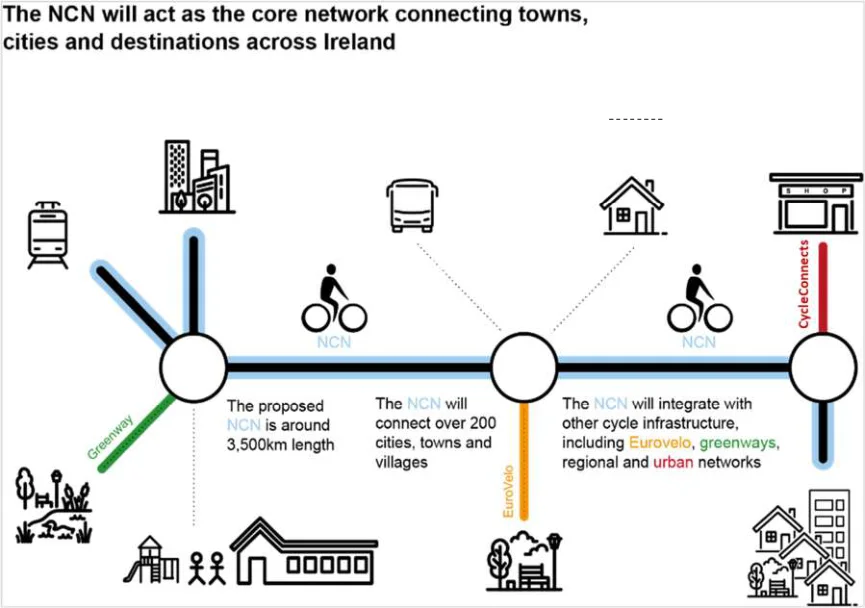
Figure 3.1: NCN as Core Cycle Network
National Cycle Network Plan
The NCN will help to facilitate Action 232 of CAP 2021, which specifically calls for the development of a coherent and connected NCN Plan, as well as Action TR23/30 of CAP 2023, which calls for the advance roll-out of national cycle networks.
3.2 NCN Plan Objectives
The NCN Plan has been developed in the context of a set of project objectives agreed by TII and key stakeholders including the DoT, NTA and CCMA.
The NCN Plan objectives, outlined in Table 3.1, are consistent with national and regional policy objectives.
Table 3.1: NCN Plan Objectives
| National policy | Policy Goal | NCN Plan Objective | |||||||
| Combat climate change & improve air quality (NPF, CAP, NIFTI, & RSES). | 1. Reduce emissions from transportation by supporting a modal shift from private vehicles to cycling and walking. | 1.1 | Increase the number of cycle trips by improving the provision of safe and attractive cycle infrastructure. | ||||||
| 1.2 | Enhance and protect local environments and biodiversity (e.g., pollinator plans, green corridors). | ||||||||
| Healthy living (NPF & SRTS). | 2. Encourage active travel for daily activities and recreation. | 2.1 | Connect to strategic destinations outside of urban areas as appropriate (including centres of education, centres of employment, and leisure destinations). | ||||||
| 2.2 | Support the development of cycling and walking culture in Ireland. | ||||||||
| Regional accessibility and economic development (NPF & RSES). | 3. Support connectivity and economic growth of regional urban areas of 5,000+ population as well as priority tourist destinations. | 3.1 | Connect identified urban areas of 5,000+ population and those urban areas listed in the NTA’s urban cycle network strategy. | ||||||
| 3.2 | Connect to strategic destinations outside of urban areas as appropriate (including transport hubs and tourist destinations), as appropriate. | ||||||||
| 3.3 | Integrate with existing and proposed cycle infrastructure (including greenways, safe routes to schools, the EuroVelo network, Interreg projects), as appropriate. | ||||||||
| 3.4 | Integrate with existing and proposed cycle infrastructure in Northern Ireland, as appropriate. | ||||||||
| Safety & accessibility (RSS & NPF & SRTS). | 4. Propose safe and accessible infrastructure that encourages modal shift and limits interactions with other vehicles. | 4.1 | Encourage use of off-road infrastructure, where appropriate. | ||||||
| 4.2 | Where efficient and effective, encourage routes that use ‘quiet’, low traffic volume roads. | ||||||||
| 4.3 | Promote the design of cycle infrastructure that is fully accessible to all users, regardless of age or ability. |
National Cycle Network Plan
| National policy | Policy Goal | NCN Plan Objective | |||||||
| 4.4 | Promote the design of cycle infrastructure that meets safety requirements. | ||||||||
| 4.5 | Promote the design of cycle infrastructure that provides a safe and secure environment for all users. | ||||||||
| Prudent use of public funds (PSC). | 5. Ensure appropriate balance between value for money and quality of outcome, in terms of potential impact on mode shift. | 5.1 | Propose corridors to maximise the number of users. | ||||||
| 5.2 | Incorporate existing greenways, disused railways, canals, bypassed national roads, regional and local roads, long distance trails, as appropriate. | ||||||||
| 5.3 | Maximise the use of publicly owned land, where possible. | ||||||||
| 5.4 | Provide a framework to support the targeted investment in associated active travel projects. | ||||||||
| 5.5 | Take lessons from best practice internationally in development of national cycle networks, particularly the UK and EU high-cycling countries. | ||||||||
| 5.6 | Future-proof cycle route capacity, taking account of population growth and additional demand from modal shift. |

Figure from page 34
Network Development

Figure from page 34
National Cycle Network Plan
Network Development
Development of the NCN corridors was based on an iterative process, summarised in Figure 4.1 and outlined in detail in this section.
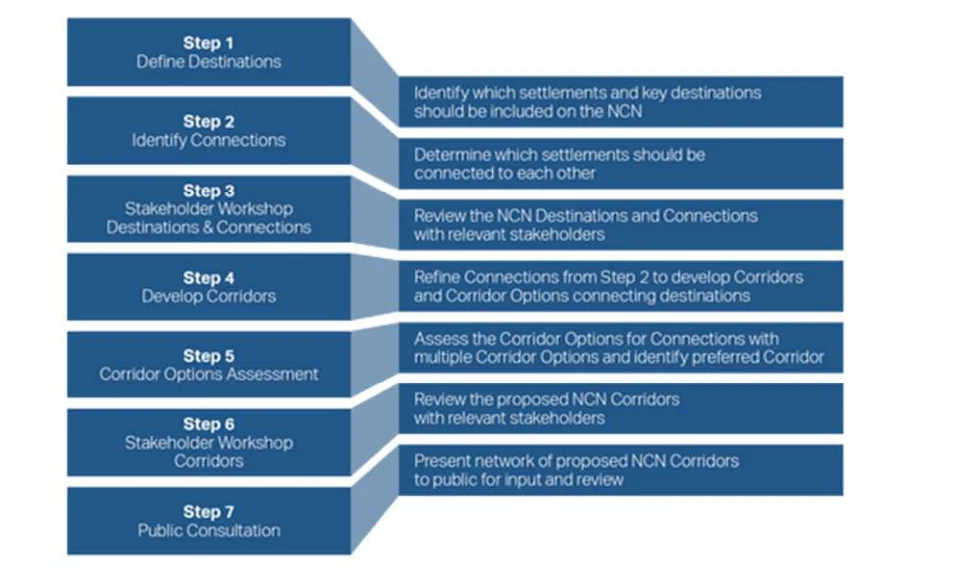
Figure 4.1: Summary of Network Development Process
Key assumptions that were central to defining the network were as follows:
Nodes are the towns, settlements or other key destinations which represent a start, end or layover point on the NCN. Three types of nodes were defined, as follows:
Primary node – Consisting of cities and / or large towns with a population of over 20,000 ─ people (towns with over 10,000 were also considered in areas which were more sparsely populated). These represent an NCN start or end point.
Secondary node – Consisting of medium sized towns with a population of between 10,000 ─ and 20,000 people (plus a selection of smaller towns in sparsely populated areas with populations of between 5,000 and 10,000). Major tourist attractions located outside urban areas were also included, and / or Major transport hubs. These represent an NCN start or end point.
Other nodes – Consisting of small towns and settlements, strategic destinations (e.g. transport ─ hubs, centres of education, centres of employment, leisure destinations, and tourist destinations).
Some exceptions to these classifications were made in areas that are remote and do not have the population threshold, to ensure an even and national spread of coverage.
Connections were defined as initial ‘straight line’ links between nodes. Following more detailed assessment of the opportunities presented by each link, a corridor between nodes was defined. Corridors are proposed only at an indicative level and provide a broad alignment within which there may be several potential routes. An options assessment exercise will be required to test the
National Cycle Network Plan
potential routes within a corridor against a series of criteria to define the preferred route. This options assessment exercise does not form part of the current project and will be undertaken as part of the roll out of the NCN.
An overview of each step in defining the NCN is presented in the following sections.
Step 1 – Define Destinations
Using the criteria outlined above, the key destinations for the NCN were identified, as outlined in Table 4.1 and Table 4.2.
Pages 24–36 · View in original PDF