1.3 and outlined in further detail in Table 1.2. The approach incorporated multiple elements to provide
Close and regular collaboration with stakeholders and a comprehensive public consultation.
Thorough assessment of existing and planned infrastructure.
Identification of potential environmental concerns and a full strategic environmental assessment.
Research on potential future user needs and behaviour.
International peer review and case studies.
A robust and tailored approach to network development and assessment.
As assessment of design standards and infrastructure requirement.
A monitoring framework.
Development of an implementation strategy.
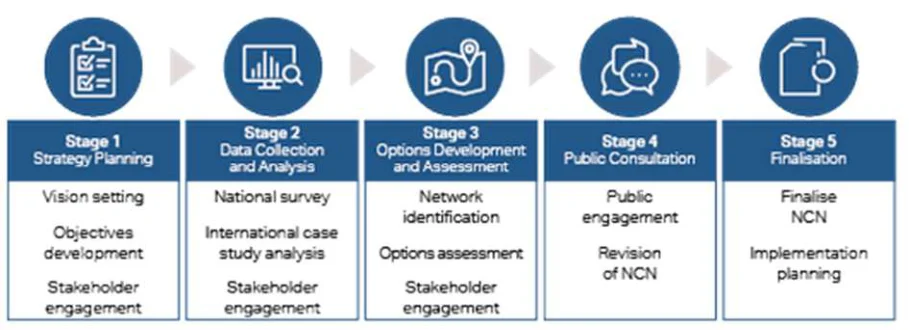
Figure 1.3: NCN Pan Development Process
National Cycle Network Plan
Table 1.2: NCN Plan Methodology
| Stage Overview | Key Tasks Undertaken | ||||
|---|---|---|---|---|---|
| Stage 1 – Strategy Planning Mobilisation of the project and agreement of approach through the development of the PEP (Project Execution Plan) and SMP (Stakeholder Management Plan) as well as commencement of critical tasks to delivery, such as the GIS dashboard and market research. The project vision and objectives were developed, and stakeholder engagement commenced. | Preparation of Project Execution Plan Development of project vision statement Development of project objectives Development of Project Logo and Collateral Preparation of Stakeholder Management Plan Market Research Development of NCN GIS Dashboard Strategic Environmental Assessment (SEA) and Appropriate Assessment (AA) Screening Initial engagement with stakeholders Stakeholder engagement | ||||
| Stage 2 – Data Collection and Analysis Analyses to inform the identification of the NCN corridors and development of an inventory of the existing and planned infrastructure. Investigation of international case studies and engagement. Market analysis including a nationally representative sample survey to define the criterion for development of the NCN. A detailed review of the network proposed in the 2010 NCN Scoping Report was also undertaken to investigate how it aligns with current objectives and requirements. | Inventory of the existing and planned cycle network Benchmarking of international case studies Identification of key destinations and attractions NCN Market Analysis Stakeholder engagement Review of 2010 NCN Scoping Study recommendations Development of assessment framework | ||||
| Stage 3 – Plan Development and Appraisal Entailed the identification and refinement of the proposed NCN corridors. The NCN Plan defines a set of corridors connecting Primary and Secondary nodes which combined make up the network. Stakeholders were engaged at key points to review work and provide feedback as the network was developed and assessed. | Policy and sustainability review Identification of NCN Corridors Stakeholder Engagement Design case studies Identification of implementation requirements Strategic Environmental Assessment (SEA) Appropriate Assessment (AA) | ||||
| Stage 4 – Public Consultation Public consultation was completed via an online website with widespread publicity and stakeholder engagement. The consultation period was open from 6th of May until the 7th of June 2022 after which an analysis of the feedback was undertaken. Feedback from both the public and stakeholders was then used to determine any amendments to the proposed plan. | Public consultation Stakeholder workshops Definition of monitoring framework Summary of feedback | ||||
| Stage 5 – Finalisation The draft NCN proposals were finalised based on the feedback received and an agreed approach to implementation and monitoring. | Preparation of Final NCN Plan |
National Cycle Network Plan
1.4Stakeholder and Public Engagement
Proactive and early engagement with stakeholders is a vital aspect of strategic transport planning and has a significant influence on the success of project delivery. The approach taken to stakeholder management in developing the NCN Plan was based on the five steps illustrated in Figure 1.4.
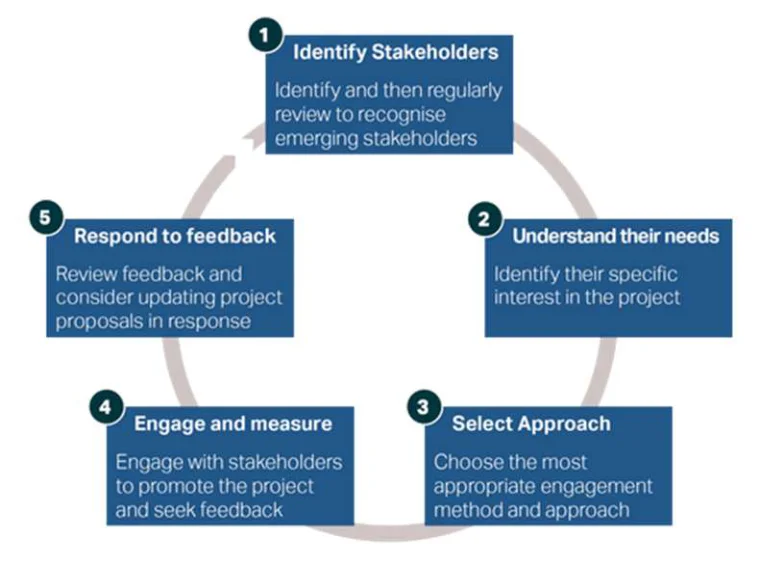
Figure 1.4: Approach to Stakeholder Engagement
Stakeholder Mapping
Stakeholder mapping incorporates steps one and two above. Following the identification of appropriate stakeholders, their respective needs were catalogued within a stakeholder register. Stakeholders were categorised as shown in Table 1.3 to reflect the different levels of engagement, as follows:
Delivery partners – These stakeholders will be instrumental in the development of the NCN through direct approval, funding, oversight and/or implementation. These stakeholders are included in the project governance structure and were engaged in monthly meetings.
Note: The Department of Transport was represented in both the Project Board and the Advisory Group. Due to its role in funding the NCN and developing various active travel policies, it was both the Project Approver and a Delivery Partner.
Engaged parties – These stakeholders had a specific role or interest in the development of cycling infrastructure and were critically important in developing the plan. Engagement commenced during the data collection phase of the project through stakeholder workshops and continued throughout the project. Engagement with this group initially focused on sharing approaches to project delivery and project objectives, as well as receiving data and information regarding existing and planned cycle and other relevant infrastructure from stakeholders. A series of workshops were also held during the network development phase of the project to solicit input and feedback at key stages (see Section 4, Network Development for further information regarding these workshops).
Interested parties – These stakeholders were identified as having an interest in the outcome of the NCN Plan and cycle infrastructure in Ireland more broadly. Engagement was primarily done during Stage 4 Public Consultation, via written notifications and submissions.
National Cycle Network Plan
General public – This group includes all other audiences who may be users of the infrastructure or have an interest in how the NCN will be delivered. Engagement with the public was focused on Stage 4 Public Consultation.
Pages 17–20 · View in original PDF