National Planning Framework
A range of non-transport focused policies and programmes are also vital to advancing the objectives of this Strategy and will also benefit significantly from its effective implementation. Many relate to spatial and land use planning and the support programmes that underpin their objectives – e.g., the National Planning Framework, regional and rural development policies and programmes, Local Authority Climate Action Plans, and parking measures. Fiscal policies are critical to achieving climate objectives and are particularly effective for transport. Wider polices in relation to education, health, accessibility and inclusion, along with support programmes for business, tourism, sports and leisure sectors will be both critical enablers for and beneficiaries of the objectives of this Strategy. The key policies and their relevance are set out below.
NPF implementation is hugely important for transport. Overall levels of transport demand and travel patterns are driven to a large extent by Government policy (national, regional and local) and settlement patterns. Low-density development and the dispersal of residential settlements, commercial zones, schools, and workplaces in peripheral areas, are major contributory factors to high levels of car dependency and the transport poverty that is experienced in some regions, posing a particular challenge for the decarbonisation of the sector.
Throughout the NPF, compact and sustainable growth is recognised as being a strategic economic objective that will aid in the reduction of private car travel and improve the ‘liveability’ and quality of life in urban places. Consolidation of development, instead of urban sprawl, is also important in creating value for money for the State in terms of investing in infrastructure.
National Planning Framework
Key to the success of sustainable and accessible mobility objectives is compact growth, better integrated land use, and planning that takes a transport-led approach to the development of housing and new settlements. As building communities predicated on car ownership is no longer sustainable, better integrated, transport-led planning will promote a modal shift towards public transport and empower people to move away from car dependency.
The revised NPF was approved by Government in April 2025. It emphasises the need for Transport- Oriented Development (ToD) by providing new sustainable communities at brownfield and greenfield locations along existing or planned high-capacity public transport corridors. The revised Framework will be critical in the context of meeting climate objectives and emphasising the intrinsic link between transport and spatial planning; particularly in the context of compact growth, demand management, transport orientated development and improved, people-centred urban centres. There has been close engagement between departments and relevant agencies on how this revision and its implementation can optimise outcomes from a transport and specifically a demand management perspective (see Recommendation 1 in Chapter 10).
The National Planning Framework (NPF) and the National Development Plan (NDP) combine to form Project Ireland 2040. The NPF sets the Government’s vision and strategy for the development of Ireland to 2040, while the NDP provides the supporting capital investment plan for the period. Project Ireland 2040 supports sustainable mobility objectives through certain strategic outcomes not least the following: Compact Growth; Enhanced Regional Accessibility; Strengthened Rural Economies; Sustainable Mobility; and Transition to a Low Carbon and Climate Resilient Society. Like this Strategy, wellbeing, equality, and opportunity represent the core, and interdependent themes of Project Ireland 2040 (PI 2040).
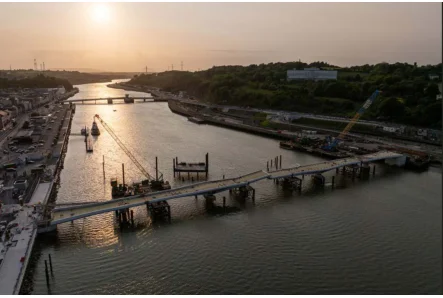
Figure from page 46
The NPF, which was revised in 2025, is at the apex of strategic planning in Ireland and establishes the overall national planning policy strategy, with which other planning policy at the national level is aligned.
Page 46 · View in original PDF