Educational Sector
further in the report of the Fiscal Measures sub-group with various recommendations set out in the report and synthesised in a number of recommendations in Chapter 10, notably Recommendation 2. Any proposals of a fiscal nature that may emerge from these recommendations in the future will be informed by social, economic and distributional analysis and will ultimately be the subject of Government decision.
of Education and Youth (DEY), is transporting over 181,000 children, including over 24,400 children with special educational needs, to and from primary and post-primary schools every day. This also includes for school transport scheme services which are being provided in the current school year to over 5,800 children who have arrived in Ireland from Ukraine. Under the Scheme, 100 million sustainable kilometres are travelled per year – the equivalent to 2,500 journeys around the world. The total cost of the scheme in 2025 was €537m.
Educational Sector
Except for 2020, due mainly to the impact of the pandemic, there has been an ever-increasing demand for the service. A Review of the School Transport Scheme ‘School Transport 2030’, which was recently completed, marks the largest review of the School Transport Scheme since it was established in 1967. The review encompassed the School Transport Scheme for Children with Special Educational Needs as well as the Primary and Post-Primary School Transport Schemes. It considered how each element of the schemes currently operate, having regard to eligibility criteria, trends, costs, availability of drivers, and overall effectiveness in meeting key objectives.
Education is a significant driver of transport demand in Ireland. It also presents a significant opportunity to effect behavioural change and establish sustainable travel habits among young people from Early Learning and Care to third level. The school journey also presents an ideal way for children to take part in regular physical activity, to interact with their peers, and to develop good road sense as pedestrians and cyclists. Active modes also help to improve children’s alertness.
However, as things stand, the provision of educational services generate a significant number of trips across the country every day – with journeys to education accounting for 19% of daily trips (NHTS: 2024). One of the key metrics in CAP23 for delivering abatement in the transport sector is to shift 30% of all Escort to Education car journeys to more sustainable modes (public transport or active travel, either accompanied or unaccompanied).
The review was conducted for the purpose of examining the broader effectiveness and sustainability of the Scheme, ensuring that it serves the students and their families adequately. The review built upon commitments on school transport within the Programme for Government, including examining options to reduce car journeys and assessing how the School Transport Scheme can work in liaison with the Safe Routes to Schools Programme. The review has also examined the potential for integrating different strands of the scheme and a more co-ordinated approach with other Government Departments that also use transport services.
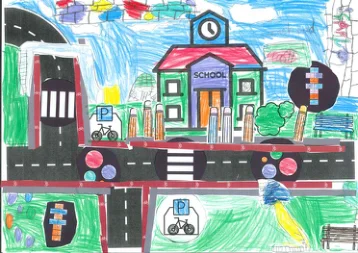
Figure from page 53
In relation to the Green Schools Programme, the Travel theme is funded by the Department of Transport, and is run by An Taisce, supported by the National Transport Authority. As part of this Programme, participating schools create action plans and set travel targets, with the ultimate aim of increasing the number of pupils walking, cycling, scooting, carpooling, using public transport or using park ‘n’ stride instead of the private car on the school run. The Green-Schools Travel Programme was rolled out nationally in September 2008 and has worked, or is working with schools
Safe Travel to School: A Child’s Perspective
Key enablers of sustainable mobility at school level are the School Transport Scheme, the Green Schools Programme (specifically the Travel theme), the Safe Routes to School Programme and the National Strategy on Education for Sustainable Development – ESD to 2030. In the current year, the School Transport Scheme, which is operated by Bus Éireann (BÉ) on behalf of the Department
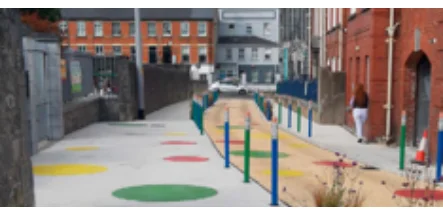
Figure from page 54
around the country to promote sustainable travel to school. 336 schools participated in the Green Schools Travel programme in 2025. Cycle parking was provided at 44 schools in 2025, and scooter parking was provided at 16 schools. The Safe Routes to School Programme (SRTS), which was launched in March 2021, is supported by the NTA and the Departments of Education and Youth. The SRTS is designed to encourage pupils and students in primary and post-primary schools to walk and cycle. It has three aims:
An Mhodhscoil after the School Street was introduced.
The Guidance also clarifies the difference between School Streets and School Zones and includes consultation and design recommendations.
ᴏ To accelerate the delivery of walking/scooting and cycling infrastructure on key access routes to schools.
The SRTS Programme, combined with investment in active travel infrastructure, has the potential to embed healthy travel behaviours at an early age. Consequently, over the period 2020 – 2024, significant progress has been made on delivering active travel infrastructure, including 664 kilometres of walking infrastructure, 399 kilometres of cycling infrastructure and 291 kilometres of greenways. Approximately 200km of additional walking and cycling infrastructure were added to the network in 2025 through the NTA’s Active and Sustainable Transport Investment Programme and TII’s National Greenways Programme.
ᴏ To provide “front of school” treatments which will enhance access to school grounds.
ᴏ To expand the amount of bike parking available at schools.
The aforementioned Active Travel Programme also funds projects under the SRTS Programme. Schools which applied to the Programme in 2021 are being selected in tranches for inclusion in the Programme. Over 900 schools applied, and following the announcement of Round 4 in December 2025, over 500 of these schools are now active in the Programme including 156 which have had projects completed. School Streets is also part of the SRTS – an initiative that restricts general traffic outside schools during drop-off and pick-up times. In the right location, School Streets can help address a range of issues associated with vehicle congestion at the school gate.
As well as the beneficial impacts of sustainable mobility on school-going children and third level students, the education sector, in conjunction with the local planning authorities, has a considerable role to play in reducing unsustainable transport demand through the provision of effective mobility management plans for schools and third level institutions and building programmes that locate or develop existing schools and institutions in a way that restrains, not accelerates transport demand, such as the development of student specific accommodation – thus negating the need for travel.
In September 2025, the NTA published School Streets Guidance which outlines how to plan, trial, and implement School Streets, with case studies from several Irish local authorities. The following shows the before and after effects of a School Streets initiative at An Mhodhscoil, Limerick City.
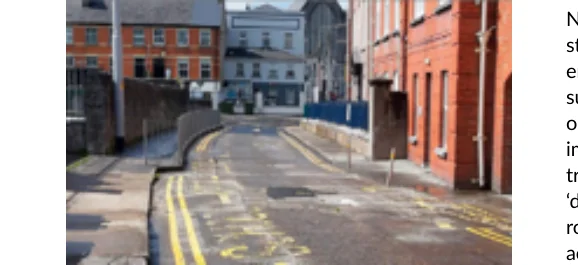
Figure from page 54
Noting that approximately 50% of third level students commute over 5km to college, localised engagement to ensure the effectiveness of sustainable transport links between transport operators and universities continues to be an important measure for negating unsustainable transport demands from students. In addition, ‘digs’ accommodation through the rent-aroom scheme and private student specific accommodation are a sustainable and important element of the student accommodation supply.
The front of school environment at An Mhodhscoil, Limerick City before a School Street was implemented.
Pages 53–54 · View in original PDF