Accessibility and Inclusion
The Generators of Demand (People) considered many of the relevant policies in place across the business, enterprise, retail and tourism sectors and identified a series of measures that could impact positively from a demand management perspective. These are set out in the separate report, summarised in Chapter 9 and synthesised in a number of key recommendations in Chapter 10.
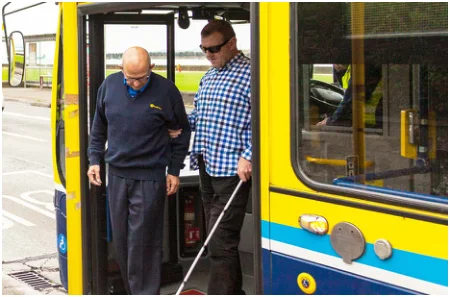
Figure from page 58
Sports Sector
Dublin Bus Independent Travel Support
Nearly half of adults in Ireland regularly participate in a sport and it is a goal of the National Sports Policy 2018-2027 to increase participation further. Also, over half of the population are regularly involved socially in sport through volunteering, club membership and/or attendance. Naturally, this level of participation does give rise to significant transport activity. Many national governing bodies, as part of their responsibilities around sustainability, are already taking steps to encourage employees, players, and fans to take more sustainable and active journeys. For example, the GAA’s Green Club Programme, which was established in December 2022, aims to promote sustainability awareness and to support Gaelic Games clubs and communities in taking simple and effective sustainability action in their grounds and activities. The Programme is structured around a range of themes including Travel & Transport. Other initiatives include communications campaigns like the ‘Munster March’. This campaign, which was launched at the end of 2023, encouraged Munster supporters of all ages to walk the one mile from Limerick City Centre to Thomond Park to help raise awareness of the club’s commitment to environmental sustainability and climate action.
can fully participate in public and community life, while inclusion means that everyone has the opportunity to realise that accessibility.
The NPF also acknowledges that ‘liveability’ or quality of life is key to attracting people to live within compact cities, towns and villages.
In this regard ‘place-making’ is central to the implementation of both the TCF policy and the Government’s new housing action plan Delivering Homes, Building Communities, 2025. For places to be successful, they need to be well connected, ensuring all users can move about with ease by incorporating the principles of Universal Design22 and providing attractive spaces in which people can meet, shop, work and exercise.
Universal Design is the design and composition of an environment so that it can be accessed, understood and used to the greatest extent possible by all people, regardless of their age, size or disability. This includes public places in the built environment such as buildings, streets or spaces that the public have access to; products and services provided in those places; and systems that are available including information and communications technology (ICT). The Centre for Excellence in Universal Design is a state funded centre dedicated to promoting Universal Design with a wide range of design guidance information available on their website.
Sports Action Plan 2024 - 2027 acknowledges that the sport sector must progressively move ever closer towards carbon neutrality in the years ahead. As such, it sets out a range of actions that will support and guide the sport sector to achieving these ambitious goals. The aim of this Strategy is to build on best practice across this sector and to replicate learnings to encourage a consistent message from this highly influential sector.
The implementation of these principles is a critical success factor for sustainable mobility, creating ‘people centered’ rather than ‘car-centered’ communities.
Accessibility and Inclusion
It is anticipated that this Government’s new Towns and Cities Fund, which is replacing the Urban Regeneration Development Fund (URDF),
From the perspective of mobility, accessibility is about ensuring that the transport system and local environment is designed so that everyone
22 https://universaldesign.ie/about-universal-design/the-7-principles
will realise the objective for well-designed public realms, with the close alignment of planning and investment reflected in a range of projects to support more compact and sustainable development in Ireland’s five cities and other large towns. High levels of accessibility require the creation of street networks (including paths through open spaces or between buildings) that are permeable, allowing users to move through an area directly and via many different routes. This is particularly important for disabled people and the elderly. Similar investment is provided to smaller urban centres, with a population of less than 10,000, through the Rural Regeneration and Development Fund (RRDF).
documents which should be utilised in design to ensure that the infrastructure is designed in an accessible and equitable way.
The quality of the journey undertaken is also important. Street environments that feel safe and comfortable and are free of impediments are critical to promoting increased pedestrian and cyclist activity, as well as increasing accessibility for disabled people, particularly those with visual impairments or sensory issues. DMURS highlights how in recent decades the prioritisation of private vehicle movement in most Irish towns has resulted in a legacy of street environments that are hostile to pedestrians, and make journeys challenging for older people, children, and women in particular.
The National Human Rights Strategy for Disabled People 2025-2030 is the most recent framework for policy and action to address the needs of people with disabilities and the key vehicle for progressing the implementation of the United Nations Convention on The Rights of Persons with Disabilities (UNCRPD). The Programme for Government 2025 placed a strong emphasis on launching this new National Disability Strategy, which outlines a forward-looking vision through to 2030. It embraces a whole-of-Government approach to advancing the implementation of the United Nations Convention on the Rights of Persons with Disabilities. Responsibility for delivering the Strategy’s commitments is shared across Government Departments and State Agencies, each accountable for actions within their remit. These commitments are structured around five central Pillars: Inclusive Learning and Education, Employment, Independent Living and Active Participation in Society, Wellbeing and Health, and Transport and Mobility.
The Department of Transport has three actions in the Domestic, Sexual and Gender Based Violence (DSGBV) Implementation Plan 2024 reflecting those actions of relevance in the SMP.
This Strategy looks to reinforce accessibility and inclusion principles within the existing transport system and service environment.
Safety is also a key determinant of whether or not people use public transportation. The study ‘Travelling in a Woman’s Shoes’ was designed to investigate the needs and travel behaviours of women. Transport is often seen as gender neutral:, however a growing body of international research is showing that this is often not the case. Women rely heavily on their cars. Women tend to have more caring responsibilities and are more impacted by safety issues. As such, men and women can have different needs, constraints, and expectations for using transport. This Strategy has been considered through a gender lens, ensuring recommendations have taken all genders into account from a social inclusion and accessibility perspective.
Informed by the UNCRPD and national policies on disability, the Design Manual for Urban Roads and Streets (DMURS) requires that new streets networks be designed to be permeable and legible, in particular for sustainable modes. Guidance on improving accessibility, and retrofitting existing environments, is also assisted through the NTA’s Permeability Best Practice Guide and Walkability Toolkit and through the Infrastructure Equality Guidance, which are intended for use on all active travel schemes funded by the NTA. This latter set of guidance, which was published in May 2024, presents a number of common design issues to be aware of when designing or upgrading an active travel scheme and outlines the different guidance
Older persons and particularly older women can face additional barriers in accessing suitable transport, with the ‘Reframing Ageing’ study published by Age Action identifying that nearly 50% of women aged 65+ and 28% of men aged 65+ in rural areas report ‘unmet’ transport needs.
This can have compounding health impacts and lead to social and political exclusion. The inclusivity of our transport system for older persons is considered within the Strategy and its Implementation Plan.
Pages 58–59 · View in original PDF