Ambition
Ambition
For the transport sector, this translates to a cut of 50% in transport emissions (relative to 2018 levels) or 6 Mt CO2 equivalent by 2030. To achieve this target, Government is prioritising a large-scale transition to Electric Vehicles (EVs) through generous and targeted incentives, higher penetration levels of biofuels in the fuel mix through regulation and increased modal shift towards more sustainable journeys through unprecedented investment and improvements in active and public transport infrastructure and services. Effectively, these represent ‘supply’ side measures – supplying more sustainable alternatives such as walking, cycling and public transport as well as the use of EVs.
The Programme for Government (PfG) 2025 commits to investing in a diverse range of transport options, with the aim of enhancing connectivity across urban and rural areas, giving people more choice and supporting sustainable growth which will also address congestion, improve air quality, reduce noise, and enhance the attractiveness and accessibility of cities, neighbourhoods and town centres. The new PfG also commits to identifying, researching and coordinating delivery of behavioural change initiatives to support modal shift and reduce congestion and improve travel options, focusing on wider societal benefits of the change. Aligned to this ambition are the Government’s climate goals, which were most recently restated through the Climate Action Plan 2025.
However, supply side measures alone will not deliver the emissions abatement required for the transport sector as they do not address the projected increases in travel demand over the intervening years, linked to population and economic growth. This means that there is a gapto-target and more needs to be done. To fully address the environmental, economic and social costs of transport inefficiency and congestion, a balance must be struck between supply and demand-led measures. While the latter will be vital to bridging the ’gap-to-target’ and to addressing those wider social and economic issues, it is acknowledged that the effectiveness of such measures will remain largely dependent on the availability of supply-side alternatives.
However, it is the Climate Action and Low-Carbon Development (Amendment) Act 2021 which sets out Ireland’s legally binding emissions reduction targets, along with a carbon budget programme and sectoral ceilings that are consistent with achieving a 51% reduction in emissions by 2030 and a net-zero position by 2050. The new Government has reaffirmed its commitment to achieving the targets set in the Climate Action Plan.
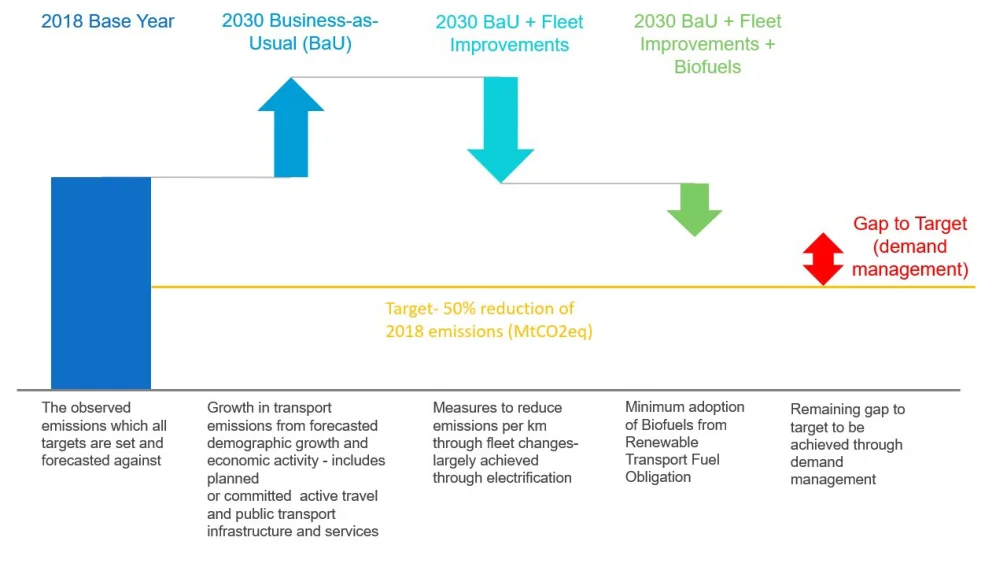
Figure 1: Gap-to-Target
Page 17 · View in original PDF