Implementation Plan
Figure from page 160
Appendix 3 Implementation Plan
| Strengthened Implementation of Demand Management across National Planning System | ||||||
|---|---|---|---|---|---|---|
| No. | Action | A-S-I Framework | Lead | Support | Timeline | Output/Outcome |
| 1 | Strengthen policy alignment and implementation mechanisms to deliver NPF National Strategic Outcome 1 ‘Compact Growth’ and NSO 4 ‘Sustainable Mobility’ given the critical role of compact growth in reducing travel demand and in enhancing transport system efficiencies. | |||||
| 1a | Identify and embed revised NPF transport priorities as part of RSES and MATS updates. | Avoid | RAs, NTA | LAs | RSES Q2 2028 MATS Q2 2029 | Transport planning investment priorities incorporated, as required, into the statutory Regional Spatial and Economic Strategies and Metropolitan Area Strategic Plans. |
| 1b | Enhance implementation mechanisms to deliver transport planning priorities in line with revised NPF (NPO 10, 97 and 99). | Avoid | DHLGH | DoT | Q2 2026 | Enhanced mechanisms identified to support NPF implementation, with timelines for introduction. |
| 1c | Extend NTA statutory arrangements for spatial and transport planning in the Greater Dublin Area to other cities for Metropolitan Area Transport Strategies in line with revised NPF. | Avoid | DoT | DHLGH, NTA, RAs | Q2 2027 | NTA remit extended with efef ct that plans will be on a statutory footing. |
| 1d | Establish advisory arrangements to assist delivery of these actions. | Avoid | DHLGH, DoT | NTA, TII, LDA | Q3 2026 | Advisory arrangements identified. |
| Embedding Polluter Pays Principle in Taxation Policy over Medium to Long Term | ||||||
|---|---|---|---|---|---|---|
| No. | Action | A-S-I Framework | Lead | Support | Timeline | Output/Outcome |
| 2 | Identify a pathway for the development of a cohesive, equitable and future-proofed taxation approach on transport based on a ‘user and polluter pays’ principle. |
Review the current range of taxes and charges applying to transport (VRT, motor tax, excise, carbon tax, tolls and VAT etc).
2a
Avoid TII, NTA Q2 2027
Consider learnings and potential next steps on the implementation of a national road user charging model taking account of latest international practice.
Avoid & Shift NTA,
2b
Q2 2027 DoF
| Empowering and Supporting Local Authorities | ||||||
|---|---|---|---|---|---|---|
| No. | Action | A-S-I Framework | Lead | Support | Timeline | Output/Outcome |
| 3 | Develop Demand Management strategies at Local Authority (LA) level taking account of the delivery of sustainable mobility alternatives. | |||||
| 3a | Develop local DM strategies in line with guidance provided by DoT/ NTA (see Recommendation 4) that facilitate compact growth targets outlined in the NPF and the Regional Spatial and Economic Strategies. | Avoid | RAs, LAs, NTA, TII | DoT | Q3 2027 | LA Strategies developed as part of wider transport planning processes and DoT/NTA guidance. Strategies should encourage innovation through use of technology and AI and be disability-proofed, and consider potential impacts on gender, neurodiverse people and marginalised groups. |
| 4 | Prepare guidance and develop modelling and other supports for LAs on the development of tailored Demand Management strategies, starting with cities outside GDA and major urban towns. | |||||
| Using the NTA’s Demand Guidance provided to LAs Management (DM) Scheme for to inform approach, emphasising 4a the GDA as a template, prepare Avoid NTA DoT Q4 2026 need for cocreation/decision- guidance and rollout supports for making at local level including the local authorities. elected representatives. | ||||||
| Develop other supports for LAs including existing transport Supports in place including 4b modelling tools to assist in the Avoid NTA DoT Q4 2026 models for application at local preparation of Local Area Demand level. Management Schemes. | ||||||
| 5 | Update national guidelines and standards in support of demand management measures and strengthen supporting oversight and co-ordination structures. | |||||
| 5a | The co-ordination and implementation of demand management measures will be supported through the existing National Guidelines and Standards Group with the aim of revisiting and prioritising space for transport modes that are less carbon and space intensive; as well as for reallocation of destinations to promote proximity. | Avoid & Shift | DoT, NTA, TII, DHLGH | LAs | Q3 2026 | DMURS Advice Note developed in relation to re-allocating street space, having regard to international best practice including the principles of Universal Design. Consistency required across other relevant documents including NTA’s Cycle Design Manual, Rapid Build Document, DoT statutory Section 38 Guidelines, Infrastructure Equality Guidance and other relevant DoT and TII standards. |
| No. | Action | A-S-I Framework | Lead | Support | Timeline | Output/Outcome |
|---|---|---|---|---|---|---|
| 6 | Enable LAs to prioritise and deliver demand management through greater integration, collaboration and the establishment of multidisciplinary teams. | |||||
| Agree model and approach for the creation of multidisciplinary teams DoT, that can support planning, Avoid, Shift & SMP Leadership DHLGH, 6a Q3 2026 Model and approach agreed. sustainable mobility, active Improve Group NTA, TII, travel, shared mobility, demand CCMA management and provision of infrastructure for EVs. | ||||||
| Protocols established by LAs to ensure those working on sustainable mobility projects Consultation at broadest level Avoid, Shift & NTA, 6b DoT Q4 2026 in LAs are consulted with undertaken within LAs. Improve DHLGH in respect to local area and transport plans as well as planning applications. | ||||||
| 7 | Incorporate demand management principles into Active Travel Schemes while assuring alignment with sustainable accessibility and road safety requirements. | |||||
| 7a | Ensure funding criteria for AT schemes optimises their demand management potential, while ensuring alignment with sustainable accessibility and road safety requirements. Update associated guidelines where relevant (see Recommendations 6 and 7). | Avoid | DoT, NTA | RSA | Q2 2026 | Funding criteria reviewed and adjusted where appropriate - including any associated guidance. |
| No. | Action | A-S-I Framework | Lead | Support | Timeline | Output/Outcome |
|---|---|---|---|---|---|---|
| 8 | Communications and engagement support for LAs. | |||||
| Expand and improve NTA, D/ Public engagement pilot community engagement Sport, Sport 8a Avoid & Shift DoT Q3 2026 initiatives developed and activities based on good Ireland, An learnings disseminated. practice and pilot learnings. Taisce, LAs | ||||||
| Sustainable Mobility Academy Develop evidence-based platof rm enhanced to guidance for LA s and others support knowledge sharing, LGMA, to engage efef ctively with networking opportunities and 8b Avoid & Shift DoT, NTA, TII CAROs, Q4 2026 communities in pre and post dissemination of best-practice LAs scheme development, through consultation and engagement Sustainable Mobility Academy. toolkits (including database of best-in-class Irish projects). | ||||||
| Develop training and accreditation programme for Long term training and LAs, including councillors, in development model developed 8c relation to DM approaches, Avoid & Shift DoT, NTA / Q4 2026 to include short, on-demand based on SMP Smart and training modules, site visits etc. Sustainable Accelerator Pathfinder. | ||||||
| Develop a long-term strategy All and implementation plan Long-term strategy and 8d Avoid & Shift DoT, NTA, TII transport Q3 2026 for the Sustainable Mobility implementation plan in place. bodies Academy. | ||||||
| 9 | Supplement, through alternative financing options, existing supports from national Government. | |||||
| 9a | Explore broader financing options for LAs including EU funding supports for DM related measures. | Avoid, Shift & Improve | CCMA, RAs | LAs, NTA, TII, LGMA, New Era, DoF | Q4 2026 | Potential non-Exchequer financing options identified and guidance disseminated to LAs. |
| Driving Efficiency in Freight Sector | ||||||
| No. | Action | A-S-I Framework | Lead | Support | Timeline | Output/Outcome |
| 10 | Continue to enhance rail freight capacity and explore potential for future growth in the sector. |
Increase freight capacity on 10a Avoid & Shift DoT Q4 2027 existing rail lines.
Explore opportunities for 10b growing rail freight services on new railway lines.
Avoid & Shift NTA, DoT Q4 2028
| No. | Action | A-S-I Framework | Lead | Support | Timeline | Output/Outcome |
|---|---|---|---|---|---|---|
| 11 | Develop Sustainable Freight Distribution Strategies for 5 Cities. |
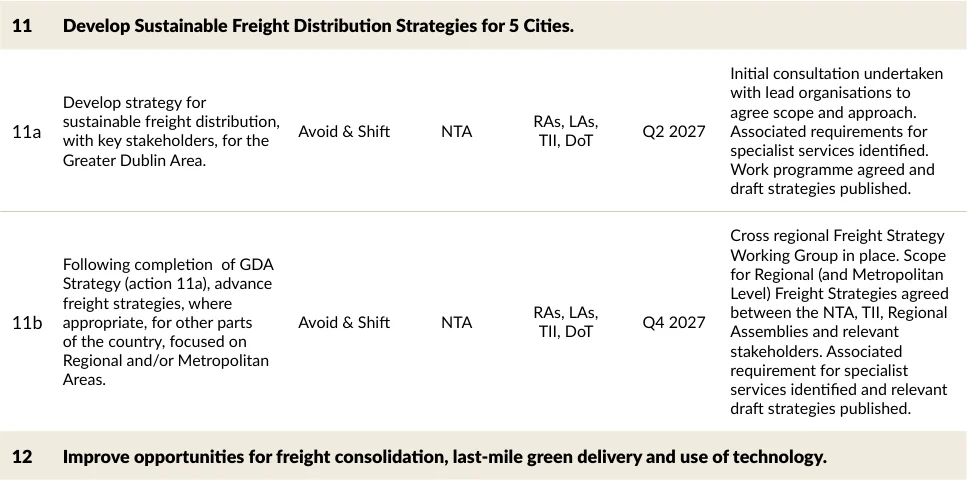
Figure from page 166
Develop strategy for sustainable freight distribution, with key stakeholders, for the Greater Dublin Area.
RAs, LAs, Avoid & Shift
11a
Q2 2027 TII, DoT
Following completion of GDA Strategy (action 11a), advance freight strategies, where appropriate, for other parts of the country, focused on Regional and/or Metropolitan Areas.
RAs, LAs, Avoid & Shift
11b
Q4 2027 TII, DoT

Figure from page 166
Work with key stakeholders to explore opportunities and collaborate on freight efficiency proposals.
NTA, CCMA, DETE, LAs, Industry, TII
Avoid, Shift &
12a
Q4 2026
Improve
Consider the role and operational model for multimodal logistics hubs in an Irish context.
Industry, Avoid & Shift
12b
Q4 2026 TII, LAs
| Strengthening Supply Side Measures to Complement Demand Management | ||||||
|---|---|---|---|---|---|---|
| No. | Action | A-S-I Framework | Lead | Support | Timeline | Output/Outcome |
| 13 | Develop further ‘supply side’ measures, particularly shared mobility interventions, to augment sustainable mobility alternatives in next iteration of SMP Action Plan. | |||||
| Working with delivery partners, implement additional measures to support captive SMP Action Plan 2026-2030 car users, further supporting Shift & DoT, NTA, TII, approved, reflecting relevant 13a the objectives of the SMP. / Q1 2026 Improve LAs measures identified in this This should include, inter alia, Strategy. the roll-out and scaling up of shared mobility/mobility hubs at a national level. | ||||||
| 14 | Review existing incentives for encouraging uptake of EVs, with a focus on targeted supports for Captive Car Usages. | |||||
| Identify incentives to support Suitable incentives to switch EV transition in areas/amongst DoF, TII, to zero-emissions vehicles 14a particular cohorts where Improve DoT, ZEVI Q3 2026 NTA agreed as part Budgetary sustainable alternatives not process. readily available. | ||||||
| Additional incentives in Identify additional supports place for HDV transition in DoF, TII, 14b for zero emission transition in Improve DoT, ZEVI Q3 2026 line with AFIR obligations NTA HDVs. and Road Haulage Strategy commitments. | ||||||
| 15 | Continue to evolve opportunities for flexible and remote working and digitalisation. | |||||
| 15a | Review latest data, research and supports for remote working and digitalisation. | Avoid | DETE, DPER | / | Q3 2026 | Further evolve supports if/ where needed and lead by example by providing a toolkit for Department/ Offices to evaluate blended working in their organisations and adhere to the ’Digital and Innovation at Scale commitments in Better Public Services’, and the ’Public Service Transformation Strategy’. |
| 16 | Encourage greater utilisation of remote working from hubs. |
Encourage remote working 16a Avoid & Shift from hubs.
/ Q2 2026
| Providing Enabling Legislation to Support Appropriate Measures | ||||||
|---|---|---|---|---|---|---|
| No. | Action | A-S-I Framework | Lead | Support | Timeline | Output/Outcome |
| 17 | Review relevant legislation to ensure powers are sufficient to bring forward demand management measures. | |||||
| Undertake mapping of demand Mapping complete and management-type measures actions identified. This identified in the strategy will provide a pathway LAs, TII, 17a and assess whether existing Avoid DoT, DCEE Q4 2026 towards developing a robust NTA legislation provides sufficient legislative framework for powers to LAs, agencies and the delivery of demand relevant Ministers. management measures. | ||||||
| Embedding Demand Management Principles and Practices Across Public Sector | ||||||
| No. | Action | A-S-I Framework | Lead | Support | Timeline | Output/Outcome |
| 18 | Embed demand management principles across all relevant Government funding programmes. | |||||
| Review undertaken of policies and programmes Undertake a review to identify with increased attention to Government policies and travel impacts, recognising funding programmes that All depts/ the need to encourage 18a inadvertently generate travel Avoid DoT Q4 2026 agencies sustainable travel, where demand and identify potential options are available and opportunities to mitigate their working in collaboration with impacts. organisations in receipt of funding. Through mechanisms such as the Climate Action Public Sector Mandate and School Guidance and other levers Sector Climate Action All depts/ developed to support public 18b Mandate, support action Avoid DCEE, DoT Q4 2026 agencies sector bodies taking action to that seeks to mitigate travel address travel demand. generating activities in key sectors (e.g. sports, education, business, tourism). | ||||||
| 19 | Reduce transport demand created by public sector services. |
All public sector bodies with more than 100 employees will be required to engage with the Smarter Travel Programme within one year of the publication of the Strategy.
19a
Avoid DCEE Q4 2026
| No. | Action | A-S-I Framework | Lead | Support | Timeline | Output/Outcome |
|---|---|---|---|---|---|---|
| Commence process to incorporate carbon Methodology developed recognition for non-PS target 19b Avoid & Shift SEAI, NTA DoT, DCEE Q4 2026 and applied to public sector attributable transport related bodies. emissions into the SEAI’s M&R system. | ||||||
| 20 | Leverage potential of Civil Service Motor Travel Rates to efef ct change, including the introduction of single rate for all cars regardless of engine type. | |||||
| Introduce a single rate for all Avoid, Shift & Options brought to 20a DPER DoT Q4 2026 cars regardless of engine type. Improve Government. | ||||||
| Examine role of CS Motor Travel Rates system in Options brought to 20b providing higher rates for Avoid & Shift DPER DoT Q4 2026 Government. greater annual distances travelled. | ||||||
| Engaging with education and sports sector to embed demand management principles and practices | ||||||
| 21 | By sharing good practice, third level institutions will lead on reducing private car journeys to and from campus through climate action strategies and Green Campus Programme. |
Increasing the supply of purpose-built student accommodation and digs accommodation in the vicinity of HEIs will reduce travel demand. Students, living on or near campus means shorter, more sustainable journeys by walking or cycling, which also supports wellbeing and campus engagement. At a broader level, increasing student accommodation supply can help create a more balanced and efficient use of transport infrastructure.
Increase the supply of student 21a Avoid DFHERIS HEA, HEIs Q4 2030 accommodation.
Encourage HEIs to make progress in reducing car travel demand and monitor progress in this regard.
Monitoring mechanism to be developed which would be published to track progress.
21b
Shift DoT, NTA DFHERIS Q4 2026
| No. | Action | A-S-I Framework | Lead | Support | Timeline | Output/Outcome |
|---|---|---|---|---|---|---|
| 22 | Increase sustainable mobility supports for primary and secondary school-going children. |
Evaluation of pilots to guide the planning and implementation needed for a national rollout of a revised School Transport Scheme. Implementation of the recommendations will continue to be planned subject to resources being available to meet the increased demand from 22b.
Advance integration of school 22a transport scheme with public transport services.
Shift DEY NTA, DoT Q2 2026
Access to the School Transport Scheme will be expanded so that an additional 100,000 pupils can be carried by 2030 (162,000 to 262,000) relative to 2024.
Support measures to expand 22b the School Transport Scheme (STS).
Shift DoT, DEY / Q4 2030
Building on the School Streets Guidance, which was published in 2025, engage with local authorities to design and implement School Streets as part of the Safe Routes to School Programme.
Doubling the number of School Streets (including trials).
22c
Avoid & Shift NTA DoT, DEY Q4 2027
| No. | Action | A-S-I Framework | Lead | Support | Timeline | Output/Outcome |
|---|---|---|---|---|---|---|
| 23 | Sporting organisations will encourage less car travel to sports fixtures and training sessions in collaboration with local communities. | |||||
| Existing or new transport toolkits expanded to guide the sports sectors in helping to reduce demand, particularly single occupancy car travel, Building on the model of through specific strategies the Green Club Programme, Sport Ireland, for reducing their transport develop toolkit for sports Sporting emissions - for example, 23a Avoid & Shift DCCS Q1 2027 sector to embed demand Orgs, DoT, available local measures such management principles and NTA, as fixtures scheduling, car park support sustainable mobility. reduction, provision of public transport shuttle services, location of sports grounds, encouragement of carpooling, private bus hire sharing of best practice etc. | ||||||
| Strategies in place from national governing sports bodies for reducing their transport emissions through, for example, available local measures such All national governing Sport Ireland, as fixtures scheduling, car park bodies to develop strategies, Sporting 23b Avoid & Shift DCCS Q1 2028 reduction, provision of public supported by toolkits (action Orgs, DoT transport shuttle services, 23a). NTA location of sports grounds, encouragement of car-pooling, private bus hire, sharing of best practice etc, akin to NTA’s Smarter Travel Programme. | ||||||
| Monitor, measure, share and Progress shared across sporting recognise performance to bodies, particularly recognition 23c reduce transport demand Avoid & Shift DoT DCCS Q1 2028 of efof rts to achieve the best generated from sports related practice. activities. | ||||||
| Engaging with business sector to embed demand management principles and practices | ||||||
| 24 | Strengthening focus on transport/mobility related dimensions of corporate sustainability requirements. |
Working Group in place involving the retail sector and other relevant stakeholders to support this recommendation through existing engagement structures.
Examine and support recommendations on how logistics models can be modified to alleviate congestion at peak times.
NTA, DETE, Avoid & Shift
Business with Q4 2026 +250 employees
24a
DoT
Companies encouraged to seek accreditation for Smarter Travel efforts to demonstrate commitment to sustainable mobility e.g. Smarter Travel Mark.
Increased take up by relevant companies of NTA Smarter Travel Mark.
24b
Shift NTA DETE Q4 2026
Review the Climate Toolkit 4 24c Business to better account for the commute to work.
DETE, NTA, Avoid & Shift DETE
Toolkit update if and as Q3 2026 DoT required.
Options identified for disincentivising workplace parking as part of DOF/DOT Working Group (established under Rec 2).
Develop options to address 24d subsidies and incentives for workplace parking.
Avoid DoT DoF Q3 2026
| No. | Action | A-S-I Framework | Lead | Support | Timeline | Output/Outcome |
|---|---|---|---|---|---|---|
| 25 | Work with the operators of visitor attractions, tourist hubs and major event organisers to increase the proportion of visitors arriving at sites/festivals by public transport and other sustainable options. |
Explore options for assisting tourism operators and transport hubs to reduce unsustainable travel demand and to enable decarbonised touring, including the role of planning and licensing in relation to travel demand generated by attractions.
Embed greater public transport use for visitor attractions and transport hubs (ports and airports).
OPW, Tourism
Operators, Airports, Ports,
25a
Avoid & Shift DETE, DoT
Q1 2027
DHLGH, NTA
Best Practice identified and pilots developed to support greater collaboration. Current licensing for large events examined in terms of travel demand conditionality.
Promote collaboration across agencies, operators and promoters to help facilitate greater access to sustainable travel options for large events.
NTA, LAs, Avoid & Shift DoT Q3 2026 Transport Ops.
25b
| Supporting public engagement and consumer awareness | |
|---|---|
| 26 | Work with the insurance industry to examine how it can contribute to the achievement of the objectives of this strategy, particularly in respect of consumer communication on activities that may reduce unnecessary car ownership. |
| Work with the insurance sector on a suite of consumer targeted communications on activities like carpooling, named driver experience, Targeted consumer no claims bonus and electric 26a Avoid & Shift DoF DoT Q3 2026 communications delivered on vehicle insurance to inform related activities. the public on methods that could reduce unnecessary vehicle ownership and journeys as well as supporting the transition to EVs. | |
| 27 | Raise consumer awareness on vehicle buying and ownership. |
Undertake engagement at EU level on the Commission’s ongoing review of Regulations relating to vehicle labelling and mandatory disclosure of emissions data, coupled with specific research to assess the potential of supplementary domestic regulatory frameworks on car advertising.
Increased consumer 27a Improve DoT ASAI, SEAI Q3 2026 awareness of car emissions.
Commission research on how best to communicate the real cost of owning a car i.e., the cost of running a car and the external costs of car use.
ESRI Behavioural Research results published and informing policy options on initiatives to communicate cost of car ownership.
27b
Shift DoT ESRI Q2 2026
| Building the Evidence Base to Inform Policy Choices and Demonstrate Success | ||||||
|---|---|---|---|---|---|---|
| No. | Action | A-S-I Framework | Lead | Support | Timeline | Output/Outcome |
| 28 | Enhance modelling tools to betet r understand the impacts of specific demand management measures as part of wider climate action initiatives. |
National transport emissions modelling refreshed to take account of demand management measures including through notably CAP26 Corrective Action Modelling Project which is also developing appropriate links with other transport and energy models to re-calibrate national transport emissions modelling overall.
Enhance modelling tools to better understand the impacts of specific demand management measures as part of wider climate action initiatives.
NTA, TII, SEAI, DoT, ESRI, DCEE
28a
Avoid
/ Q2 2026
Building on the Life Emerald Project, identify opportunities for utilising the national air quality modelling infrastructure to assess the effect of demand management measures on localised air pollution.
Opportunities identified, especially in areas at risk of exceedance of air pollution limits under AAQD.
DoT, NTA, Avoid EPA
28b
Q2 2027 DCEE
Support a pilot programme with a sample of Local Authorities to develop roadmaps for reducing air pollution levels in identified areas of concern, in anticipation of new requirement under the Ambient Air Quality Directive (AAQD).
Determine potential parameters for local transportrelated interventions to improve air quality.
DoT, EPA, Avoid & Shift DCEE Q4 2026 LAs, UTRAP
28c

Figure from page 173
CAP Corrective Action Modelling Project (CAMP) to provide detailed consideration of how measures could interact with each other and will identify the degree to which approaches (i.e. suite of measures) would be most efficient in reducing transport emissions. This will include a socio-economic assessment to consider the economic and social impacts of measures.
Continue to build understanding of cumulative and relative impacts of the recommendations in Strategy.
NTA, TII, Avoid DoT Q2 2026 SEAI, EPA
29a
| No. | Action | A-S-I Framework | Lead | Support | Timeline | Output/Outcome |
|---|---|---|---|---|---|---|
| 30 | Undertake analysis on the efef ctiveness of reducing car parking as a demand management measure, taking account of wider parking availability. | |||||
| Agree approach to developing a national parking inventory Commence development DHLGH, for towns with populations 30a of a national parking data Avoid DoT NTA, TII, Q2 2026 over 20k to support potential inventory. OPW, RAs parking related measures inter alia through the LA Demand Management Strategies. | ||||||
| Methodology developed to capture key data for replication Establish quantum and nature DHLGH, and comparison across urban 30b of car parking that is available Avoid DoT Q4 2026 NTA,TII centres nationally, with an in urban centres. initial focus on towns with populations over 20k. | ||||||
| Establish quantum of public sector car parking provision. Quantify space currently DHLGH, Develop methodology, 30c dedicated to parking across Avoid DoT NTA, TII, Q4 2026 including potential mapping the public sector. OPW and tracking of parking spaces, for achieving objectives in the Public Sector Mandate. | ||||||
| Undertake analysis, building on data captured from actions Examine efef ctiveness of 30a to 30c above, to inform 30d reducing car parking as a Avoid DoT, NTA LAs Q2 2027 approaches to parking control demand management measure. that support objectives of this Strategy. | ||||||
| 31 | Establish mechanism to support demand management pilot measures. | |||||
| 31a | Design an appropriate funding mechanism to support LAs in particular to develop and roll out pilot, demonstrator projects to evaluate impacts. | Avoid | DoT | DoF, NTA | Q4 2026 | Funding options identified to support pilot demonstrator and capacity building initiatives across all sectors involved in the implementation of the Strategy, including ongoing research. |
| No. | Action | A-S-I Framework | Lead | Support | Timeline | Output/Outcome |
|---|---|---|---|---|---|---|
| 32 | Establish an oversight mechanism to monitor and evaluate the Strategy. |
Establish an oversight mechanism to monitor and evaluate the Strategy, ensuring its evaluation is fully aligned with the Just Transition Framework.
32a
Avoid / Q2 2026
Agree and develop structured mechanism for data capture to inform the work of the Groups established under 32.
32b
Avoid / Q3 2026

Figure from page 176
Pages 160–176 · View in original PDF