Evaluation and Review
Figure from page 132
12. Evaluation and Review
The success of this Strategy will be measured against its objectives. Measuring such success is complex because this Strategy does not stand alone. Firstly, it is one of two key policy documents involved in the effort to reduce vehicle kilometres travelled - by reducing transport demand (this Strategy) and by increasing the opportunities for shifting to more sustainable journeys (the Sustainable Mobility Policy). This Strategy relies on the implementation of the SMP and the SMP’s objectives will be heavily assisted by this Strategy.
means to people in Ireland. For example, the Wellbeing Framework 2023 provides policymakers with a more holistic way of thinking about the success of policies and consists of eleven dimensions which cover outcomes associated with sustainable quality of life. The most recent report under the Framework, Understanding Life in Ireland 2025: The Well-Being Framework 2025, states that ‘Ireland’s Well-being initiative seeks to inform Government priorities and policy objectives, and to think about longer-term challenges in a new way, by reviewing economic, social and environmental outcomes together. It places an explicit focus on sustainability and equality.’
Equally, a reduction in kilometres travelled, and associated emissions reduction, will not happen unless other conditions are also favourable e.g., the proliferation of compact settlements, transport oriented planning, people-centred design, public sector leadership, appropriate location of schools, hospitals, health centres, libraries etc.
Having defined well-being in broad terms, the Department of Transport’s Spending Review paper (2023) advises that it is important to consider the transport sector’s contribution to well-being and how transport can enable people to live meaningful lives. While it is difficult to connect the provision of transport infrastructure and services to the dimensions of the Well-being Framework, there are several ways in which the transport sector can both directly and indirectly impact on individual and societal wellbeing.
Given the complexities involved, it is proposed to incorporate a wellbeing approach to the monitoring and evaluation of this Strategy.
Assessing the well-being impact of public policy interventions has begun to gain prominence both internationally and in Ireland in recent years. The focus on well-being has emerged in response to a recognition that tracking indicators such as economic growth, while useful, does not provide a holistic view of what is intrinsically valued by a society. As set out in the report ‘Beyond GDP – Quality of Life Assessment’, Government has come a long way in understanding what quality-of-life
For example, transport directly affects the Built Environment in many ways, particularly its role in shaping how land is used and how public spaces and neighbourhoods are designed. Within this context, developments need to take account of the implications for nature restoration and climate adaptation.
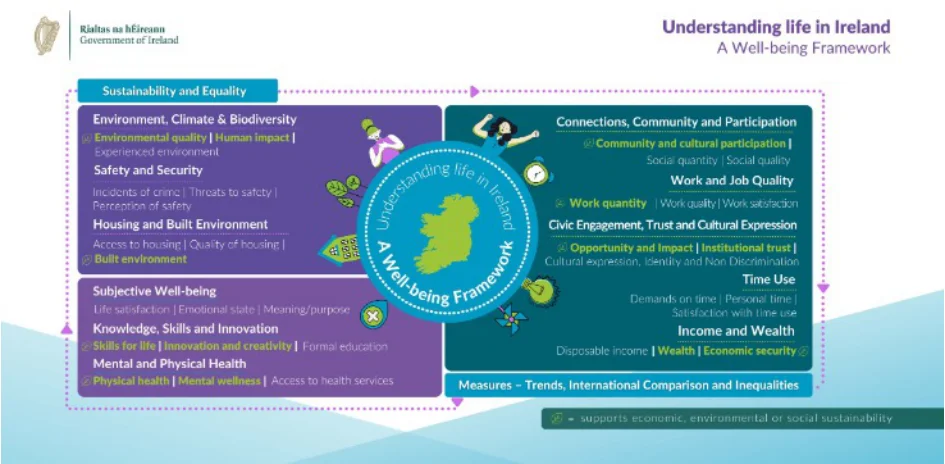
Figure 17: Well-being framework
Pages 132–133 · View in original PDF