Communications and Engagement
Figure from page 62
6. Communications and Engagement
Effective consultation, engagement and communication initiatives will be key to increasing public and stakeholder support for the recommendations identified in this Strategy. Public opposition has been highlighted as a challenge across all of the sub- group discussions, and indeed in the context of the wider implementation of the Government’s Climate Action ambitions.
The Public Engagement Strategy also supports the ongoing work of the Department’s Communication Strategy and the flagship Your Journey Counts campaign. The objective of the ‘Your Journey Counts’ campaign, which was launched by the Department in August 2023, is to encourage more members of the public to make the switch to sustainable transport modes.
Your Journey Counts supports this behavioural shift by encouraging the public to take public transport and walk, wheel, or cycle whenever possible. Your Journey Counts is an integrated multi-platform communications campaign. The campaign appears across TV, radio, print (local and national), social media, digital and Out of Home advertising formats. Subsequent phases of the campaign focused on rural communities, employing tailored messaging focused on improvements in regional and local public transport links; socially native, short form content to appeal to younger demographics online; and reward messaging around passenger figures and emissions saved in public transport hubs and invehicle. A dedicated campaign landing page was developed in both English and Irish, to highlight investment in public transport, active travel and supports available to people in helping them make the switch.
Given the significant impact that communications and engagement can have in promoting transformational change, the Department of Transport has developed high-level strategic approaches to communications and engagement in relation to climate action and sustainable mobility, specifically in relation to efforts to reduce transport related carbon emissions.
On engagement specifically, and in line with the OECD’s recommendations in its 2022 Report, it is clear that a robust strategy around public engagement is needed to realise our climate policy objectives, to deliver the infrastructure and services required, and to achieve buy-in from the public around necessary behaviour changes and individual transport choices that will facilitate these aims. This was reflected in specific actions in CAP23 (TR/23/69(TF)) and the Government’s Sustainable Mobility Policy (SMP). In this context, the Public Engagement on Climate Action and Sustainable Mobility: Strategic Approach 2024-25 was published in May 2024. A successor strategy will be prepared in 2026.
The main objective of the Public Engagement Strategy is to build awareness and inspire ownership for action and behavioural change in individuals, private organisations, and public sector bodies, whilst also increasing support and acceptance for the delivery of critical sustainable mobility infrastructure. Supported by robust evidence and market research, the Strategy and its implementation will provide very useful insights in relation to demand management measures and will inform how best to engage communities in the design and implementation of these measures over the coming years. Building awareness around the services and incentives that already exist is also a clear goal, bringing attention to progress that has been - and will be - made in public transport as well as highlighting all the positives to help counteract established negative beliefs.
As part of post-campaign analysis, B&A Research conducted a nationally representative survey demonstrating that 82% of respondents said that the campaign increased their understanding of the need to use more environmentally friendly transport options; 74% stated that the campaign made them consider transport carbon emissions; 2 in 5 report that they walk, cycle, or use public transport more now than before the campaign and 1 in 3 asserts to have replaced private car travel as a result of the Your Journey Counts campaign.
As part of the overall suite of measures to support the objectives of the Strategy, the Department has considered the role of car advertising in inducing a car-centric mindset, as well as the effectiveness of Ireland’s application of car labels at points of sale, in accordance with relevant EU Directives.
The labels provide consumers with information regarding the CO2 emissions and fuel efficiency of new cars to facilitate informed decisions.
Communications and engagement-related actions are also expected to be a key feature of that Plan.
At the 2024 Forum29, a new Sustainable Mobility Academy (SMA) was launched. This platform brings together professionals from national and local governments, academia and the private sector, creating a space to connect, and share insights on sustainable mobility. Key features of the platform include:
In light of this, the Department of Transport is engaging fully and proactively with the EU’s reappraisal of the Car Labelling Directive 1999/94/EC. The review is expected to be complete in 2026, after which a new regulation may be proposed by the European Commission. Required amendments to the implementing regulations at a national level will be followed through as a priority. This work will be a critical element in implementing Recommendation 27 of this Strategy (raising consumer awareness on emissions from car use).
ᴏ A curated library of case studies from Ireland and abroad
ᴏ Insights into emerging best practices in transport and urban planning
ᴏ 90+ public-sector only resources, serving a centralised hub of information and tools to assist users in their mobility needs.
Finally, under the SMP, the Department of Transport hosts an annual National Sustainable Mobility Forum with a view to providing ‘a platform for collaborative engagement with national, regional and local stakeholders. The National Sustainable Mobility Forum has been held on an annual basis since 2023. The 2025 Forum, which took place across four parallel sessions in May 2025, brought together a wide range of stakeholders with a view to informing the development of the next SMP Action Plan, which will cover the period from 2026 to 2030.
In addition to the above, ongoing communication campaigns and engagement will be needed to increase awareness about the need for, and the benefits of, demand management measures at a local level in particular. For this reason, Recommendation 8 of this Strategy aims to provide a communications and engagement support for LAs to build on the work that is already underway at a national level.
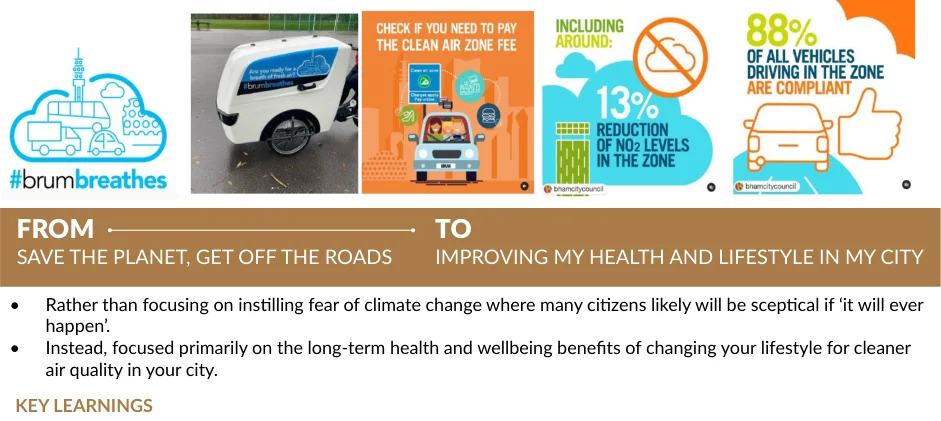
Figure from page 64
FROM SAVE THE PLANET, GET OFF THE ROADS
TO IMPROVING MY HEALTH AND LIFESTYLE IN MY CITY
• Rather than focusing on instilling fear of climate change where many citizens likely will be sceptical if ‘it will ever happen’. • Instead, focused primarily on the long-term health and wellbeing benefits of changing your lifestyle for cleaner air quality in your city.
KEY LEARNINGS
• Localised campaign and using local colloquial language. • Framed as positive lifestyle choice. • Made it tangible by focusing on health benefits. • Communicated progress and impact of clean air zone. • Tapped into behavioural science and social norms by communicating that citizens in the community are already compliant.
29 National Sustainable Mobility Forum 23 May 2024 (www.gov.ie)
This recommendation is focused on ensuring success in the delivery of transformative projects and initiatives, with the mainstreaming of project funds to support – through inhouse skills enhancement as well as the procurement of specialists - the mainstreaming of engagement, co-creation and communications at local delivery level. Such funding will focus on resourcing ‘behavioural change campaigns’ at neighbourhood/local community level, beyond those ordinarily undertaken as part of existing statutory processes such as those under Section 38 of Road Traffic Act.
Initiatives supported by the funding will also look to good practice cases in communicating and delivering demand management measures at a local level. For example, the #BrumBreathes initiative focused on the health benefits associated with its Clean Air Zone.
Appendix 1, which includes national and international demand management use cases, also illustrates how localised campaigns can be put to good effect in socialising change.
Pages 62–65 · View in original PDF