6 Public Consultation
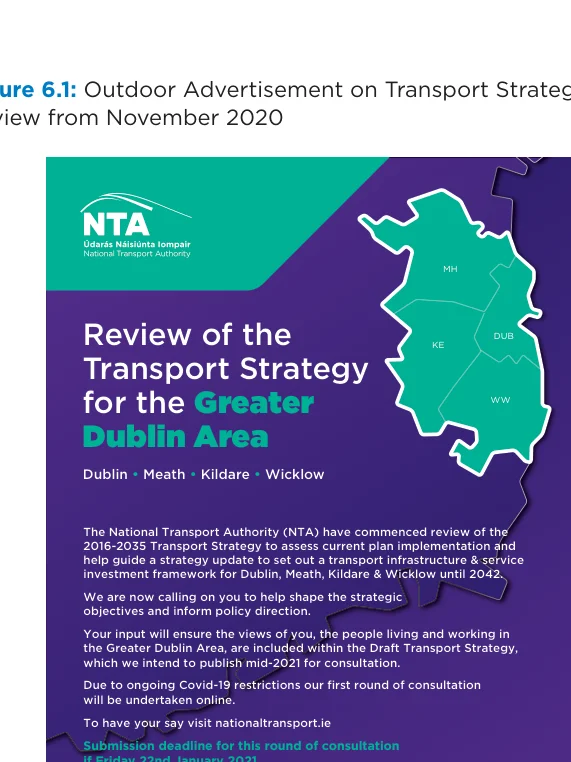
Figure from page 44
Figure 6.1: Outdoor Advertisement on Transport Strategy Review from November 2020
In total over 4,000 submissions were received, predominantly from the general public, with 92 submissions received from various stakeholders and groups. Almost half of respondents who gave a place of residence, were from County Meath, reflecting the scale of the campaign to deliver a rail service to Navan.
| MH Review of the DUB KE Transport Strategy for the Greater WW Dublin Area Dublin • Meath • Kildare • Wicklow The National Transport Authority (NTA) have commenced review of the 2016-2035 Transport Strategy to assess current plan implementation and help guide a strategy update to set out a transport infrastructure & service investment framework for Dublin, Meath, Kildare & Wicklow until 2042. We are now calling on you to help shape the strategic objectives and inform policy direction. Your input will ensure the views of you, the people living and working in the Greater Dublin Area, are included within the Draft Transport Strategy, which we intend to publish mid-2021 for consultation. Due to ongoing Covid-19 restrictions our first round of consultation will be undertaken online. To have your say visit nationaltransport.ie Submission deadline for this round of consultation if Friday 22nd January 2021 And when we publish our proposals next year, we will back again, looking for a more detailed response to our plans Be sure to have your say. | |
|---|---|
The responses to the consultation covered many different aspects of transport needs across the region, some with very local issues and others of a more strategic nature. Two of the most significant outcomes of the questionnaire are illustrated in figures 6.2 and 6.3 with almost universal support for the reduction in reliance on the private car, and with just under half stating it was the most important mode pre-pandemic.
In summary the main issues raised were as follows:
Navan Rail Line;
Metro to South West Dublin;
Extension of DART;
Improvements and expansion of the Luas network;
Improvements to the cycling infrastructure;
Improvements to the pedestrian environment;
Matters related to various BusConnects schemes; and
Electric bikes and scooters.
All of the submissions were carefully considered and taken into account in the development of the Transport Strategy.
6.2 Consultation on the Draft Strategy
Preliminary Equality Impact Assessment;
Pre-Draft Public Consultation Report;
Policy and Guidance Review;
6.2.1 The Consultation Exercise
9 Area-Based Transport Studies;
5 Transport Scheme Studies; and
The Draft Transport Strategy was published on the 9th November for an 8 week consultation period. As another wave of the pandemic emerged at this time and work-from-home advice was reinstated, this consultation was undertaken on a virtual basis.
4 Studies of Specific Transport Sectors
This comprehensive suite of documents published alongside the Transport Strategy demonstrates the breadth and depth of analysis undertaken in its preparation.
The Draft Transport Strategy was publicised widely throughout the GDA with bus shelter and newspaper advertisements, (see Figure 6.2) and extensive engagement via social media.
Members of the public and stakeholders were directed to an online portal to make submissions and to a feedback form to give their views. In addition, the NTA provided address details for postal submissions.
The NTA hosted six online public webinars during the consultation period and a number of other stakeholder engagements.
The NTA received 1,020 submissions made up of 911 public and stakeholder submissions via the online portal, 109 via email (85 of which related to a campaign) and 270 via responses to the survey. This 1,020 responses compares to a total of 155 submissions received during the preparation of the 2016 strategy.
The strategy was available to view in the NTA’s offices which were opened to the public by appointment for the period of the consultation. The following documents were displayed on the main strategy consultation portal on the NTA’s website:
Draft Strategy Report (Irish, English, Easy to Read and Accessible versions and Executive Summary);
SEA Environmental Report;
Appropriate Assessment Natura Impact Statement;
Strategy Development and Modelling Report;
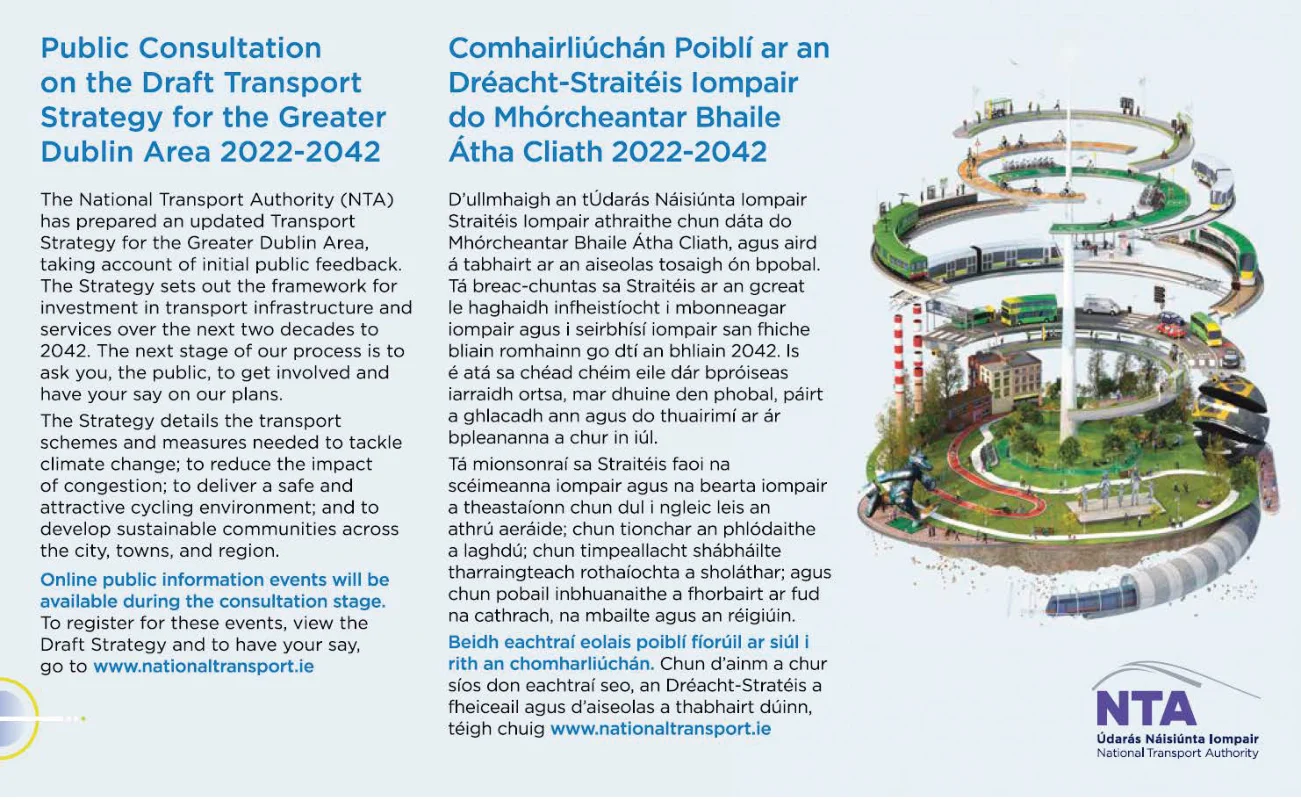
Figure 6.2: Outdoor Advertisement on Transport Strategy Review from November 2021
6.2.2 The Main Issues Raised
- Safety and Security of the Transport System;
Clearly with over 1,000 submissions, a vast array of issues emerged. A number of campaigns emerged in a similar manner to the pre-draft stage, with a focus on individual project-level considerations.
-
Equality in Transport; and
-
Enforcement of Traffic Laws.
Beyond these 16 main issues, which covered the vast majority of representations made, there were a plethora of other matters raised across the spectrum of transport and planning themes.
The main issues raised were as follows:
-
Ambition and Delivery Timelines;
-
Public Consultation and Engagement;
6.2.3 NTA Response
The NTA Strategy Team reviewed each submission. The submissions were then summarised using the online portal, focussing on those elements of each submission which sought a specific change to the transport strategy. These suggested changes were considered and a response drafted to each.
-
The Details of the Cycle Network Plan;
-
Fare Structure on Commuter Rail Services;
-
Navan Rail Line and the Dunsany Rewilding Project;
-
MetroLink and the Charlemont Terminus;
This exercise informed the revision of the Strategy. A Public Consultation report has been prepared alongside the strategy, focussing on the main issues raised. The appendices to that report set out the responses of the NTA Strategy Team to the myriad of matters raised by respondents, categorised according to each chapter of the transport strategy.
-
Metro to South West Dublin;
-
BusConnects Network and Core Bus Corridors;
-
Details of the DART+ Project;
As such, this Transport Strategy comprises a comprehensive approach to transport planning in the GDA for the next 20 years based on a high level of technical and policybased analysis and incorporating feedback from the public consultation process.
-
Delivery of DART+ Tunnel;
-
Extension of DART+ Services to Commuter Towns;
-
New Rail Stations;
-
Accessibility and Catering for Disabled People;
Figure from page 48
7. Strategy Development Process
- Strategy Development Process
7.1 Introduction
“The objective of the transport strategy shall be to provide a long-term strategic planning framework for the integrated development of transport infrastructure and services in the GDA.
This chapter provides a brief summary of the process of developing the Transport Strategy. Further details of aspects of the development work can be found in the following separate documents:
When preparing a transport strategy the Authority shall have regard to:
- Report on the Pre-Draft Public Consultation;
• demographic, economic, social, travel and transport trends in the GDA; • • existing, planned and projected land use developments.”
-
GDA Transport Strategy Modelling Report;
-
Supplementary Area Based Studies;
-
Various Scheme Studies;
-
Various Sectoral Studies; and
Dublin Transport Authority Act, Government of Ireland, 2009
- The SEA Environmental Report and AA Natura Impact
Statement.
Figure from page 49
Pages 44–49 · View in original PDF