11 Cycling and Personal Mobility Vehicles
- Cycling and Personal Mobility Vehicles
11.1 Introduction
“Nearly a quarter of adults cycle at least once a week in the Dublin metropolitan area, with 11% cycling five days a week or more.”
Since the publication of the prior transport strategy in 2016, cycling mode share has continued to grow steadily in line with trends evident since the mid-2000s. While the reasons for this growth are varied, cycling levels in the GDA and nationally are now higher than at any point in the past 30 years. The findings of the NTA / Sustrans Bike Life survey, conducted before the Covid-19 pandemic and available on the NTA website, illustrates clearly the prevailing patterns of cycling and attitudes of the public towards this mode and how it is served (see inset).
“69% would find more cycle tracks along roads, physically separated from traffic and pedestrians useful to help them cycle more.”
“84% of residents also support building more physically separated on-road cycle tracks, even when this would mean less space for other road traffic.
“Cycling in the Dublin area takes up to 60,000 cars off the roads each day.”
The notable growth and diversification in cycling in terms of the range of people cycling, their reasons for cycling, and bicycle type in the recent past requires a strong policy foundation and adequate funding to support the continuation of these trends.
“Cycling creates €258.5 million in economic benefits for the individual and society annually.”
Many challenges have emerged in providing the step-change in the quality of cycling infrastructure required to serve this growth. While there has been a number of high quality schemes delivered across the region, such as along sections of the canals and on some key radial routes, the requirement to deliver a coherent network linking origins and destinations and catering for trips within communities and to schools remains. The need to deliver this comprehensive network has become even more apparent during the Covid-19 pandemic.
“Bike Life, National Transport Authority and Sustrans, 2020”
Network Planning, Infrastructure Design, Cycle Parking and Bike Share Schemes are all key elements of a comprehensive, inclusive, cycle-friendly environment, and this chapter sets out the objectives of the NTA up to 2042 under these programme headings.
11.2 The Message from the Covid-19 Pandemic
During the period of most stringent restrictions on people’s movements in spring and summer 2020, the numbers of people cycling increased significantly. Practically traffic-free roads and distance limits encouraged more people to move around their local area in a different way. Parents felt safe enough to bring their children cycling on main roads and people got to experience the city in a way they may not have before.
The NTA and the local authorities responded to this, and to the need to maintain social distancing as the economy reopened, by rolling out a large amount of temporary Covid Mobility schemes. In many cases, cycling projects which had been envisaged and planned for many years were realised very quickly under emergency arrangements – projects such as the Coastal Mobility Route in Dún Laoghaire-Rathdown and sections of the Liffey Cycle Route in Dublin City Centre.
As the pandemic ends and patterns of movement return towards pre-Covid ways, it is essential that the message given by the public is listened to and acted upon by the NTA and local authorities when it comes to cycling infrastructure. It is inevitable that not all temporary measures will be retained via the formal planning process but the change in mentality as to what is possible for cycling must be harnessed and built upon over the coming years to deliver the step-change in facilities that is being demanded.

Figure from page 107
Cycling
More Cycle Parking at Train Stations and Bus Stops
Bike Share Scheme expansion and electrification
More On-Street Cycle Parking
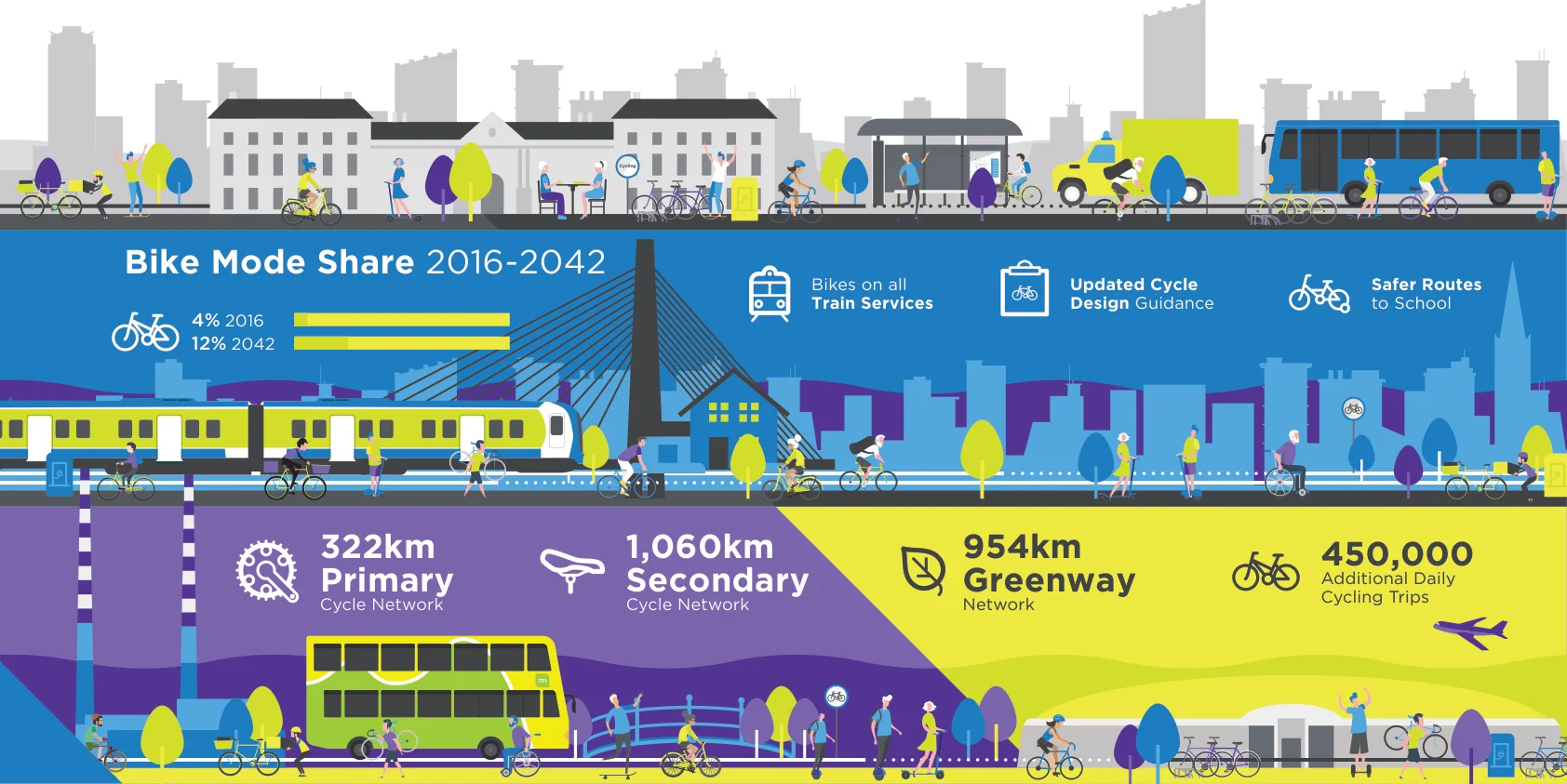
Figure from page 107
Cycling Cycling
| Bike Mode Share 2016-2042 Bikes on all Updated Cycle Safer Routes Train Services Design Guidance to School 4% 2016 12% 2042 | |
|---|---|
| 322km 1,060km 954km 450,000 Primary Secondary Greenway Additional Daily Cycling Trips Cycle Network Cycle Network Network TFI |
11.3 GDA Cycle Network
The revised network forms a key component of the overall transport network for the region. Covering the full GDA region, it sets out a comprehensive cycle network for development during the period of the Transport Strategy. Figure 11.1 comprises an excerpt from the network and the full network is set out in the separate Cycle Network Plan.
In 2013 the NTA published the Greater Dublin Area Cycle Network Plan. The purpose of the Plan was to guide investment in cycle infrastructure by the NTA and other related agencies, by developing a network of cycle routes for the GDA. The route network comprises Primary, Secondary, Feeder, Greenway and Inter-urban routes for the region, including dedicated town networks for all settlements. The network also incorporates those elements of the Dublin-Galway Euro-Velo 2 route that are within the GDA.
Measure CYC1 – GDA Cycle Network
It is the intention of the NTA and the local authorities to deliver a safe, comprehensive, attractive and legible cycle network in accordance with the updated Greater Dublin Area Cycle Network.
It should be noted that there is no direct link between the route classification in the Cycle Network and the type of infrastructure that may be provided. For example, a quiet residential street which precludes through traffic may form part of a primary route but would not require any specific cycle infrastructure by virtue of its design and traffic volumes. Similarly, a major regional distributor road may form part of the secondary network and may therefore require fully-segregated cycle tracks in order to be safe and attractive.
11.4 Cycle Infrastructure Provision and Management
The National Cycle Manual has guided the design of cycle infrastructure in the past decade. Any schemes funded by the NTA over this period were required to demonstrate consistency with the manual.
While the 2013 Plan has provided a robust framework for such investment to date, evolutions in cycle policy, design guidance and urban form since its publication have prompted an update of the network. This review has ensured that the network proposed is fit for purpose, and takes account of the needs of the full spectrum of users and trip types. The revised GDA Cycle Network forms part of the Transport Strategy and is published in full alongside this report.
Design standards change over time, however, and new approaches emerge internationally and need to be examined as to their appropriateness in an Irish context. This can be seen in some of the cycle provision included in the BusConnects schemes. Additionally, as the community of cyclists grows
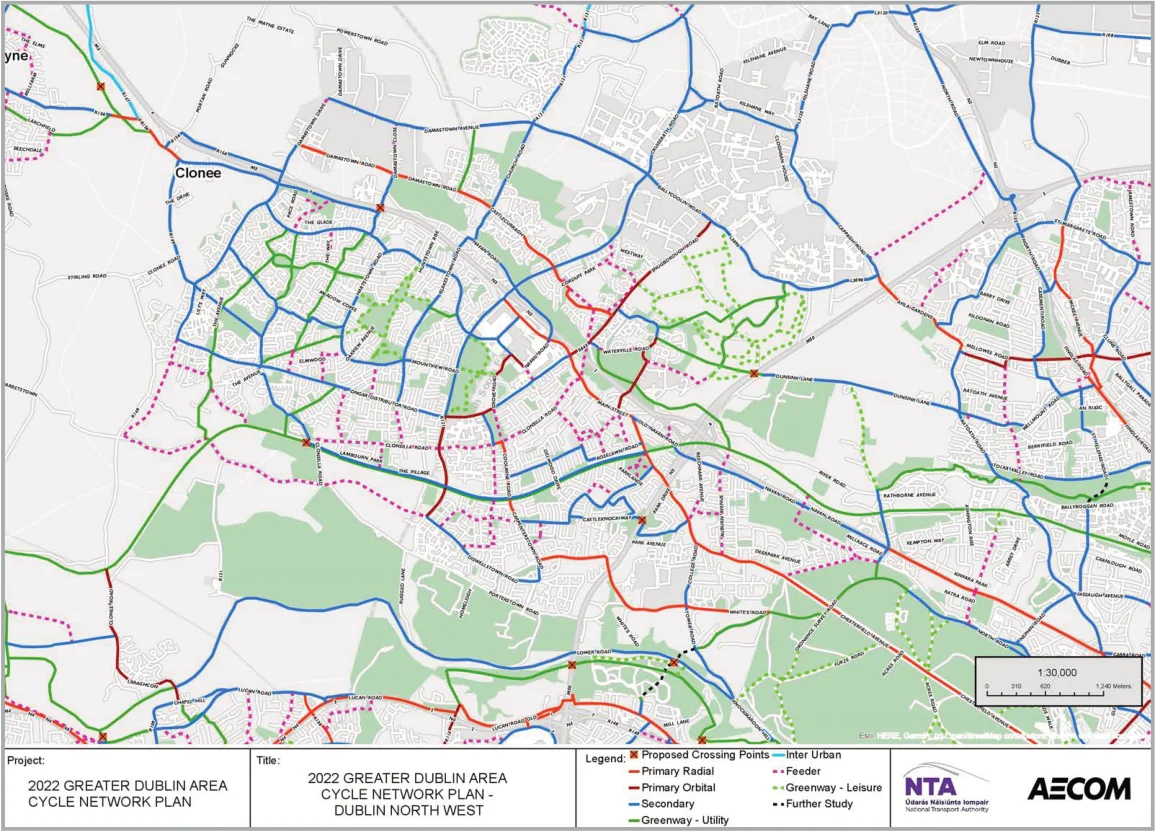
Figure 11.1: Extract from the Updated GDA Cycle Network
and its range broadens, different needs also emerge. As more women and girls cycle, for example, personal security needs may become more pronounced, in particular on off-road greenways. There has also been notable growth in electric bikes, cargo bicycles and tricycles, multi-seat family cycles, plus hand cycles and adapted cycles catering for users with a range of mobility limitations.
Measure CYC2 – Cycle Infrastructure Design
It is the intention of the NTA to ensure that cycle infrastructure in the GDA provides an appropriate quality of service to all users, through the implementation of the design guidance contained in the latest version of the National Cycle Manual.
All of these factors contribute to the manner in which cycle infrastructure is provided. As such, the NTA is in the process of reviewing and updating the National Cycle Manual to take account of these issues and developing international practice.
Measure CYC3 – Extended Hours of Operation of Cycle Infrastructure
One of the key aspects of cycle infrastructure provision is the period of time during which they are dedicated for the use of cyclists. As the number of cyclists grows and as their population and associated needs diversifies, the requirement to ensure that cyclists can travel unimpeded along their entire journeys becomes critical well outside the traditional traffic peak hours. This needs to be reflected in how cycle infrastructure is managed and in the associated management of traffic, loading and parking.
The NTA and local authorities will extend the operations of cycle infrastructure. For fully-segregated cycle tracks they will all operate on a 24-hour basis. For on-road cycle lanes, they will generally also operate on a 24-hour basis, other than in exceptional circumstances where such provision is not practicable.
Similarly, the maintenance of the surface quality and markings associated with cycle infrastructure is important from a safety and attractiveness point of view and will need to be undertaken in a manner which reflects the objectives of all agencies in this regard.
Measure CYC4 – Maintenance of Cycle Infrastructure
The local authorities will maintain the cycle network to a high standard, ensuring that it is safe, comfortable and attractive to cycle.
11.5 Cycle Parking
Measure CYC5 – Cycle Parking
The availability of cycle parking at the beginning and end of a journey can greatly influence the decision to choose to cycle. Destination cycle parking can be provided in a range of locations, including privately at workplaces, as public cycle parking in urban areas either on-street or in larger off-street facilities, or at other destinations such as cultural, leisure or recreational facilities. Where public cycle parking is provided it must cater for the full spectrum of cycles.
It is the intention of the NTA to deliver, through the statutory planning process and liaison with relevant stakeholders, high quality cycle parking at origins and destinations, serving the full spectrum of cyclists including users of non-standard cycles.
A public cycle parking strategy should also be included by local authorities in Development Plans and Local Area Plans in tandem with workplace parking standards and residential cycle parking standards. In urban areas, public cycle parking is often occupied by workers from the locality who may park on street for the full day if they lack workplace parking, or by local residents without dedicated parking at home. By promoting workplace and residential parking provision, the demand for on-street parking may reduce. Existing on-street stands can then serve their primary purpose of catering for shorter-term retail, leisure or business use.
Measure CYC6 – Cycle Parking Strategies
Local authorities will prepare public cycle parking strategies in order to ensure that there is sufficient shortstay safe and secure cycle parking available on-street and/ or off-street, including spaces for cargo bikes and other non-standard bike designs, in city, town and village centres.

Figure from page 111
In addition, the NTA will work with local authorities, transport operators and local authorities to address the need for sufficient cycle parking at rail stations, transport interchange locations and mobility hubs.
In preparing Development Plans, the NTA will encourage local authorities to allow for at least 20% of trips to be undertaken by cycling and for cycle parking standards to be set out on this basis.
11.6 Bike Sharing
its launch. Separately, a number of other bike share schemes have been introduced on a commercial basis in recent years, licensed by the relevant local authority and generally using dockless bikes which don’t require dedicated bike stations to be developed on street.
Bike sharing schemes have become key elements in the multimodal transport environment, providing for ‘last mile’ journeys from public transport stops to workplaces and for a range of retail, leisure and recreational trips within urban areas. When planned correctly they can contribute to increased use of public transport, serve as a low-cost entry point to cycling for newer commuters and recreational cyclists and facilitate reduced reliance on the private car.
With over 30 million journeys taken on dublinbikes since the launch of the scheme and the success of other bike share schemes in the region, it is evident that there is a major role for bike sharing as part of the overall integrated transport system for the GDA. However, it is also clear that such schemes need to be well-planned, appropriately sized and affordable, while also being readily available and easy to use. It is also important that the region does not end up with a proliferation of individual and unconnected schemes, each vying for the same users, and with individual users potentially requiring to join multiple schemes to provide appropriate coverage to suit their needs.
Although there is no limit to the distance that can be travelled, bike sharing schemes generally work best when they cater for shorter journeys in urban areas. Station-based schemes require bikes to be docked to complete a journey, and dockless schemes usually cover a defined area in which bikes must be parked at the end of a trip. Larger schemes typically incur higher operational costs, and usage tends to be lower in areas of lower population density. The expansion of these schemes must take account of such constraints in order to provide optimal coverage.
Accordingly, the NTA will seek the development of a structured network of coordinated bike share schemes, appropriately serving key urban areas and operating on an integrated basis
There are three main strands to plans for bike sharing over the lifetime of this strategy – expansion of bike sharing schemes across the region, provision of electric bike sharing and interoperability between different schemes.
Measure CYC7 – Bike Share Scheme Expansion
The NTA, in collaboration with the local authorities, will seek the development of a structured network of coordinated bike share schemes, appropriately serving key urban areas and operating on an integrated basis.
11.6.1 Expansion of Bike Share Schemes
The dublinbikes scheme was introduced by Dublin City Council in 2009 and has undergone a number of expansions since
11.6.2 Electrification of Bike Rental Schemes
The provision of electric bikes can attract new users to bike sharing schemes and can extend the overall reach of a scheme. They offer the benefits of lower effort and potentially longer distances. However, as noted earlier, bike share schemes work best when they cater for shorter journeys in urban areas, and the potential for further electrification should be considered in the context of the operational limits of a bike share scheme. However, more and more schemes internationally offer electric bike options as part of their offering and customers have embraced the new potential offered by electric bikes.
Accordingly, the NTA will support the provision of electric bike share schemes, appropriately integrated in the overall bike share scheme structure for the region.
Measure CYC8 – Bike Share Scheme Electrification
The NTA will support the provision of electric bike share schemes, appropriately integrated in the overall bike share scheme structure for the region.
11.6.3 Interoperability between Bike Share Schemes
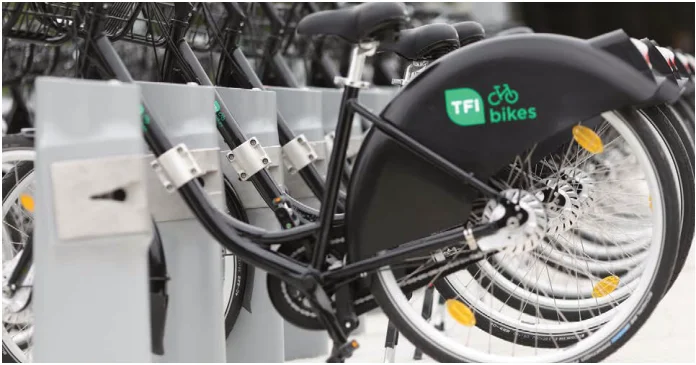
Figure from page 114
The uncontrolled expansion of bike share schemes in an uncoordinated way is undesirable on several levels. Firstly, commercial realities mean that multiple schemes may focus on particularly lucrative areas but omit coverage of other less viable areas. Secondly, a multitude of singular schemes operating across the region, means that a user may need to be a member of, and subscriber to, multiple schemes in order to cover the spectrum of trips that he or she may wish to make.
To address the latter point, achieving interoperability between different schemes is patently desirable from a customer perspective. The ability of a customer of Scheme A to be able to use the bikes of Scheme B when appropriate, extends the usefulness of the family of bike share schemes, and is a precursor to the concept of “mobility as a service”.
Measure CYC9 – Interoperability between Bike Schemes
While this requires commercial and technical arrangements to be put in place between operators, the NTA intends to pursue a programme of interoperability between bike sharing schemes within the GDA.
The NTA will seek to put in place interoperability arrangements between bike sharing schemes within the GDA such that the customer of one scheme is enabled to use the bikes of another scheme, and will explore the role of Next Generation Ticketing in this regard.
11.7 Bikes on Public Transport
Measure CYC10 – Bikes on Public Transport
Folding bikes are permitted on all public transport vehicles. At present, there is limited space for bringing standard bicycles on public transport. Only Inter-City trains permit bicycles on all services, and DART trains permit them during off-peak hours. Standard bikes are not permitted on Luas or metropolitan bus services.
The NTA will facilitate the carriage of standard bicycles on all newly acquired (during this strategy period) DART, Commuter and Intercity rail carriages operating in the Greater Dublin Area at all times.
In future, all new rail carriages will accommodate bicycles at all times in accordance with EU legislation. The NTA has already begun the procurement process for these carriages, which will commence entering service in the coming years. As such, all Irish Rail services using newly procured fleet, including new DART fleet, will accommodate a minimum of 4 bicycles per train, in addition to an unlimited number of folding bikes.
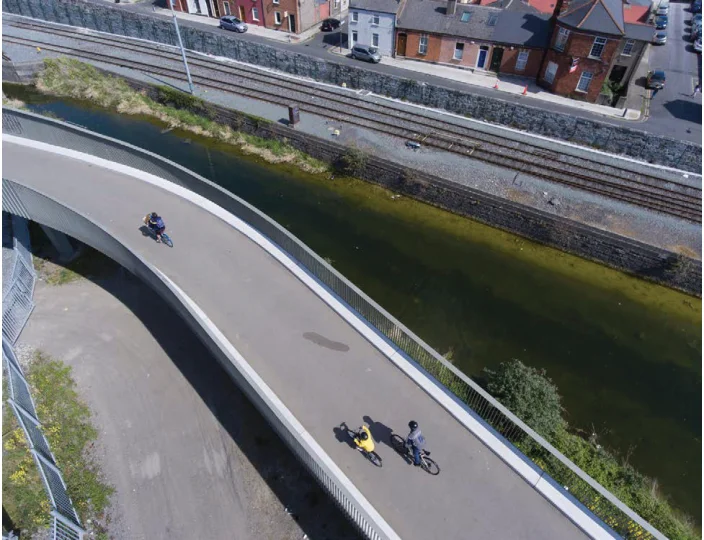
Figure from page 115
Luas, by virtue of its operating characteristics which include no storage space; a significant requirement for passengers standing at all times; the potential for sharp acceleration and deceleration; and the need for emergency braking due to its un-segregated design, is unsuited for carriage of standard bicycles on board. Metropolitan bus services facilitate folding bicycles at all times; however, there is no adequate, safe, convenient and efficient model for the carriage of standard bicycles on these services.
11.8 Emerging Personal Mobility Modes
Measure CYC11 – Pedal Assisted E-Bikes
The NTA and local authorities will take into account the growing use of pedal-assisted E-bikes, and the benefits they may bring, in planning and designing the transport network in the GDA.
11.8.1 Electric Bikes
Electric bicycles or e-bikes are bicycles with an integrated electric motor used to assist propulsion. This means that they can extend the travel distance, or gradients traversed, well beyond the typical limits of a standard bicycle. They use rechargeable batteries and typically reach top speeds of 25km/h. E-bikes can be broken down into two broad categories, Pedelecs and S-Pedelecs.
11.8.2 Electric Scooters
An electric scooter, or an e-scooter is similar to a two-wheeled manual scooter except it does not require any physical effort. It is propelled forward by an electric motor and is equipped with brakes. The e-scooter is rechargeable, and the electricity is stored on a battery within the scooter.
Pedelecs are pedal-assisted e-bikes and are treated as bicycles under Irish law. S-pedelecs are fully mechanically propelled vehicles which reach speeds well above 25 km/h and are treated like mopeds under Irish law. As such, the latter is dealt with in Chapter 14.
E-scooters are not currently legislated for use on public roads in Ireland, but upcoming legislation will seek to introduce a balance between encouraging uptake of scooters and other personal mobility vehicles while addressing user and public safety issues. Individually owned vehicles are already in use on Dublin streets, on footpaths, cycle tracks and lanes and onroad, and without specific speed limits.
There is a significant opportunity for pedal-assisted E-Bikes to play a far greater role in the GDA’s transport system, primarily by extending the range of “cycleable” trips to 10 km and beyond. There are challenges associated with E-bikes in terms of mixing vehicles of varying speeds and the desire for overtaking, as well as speed expectations of pedestrians and motorists –this point is linked to the requirement for enhanced cycle infrastructure. The NTA is of the view that this emerging trend will continue and that transport investment priorities will need to reflect the growth of pedal-assisted E-bikes.
E-scooters are highly transportable for the customer; various designs enable rapid folding and easy carriage, making their integration with public transport easier. Parking infrastructure
11.8.3 Other Emerging Personal Mobility Modes
can be relatively cheap to build and maintain and their small footprint means otherwise unused spaces could be used productively.
Beyond e-scooters and e-bikes, there is a plethora of emerging personal mobility modes coming to market. Improved overall safety and footfall in newly pedestrianised areas have encouraged the uptake of micro-mobility modes such as Segways, Folding Scooters, Electric Skateboards and Quadricycles. As people continue to find new modes of personal mobility and as their legal status is clarified, the available infrastructure may also need to evolve to support these new mobility modes and how they are used.
E-scooters present similar challenges to E-bikes in terms of the mixing of modes of different speeds, but also in terms of the ease with which they can navigate through the urban realm and potential conflicts with pedestrians. They present a unique high-risk in this regard as they are low visibility and operate silently and at high-speeds.
E-scooter trips may also be simply replacing cycling and walking trips, and in such a scenario they would not be contributing to reduced congestion or emissions. The NTA will respond as required to the legislation adopted in this area and will consider E-scooters as part of the implementation of the Transport Strategy.
Measure CYC13 – Other Emerging Personal Mobility Modes
The NTA, local authorities and Government will monitor emerging trends in personal mobility and respond accordingly in terms of legislation, regulation and infrastructure design.
Measure CYC12 – Electric Scooters
Subsequent to the enactment of national legislation, the NTA and local authorities will take into account the growing use of E-scooters and the benefits they may bring, in planning and designing the transport network in the GDA.
11.9 Supporting Cycling Measures
In addition to the above, there are additional measures which support the cycling and other personal mobility modes. Some of these are intrinsic within other measures of the Transport Strategy but are reiterated or made explicit here as appropriate, as follows:
Cycle Bus schemes for the safe transport of groups of schoolchildren by bicycle supervised by parents and other adult members of the community. These form part of many Green Schools Travel modules;
The provision of public charging points for E-Bikes at public bike parking facilities; and
Specific parking for E-Scooters.
As these areas are constantly growing in range and depth, the NTA will monitor any emerging technologies, infrastructure, policies and programmes which support cycling and other personal mobility modes.
Measure CYC14 – Supporting Measures for Cycling
The NTA will monitor new developments related to supporting measures for cycling, including emerging technologies, infrastructure, policies and programmes, with a view to their implementation in the GDA.
Pages 105–118 · View in original PDF