1 Introduction
- Introduction
This Transport Strategy for the Greater Dublin Area 2022- 2042 (Transport Strategy) replaces the previous framework, titled the Transport Strategy for the Greater Dublin Area 2016- 2035, which was approved by the then Minister for Transport, Tourism and Sport in 2016.
Luas Cross City;
The reopening of the Phoenix Park Tunnel Rail Line;
The on-going roll out of cycle tracks and greenways;
Metrolink;
That prior transport strategy set out to contribute to the economic, social and cultural progress of the Greater Dublin Area (GDA) by providing for the efficient, effective and sustainable movement of people and goods. In other words, it was about making the Dublin region a better place for people who live and work there, and for those who visit.
DART+ Programme;
Investment in bus priority and bus service improvements – BusConnects Dublin; and
M7 Naas to Newbridge widening, Osberstown Interchange and Sallins Bypass.
It did that by providing a framework for the planning and delivery of transport infrastructure and services in the GDA. It has also provided a transport planning policy around which other agencies involved in land use planning, environmental protection, and delivery of other infrastructure such as housing, water and power, could align their own investment priorities.
Under the Dublin Transport Authority Act 2008, the National Transport Authority (NTA) must review its transport strategy every 6 years. Arising from the review of the 2016 plan, an updated strategy has been developed which sets out the framework for investment in transport infrastructure and services over the next two decades to 2042.
Of course no transport strategy can ever be a standalone document. A transport strategy will always be part of a larger picture of overall national policies that must work towards a single set of overall objectives. To a large extent, policies and objectives around issues such as land use, development, population distribution, investment, sustainability and climate
It has been an essential component, along with investment programmes in other sectors, for the development of the GDA which covers the counties of Dublin, Meath, Kildare and Wicklow. Major projects provided for in the strategy included:
| National Trans 8 Greater Dublin | port Authority Area Transport Strategy 2022-2042 | action, for example, are determined by other state agencies and authorities, but must be fully reflected in any transport strategy. As such, this Transport Strategy has been developed to be consistent with the spatial planning policies and objectives set out in the Regional Spatial and Economic Strategy (RSES) as adopted by the Eastern and Midland Regional Assembly in June 2019, and finalised in January 2020. These objectives in turn are consistent with the National Planning Framework and the National Development Plan as set out in Project Ireland 2040. This Transport Strategy is also based on national policies on sustainability as set out in climate action and low carbon legislation, and in climate action plans. The potential impacts of the on-going Covid-19 pandemic, beyond the short-term, have also been taken into account. |
|---|---|---|
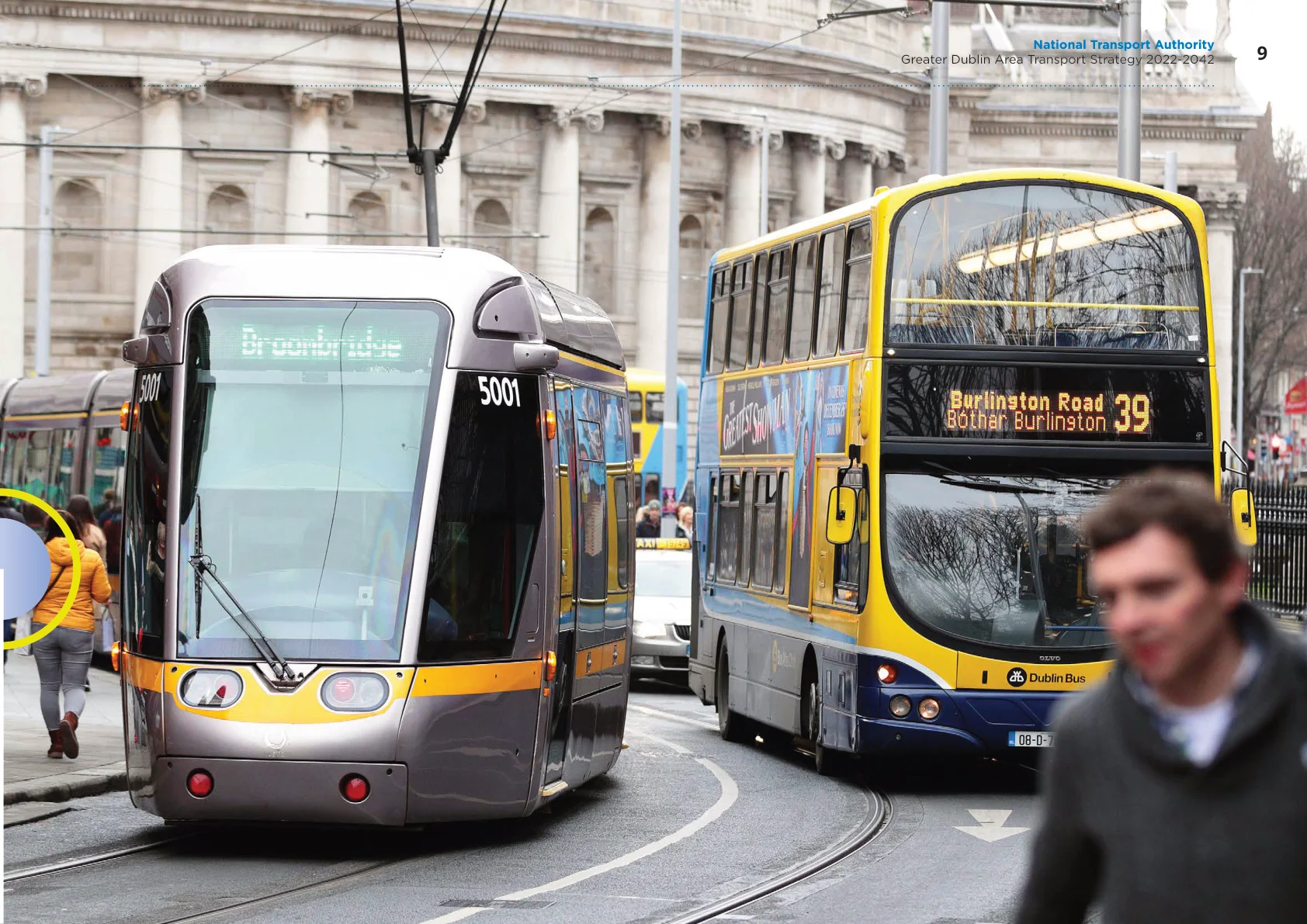
Figure from page 9
Figure from page 10
2. Progress Made on the Prior Transport Strategy
Pages 7–10 · View in original PDF