2.4 Principle 4: Options will be
2.4 Principle 4: Options will be provided for those who cannot charge at home
MShared Charging: Shared-charging solutions,
whereby EV owners can rent out the use of their personal home charge point, can provide a low-cost, easy-to-deliver charging solution for EV owners without access to a driveway.
For some, charging at home will not be an option. It is vital that they are provided with residential charging solutions that mirror and give the same
MDestination charge points: The provision of EV
charge points at destinations such as sports
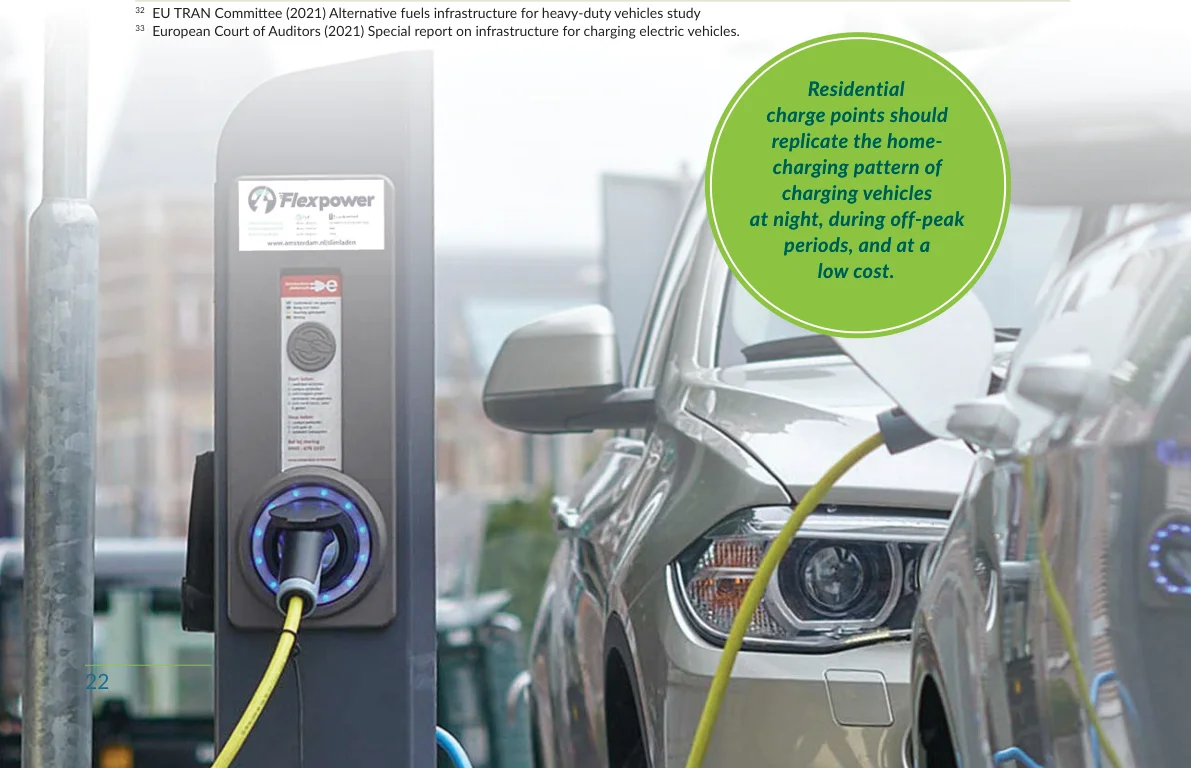
Figure from page 24
32 EU TRAN Committee (2021) Alternative fuels infrastructure for heavy-duty vehicles study
33 European Court of Auditors (2021) Special report on infrastructure for charging electric vehicles.
Residential charge points should
replicate the homecharging pattern of
charging vehicles at night, during off-peak
periods, and at a
low cost.
investment and assets. It will allow employment and economic opportunities to be identified and maximised.
facilities, retail outlets, hotels, co-working hubs, tourist sites, and privately-operated carparks will also cater for the charging needs of people wishing to top up their EVs during the day and while on the go. Such locations would be particularly suited for fast charge points and (depending on duration of stay) high-powered charge points. The latest Energy Performance of Buildings Regulations 2021 will also require the provision of charging points and ducting infrastructure in new buildings and existing buildings undergoing major renovations (other than a dwelling). This is subject to the building meeting specific thresholds.
As EV uptake increases and becomes more mainstream in Ireland, it is anticipated that there will be a collective shift in public understanding about how private vehicles are refuelled. The existing model of visiting petrol forecourts will shift to one where refuelling (or, in fact, charging) is primarily done at home. Depending on individual travel needs, only a small amount of top-up charging may be required. In effect, EV drivers can depart their place of residence with the equivalent of a ‘full tank’ daily, without ever needing to visit a public charge point.
MEn-route charge points: Increased provision
of publicly-accessible high-powered (c. > 100 kW) charge points will also be needed to cater for drivers making longer journeys, such as between cities or along the National Roads Network.
At present, research into perceptions about the existing charging network indicates that, for the most part, private citizens consider there to be an insufficient supply of publicly-accessible charge points to meet the current level of demand. One of the key objectives of this strategy is to address the possible range and charger anxiety of early EV adopters and to provide confidence to potential users regarding their charging options. This is particularly important for those who cannot charge at home. With this shift to private refuelling/charging behaviour as EVs become more mainstream, there will be an equivalent shift in public perceptions regarding the frequency of recharging and dependence on public charging points.
MFast Taxi-Charging Hubs: To support the
greening of the taxi fleet, a number of dedicated fast taxi-charging hubs will be required to enable drivers to quickly charge and go.
MPublicly-accessible heavy-duty-vehicle
charge points: A minimum number of publiclyaccessible high-powered charge points will also be required to meet the future charging needs of heavy-duty electric vehicles such as large goods trucks. This number will be set out in the revised Alternative Fuels Infrastructure Regulation and will be dictated by Irelandspecific market needs and freight transport patterns.
Pages 24–25 · View in original PDF