9.7 Access to Arts, Culture, Language

Figure from page 4
Regional Spatial & Economic Strategy
Director’s Foreword
A Regional Spatial and Economic Strategy (RSES) is a strategic plan and investment framework to shape future growth and to better manage regional planning and economic development throughout the Region. It identifies regional assets, opportunities and pressures and provides appropriate policy responses in the form of Regional Policy Objectives.
This RSES brings together for the first time spatial planning, economic policy and provides the environment for investment, and in doing so it marks a significant policy milestone for Regional Government in Ireland. Members from the 12 local authorities that constitute the Region, came together as an Assembly to make, for the first time, an overarching strategy that benefits the entire Region. In making this Strategy the Assembly is playing a key role in informing new approaches towards assisting in the delivery of regional development.
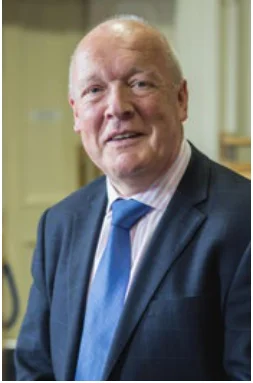
Figure from page 4
Throughout the strategy there are 3 cross cutting key principles;
• Healthy Placemaking - To promote people’s quality of life through the creation of healthy and attractive places to live, work, visit, invest and study in.
• Climate Action - The need to enhance climate resilience and to accelerate a transition to a low carbon society recognising the role of natural capital and ecosystem services in achieving this.
• Economic Opportunity - To create the right conditions and opportunities for the Region to realise sustainable economic growth and quality jobs that ensure a good living standard for all.
The Assembly recognises the opportunities in the changing dynamic in Ireland and the Strategy seeks to optimise investment in the region and maximise the potential of national and European funding. This will be done through partnership with stakeholders and in collaboration with other agencies to deliver on the shared vision of the Strategy and to continue building a sustainable, healthy and resilient region.
Established in 2015, the Assembly spent its initial setup period developing a comprehensive understanding of the needs of its stakeholders, particularly across the areas such as place making, housing, economic opportunity, our environment and heritage and the regions infrastructure challenges. An evidence based approach, to establish the issues and identify solutions, was undertaken by the Assemblies executive team and underpins the Strategy. A vision for the Region was developed by the elected members and stakeholders to guide and inform the policies and objectives of the Strategy.
Jim Conway, Director
The RSES builds on the foundations of Government policy in Project Ireland 2040, which combines spatial planning with capital investment, and has been prepared from an extensive bottom up consultation process. It is an integrated cohesive policy document that provides a Spatial Strategy to manage future growth in the region. It is a Climate Action Strategy to accelerate climate action. It is an Economic Strategy to sustain and strengthen our economy and a Metropolitan Plan for the sustainable growth of Dublin as an international city. Finally, it is an Investment Framework to prioritise funding.

Figure from page 5
Cathaoirleach’s Message
It gives me great pleasure to introduce the first Regional Spatial and Economic Strategy for the Eastern and Midland Region, which has been made by the Regional Assembly. It marks the result of extensive consultation and work across the region and it demonstrates the importance and effectiveness of regional government.
At the outset I would like to thank and commend my colleagues from the 12 local authorities represented on this Assembly who worked tirelessly to ensure that an equitable and far sighted strategy, designed to achieve balanced regional growth across the entire region, is now in place to ensure a clear roadmap for achieving healthy placemaking, climate action and economic opportunity for all citizens.
Ours is a diverse region, stretching from a vibrant national capital of international significance through areas of rich heritage and immense natural beauty that support a varied tourism and recreation offering. We have natural assets include the raised bogs and lakes in the Midlands, the Wicklow Mountains National Park, Slieve Bloom mountains, the bays and estuaries of the eastern seaboard and inland waterways such as the Royal and Grand Canals and the Shannon corridor.
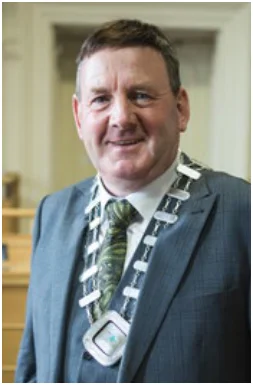
Figure from page 5
Our built heritage includes historic and walled towns, world class museums and attractions such as the Book of Kells and the UNESCO World Heritage site of Brú na Boinne, the medieval monasteries of Clonmacnoise and Glendalough and a number of historic castles, houses and demesne landscapes.
This Strategy will ensure that we focus on maximising these great advantages as well as identifying new opportunities and planning for the foreseen and unforeseen challenges that await us, both here in Ireland and internationally.
Starting in 2017, we sought the views of individuals and organisations to build up a picture of what was needed to ensure the future of the people who live, work and lead their lives in our Region and indeed that of the generations to come.
This Strategy marks a significant step forward by regions in Ireland and demonstrates what we can achieve when we pull all our regional strength together. It now falls to us to make sure the objectives of the Strategy are met and I look forward to being a part of making this happen over the coming years.
I would like also to thank everyone who contributed to bringing the Strategy together, be they individuals or those who work for the many stakeholders who actively participated in this production.
Eddie Fitzpatrick, Cathoirleach
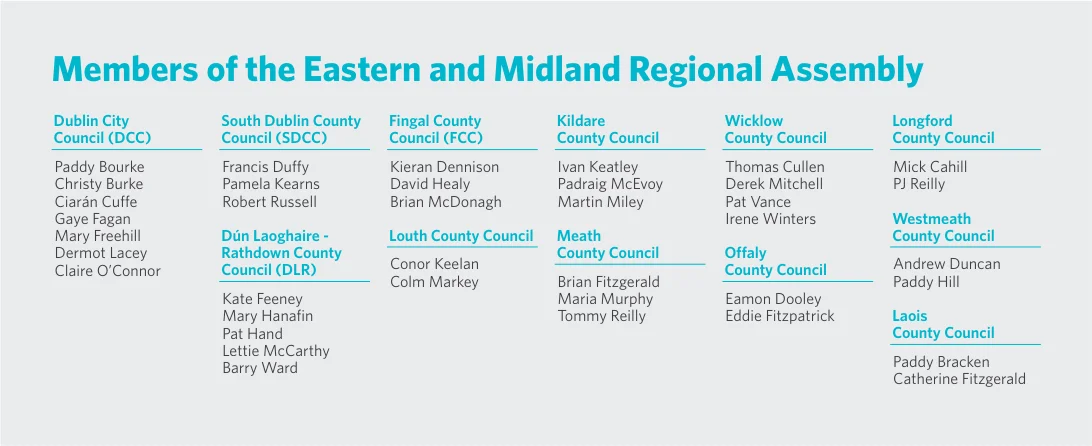
Figure from page 5
Members of the Eastern and Midland Regional Assembly
Dublin City Council (DCC)
South Dublin County Council (SDCC)
Fingal County Council (FCC)
Kildare County Council
Wicklow County Council
Longford County Council
Paddy Bourke Christy Burke Ciarán Cuffe Gaye Fagan Mary Freehill Dermot Lacey Claire O’Connor
Francis Duffy Pamela Kearns Robert Russell
Kieran Dennison David Healy Brian McDonagh
Ivan Keatley Padraig McEvoy Martin Miley
Thomas Cullen Derek Mitchell Pat Vance Irene Winters
Mick Cahill PJ Reilly
Westmeath County Council
Dún Laoghaire - Rathdown County Council (DLR)
Louth County Council
Meath County Council
Offaly County Council
Conor Keelan Colm Markey
Andrew Duncan Paddy Hill
Brian Fitzgerald Maria Murphy Tommy Reilly
Kate Feeney Mary Hanafin Pat Hand Lettie McCarthy Barry Ward
Eamon Dooley Eddie Fitzpatrick
Laois County Council
Paddy Bracken Catherine Fitzgerald
Regional Spatial & Economic Strategy
1 Introduction
Pages 4–6 · View in original PDF