9.5 Social and Economic Opportunity
9.5 Social and Economic Opportunity
Social Inclusion is a key objective at national and local level. It refers to the way in which all persons in a community are integrated in an equal manner by reducing barriers to social inclusion for example belonging to a jobless household; being a lone parent; having a disability; being homeless or affected by housing exclusion; and belonging to an ethnic minority.
Local Economic and Community Plans (LECPs)
Europe 2020 includes targets to reduce the number of people in or at risk of poverty and social exclusion. People are living in poverty if their income and resources (material, cultural and social) are so inadequate as to preclude them from having a standard of living which is regarded as acceptable by Irish society generally. As a result of inadequate income and resources people may be excluded and marginalised from participating in activities which are considered the norm for other people in society.
The Local Government Reform Act 2014, gave local authorities an expanded economic role including the preparation and adoption of LECPs. For the first time, LECPs require the integration of local economic and community development activities to promote economic and social opportunities for citizens and communities.
The first round of six year LECPs, launched in 2016, are overseen by Local Community Development Committees (LCDCs) and seek to facilitate collaboration between the public sector, agencies and business sector as well as the community and voluntary sector. LECPs highlight a number of local policy and actions to provide opportunities for participation by marginalised communities and social groups at risk of exclusion.
There is a clear link between health and social class with selfreported rates of good health much lower in areas of social disadvantage. The Trutz Haase deprivation index identifies pockets of affluence and deprivation in the Region70. Figure 9.3 shows the Pobal HP Deprivation Index scores for the Region.
Education and skills are closely related to employment opportunities. The level of third level educational attainment can be seen as an indicator of the economic potential of a place as the proximity of a suitably skilled labour force is a key determinant for the location of businesses. The total population with a third level education residing in the Region is nearly 37%, above the State average (33%), however there are clear regional differences between the Midland (26%) and Dublin counties (41%). EU 2020 sets targets of at least 40% of 30-34 year olds completing third level.
It is important that local authorities work collaboratively with service providers and stakeholders including the local community through LCDCs and the LECPs to identify social infrastructure needs and set out an agreed programme of social infrastructure provision with key stakeholders involved in that process.
In the formulation of LECPs local authorities should consider demographic trends and patterns when carrying out an assessment of the need for social infrastructure to consider the impact of factors such as an ageing population and the resulting demand for facilities.
The Economic Strategy of the RSES seeks to promote the creation of quality jobs that support a decent standard of living and afford economic security. Additional social inclusion measures are required to ensure that everyone is able to benefit and access economic opportunities across the Region.
70 https://www.pobal.ie/app/uploads/2018/06/The-2016-Pobal-HP-Deprivation-Index-Introduction-07.pdf

Figure from page 209
Quality of Life
Social Enterprise
A Social Enterprise is an enterprise whose main objective is to achieve a social impact71 and many social enterprises have emerged from the community and voluntary sector. Access to services is key to addressing social exclusion and inequality, and an increasing array of local support services are being developed in collaboration with Social Enterprise, such as homecare, employment activation, environmental services, and social housing.
Objectives to support social enterprises are set out in many local authorities’ LECPs, with further supports and services provided by Local Enterprise Offices (LEOs), which act as a ‘first stop shop’ for those in business or starting a business, including social enterprises, subject to certain criteria. The Department of Rural and Community Development (DRCD) is preparing a national social enterprise policy for Ireland. Refer also to Chapter 6 Economy and Employment – Drivers for Resilient, Sustainable and Inclusive Economic Growth.
REGIONAL POLICY OBJECTIVES:
Social and Economic Opportunity
RPO 9.18: Support the implementation of local authority Local Economic and Community Plans, in collaboration with Local Community Development Committees (LCDCs) and through the use of spatial planning policies, to seek to reduce the number of people in or at risk of poverty and social exclusion in the Region.
CASE STUDY:
RPO 9.19: EMRA shall work collaboratively with stakeholders including the wide range of service providers through the LECPs to effectively plan for social infrastructure needs.
Ava Housing
Ava Housing, formerly the Abhaile project is a scheme for older homeowners to reconfigure their family-sized homes, creating a new rental unit within the house. This social enterprise provides project management and support services from the initial adaption works to managing and collecting of rent on behalf of the homeowner.
The Ava Housing72 model addresses two key housing needs; enabling older homeowners, some of which are at risk of social exclusion, to remain in their homes and communities by future-proofing the home and providing for a better standard of living; and generating new affordable single occupancy rental capacity from our existing housing stock which can provide access to jobs, transport and public services. The scheme was awarded a Social Enterprise Grant Scheme, drawn down under the Dublin City Local Enterprise Office (LEO), and won the Homes for Smart Ageing Universal Design Challenge under the Rebuliding Ireland Programme.
71 Social Enterprises are defined as enterprises that; trade for a social/societal purpose; earn at least part of their income from trading activity; are separate from government; re-invest surplus to pursue the social objective (Forfas, 2013.)

Figure from page 210
Regional Spatial & Economic Strategy
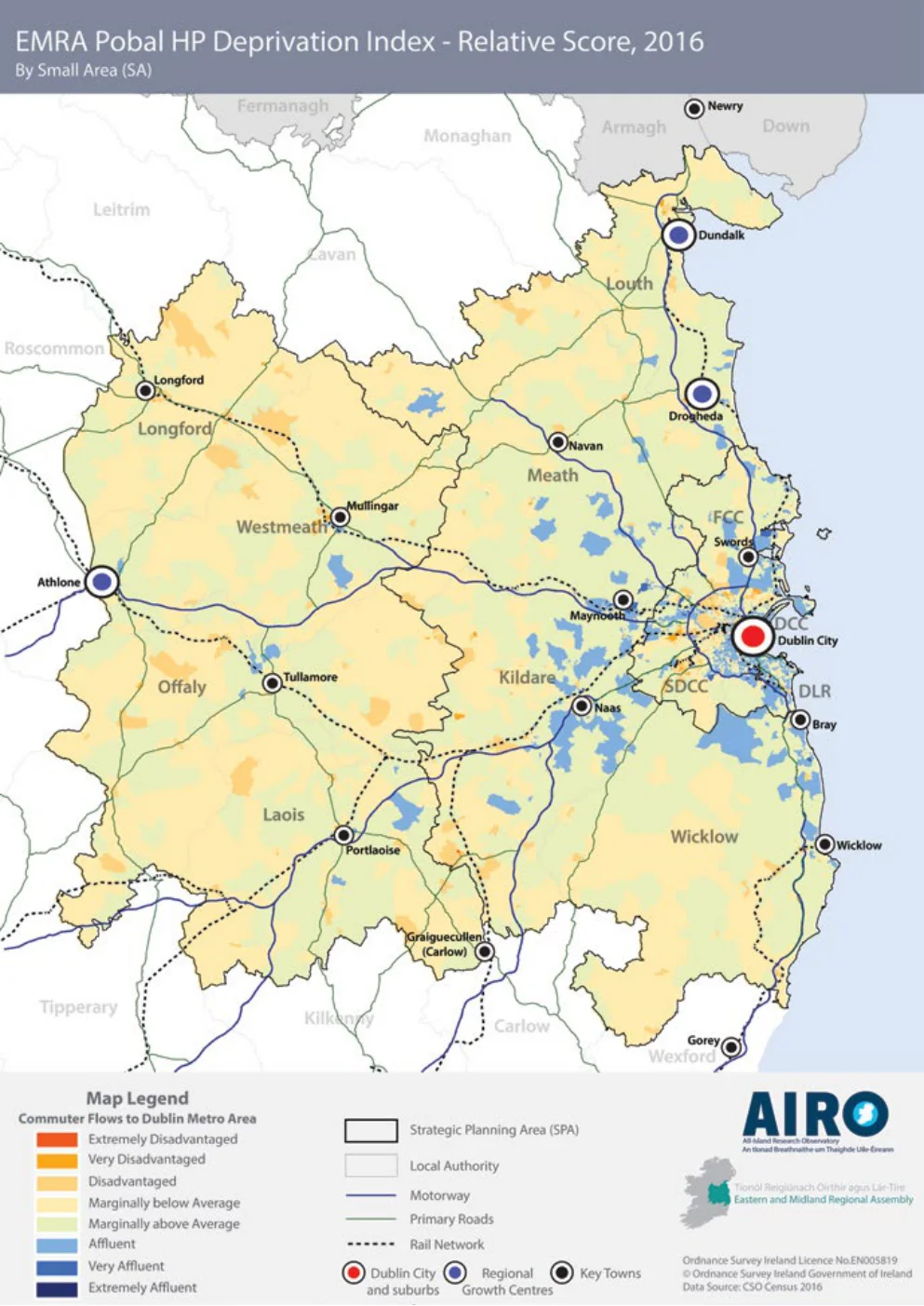
Figure 9.3 Pobal HP Deprivation Index

Figure from page 211
Quality of Life
Pages 208–211 · View in original PDF