9.4 Healthy Placemaking
9.4 Healthy Placemaking
Healthy placemaking seeks to protect and enhance the unique identity and character of places and to facilitate improvements to human wellbeing and the quality of life that comes from the interaction of people and their environment. Placemaking is underpinned by good urban design, which seeks to create public spaces that are vibrant, distinctive, safe and accessible and which promote and facilitate social interaction.
The creation of healthy and attractive places requires ongoing improvements to the physical and social infrastructure of our urban centres, some of which have experienced decline due to prevailing trends of counter-urbanisation and for online and out of town shopping. Effective public realm interventions can dramatically improve human wellbeing and are also a key factor in enhancing the attractiveness of places for talent and business investment as well as for residents, workers, visitors and shoppers.
A key element of healthy placemaking is the need to ensure alternatives to the car in the design of streets and public spaces and to prioritise and promote cycling and walking as active transport modes. The provision of high quality public transport, greenways and cycleways can enhance areas, contributing to more attractive places and creating opportunities to be physically active and reduce the negative consequences of car-based commuting.
GUIDING PRINCIPLES
Guiding Principles for the creation of healthy and attractive places68, to ensure that;
• Good urban design principles are integrated into the layout and design of new development, as set out in Departmental Guidelines ’Sustainable Residential Development in Urban Areas’ and the ‘Design Manual for Urban Roads and Streets (DMURS)’
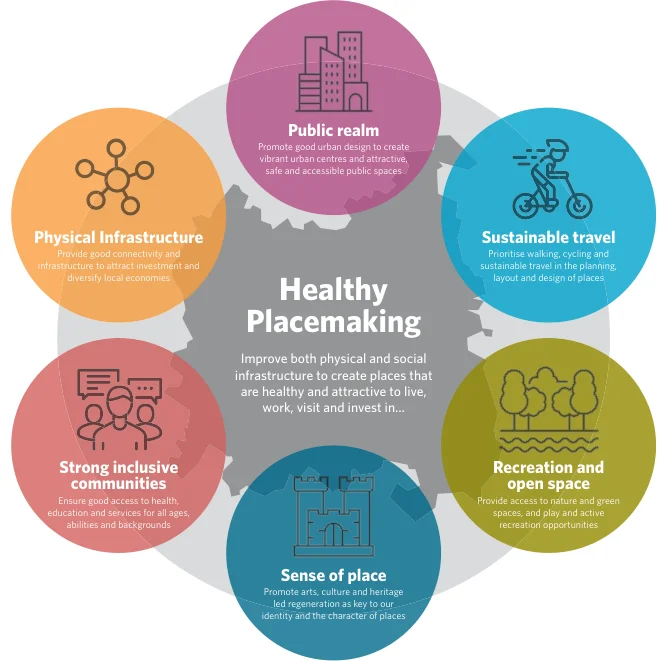
Figure 9.2 Healthy Placemaking Stategy
• Future development prioritises the need for people to be physically active in their daily lives and to promote walking and cycling in the design of streets and public spaces
Public realm Promote good urban design to create
• New schools and workplaces are linked to walking and cycling networks
vibrant urban centres and attractive,
safe and accessible public spaces
Physical Infrastructure
Sustainable travel
• Exposure of children to the promotion of unhealthy foods is reduced such as the careful consideration of the location of fast food outlets in the vicinity of schools and parks
Provide good connectivity and infrastructure to attract investment and
Prioritise walking, cycling and sustainable travel in the planning,
Healthy Placemaking
diversify local economies
layout and design of places
Improve both physical and social infrastructure to create places that
are healthy and attractive to live,
• Provision of open space should consider types of recreation and amenity uses required
work, visit and invest in…
Strong inclusive
Recreation and
communities Ensure good access to health, education and services for all ages,
open space Provide access to nature and green
• Public open spaces to have good connectivity and be accessible by safe, secure walking and cycling routes
spaces, and play and active
abilities and backgrounds
recreation opportunities
Sense of place Promote arts, culture and heritage
• Open space to be planned for on a multi-functional basis incorporating ecosystem services, climate change measures, Green Infrastructure and key landscape features in their design.
led regeneration as key to our identity and the character of places
68 For more information see DECLG ‘Local Area Plans- Guidelines for Planning Authorities’, 2013 (Chapter 5)

Figure from page 206
Regional Spatial & Economic Strategy
Recreation and Open Space
REGIONAL POLICY OBJECTIVES:
The focus on compact growth and increased densities in urban areas will require a greater alignment between the development of communities and the provision and planning of open space to provide for the recreational and amenity needs of communities. The RSES supports the preparation of open space and parks strategies by local authorities, and for enhanced cross boundary collaboration to provide for a hierarchy of open space provision including regional scale open space and recreational facilities.
Healthy Placemaking
RPO 9.10 In planning for the creation of healthy and attractive places, there is a need to provide alternatives to the car and to prioritise and promote cycling and walking in the design of streets and public spaces. Local authorities shall have regard to the Guiding Principles for ‘Healthy Placemaking’ and ‘Integration of Land Use and Transport’ as set out in the RSES and to national policy as set out in ‘Sustainable Residential Development in Urban Areas’ and the ‘Design Manual for Urban Roads and Streets (DMURS)’.
Recreation infrastructure and green spaces which are attractive, rich in biodiversity and well connected are shown to contribute to improved physical and mental health. It is important to consider green space within a holistic framework as it can be enhanced through other means in the built environment including the quality of the surrounding environment, density of residences, land-use mix, connectedness and walkability. The presence of green spaces also has a role to play in reducing air pollution, mitigating floods, protecting wildlife and improving building energy performance.
RPO 9.11: Local authorities shall support the preparation of Design Guidelines to provide for improvements in the appearance of streetscapes and for revitalising spaces for example with cost effective, temporary uses that build on the longer-term vision for space.
RPO 9.12: In Planning policy formulation and implementation local authorities and other stakeholders shall be informed by the need to cater for all levels of disability, through the appropriate mitigation of the built environment, and in particular for the needs of an ageing population.
Research shows that access to green spaces (parks, forests, fields, trees, etc.) and blues spaces (rivers, canals, lakes, coasts) also have clear health benefits. These green and blue spaces can be called green and blue infrastructure (GBI), see Case Study ‘GBI Health’69. Green infrastructure in all its forms and multifunctionality is addressed in Chapter 7 Environment and Climate.
RPO 9.13: Local authorities and relevant agencies shall ensure that new social infrastructure developments are accessible and inclusive for a range of users by adopting a universal design approach and provide for an age friendly society in which people of all ages can live full, active, valued and healthy lives.
CASE STUDY:
GBI Health
Research has shown that people in areas with more GBI (Green and Blue Infrastructure) tend to be healthier. GBI Health is a research project by NUI Maynooth, University College Dublin and the Eastern and Midland Regional Assembly that applied a health led approach to examine the strength of the effect that different types of GBI e.g. rivers versus parks, can have on human health.
This research carried out an audit of Irish health data to identify areas of low and high health outcomes and used GIS mapping to determine what types of GBI were present at multiple scales (neighbourhood to region). The results of the spatial analysis and statistical modelling confirmed associations of good health outcomes with the presence of GBI and associations of poor health outcomes with lower levels of GBI. The results found stronger associations with green rather than with blue space.
69 https://gbihealthireland.com/

Figure from page 207
Quality of Life
GUIDING PRINCIPLES
REGIONAL POLICY OBJECTIVES:
Recreation and Open Space
In planning for recreation and open space local authorities should follow these Guiding Principles:
RPO 9.14: Local authorities shall seek to support the planned provision of easily accessible social, community, cultural and recreational facilities and ensure that all communities have access to a range of facilities that meet the needs of the communities they serve.
• Facilitate a sufficient supply of good quality sports and recreation facilities, including networks for walking, cycling and other activities and shall maximise the multiple use of such facilities by encouraging the co-location of services between sports providers, schools, colleges and other community facilities.
RPO 9.15: Local authorities shall support the vision and objectives of the National Sports Policy, including working with local sports partnerships, clubs, communities and partnerships within and beyond sport, to increase sport and physical activity participation levels locally.
• Support play policies to address the play and recreation needs of children and young people and ensure the integration of play provision and child-friendly neighbourhoods.
RPO 9.16: Local authorities shall support the objectives of public health policy including Healthy Ireland and the National Physical Activity Plan, through integrating such policies, where appropriate and at the applicable scale, with planning policies contained in development plans.
• Provide for the development of dedicated youth spaces in key urban areas and the development of multifunction spaces in smaller communities / rural areas.
RPO 9.17: To support local authorities in the development of regional scale Open Space and Recreational facilities particularly those close to large or growing population centres in the Region.
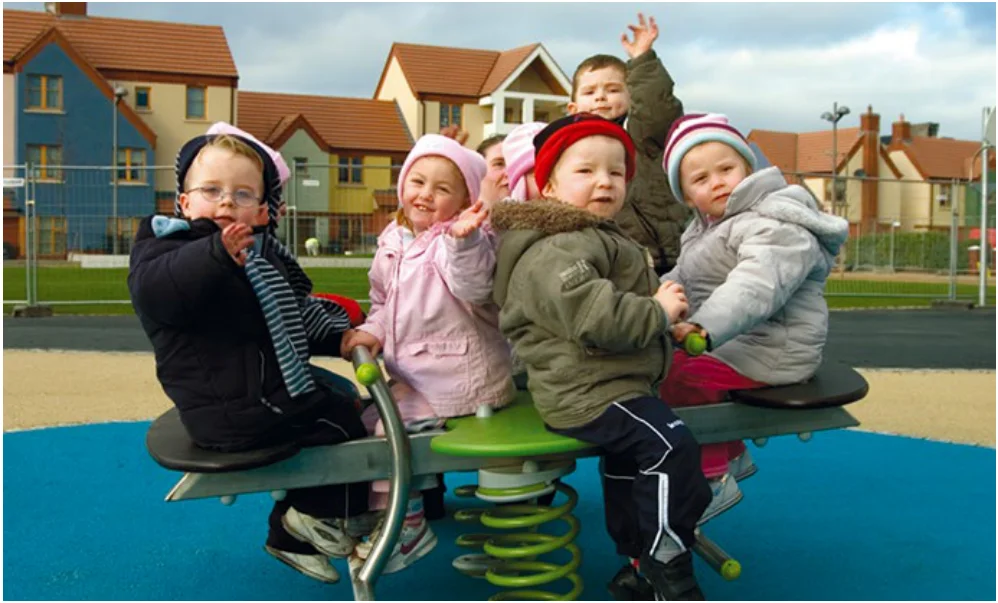
Figure from page 207

Figure from page 208
Regional Spatial & Economic Strategy
Pages 205–208 · View in original PDF