11.2 Collaboration with Northern Ireland in Support of an All Island Approach
11.2 Collaboration with Northern Ireland in Support of an All Island Approach
In the context of ongoing North-South cooperation across a wide range of policy areas, there are three key areas of practical co-operation between relevant departments and local authorities in Ireland and Northern Ireland that will both support and be supported by the implementation of both the NPF and the RSES. These relate to economic development, investment in infrastructure and environmental management.
Dublin – Belfast Economic Corridor
The Dublin – Belfast Economic Corridor, as the largest economic agglomeration on the island of Ireland, is identified in this Strategy as a regional growth enabler. The Corridor comprises a nationally important spine connecting the two largest settlements on the island of Ireland via the regional centres of Drogheda, Dundalk and Newry. The Corridor is underpinned by a strong presence of transport infrastructure connecting Dublin and Belfast.
The regional centres of Drogheda and Dundalk have the potential to form part of a sustainable network of centres of scale, including Newry, connected by public transport within the Region and within the Dublin-Belfast Economic Corridor. The location of Dundalk and Drogheda provides for enhanced cross-border interactions which if promoted can help to realise the growth potential of Drogheda-Dundalk-Newry as an important cross-border network for regional development.
The Corridor is also the national entry point to the island through its airports and ports with three major airports, Dublin Airport, Belfast International Airport and Belfast City Airport, and significant ports in Belfast and Dublin, with complimentary ports along the Corridor.
This needs to be supported through targeted investment in transport infrastructure and services in connecting major urban centres and international gateways, complementing and maintaining its function as part of the EU TEN-T core network, that sees All-Ireland linkages to Cork, whilst the Dublin- Belfast Economic corridor also provides separate linkages onto the Dublin-Rosslare Corridor, see Figure 11.1.
This Strategy supports a drive in the linkage between Dundalk and Newry to strengthen a cross border synergy in services and functions between these towns, to ensure that drivers and policy are complimentary and not competing and for these two towns to continue an approach to shared services and interlinked growth.

Figure from page 230
Regional Spatial & Economic Strategy
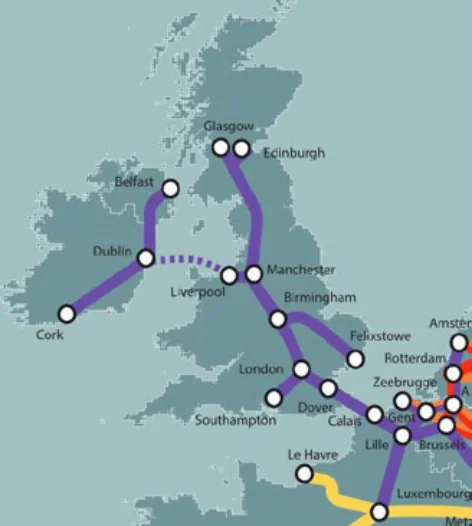
Figure 11.1: TEN – T Core Network (North Sea – Mediterranean).
Investment in Transport, Energy and Communications Infrastructure
This strategy supports the co-operation with relevant departments in Northern Ireland to provide for enhanced transport connectivity between Ireland and Northern Ireland, to include crossborder road and rail, cycling and walking routes, as well as blueways, greenways and peatways.
The need for a new interconnector between the electricity grids of Northern Ireland and Ireland has been identified by the Irish Government and Northern Ireland Executive as a project of common interest. Future enhancement of energy security and resilience to support a population of 8 million people will be supported through progression of further north-south interconnection of electricity grids. The South-North gas pipeline, enhanced East- West interconnection between the island, wider UK and European gas networks and ongoing work to harmonise gas transmission arrangements on the island support meeting EU requirements for gas market integration. These objectives are supported in the Regional Policy Objectives (RPOs) included in this Strategy, see also Chapter 10 Infrastructure.
Figure 11.1: TEN – T Core Network (North Sea – Mediterranean). Source: ec.europa.eu
The Dublin- Belfast Economic Corridor has the capacity to provide the only potential paired city growth pole on the Island of scale - reaching a European benchmark 5 million population target to compete with similar city regions in the EU. The imperative to counteract BREXIT with a proactive spatial economic policy adds to the international significance of the Corridor, see also Chapter 6 Economy and Employment.
In the information age, telecommunications networks play a crucial role in enabling social and economic activity. This RSES supports actions to strengthen communications links to develop a stable, innovative and secure digital communications and services infrastructure on an all-island basis in co-operation with relevant departments in Northern Ireland. This includes, subject to appropriate environmental assessment and the outcome of the planning process, support for further enhancement of links between the North American continent and the island of Ireland and Europe, direct access to international backbone data systems and the roll-out of appropriate public policy and investment interventions such as the National Broadband Plan.
The Strategy promotes the strategic function of the Dublin to Belfast Economic Corridor as a driver for regional economic development within the EMRA area.
Figure from page 230

Figure from page 231
All Ireland Cohesion
Tourism
Management of Our Environment
This Strategy supports the coordination and promotion of all-island tourism initiatives through continued co-operation between the relevant tourism agencies and Tourism Ireland.
In recognition that national and other administrative boundaries do not reflect the trans-boundary nature of the environment and its stewardship, this Strategy seeks to ensure effective management of shared landscapes, heritage, water catchments, habitats, species and transboundary issues in relation to environmental policy in cooperation with relevant departments in Northern Ireland.
This includes support for themed tourism branding bundles linking tourism assets north and south and support for development of blueways and greenways which can offer potential for an enhanced tourism offering throughout the border area including support for longdistance cycling/walking routes which link Northern Ireland and Ireland, see also Chapter 6 Economy and Employment in relation to sectoral opportunities and Chapter 7 Environment & Climate on Green Infrastrcture.
Catchment based strategies require management by both jurisdictions and a number of jointly funded North-South Implementation Bodies have roles and responsibilities in these areas in addition to co-ordination through the North South Ministerial Council. This includes for example the EU Water Framework Directive (WFD) which requires Member States to coordinate their efforts in relation to international river basin districts. Additionally, management of all coastal and transitional waters surrounding the island of Ireland requires a coordination approach, as does management of cross-border groundwater and co-ordination of landscape character assessment, habitats and protected sites.

Figure from page 231

Figure from page 232
Regional Spatial & Economic Strategy
Pages 229–232 · View in original PDF