44 persons
100 persons
1,455 persons
Kildare
+17.4% (102,200)
+13.5% (160,200)
Dún Laoghaire-
Wicklow
Population Density per km Population Change 2000-2016
Figure 1.5 Our Strategic Planning Areas: Vital Statistics, CSO 2016
The Region is also home to areas of rich heritage and immense natural beauty that support a varied tourism and recreation offering, with more than 270km of coastline from Carlingford Lough in County Louth to Kilmichael Point on the Wicklow-Wexford border. Key natural assets include the raised bogs and lakes in the Midlands, the Wicklow Mountains National Park, Slieve Bloom Mountains, the bays and estuaries of the eastern seaboard including the Dublin Bay UNESCO Biosphere and inland waterways such as the Royal and Grand Canals and the Shannon corridor, which are a key focus for water-based tourism.
The Eastern and Midland Region is the economic engine of the State and is on the trans-European network linked to Liverpool across the Irish Sea and to Belfast along the M1 Corridor. The Region is administratively based on three Strategic Planning Areas (SPAs) namely, The Dublin SPA, The Eastern SPA and The Midlands SPA, which provide for a sub-regional planning remit. The SPAs recognise the historic connections and ongoing similarities that exist at this level. The Dublin region is the main global gateway to Ireland, with Dublin Airport one of the fastest growing in Europe and continued growth both in the import and export of goods through Dublin Port. The Eastern counties have the benefit of proximity to Dublin and a strong tourism and leisure offering as well as good national and international connectivity. The Midlands is a dynamic region, centrally located in the heart of Ireland with a high-quality environment and quality of life and unparalleled national interconnectivity.
Our built heritage includes historic and walled towns, world class museums and attractions such as the Guinness Storehouse, the Book of Kells and the UNESCO World Heritage site of Bru na Boinne, the medieval monasteries of Clonmacnoise and Glendalough and a number of historic castles, houses and demesne landscapes.

Figure from page 15
Introduction
A Growing Region
From 2006 to 2016 the Region grew by 15% - an increase of over 300,000 people – exceeding the state average growth rate of 12% over the same period. The Region contains some of the fastest growing communities in the Country which increases demand for housing, infrastructure and services in those areas.
Recent trends show that population growth is set to continue having regard to the Region’s young demographic profile and a return to net inward migration as the Country returns to economic growth after a severe economic crash in 2008. However, population growth rates varied across the Region, with some peripheral and inner urban areas experiencing population decline between 2006 and 2016, while other areas have seen significant growth rates see Figure 1.6.
In line with a prevailing state-wide trend of urbanisation, the Region saw the continued increase in the share of population residing in urban areas however alongside this is a trend for counter urbanisation with strong growth in the peri-urban and rural areas surrounding Dublin. Laois and Fingal were the fastest growing counties, with significant growth rates of 26% and 23% respectively.
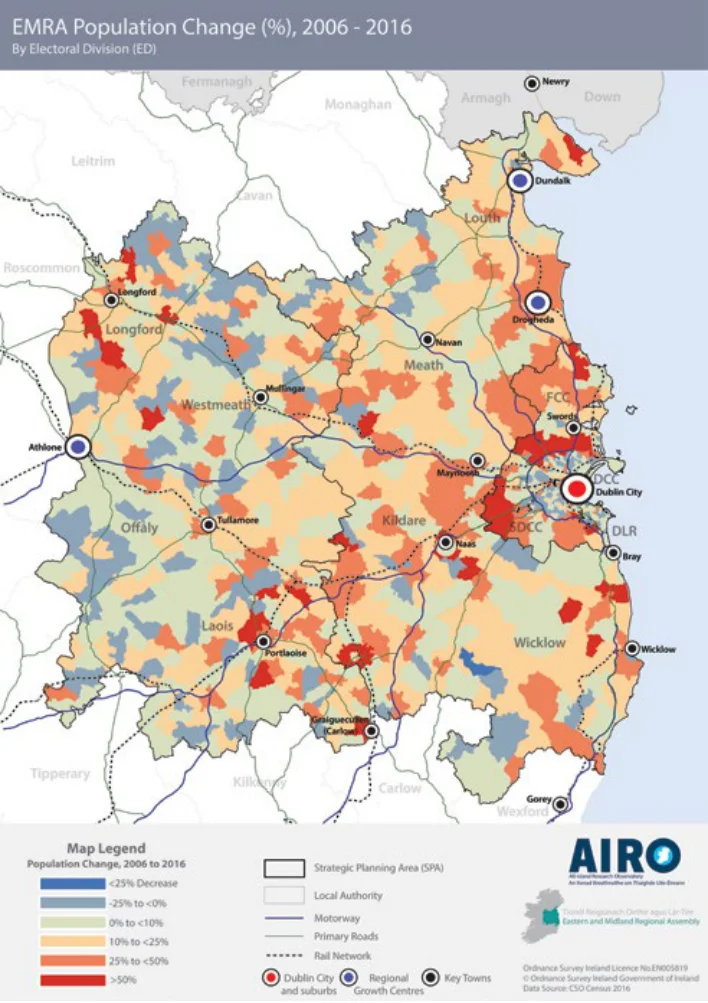
Fig 1.6 Population Change (%) 2006-2016

Figure from page 16
Regional Spatial & Economic Strategy
Young and Diverse
It is important to understand the age breakdown and demographic profile of our population if we are to plan for the long-term housing, transport, education and employment needs of our young, yet ageing population and to attract and retain our highly skilled and multi-cultural labour force.
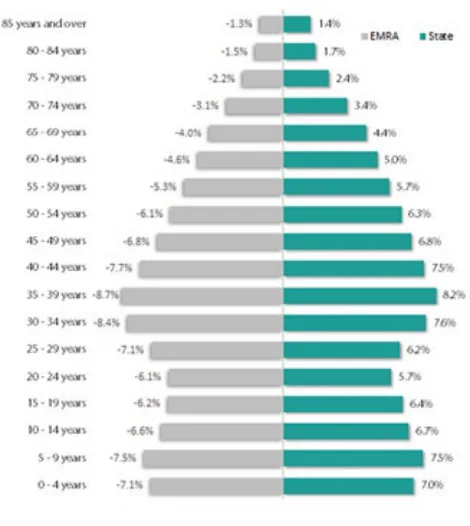
Figure from page 16
EMRA Age Profile (CSO, 2016)
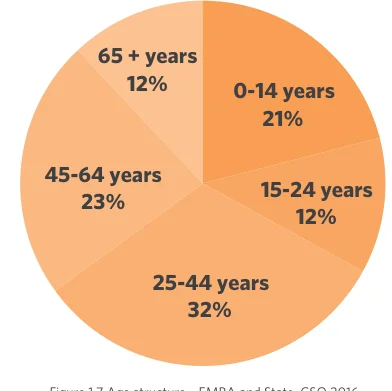
Figure from page 16
Pages 14–16 · View in original PDF