8.4 Transport Investment Priorities
8.4 Transport Investment Priorities
Major transport infrastructure investments, identified in the Project Ireland 2040 - National Development Plan, have an important role in enabling the sustainable and balanced development of the Region over the period of the RSES.
Table 8.2: Rail Projects for the Region
DART Expansion Programme - new infrastructure and electrification of existing lines, including provision of electrified services to Drogheda or further north on the Northern Line, Celbridge-Hazelhatch or further south on the Kildare Line, Maynooth and M3 Parkway on the Maynooth/ Sligo Line, while continuing to improve DART services on the South-Eastern Line as far south as Greystones
Proposals for infrastructure investment should clearly demonstrate their consistency with spatial planning objectives, at regional and national level. Such proposals will be subject to environmental assessment and feasibility where assessment has not already taken place.
Provide for an appropriate level of commuter rail service in the Midlands and South-East
Complete the construction of the National Train Control Centre.
New stations to provide interchange with bus, LUAS and Metro network including Kishoge, Heuston West, Cabra, Glasnevin, Pelletstown and Woodbrook.
The management, maintenance and improvement of existing transport infrastructure is also a key consideration, to ensure that the safety, capacity and the efficiency of the networks are maintained and factored into the capital funding process.
A feasibility study of high-speed rail between Dublin Belfast, Dublin Limerick Junction/Cork will be carried out.
Rail
Reappraisal of the extension of the Dunboyne/ M3 Parkway line to Navan during the Mid Term Review of the GDA Transport Strategy.
The primary function of the rail network in the Region is to provide commuter rail services to Dublin City, and major employment locations within the Metropolitan Area and in large towns. Intercity rail services also play a key role in offering sustainable travel alternatives for longer distance trips, providing improved interregional connectivity.
Complete construction of Metrolink from Swords to Sandyford and consider underground extensions to other locations from Charlemont.
LUAS Green Line Capacity Enhancement in advance of Metrolink.
REGIONAL POLICY OBJECTIVES:
Undertake appraisal, planning and design of LUAS network expansion to Bray, Finglas, Lucan and Poolbeg.
Rail Infrastructure
Undertake assessment, and, if appropriate, planning and design of LUAS network expansion to Hazelhatch and Booterstown.
RPO 8.8: The RSES supports delivery of the rail projects set out in Table 8.2, subject to the outcome of appropriate environmental assessment and the planning process.
In principle there is a need to carry out an evaluation of underground metro routes within the M50.
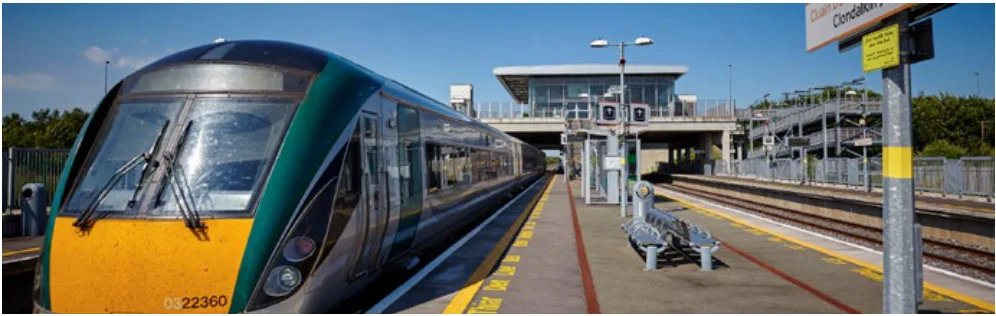
Figure from page 190

Figure from page 191
Connectivity
Bus
Strategic Road Network
Within the Dublin Metropolitan Area, investment in bus infrastructure and services will be delivered through BusConnects. Outside the Metropolitan Area, where bus services provide the backbone of the regional public transport system, in particular for those without access to the private car, investment will be focussed on improving connectivity between regional settlements, including Dublin, and enhancing the reliability and the level of service within key settlements.
The quality of the strategic road network and connectivity to it, within the Region has been substantially improved over the last two decades, with many large-scale road schemes being completed and/or nearing completion. The NDP recognises the importance of achieving steadystate maintenance and safety of the National Roads network as a priority in order to ensure that the existing extensive transport networks, which have been greatly enhanced over the last two decades, are maintained to a high level to ensure high quality levels of service, accessibility and connectivity for transport users.
REGIONAL POLICY OBJECTIVE:
The RSES recognises the importance of maintaining, improving and protecting the strategic function of the key transport corridors including the imperative to improve and protect the strategic function of the Dublin to Belfast road corridor, which forms part of the TEN-T core network.
Bus Infrastructure
RPO 8.9: The RSES supports delivery of the bus projects set out in Table 8.3 subject to the outcome of appropriate environmental assessment and the planning process.
It is not intended to establish an exhaustive list of schemes for development over the period of the RSES especially with regard to maintenance and management of the Region’s roads network. Instead, it is intended that road schemes are developed in accordance with Guidelines on a Common Appraisal Framework for Transport Projects and Programmes for the Department of Transport, Tourism and Sport in accordance with the general objectives of the RSES and the NTA’s Transport Strategy for the Greater Dublin Area.
Table 8.3: Bus Projects for the Region
Core Bus Corridors comprising 16 radial routes and 3 orbital routes in Dublin
Regional Bus Corridors connecting the major regional settlements to Dublin
REGIONAL POLICY OBJECTIVES:
Dublin Metropolitan Bus Network Review
Investment in Improved Strategic Road Connectivity
Network reviews for the largest settlements across EMRA, with a view to providing local bus services
RPO 8.10: The RSES supports appraisal and or delivery of the road projects set out in Table 8.4 subject to the outcome of appropriate environmental assessment and the planning process.
Review of bus services between settlements
Review of local bus services throughout EMRA, including services to small towns and villages and the rural transport programme
New interchange and bus hub facilities
New fare structures
Enhanced passenger information
Improvements to bus waiting facilities
Integrated timetabling of bus and rail into a coherent national and regional network.

Table 8.4: Road Projects for the Region
Regional Spatial & Economic Strategy
REGIONAL POLICY OBJECTIVE:
M7 Naas to Newbridge bypass widening, Osberstown Interchange and Sallins Bypass
Dublin – Belfast Economic Corridor
N2 Slane Bypass
RPO 8.11: Support the improvement, and protection, of the EU TEN-T network and the strategic function of the Dublin to Belfast road network.
N2 Rath Roundabout to Kilmoon Cross
N2 Ardee to south of Castleblaney
RPO 8.12: Support the delivery of a higher speed rail connection between Belfast and Dublin and Cork.
M4 Maynooth to Leixlip
M4 Mullingar to Longford (and Sligo)
M11 from Jn 4 M50 to Kilmacanogue
Rural Transport
N3 Clonee to M50
N52 Ardee Bypass
The NTA provides rural transport services through the Local Link Rural Transport Programme Strategic Plan 2018-2022. The key priorities of this programme continue to be directed at addressing rural social exclusion and the integration of rural transport services with other public transport services. The services provided under the programme are therefore intended to fulfil a primarily social function, in meeting the needs of communities in towns, villages and rural areas.
N52 Tullamore to Kilbeggan
M50 Dublin Port South Access
A number of significant regional road schemes will also be supported and local relief roads will be brought forward as a means of reallocating existing road space in urban areas to public transport, walking and cycling in accordance with guiding principles of this Strategy, subject to the outcome of appropriate environmental assessment and the planning process.
The NTA will develop and expand the Local Link Rural Transport Programme in the following manner:
In addition, long term protection shall remain for the Eastern Bypass and the Leinster Outer Orbital Route.
• seek further integration with other public transport services, including HSE and school transport;
• better linkage of services between towns, villages and rural areas;
Dublin – Belfast Economic Corridor
The Dublin – Belfast Economic Corridor comprises an internationally important spine connecting the two largest settlements on the island of Ireland via the regional growth centres of Drogheda, Dundalk and Newry.
• ensure fully accessible vehicles operate on all services;
• enhance the customer experience;
• increase patronage among children and young people; and
The RSES will promote the strategic function of the Dublin to Belfast corridor as a driver for regional economic development within the Region. This needs to be supported through targeted investment in transport infrastructure and services in connecting major urban centres and international gateways, complementing and maintaining its function as part of the EU TEN-T core network. The EMRA is seeking to promote public transport-based development on the Dublin – Belfast Economic Corridor (see Chapter 6 Economy and Employment).
• encourage innovation in the service.
REGIONAL POLICY OBJECTIVE:
Rural Transport Programme
RPO 8.13: Support the Local Link Rural Transport Programme throughout rural areas of the Region.

Figure from page 193
Connectivity
Park and Ride
Walking and Cycling
REGIONAL POLICY OBJECTIVES:
The following walking and cycling objectives will guide investment in the EMRA:
Park and Ride
• Delivery of the cycle network set out in the NTA Greater Dublin Area Cycle Network Plan inclusive of key commuter routes and urban greenways on the canal, river and coastal corridors
RPO 8.14: The RSES supports delivery of the strategic park and ride projects set out in Table 8.5 subject to the outcome of appropriate environmental assessment and the outcome of the planning process.
• Delivery of the National Cycle Plan within the Region inclusive of the Greenway and Blueway projects
• Provide safe cycling routes in towns and villages across the Region
Table 8.5: New and Enhanced Park and Ride
• Enhance pedestrian facilities in all urban areas in the Region; and
Swords
Finglas
• Investment priorities for cycleways feasibility and route selection studies for cycleways shall identify and subsequently avoid high sensitivity feeding or nesting points for birds and other sensitive fauna.
Dunboyne
Liffey Valley
Naas Road
Carrickmines
Woodbrook
Greystones
In addition, others may be developed in appropriate locations where the national road network meets the strategic public transport network. Across the EMRA, in particular at regional and suburban train stations and on bus routes, the potential for the development and/or expansion of local park and ride facilities will also be examined.
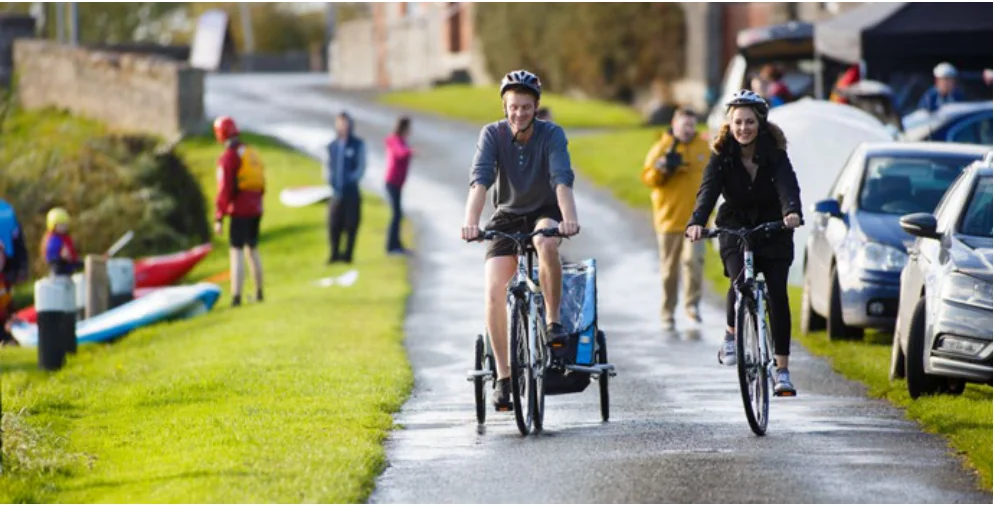
Figure from page 193

Figure from page 194
Regional Spatial & Economic Strategy
Pages 190–194 · View in original PDF