7.9 Climate Change
7.9 Climate Change
Climate change is a global challenge which requires a strong and coherent response at national, regional and local level. Observations show that Ireland’s climate is changing in terms of sea level rise, higher average temperatures, changes in precipitation patterns, more frequent weather extremes, the spread of invasive alien species and increased risk of wild fires, for example upland gorse fires. These changes are projected to continue over the coming decades. Climate change will have diverse and wide-ranging impacts on the Eastern and Midland Region’s environment, society and economic development, including managed and natural ecosystems, water resources, agriculture, food security and bioeconomy, human health and coastal zones.
The thematic approach taken in preparation of this Strategy is underpinned by cross-cutting key principles, one of which is climate change. Climate change is impacting and will continue to impact many of the policies and objectives contained in the Strategy and as such informs policies including those in relation to flood risk management and surface water drainage, settlement strategy, transport, waste management, water services, energy, natural heritage, and green and blue infrastructure.
Project Ireland 2040 the National Planning Framework outlines the role of the planning system in facilitating mitigation of and adaptation to climate change and ensuring that sustainable infrastructure networks build resilience to climate change. In this regard National Strategic Outcome 8 is dedicated to achieving transition to a Low Carbon and Climate Resilient Society. This objective will shape investment choices over the coming decades in line with the National Mitigation Plan and the National Adaptation Framework noting that new energy systems and transmission grids will be necessary for a more distributed, renewable energy focused system, harnessing both the considerable on-shore and off-shore potential from energy sources such as wind, wave and solar and connecting the richest sources of that energy to the major sources of demand.
Climate policy at global, national, regional and local level will continue to be driven by the need to reduce GHG emissions, replacement of fossil fuels or high embedded carbon products with sustainable alternatives such as biobased products, and also enhancing carbon sinks. Emissions in the Region largely come from energy supply, transport, residential and commercial buildings and industry. However, no matter how successful efforts to reduce GHG emissions turn out to be, climate change will continue to impact the Region over the coming decades. The need for appropriate adaptation or climate proofing measures will therefore also be necessary to ensure a comprehensive response to the challenge of climate change in the Region. Adaptation involves taking steps to adjust human and natural systems in response to existing and anticipated climatic change, in order to avoid unwanted impacts and to take advantage of new opportunities that may arise. The priority policy areas identified are energy generation, the built environment and transport.
CASE STUDY:
URB-ADAPT
Urb-ADAPT is a partnership between EMRA and University College Cork, funded by the EPA, to aid climate change adaptation for urban areas in the Eastern and Midlands region.
With Dublin city as a case study, the project aims to develop a regional approach to the assessment and management of current and future vulnerability to climate risks. The project will identify options and requirements and produce implementation guidelines for local authorities across our region in adapting to a changing climate53.
The National Adaptation Framework outlines the following summary of observed and projected climate changes and impacts for Ireland. For an overview of legislation and policy relating to climate change refer to Appendx D.

Figure from page 173
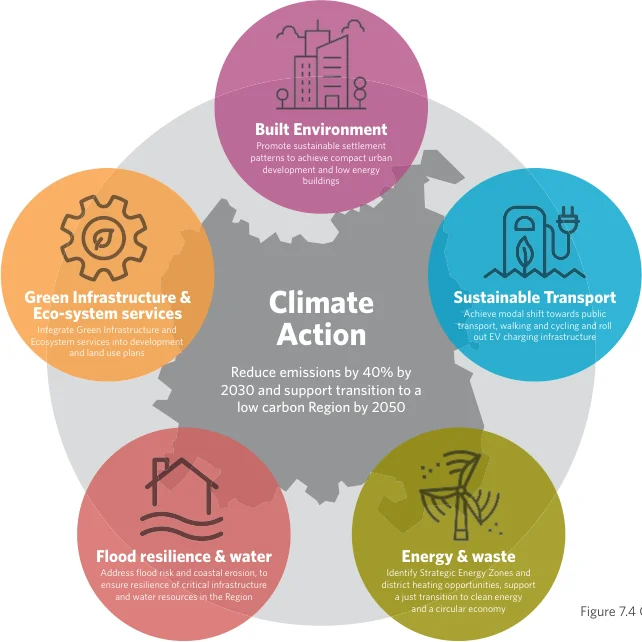
Figure from page 173
Built Environment
Promote sustainable settlement patterns to achieve compact urban
Green Infrastructure &
Sustainable Transport
Eco-system services
Achieve modal shift towards public transport, walking and cycling and roll
Integrate Green Infrastructure and Ecosystem services into development
out EV charging infrastructure
and land use plans
Reduce emissions by 40% by 2030 and support transition to a low carbon Region by 2050
Flood resilience & water
Energy & waste Identify Strategic Energy Zones and district heating opportunities, support
Address flood risk and coastal erosion, to ensure resilience of critical infrastructure
and water resources in the Region
a just transition to clean energy
and a circular economy
Figure 7.4 Climate Stategy
| Parameter | Observed | Projected | Example of Biophysical Impacts |
|---|---|---|---|
| Temperature | n A verage temperatures have increased by 0.8°C since 1900, an average of 0.07°C per decade. n T he number of warm days (over 20°C) has increased while the number of cold days (below 0°C) has decreased. | n P rojections indicate an increase in average temperatures across all seasons (0.9- 1.7°C). n T he number of warm days is expected to increase and heat waves are expected to occur more frequently. | n I ncidences of cold stress are likely to decrease while incidences of heat stress will increase. n T he duration of the growing season will increase, occurring earlier and extending farther. |
| Precipitation | n I ncrease in average annual national rainfall of approximately 60mm or 5% in the period 1981-2010, compared to the 30- year period 1961-1990. n T he largest increases are observed over the west of the country. | n S ignifciant reductions are expected in average levels of annual, spring and summer rainfall. n P rojections indicate a substantial increase in the frequency of heavy precipitation events in Winter and Autumn (approx. 20%). | n T he increased occurrence of dry spells will result in increased pressure on water supply. n A n increase in the frequency of extreme precipitation events will result in increased ful vial and pluvial fol od risk. |
| Wind Speed and Storms | n N o long-term change in average wind speed or direction can be determined with confdi ence. n T he number and intensity of storms in the North Atlantic has increased by approx. three storms per decade since 1950. | n P rojections indicate an overall decrease in wind speed and an increase in extreme wind speeds, particularly during winter. n T he number of very intense storms is projected to increase over the North Atlantic region. Projections suggest that the winter track of these storms may extend further south and over Ireland more often. | n I ncreases in extreme wind speeds may impact on wind turbines and the continuity of power supply. n I nfrastructure will be at risk due to the increased occurrence of intense storms (e.g. winter 2013/2014). |
| Sea Level and Sea Surface Temperature | n H istorically, sea level has not been measured with the necessary accuracy to determine sea level changes around Ireland. However, measurements from Newlyn, in southwest England, show a sea level rise of 1.7cm per decade since 1916. These measurements are considered to be representative of the situation to the South of Ireland. n S ea surface temperatures have increased by 0.85°C since 1950, with 2007 the warmest year in Irish coastal records. | n S ea levels will continue to rise for all coastal areas, by up to 0.8 m by 2100. The south of Ireland will likely feel the impacts of these rises frist. n S ea surface temperatures are projected to continue warming for the coming decade. For the Irish Sea, projections indicate a warming of 1.9°C by the end of the century. | n S ignifciant increase in areas at risk of coastal inundation and erosion. n I ncreased risk to coastal aquifers and water supply. n C hange in distribution fsih species; n I mplications for fsiheries and aquaculture industries. |
Figure 7.5 Observed and projected climate changes and impacts for Ireland Source: National Adaptation Framework

Figure from page 174
Regional Spatial & Economic Strategy
Current Situation
The EPA’s Greenhouse Gas Emissions Projections Report 2017-203554 provides an assessment of Ireland’s total projected greenhouse gas emissions out to 2030, progress towards achieving its emission reduction targets set under the EU Effort Sharing Decision up to 2020 and a longer-term assessment based on current projections.
The report indicates an overall increase in greenhouse gas emissions from most sectors. The projected growth in emissions is largely underpinned by projected strong economic growth and relatively low fuel prices leading to increasing energy demand over the period. The report finds that Ireland is not projected to meet 2020 emissions reduction targets with our non-Emissions Trading Scheme emissions projected to be between 0% and 1% below 2005 levels in 2020. This compares to the target of 20% below 2005 levels by 2020. Furthermore, Ireland is not on the right long-term trajectory to meet longer term EU and national emissions reduction commitments in the electricity generation, built environment and transport sectors.
stations are located within the EMRA Region in Edenderry, Lough Ree and West Offaly. The majority of emissions from energy industries come from power generation. Peat use for power generation is expected to decrease in the short to medium term and the RSES seeks to ensure that alternative energy sources can be facilitated. In terms of transport aviation (Dublin Airport), road and rail are the main sources of emissions. The overall growth in transport emissions projections is largely underpinned by growth in diesel fuel consumption which is expected to decline post 2025 with the acceleration of the deployment of electric vehicles during this period. Policies are therefore needed to facilitate and encourage use of electric vehicles and to increase the potential for trips to be taken by sustainable modes of transport. Emissions in the agriculture and built environment sector are projected to increase and the RSES will need to address the built environment (mainly residential) sector.
The main emissions sources which are relevant to the EMRA Region include electricity, built environment, the transport sector and agriculture. In terms of energy the largest source of emissions is fossil fuel generating stations. Three peat fired
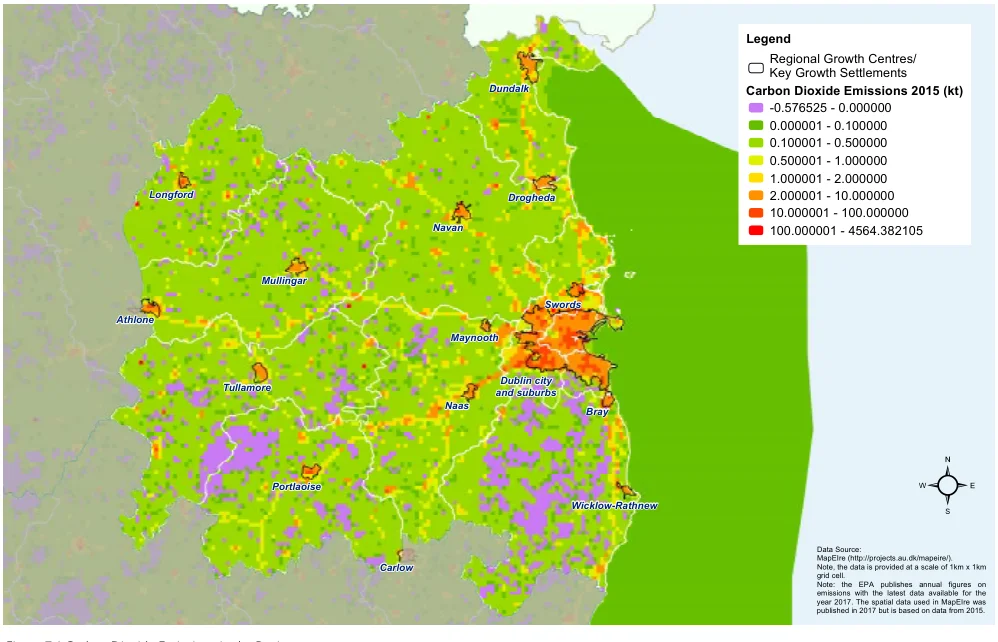
Figure from page 174
Legend
Regional Growth Centres/ Key Growth Settlements Carbon Dioxide Emissions 2015 (kt)
Dundalk
-0.576525 - 0.000000 0.000001 - 0.100000 0.100001 - 0.500000 0.500001 - 1.000000 1.000001 - 2.000000 2.000001 - 10.000000 10.000001 - 100.000000 100.000001 - 4564.382105
Longford
Drogheda
Navan
Mullingar
Swords
Athlone
Maynooth
Dublin city and suburbs
Tullamore
Naas
Bray
²
Portlaoise
Wicklow-Rathnew
Data Source: MapEIre (http://projects.au.dk/mapeire/). Note, the data is provided at a scale of 1km x 1km grid cell. Note: the EPA publishes annual figures on emissions with the latest data available for the year 2017. The spatial data used in MapEIre was published in 2017 but is based on data from 2015.
Carlow
Figure 7.6 Carbon Dioxide Emissions in the Region

Figure from page 175
Environment and Climate
Estimates of GHG emissions at a regional level using 2015 CO2 emissions shows that the highest concentrations of emissions occur in Dublin City and its suburbs, the major settlements, and along the national road network. Some areas show zero to negative CO2 emissions – these areas represent carbon sinks, or areas which can remove CO2 from the atmosphere, such as bogs and large areas of forestry; the mapped distribution of these indicate that the largest sinks occur in the Wicklow Mountains and Slieve Bloom Mountains, as well as in pockets throughout the Midlands.
In terms of addressing the future challenges of climate change, the EMRA will work closely with the newly appointed Climate Action Regional Offices (CAROs). The Dublin Metropolitan Climate Action Regional Office (run by the four Dublin local authorities assisted by Codema) and the Eastern and Midland Climate Action Regional Office (run by Kildare County Council) will be responsible for planning and actions regarding Climate Change mitigation and adaptation in their regions. Climate Action Regional Offices shall ensure coherence and coordination with the RSES when formulating regional climate change adaptation plans.
Figure from page 175

Figure from page 176
Regional Spatial & Economic Strategy
Support Transition to a Low Carbon, Circular & Climate Resilient Region
The Eastern and Midland Regional Assembly is committed to the Region becoming a low-carbon and circular region. This will require reduction of all greenhouse gases, of which carbon dioxide is the most prominent. The priority is to minimise energy demand and waste, and then address how energy will be supplied and renewable technologies incorporated. In order to address this, it is necessary to reduce the effects of climate change through settlement and travel patterns, energy use, waste and protection of green infrastructure.
In order to ensure that future development in the Region will be transitioned to a low carbon usage there is a need to be able to assess the level of transport demand and greenhouse gas emissions. For local authorities, in analysing land for urban development, there is a need to inform the decision making at Core Strategy stage by the ability to assess the predicted impact of the potential land use on modal split and transport greenhouse gas emissions. The Assembly will progress this method of assessment with key stakeholders and transport agencies to provide a robust method of assessment. In addition, city and county development plans will undergo assessment of their impact and progress on carbon reduction targets (See Chapter 3 Growth Strategy RPO 3.6).
In terms of addressing the future challenges of climate change, the EMRA will work closely with the newly appointed Climate Action Regional Offices (CAROs). The Dublin Metropolitan Region Climate Change Office (run by the four Dublin Local Authorities) and the Eastern and Midland Region Climate Change Office (run by Kildare County Council) will support Climate Action in the EMRA region. It will be critically important that actions identified by both the Climate Action Regional Offices and the RSES align in terms of ensuring coherence on climate action responses.
An increase in electricity demand is likely resulting not only from increased population and economic development but also resulting from a move away from the use of fossil fuels in the transport sector towards clean mobility.
CASE STUDY:
In order to ensure security of electricity supply the Strategy must address this increased demand for electricity in such a way as to strike a balance between addressing the need for a significant shift towards renewable energy and enabling resources to be harnessed in a manner consistent with the principles of proper planning and sustainable development.
National mapping of GHG and non- GHG emissions sources
The ‘National mapping of GHG and non-GHG emissions sources’ in Ireland was funded by the EPA and carried out by Aarhus University (AU), Denmark, in cooperation with the Irish emission inventory and the EPA GIS team responsible for the EPA GeoPortal, to support national reporting of spatial emissions, which is now a requirement under international conventions and directives.
A key element of the Strategy is the need to monitor progress towards achieving a low carbon, circular and climate resilient society.
The bioeconomy in Ireland has enormous potential which is yet to be unlocked. Development of the bioeconomy is also consistent with Ireland’s low carbon transition objective. Favouring renewable biological resources over fossil fuelbased ones through the expansion of the bioeconomy, whilst keeping sustainability concerns to the fore, has the potential to contribute towards meeting Ireland’s climate change targets. As the bioeconomy has the potential to grow rural and regional businesses and jobs, it is a useful instrument to embed pro-environmental actions. The bioeconomy extends from farming and the agri-food businesses, marinebased industries, forestry, waste management, energy suppliers, and pharma and bio-technology products. Ireland has flourishing firms in all of these sectors but much more can be done to unlock the bioeconomy’s commercial potential and its environmental benefits.
MapEIre provide emissions with a high spatial resolution of 1 km x 1 km. Emissions mainly occur from road transport, with elevated emissions in urban areas. Spatial emissions for 2016 are consistent with 2018 emission inventory reporting. Output from the national emission mapping model “MapEIjoint re” is presented in maps and shapefiles can be downloaded directly from the website55.
55 http://projects.au.dk/mapeire/spatial-results/download/

Figure from page 177
Environment and Climate
CASE STUDY:
REGIONAL POLICY OBJECTIVES:
Bioeconomy
Climate Change
RPO 7.30: Within 1 year of the adoption of the RSES, the EMRA shall seek with other stakeholders to carry out an assessment of transport emissions in the Region to identify GHG forecasting and to analyse the emissions impacts of development in the Region.
A sustainable bioeconomy is the renewable segment of the circular economy. It can turn bio-waste, residues and discards into valuable resources and significantly cut food waste. Realising this potential requires investment and implementing systemic changes that cut across different sectors (agriculture, forestry, fisheries, aquaculture, food, biobased industry).
RPO 7.31: Within 1 year of carrying out a regional emissions assessment, EMRA shall compile and publish an emissions inventory and, in collaboration with the relevant departments and agencies, agree emissions reductions targets in accordance with agreed national sectoral plans and to support an aggregate 40% reduction in greenhouse gas emissions by 2030 in line with the EU 2030 Framework.
EU and National Funds will support Research and Innovation outputs that address cross-cutting challenges and opportunities in the bioeconomy, including the teaming up of regions in bioeconomy-related Smart Specialisation partnerships. The Department of Agriculture, Food and the Marine and SEAI are also supporting a number of bioeconomy related projects including Agri Bio Circular Economy, led by UCD - ABC Economy, develops new sustainable value chains for the circular bioeconomy in Ireland by maximising value and minimising environmental impacts through cascading of biomass for production of biobased products and energy56.
RPO 7.32: With the assistance and support of the Climate Action Regional Offices, local authorities shall develop, adopt and implement local climate adaptation and mitigation strategies which shall address issues including local vulnerability to climate risks and identify and prioritise actions, in accordance with the Guiding Principles of the National Adaptation Framework, National Mitigation Plan.
RPO 7.33: Climate Action Regional Offices shall provide support to the local authorities on the development, adoption and implementation of local climate action strategies (which can address both adaptation and mitigation). Ongoing support should relate to the specific actions, and obligations and timescales for same that must be undertaken by the local authorities in accordance with local climate change adaptation strategies and compliance with national policy.
RPO 7.34: EMRA supports the National Policy Statement on Bioeconomy (2018) and supports the exploration of opportunities in the circular resource-efficient economy including undertaking a bioeconomy feasibility study for the Region to identify the area of potential growth in the Region to inform investment in line with the national transition objective to a low carbon climate resilient economy.

Figure from page 178
Regional Spatial & Economic Strategy
Decarbonising the Energy Sector
The need for early stakeholder engagement in relation to renewable energy generation projects is critical. Effective community engagement is essential for building public confidence and to help Ireland achieve a transition to renewable energy. An increase in community participation in renewable energy projects such as community ownership models should be supported in this regard. Optimisation of community benefit from renewable energy projects also needs to be ensured.
The Region will need to shift from its reliance on using fossil fuels and natural gas as its main energy source to a more diverse range of low and zero-carbon sources, including renewable energy and secondary heat sources. Decentralised energy will be critical to the Region’s energy supply and will ensure that the Region can become more self-sufficient in relation to its energy needs.
The ‘Sustainable Energy Community’ Network is a programme established by Sustainable Energy Authority of Ireland (SEAI) supporting communities in which everyone works together to develop sustainable energy systems. 200 no. communities across Ireland are now part of the Sustainable Energy Communities network, a rapidly expanding national movement towards a cleaner energy future. This programme has been particularly successful in the Region.
Generating electricity supply from indigenous renewable sources requires:
• facilitating the provision of appropriate renewable energy infrastructure and technologies and deeper cooperation with Northern Ireland and the EU
• expansion and upgrading of the grid with the aim of increasing the share of variable renewable electricity that the all-island system can accommodate
• Onshore wind, bioenergy, solar and offshore energy
CASE STUDY:
• Effective community engagement including support for micro generation
Dunleer Sustainable Energy Community
• Moving from carbon intense fossil fuel generation to lower emissions fuels
In 2015 the Dunleer
Sustainable Energy Community (SEC) was established with the vision of providing leadership to the community of Dunleer County Louth and other communities across Ireland on addressing the challenge of climate change. The objectives of the group are:
• Increasing the use of electricity and bioenergy to heat our homes and fuel our transport
• The need to ensure sufficient electricity to meet increased demand
The Strategy supports an increase in the amount of new renewable energy sources in the Region. This includes the use of wind energy – both onshore and offshore, biomass, and solar photovoltaics and solar thermal, both on buildings and at a larger scale on appropriate sites in accordance with National policy and the Regional Policy Objectives outlined in this Strategy.
• Education; through the ‘energy ambassadors’ community education programme to advise people on everyday steps to reduce energy use
• Retrofit of homes; leading to a 30% reduction in energy use in 200 homes throughout County Louth
• Community energy generation; partnering with the Centre for Renewable Energy at Dundalk IT, Louth County Council and the Alheim region in Germany to develop knowledge and best practice
It is necessary to establish a consistency of approach by planning authorities, both in identifying areas suitable for renewable energy development and having regard to potential impacts, inter alia on biodiversity, landscape and heritage. It is also necessary to reflect the advancements in technology, and reflect the need to engage with, and be responsive to the needs of communities asked to host renewable energy infrastructure.
District heating offers an efficient and cost-effective heating option using networks from a variety of potential technologies and renewable energy sources, such as combined heat and power (CHP), biomass energy, geothermal or energy from waste. The use of renewable energy solutions to provide heating and hot water to houses and businesses contributes to sustainability as it reduces demand for and consumption of energy while using a renewable form of fuel.

Figure from page 179
Environment and Climate
REGIONAL POLICY OBJECTIVES:
Waste heat presents a huge indigenous resource. Waste heat is the single largest available low-carbon source of energy available in the Region that is not being used. In Dublin City alone, there is enough waste heat to meet the heating demands of nearly half of the city’s buildings. These sources of heat are typically used in District Heating systems. Sources of waste heat include data centres. Waste heat is a resource which is too often overlooked and can meet a large proportion of the Region’s heat demands indigenously and without fossil fuels. In response, the Strategy seeks to support the micro-generation, geothermal energy, district heating, storage of heat and energy and the role of the electricity transmission and distribution network.
Decarbonising the Energy Sector
RPO 7.35: EMRA shall, in conjunction with local authorities in the Region, identify Strategic Energy Zones as areas suitable for larger energy generating projects, the role of community and micro energy production in urban and rural settings and the potential for renewable energy within industrial areas. The Strategic Energy Zones for the Region will ensure all environmental constraints are addressed in the analysis. A regional landscape strategy could be developed to support delivery of projects within the Strategic Energy Zones.
RPO 7.36: Planning policy at local authority level shall reflect and adhere to the principles and planning guidance set out in Department of Housing, Planning and Local Government publications relating to ‘Wind Energy Development’ and the DCCAE Code of Practice for Wind Energy Development in Ireland on Guidelines for Community Engagement and any other relevant guidance which may be issued in relation to sustainable energy provisions.
CASE STUDY:
HeatNet
South Dublin County Council has an established track record in participating in European projects, with a focus on Spatial Planning and Energy for Communities in partnership with other local authorities across Europe and the Covenant of Mayors initiative. In partnership with City of Dublin Energy Management Agency (CODEMA), the Council is now leading a project to develop Dublin city’s first public district-heating network.
RPO 7.37: A bioeconomy plan for the Region should be developed that outlines the capacity of the Region to supply the range of bioenergy resources required for the fuel mix as well as the current and projected consumption requirements for growth in this market.
With partners across 5 EU states, the ‘HeatNet’ project will link Tallaght Hospital to the County Hall complex to form the core of a district-heating network which when operational is expected to save the Council almost 1,900 tonnes per year after 5 years. Heatnet will run until 2020 and will receive European Regional Development Funding through the INTERREG North West Europe programme.
RPO 7.38: Local authorities shall consider the use of heat mapping to support developments which deliver energy efficiency and the recovery of energy that would otherwise be wasted. A feasibility assessment for district heating in local authority areas shall be carried out and statutory planning documents shall identify local waste heat sources.
Local authorities should harness the potential of renewable energy in the Region across the technological spectrum from wind and solar to biomass and, where applicable, wave energy, focusing in particular on the extensive tracts of publicly owned peat extraction areas in order to enable a managed transition of the local economies of such areas in gaining the economic benefits of greener energy.
The provision of infrastructure should be supported in order to facilitate a more distributed, renewables-focused energy generation system, harnessing both on-shore and off-shore potential from energy sources such as wind, wave and solar and connecting sites of optimal energy production to the major sources of demand.

Figure from page 180
Regional Spatial & Economic Strategy
Low Energy Buildings
Decarbonising Transport, Sustainable Settlement Patterns and Compact Growth
The design, construction and operation of new buildings has a significant role to play in reducing energy demand and increasing energy efficiency into the future. Careful consideration should also be given to the adaptability of buildings over time, to enable the building stock to be retrofitted or refurbished to meet higher energy efficiency standards into the future. The importance of wood as a low embodied energy material in the construction industry is recognised. The Strategy recognises the importance of the concrete industry in the sustainable long-term development of the construction industry. The ‘wholelife performance’ of concrete products is acknowledged as is the aggregates and concrete industry’s continued strive to provide a net positive environmental impact throughout the lifetime of its products57.
There is an increasing awareness and understanding of the ability of coherent transport planning to contribute towards lowering our national carbon emissions profile, as well as supporting the local economy, facilitating economic development and providing other social and economic benefits to local communities.
Well-planned settlements can ensure that sustainable transport patterns are established by reducing the need for unnecessary private car journeys – and the associated CO2 emissions - and promoting modal shift towards low-carbon travel alternatives such as public transport, walking and cycling. Chapter 8 Connectivity of this Strategy puts forward a Transport Strategy which provides for a shift towards alternatives to the private car, increased walking and cycling, and promotion of greater efficiency in the use of our transport networks. It is of fundamental importance that the distribution of activity (for example where people live and work) is planned in a manner which reduces the need to travel and achieves a move towards a low carbon society having regard to the impact which transport has on carbon emissions.
The National Energy Efficiency Action Plan (NEEAP) 2013- 2020 was updated in 2017 and requires the public sector to show leadership on energy efficiency with a target of 33% improvement in energy efficiency applied to the public sector.
The recast of the Energy Performance of Buildings Directive (EPBD) requires that all new buildings (public and private) are Nearly Zero-Energy Buildings (NZEB) by 2020 (this broadly equates to a BER Rating A3). This is a critical requirement for the housing stock in particular.
Clean and energy-efficient vehicles play an important role in reducing energy consumption, CO2 levels and pollutant emissions. Green public procurement policies therefore represent a valuable tool in demonstrating strong leadership, as well as normalising and supporting the uptake of lowemission vehicles. This is recognised on a national and international level through the Clean Vehicles Directive.
REGIONAL POLICY OBJECTIVES:
Full electrification of the national car fleet represents a feasible option for Ireland, where supporting recharging infrastructure is developed. Though it is expected that most electric vehicle (EV) recharging will happen in homes with driveways, it is important that charging is available where this is not an option. The roll out of EV infrastructure, in particular EV charging infrastructure must, therefore, be integrated and mainstreamed into spatial and planning policies and supported across all levels of governance to ensure that the charging network will allow us to meet current and future needs in the Region.
Low Energy Buildings
RPO 7.39: Local authorities shall report annually on energy usage in all public buildings and will achieve a target of 33% improvement in energy efficiency in all buildings in line with the requirements of the National Energy Efficiency Action Plan (NEEAP).
RPO 7.40: Local authorities shall include policies in statutory land use plans to promote high levels of energy conservation, energy efficiency and the use of renewable energy sources in existing buildings, including retro fitting of energy efficiency measures in the existing building stock and energy efficiency in traditional buildings. All new buildings within the Region will be required to achieve the Nearly Zero-Energy Buildings (NZEB) standard in line with the Energy Performance of Buildings Directive (EPBD).
Modal shift to public transport or non-motorised transport should be supported through improved behaviour and improved transport infrastructure. This should be supported by increased availability of low carbon fuels/biofuels such as Compressed Natural Gas (CNG) as well as implementation of the National Policy Framework on Alternative Fuels Infrastructure for Transport in Ireland and on Parking.
RPO 7.41: Support and promote structural materials in the construction industry that have low to zero embodied energy & CO2 emissions.
57 https://www.irishconcrete.ie/backbone-sustainable-construction/environment/

Figure from page 181
Environment and Climate
Resilience of Critical Infrastructure
REGIONAL POLICY OBJECTIVES:
Critical infrastructure (CI) provides the essential functions and services that support European societal, economic and environmental systems.
Decarbonising Transport
RPO 7.42: Local authorities shall include proposals in statutory land use plans to facilitate and encourage an increase in electric vehicle use, including measures for more recharging facilities and prioritisation of parking for EVs in central locations.
As both natural, including extreme weather events, and man-made disaster and crises situations become more common place, the need to ensure the resilience of CI so that it is capable of withstanding, adapting and recovering from adverse events is paramount. Critical infrastructure includes transport Infrastructure, electricity and gas networks, flood risk management, and water services infrastructure. Critical transport infrastructure is often locally clustered, which can concentrate the negative impacts of climate change and create challenges for contingency planning and responses to extreme weather events. It is important that local authorities, as key decision makers and frontline actors in emergency planning, should be supported in identifying risks and vulnerabilities to key infrastructure to build capacity within their organisations and structures.
Incorporating renewable energy within Ireland’s energy supply may improve the resilience of energy infrastructure as reliance on energy imports and the associated concentrated infrastructure is reduced. Distributed renewable energy sources can contribute to local energy system resilience. For example, during both Storm Ophelia and Storm Emma, when the operation of many of Ireland’s infrastructures was challenged, wind energy maintained output throughout the adverse conditions and contributed to maintaining local supply and post event recovery to normal operation.
The Region should promote best practice in resilience in critical infrastructure, including implementation of emerging European best practice in this regard.
REGIONAL POLICY OBJECTIVES:
Resilience of Critical Infrastructure
RPO 7.43: Climate Action Regional Offices and local authorities should consider the identification of critical infrastructure within their functional areas, and particularly of the interdependencies between different types of sectoral infrastructure, as a first step in ‘future-proofing’ services and to help to inform longerterm adaptation planning and investment priorities.
Regional Spatial & Economic Strategy
8 Connectivity
Pages 172–182 · View in original PDF