7.3 A Clean and Healthy Environment
7.3 A Clean and Healthy Environment
We depend on our natural resources to protect public health, the environment, amenities and to sustain employment in sectors such as agri-food and tourism, particularly in rural Ireland.
The Region’s natural capital can be defined as our stock of renewable and non-renewable resources (e.g. plants, animals, air, water, soils, minerals) that combine to yield a flow of ecosystem services that provide benefits to people. These benefits include clean air and water, a stable climate, protection from floods, food to eat, the resources we use for fuel, building materials, clothes and medicines, recreation and a sense of peace and wonder, as well as habitat for wildlife. Managing natural capital so that it can continue to deliver the ecosystem services that give us these benefits is important in order to ensure sustainable development. Unmanaged natural capital risks the continued degradation and depletion of these assets, and in turn, of their capacity to provide the economy and society with the ecosystem benefits that they depend on. These services also regulate our climate, regulate our water flows (e.g. through wetlands and forests), sequester and store carbon in our peatlands and improve soil quality for our crops.
The EPA’s ambient air quality monitoring network provides real time air quality data for urban areas within the Region. The Department of Communications, Climate Action and Environment are developing a National Clear Air Strategy. This will require local authorities to play a role in local data collection to support the EPA’s network and to facilitate air quality alerts and pollen counts.
REGIONAL POLICY OBJECTIVE:
Air Quality
RPO 7.7: To reduce harmful emissions and achieve and maintain good air quality for all urban and rural areas in the Region and to work with local authorities and the relevant agencies to support local data collection in the development of air quality monitoring and to inform a regional air quality and greenhouse gas emissions inventory.
Access to a clean and healthy natural environment is also shown to bring multiple associated health benefits while environmental pollution can have negative effects on human health, on animals and plants and on natural ecosystems. Most sources of environmental pollution are caused by human activities such as transportation, construction, industrial and agriculture activities and domestic waste.
Noise pollution
Stress from living with noise can have chronic effects on human health including impacts on mental health and sleep disturbance. Excessive noise also has harmful effects on wildlife. The EU Environmental Noise Directive requires that local authorities prepare strategic noise maps and action plans, setting out mitigation measures to reduce the harmful effects, including long term exposure to environmental noise from roads, railways and airport traffic and the protection of ‘quiet areas’, which are shown to bring significant health and wellbeing benefits. The EPA has established an Ocean Noise Register for Ireland. See also Chapter 8 Connectivity in relation to airport noise.
Air Quality
Air pollution is one of the biggest environmental risks to human health leading to respiratory disease, asthma and lung cancer, and to the environment as sources of air pollution also produce climate pollutants. Particulate matter from the burning of fossil fuels for home heating and nitrogen dioxide from traffic is a leading cause of air pollution in the Region.
The protection of air quality requires cross sectoral policy responses to address air pollution emissions including; integrated land use and transport; a shift to active and public transport modes of travel; use of alternative cleaner fuels for home heating and transport including the use of Compressed Natural Gas powered commercial vehicles, a transition to electric vehicles and electrification of public transport and local authority fleets; the promotion of energy efficient buildings and cleaner home heating; the development of Green Infrastructure in urban areas, as trees, hedgerows and bushes can remove pollutants from the air.
REGIONAL POLICY OBJECTIVE:
Noise Pollution
RPO 7.8: Local authorities shall incorporate the objectives of the EU Environmental Noise Directive in the preparation of strategic noise maps and action plans that support proactive measures to avoid, mitigate, and minimise noise, in cases where it is likely to have harmful effects.

Figure from page 156
Regional Spatial & Economic Strategy
Light pollution
Water Quality
Artificial light is important for businesses, homes, roads and recreational purposes, however the inappropriate or excessive use of artificial light – especially blue light – can be harmful to wildlife, particularly nocturnal species and on human health due to sleep disruption. Light pollution can refer to skyglow (the brightening of the night sky over urban areas), light trespass (where light falls where it is not intended) or light glare (where light is excessively bright). Light pollution is increasing in the Region due to increasing development.
Most public water comes from surface water sources including rivers and lakes, groundwater and springs and it is vital that it does not contain pollutants that might endanger public health, aquatic systems and the amenity value of our waters. The Region has abundant water resources including major rivers, lakes and groundwater resources, see also Section 7.7 Green Infrastructure. The aim of the Water Framework Directive (WFD) is to maintain high and good ecological status waters where they exist, and prevent deterioration of status in all waters by identifying key threats to water quality on a catchment basis.
REGIONAL POLICY OBJECTIVE:
Pollution from urban waste water is one of the key threats to water quality, due to inadequate urban waste water treatment (UWWT), storm water overflow or direct discharges into watercourses. Hydromorphology (the physical modification of water bodies due to water abstraction, channelisation and the building of embankments, dams and weirs) is also identified as a key pressure. Loss of wetlands, discharge of silt, drainage, run-off from farming, septic tanks, peat extraction, hedge removal and land improvements can all be significant to water and aquatic habitat quality. With regard to biodiversity, species considered to be most under threat are those linked to wetlands and that are sensitive to water pollution.
Light Pollution
RPO 7.9: Local authorities shall consider measures to minimise the harmful effects of light pollution in the future provision of outdoor lighting, including improving their approach to street lighting and ensuring that new developments are lit appropriately and to ensure that environmentally sensitive areas are protected.
Sustainable Urban Drainage Systems (SuDs) (see also Chapter 10 Infrastructure – Guiding Principles for incorporation of SuDs) and Wetland and River Restoration initiatives can play a role in regulating the flow and water filtration. In addition, water conservation is increasingly important and sustainable water management practices such as rainwater harvesting and adopting circular economy systems can help in meeting our obligations under the Water Framework Directive and Climate adaptation.
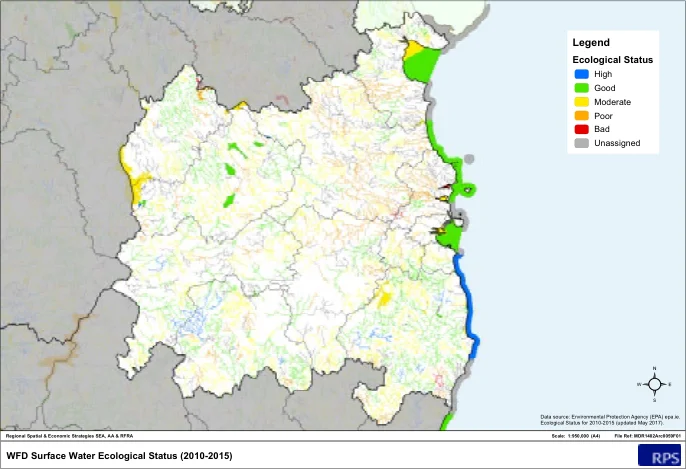
Figure 7.1 Status of Water Bodies
Legend
Ecological Status
High
Good
Moderate
Poor
Bad
Unassigned
² Regional Spatial & Economic Strategies SEA, AA & RFRA
Data source: Environmental Protection Agency (EPA) epa.ie. Ecological Status for 2010-2015 (updated May 2017).
File Ref: MDR1402Arc0059F01
Scale: (A4) 1:950,000
WFD Surface Water Ecological Status (2010-2015)

Figure from page 157
Environment and Climate
Integrated Catchment Management
Compliance with the Water Framework Directive (WFD) is achieved through River Basin Management Plans (RBMPs) and a Programme of Measures that are reviewed every six years. For the second cycle of those plans from 2018–2021, a single national River Basin District has been defined. EU Water Policy Regulations also place new obligations on local authorities in coordinating the catchment management and public participation elements of the WFD and the development and implementation of River Basin Management Plans (RBMPs).
REGIONAL POLICY OBJECTIVES:
The draft ‘Water Services Guidelines for Planning Authorities’ is being prepared by DHPLG to assist planning authorities in implementing the requirements of the WFD. Once finalised, the Guidelines will be issued under Section 28 of the Planning and Development Act 2000. The Guidelines are prepared in consultation with Irish Water and the local authority sector.
Water Quality
RPO 7.10: Support the implementation of the Water Framework Directive in achieving and maintaining at least good environmental status for all water bodies in the Region and to ensure alignment between the core objectives of the Water Framework Directive and other relevant Directives, River Basin Management plans and local authority land use plans.
The Local Authority Water and Communities Offices (LAWCO) has been set up to co-ordinate local authorities on water issues and to engage with local communities on water related projects. There are two regional committees supported by LAWCO in the Eastern and Midland Region which include the Border, and the Midlands and Eastern regions.
RPO 7.11: For water bodies with ‘high ecological status’ objectives in the Region, local authorities shall incorporate measures for both their continued protection and to restore those water bodies that have fallen below high ecological status and areas ‘At Risk’ into the development of local planning policy and decision making any measures for the continued protection of areas with high ecological status in the Region and for mitigation of threats to waterbodies identified as ‘At Risk’ as part of a catchmentbased approach in consultation with the relevant agencies. This shall include recognition of the need to deliver efficient wastewater facilities with sufficient capacity and thus contribute to improved water quality in the Region.
The Regional Committees are developing a Regional Integrated Catchment Management Programme for the period of this RBMP (2018– 2021) to set out new evidencebased measures for mitigation of threats in water bodies identified as being ‘At Risk’ and prioritised Areas for Action under the RBMP. A key aim of Integrated Catchment management is to facilitate the movement and sharing of data and information between local authorities, the EPA and other relevant public authorities at the water-body scale.
Figure from page 157

Figure from page 158
Regional Spatial & Economic Strategy
Pages 155–158 · View in original PDF