6.6 Drivers for Resilient, Sustainable and Inclusive Economic Growth
6.6 Drivers for Resilient, Sustainable and Inclusive Economic Growth
Economic growth is driven by productivity growth which in turn is underpinned by skills, innovation, infrastructure, trade, and our enterprise ecosystem.
Skills and Talent
Innovation
It is people who innovate, who have ideas, who build networks to produce and grow our economy. The ability to develop, nurture, retain and attract talent is critical in today’s dramatically changing world, therefore education and training institutions are needed to develop our people’s skills and talent. However, it needs to be ensured that the skills are appropriate and relevant to the needs of the individual, the economy and society as a whole. The National Skills Council (NSC) advises on prioritisation and delivery of identified skills needs, and Regional Skills Fora managers26 foster stronger links between employers and the education and training sector.
The collective capacity to innovate is one of the most important sources to improve productivity and maintain competitiveness for the Region. Innovation 2020 sets up the national strategy for research development, science and technology, it identifies the actions for supporting innovation in enterprise, education for innovation, and innovation for social progress in the economy.
The DBEI Disruptive Technologies Innovation Fund (DTIF) aims to encourage collaboration in science, technology and innovation to increase our innovation capacity, and it draws from the Research Priority Areas 2018-2023, see Table 6.2.
Although progress has been made with Apprenticeship and traineeship programmes27, there are still challenges on lifelong learning with the national rate below the European average. Particular shortfalls are amongst the employed, workers over the age of 35 and those who do not hold a third level qualification.
The Region is home to a wide range of organisations engaged in innovation, such as education institutions and research centres28, most of which are located in the Dublin Metropolitan Area, Athlone and Dundalk. This is a key strength of the Region that can be capitalised upon.
26 The Fora have been established to align with wider Government policy and initiatives on regional economic development, including the Regional Action Plans for Jobs, Education and Training Providers Enterprise agencies, local authorities, INTREO. Various Government departments and agencies, representatives of enterprise and employers in each region. The Fora main activities and outcomes: Engagements, Forum Specific Event Participation, Signposting, Industry Involvement with Education Provision HE, Relationship building, Skills needs assessments, and Apprenticeship/Traineeship Development.
27 Recently the Apprenticeship Council developed programmes in the areas of insurance practice, electrical engineering, accounting technician and international financial services. A total of 8 new traineeship programmes have been developed and rolled out in 2017 in areas such as hospitality, animation and engineering.
28 http://www.knowledgetransferireland.com/Find-a-Research-Partner/Research-Map-of-Ireland/

Table 6.2 Disruptive Technologies Innovation Fund (DTIF)
Economy & Employment
| Table 6.2 Disruptive Technologies Innovation Fund (DTIF) | |
|---|---|
| Themes | Priority Areas |
| ICT | Future Networks, Communications and Internet of Things |
| Data Analytics Management, Security, Privacy, Robotics, Artificial Intelligence (including Machine Learning), Augmented Reality and Virtual Reality | |
| Digital Platforms, Content and Applications | |
| Health and Wellbeing | Connected Health and Independent Living, |
| Medical Devices | |
| Diagnostics | |
| Therapeutics | |
| Food | Food for Health, Smart and Sustainable Food Production and Processing |
| Energy, Climate Action and Sustainability | Decarbonising the Energy System and Sustainable Living |
| Manufacturing and Materials | Advanced and Smart Manufacturing, |
| Manufacturing and Novel Materials | |
| Services and Business Processes | Innovation in Services and Business Processes |
REGIONAL POLICY OBJECTIVES:
Skills and Innovation
RPO 6.25: Support REPs, LEOs and local authorities to collaborate with the Regional Skills Fora managers, Higher Education Institutes, Education and Training Boards and local stakeholders to address skills shortages and lifelong learning challenges in the Region.
RPO 6.26: Support and foster the collaboration of industry and research to identify areas of research, development and innovation, and to identify projects for funding.
RPO 6.27: Support community and adult education providers who are already providing formal and nonformal education to targeted disadvantage groups and who have already identified the barriers to participation in lifelong learning such as childcare, transport and rural isolation to increase participation rates and support progression into further education and employment.
Figure from page 143

Figure from page 144
Regional Spatial & Economic Strategy
Social Enterprise
Technology and Innovation Poles-Anchors: Regional Scientific Centres
Social enterprises trade for a social/societal purpose, earn at least part of their income from trading activity, they are separate from government, and re-invest surplus to pursue the social objective. They assist with addressing social, economic and environmental challenges while fostering inclusive growth, shared prosperity, social inclusion, training and job creation often for marginalised people. They represent an opportunity to deal with endemic unemployment blackspots.
The creation of Technology and Innovation Poles provided for under the NPF, envisages building facilities and developing the expertise and supportive capabilities of the Institutes of Technology (IoTs) and Universities (DCU, UCD, Trinity and NUI Maynooth) that includes working with Enterprise Ireland, IDA Ireland and Regional Skills Fora, to support the development and growth of the Region.
This concept sees a role for the IoTs, as a driver of startups and scale-up of enterprises across the Region through inter-institutional connections and impactful collaboration.
Social enterprises operate in what is known as the Third Sector or the social economy and seek to address challenges which the private sector may not see a viable or profitable opportunity and in which the public sector may struggle to provide effective service delivery. They typically embrace and embed collaboration, solidarity, pluralism and sustainability leading to integrated economic and community development in their respective setting or concerning their social objective. See also Chapter 9 Quality of Life in relation to Social and Economic Opportunity.
REGIONAL POLICY OBJECTIVES:
Technology and Innovation Poles – Anchors: Regional Scientific Centres
RPO 6.29: Support the development of sites where high-tech and high potential start-ups (HPSU29) can thrive, in conjunction with IoTs and Universities, to create collaborative and innovative growth.
REGIONAL POLICY OBJECTIVES:
Social Enterprise
RPO 6.28 Support local authorities in the design, development and roll-out of social enterprise practices, with a strong emphasis on collaboration.
29 A HPSU is defined as: a start-up that is introducing a new or innovative product or service to international markets; is involved in manufacturing or internationally traded services; is capable of creating 10 jobs in Ireland and realising €1 million in sales within three to four years of starting up; is led by an experienced management team; is headquartered and controlled in Ireland; and is less than five years old from the date of the company’s registration.

Figure from page 145
Economy & Employment
Smart Cities, Towns and Villages
CASE STUDY:
Although there is no single definition of a smart city, at its simplest, the concept envisages a smart city as one that has digital technology embedded across all urban functions. There are opportunities for greater innovation in and around our cities, towns and villages.
‘Smart Dublin’
Smart Dublin is an initiative of the Dublin local authorities, which aims to promote the Dublin region as a world leader in the development of smart city technologies, using open data, and with innovation districts such as Smart Docklands as a test bed. Smart Dublin is participating in the national innovation pre-commercial procurement initiative administered by Enterprise Ireland (Small Business Research Initiative), which provides an opportunity for local authorities to engage with smart technology providers, researchers and citizens to develop new technology solutions through a programme of competitive challenges32.
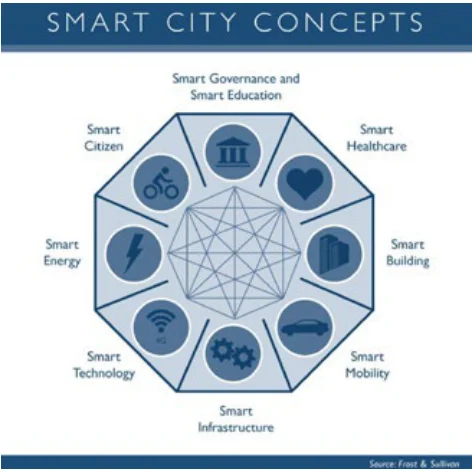
Figure 6.7 Smart City Concepts
The ‘All Ireland Smart Cities Forum’, supported by Maynooth University provides a platform for networked knowledge sharing between the cities of Cork, Dublin, Limerick, Galway, Waterford, Belfast, Derry and Newry and includes the two regional initiatives of Smart Dublin and Cork Smart Gateway.
The EU Action for Smart Villages33 initiative seeks to develop the potential offered by improved rural connectivity and digitisation and to build on local enterprise and infrastructure assets to drive innovations around energy, transport, agri-food, tourism, e-services, remote working etc.
The Smart City30 is a concept and platform to solve complex challenges and achieve policy outcomes, such as the efficient use and deployment of infrastructure and local services, increasing public safety, increasing entrepreneurial activity through the intelligent usage of technology. It involves a systematic integration of ICT in the planning, design, operations and management of our cities, towns and villages for the benefit of the citizen. Smart cities boost the location’s attractiveness for people and business, especially those who want to innovate31.
Local authorities can also support the development of ‘smart communities’ by allowing use of public assets to support increased local connectivity and by ‘digital master planning’ of new large-scale development areas. To leverage the Disruptive Technologies Innovation Fund, EMRA will support and identify flagship projects that would benefit from public-private partnerships involving experiments with emerging technologies and a focus on the citizen experience. This will demonstrate ambition and showcase Ireland as a technology-rich economy in an international context34.
REGIONAL POLICY OBJECTIVES:
Smart Cities, Towns and Villages
RPO 6.30: Support existing smart city initiatives such as Smart Dublin and the All Ireland Smart Cities Forum and support the development of smart city programmes in Athlone, Dundalk and Drogheda.
30 Although there is no single definition, at its simplest, the concept envisages a smart city as one that has digital technology embedded across all city functions. http://www.forbes.com/sites/sarwantsingh/2014/06/19/smart-cities-a-1-5-trillion-market-opportunity/
31 Examples of smart city initiatives include: Amsterdam Smart City (ASC); Barcelona (e.g. Open Data BCN); Copenhagen (first carbon neutral city ambition); and Esbjerg, Denmark (Next Step City)
33 European Commission, European Network for Rural Development, EU Action for Smart Villages, 2017
34 International examples include: the ambition to make Paris car free by 2025; Singapore is working with Siemens on waste disposal and marketing itself as a place for tech research into waste; Sweden is focusing on e-payments to become an almost cashless society; Estonia was the first country in the world to implement a nationwide ‘birth-to-death’ electronic health record system.

Figure from page 146
Regional Spatial & Economic Strategy
Our Enterprise Ecosystem-Stimulating a Pipeline for Growth
The survival and growth of new businesses are critical elements of any economy’s growth and performance. New businesses are the source of new ideas, technologies, disruptive business models and new sectors. Entrepreneurs and start-ups thrive within a dynamic community of like-minded and supportive individuals, hence, it is an aim of the RSES to create a business environment that is conducive to business start-up, including SMEs, and sustaining growth throughout all phases of their lifecycle. EMRA will aid and support enterprise development agencies in the removal of obstacles to starting a business, and to seek ways in which risk can be minimised, to ensure that starting a business is considered to be a valid career option.
In order to gain the maximum return on investment, a series of factors needs to be borne in mind that will maximise the likelihood of new business formation and continued success of existing businesses. The evidence35 points to the availability of human capital36; proximity to a third level institution; transport infrastructure; broadband infrastructure37; and finally, a diverse local sectoral mix as being key factors in the development of start-ups. In addition, access to finance is required and investigations into the suitability of Local Public Banking Models are acknowledged, specifically through the inclusion of post offices and credit unions as part of invigorating local communities particularly in the area of SMEs and the agri sectors that allow commerce to thrive.
In addition, co-working spaces and business incubator hubs play an important part of the ecosystem as they represent the physical environment where entrepreneurs and start-ups operate. With this in mind, a network of co-working hubs hosting techworkers and distributed across the Region offers a platform to materialise and further develop the concept of Ireland’s Edge. The network can be centrally directed but locally managed and driven by a whole range of stakeholders. It represents a hotbed of learning, creativity and innovation with the potential to become a significant experimental testbed for developing a practical, internationally comparable approach to development. Kells Technology Hub and MERITS Think Space in Naas are examples of these hubs.
The Local Enterprise Offices (LEOs) network that operate throughout the Region play a key role as the first one-stop shop for small enterprises that trade locally. The LEOs act as catalysers, drivers and accelerators of entrepreneurship by means of training and increasing networking and connections in the innovation and entrepreneurship ecosystem.
Finally, from a social perspective, the challenges posed by unemployment blackspots are recognised. An understanding of their nature and causes is required in order to identify policy responses and revert reinforcing negative patterns39.
REGIONAL POLICY OBJECTIVES:
On one hand, LEOs reinforce the ‘think small first’ principle in terms of coordinating with relevant stakeholders to make it easier for businesses to start and to navigate their way through the first years of trading. On the other hand, EI and IDA work on creating and strengthening linkages between Irish-owned enterprises and foreign-owned enterprises38. In the context of BREXIT and disruptions to supply chains, it is timely to accelerate activities in this regard, building on learnings to date, and further strengthening the capabilities and capacities of Irish owned enterprises to meet demand for innovative products and services. Altogether, enterprise development agencies and LEOs support existing Irish Entrepreneurs and set-up conditions to attract overseas entrepreneurs to the country.
Innovation Capacity
RPO 6.31: Support enterprise development agencies and LEOs in their efforts to increase business innovation capacity, to create a distributed network of coworking hubs, to promote Ireland’s Edge to strengthen linkages between Irish-owned enterprises and foreign owned enterprises, and to support existing Irish entrepreneurs and to attract overseas entrepreneurs.
35 McCoy et al. (2018) the impact of broadband and other infrastructure on the location of new business establishments. Journal of Regional Science.
36 Measured as the percentage of the population with a third level qualification.
37 Which needs to be coupled with availability of Human capital to have a significant effect.
38 The ‘Global Sourcing Initiative’, ‘Trade Missions’ to Ireland and ‘Peer networks for Lean initiatives’ provide a stimulus to increase linkages between Irish and foreign owned entities and contribute to optimising spillover benefits.
39 Clustering initiatives to address unemployment blackspots in the region may adopt a ‘shared value’ approach or ‘inclusive cluster framework initiative’, for instance: http://masseconomics.com/wp-content/uploads/2014/05/EDJ_12_Fall_InclusiveClusters.pdf

Figure from page 147
Economy & Employment
Infrastructure Investment
CASE STUDY:
Continuous investment in infrastructure is required to meet the growing demands from population and increasing economic activity. In line with Project Ireland 2040, several large infrastructure projects have already been approved for feasibility studies. Therefore, the Regional Investment Plan will be co-ordinated along with the forthcoming National Land Development Agency, as well as the NDP.
Tech Hubs
Co- working spaces provide desk and office space, a coworking community, and the supports and networks that technology entrepreneurs and businesses need to start, internationalise, and grow their business. It is an objective of the Department of Business Enterprise and Innovation (DBEI) to build a network of innovative co-working spaces in the Mid East counties of Kildare, Meath and Wicklow.
REGIONAL POLICY OBJECTIVES:
The Kells Technology Hub is an example, which offers serviced affordable accommodation to startups and SME’s to support entrepreneurship, training and the delivery of innovation programme, which was funded through the ‘Rural Economic Development Zone’ (REDZ) initiative. MERITS will be a new, purpose built, co-working incubation and accelerator space in Naas, with technology expertise and supports by MaynoothWorks, which will house over 100 tech workers when open in 2020.
Infrastructure Investment
RPO 6.33: With the allocation outcomes from the competitive calls EMRA, in cooperation with the Department of Public Expenditure and Reform (DPER), will prepare a Regional Investment Plan for the Region in accordance with Project Ireland 2040 and the Public Spending Code.
Trade
Monitoring and Evaluating Our Ecosystem Performance
Mechanisms to gain access to international markets, such as Free Trade Agreements provide an opportunity for the Region’s enterprise base to grow and compete internationally. Although trade agreements are managed at EU level, measures can be put in place to gain greater share in international markets for the Region, and to increase the chances of entry into new markets. These mechanisms include international relationships and visibility with branding and reputation.
Establishing an environment to stimulate entrepreneurship will require concerted effort to continuously assess and reassess what is working and what is not and to take the necessary actions in a timely manner to redress barriers.
REGIONAL POLICY OBJECTIVES:
EMRA supports the development of a coherent and shared vision for all EMRA stakeholders with international focus, building on heritage, culture and attractive qualities of the Region. This vision can be supported with case studies for public buy-in, LECPs should consider a similar international focus.
Ecosystem Performance
RPO 6.32: Support enterprise development agencies to map, monitor and evaluate the Region’s enterprise and innovation ecosystem, benchmarking against other relevant jurisdictions nationally and internationally.
EMRA with its European role and the Irish Regions European Office shall collaborate with Government departments to strengthen and develop international partnerships and strengthen the Region’s economic diplomacy. This includes proposals for re-routed trade corridors between Irish ports and mainland Europe after Brexit.
REGIONAL POLICY OBJECTIVES:
Branding
RPO 6.34: EMRA will support the construction of a regional brand that is consistent with, and complementary to, current local and national branding, to promote the Region domestically and abroad.

Figure from page 148
Regional Spatial & Economic Strategy
Pages 142–148 · View in original PDF