6.5 Specific Sectors: Retail, Tourism, Marine, Low Carbon Economy and Agriculture
6.5 Specific Sectors: Retail, Tourism, Marine, Low Carbon Economy and Agriculture
The following specific sectors- as labour intensive economic activities - are of particular importance to the Region, given their sensitivity for job creation, maintenance and sustainability.
Retail
The retail sector is a significant employer and economic contributor in the Region. It also plays a key role in placemaking and creating attractive liveable environments. As a significant attractor it enables the provision of strong mixed-use commercial cores throughout the network of city, towns and villages in the Region and can play a key role in the regeneration of areas.
The Retail Planning Guidelines for Planning Authorities 2012 are designed to ensure retail development is plan-led, to promote city centre vitality through the sequential approach to development, enable good quality development in appropriate locations, facilitate a modal shift; all to deliver quality urban design outcomes.
REGIONAL POLICY OBJECTIVES:
Retail Strategies and Retail Planning Guidelines
RPO 6.10: EMRA will support the preparation of a Retail Strategy / Strategies for the Region in accordance with the Retail Planning Guidelines for Planning Authorities 2012, or any subsequent update, to update the retail hierarchy and apply floorspace requirements for the Region.
The Retail Strategy for the Greater Dublin Area 2008 was prepared by the Dublin and the Mid-East Regional Authorities (now dissolved). The retail hierarchy as expressed in the GDA strategy is substantially reflected in current city and county development plans, and is presented here combined with the existing retail hierarchy in the remainder of the Region that was not included in the GDA. It is recognised that the floorspace thresholds detailed in the GDA strategy were prepared in a different economic climate and in many cases are still to be reached. In this regard, EMRA will support and drive the preparation of a new retail strategy for the Region under the requirements of the Retail Planning Guidelines for Planning Authorities 2012, or any subsequent update, to update this hierarchy and apply floorspace requirements for the Region.
RPO 6.11: Future provisions of significant retail development within the Region shall be consistent with the Retail Planning Guidelines for Planning Authorities 2012, or any subsequent update, and the retail hierarchy for the Region, expressed in the RSES, until such time as this hierarchy is updated.
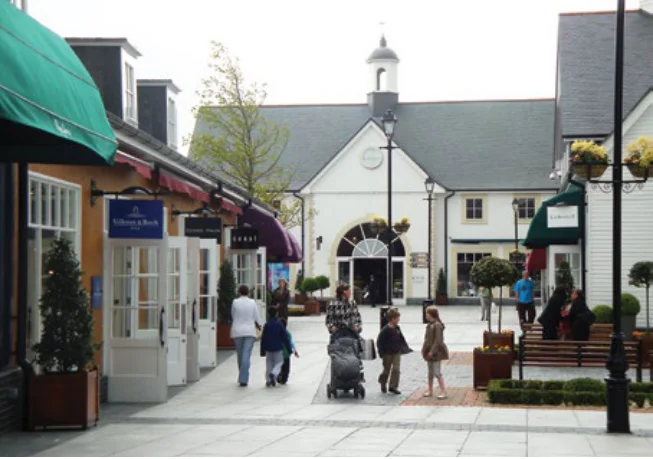
Figure from page 136

Table 6.1 Retail Hierarchy for the Region
Economy & Employment
| Table 6.1 Retail Hierarchy for the Region | |
|---|---|
| Level 1 | Metropolitan Centre |
| Dublin City Centre | |
| Level 2 | Major Town Centres & County (Principal) Town Centres |
| Dún Laoghaire: Dún Laoghaire, Dundrum | |
| Fingal: Swords, Blanchardstown | |
| Kildare: Naas /Newbridge, Maynooth | |
| Laois: Portlaoise | |
| Longford: Longford | |
| Louth: Drogheda, Dundalk | |
| Meath: Navan | |
| Offaly: Tullamore | |
| South Dublin: Tallaght, Liffey Valley | |
| Westmeath: Athlone, Mullingar | |
| Wicklow: Bray, Wicklow | |
| Level 3 | Town And/Or District Centres & Sub-County Town Centres (Key Service Centres) |
| Dublin City: Finglas, Northside Shopping Centre, Ballyfermot, Rathmines, Crumlin Shopping Centre, Donaghmede Shopping Centre, Omni, Ballymun, Point Village and Poolbeg, Clongriffin / Belmayne, Phibsborough, Naas Road | |
| Fingal: Malahide, Balbriggan, Skerries, Charlestown | |
| South Dublin: Adamstown, Crumlin (Ashleaf), Clonburris, Clondalkin, Citywest, Kilnamanagh, Lucan, Rathfarnham | |
| Dún Laoghaire–Rathdown: Stillorgan, Blackrock, Cornelscourt, Nutgrove, Cherrywood | |
| Wicklow: Greystones, Arklow, Blessington (Baltinglass, Rathdrum, Newtownmountkennedy) | |
| Meath: Ashbourne, Dunshaughlin, Kells, Trim (Laytown/Bettystown) | |
| Kildare: Celbridge, Kilcock, Kilcullen, Athy, Kildare, Monasterevin, Clane, Leixlip | |
| Laois: Portarlington, Graiguecullen | |
| Louth: Ardee, Drogheda District Centre: Matthews’ Lane, Dundalk District Centres: Dublin Road & Ard Easmuinn | |
| Offaly: Birr, Edenderry | |
| Westmeath: Castlepollard | |
| Longford: Granard | |
| Level 4 | Neighbourhood Centres, Local Centres-Small Towns And Villages |
| Level 5 | Corner Shops/Small Villages |
Framework for Town Centre Renewal
The concepts of vitality and viability are central to maintaining and enhancing town centres. Keeping a town vibrant and responsive to the needs of the community is an ongoing challenge and a greater range of supports need to be put in place to enable successful town centre renewal. These supports could include administrative supports by local authorities, training supports for town centre coordinators or other town stakeholders and financial supports such as grants for office fit outs, shop front grants, or supports for starting businesses and the Town and Village Renewal scheme and urban and rural regeneration funding.
The Framework for Town Centre Renewal (Retail Consultation Forum, 2017) sets out an action plan for Town Centre renewal which has the potential to support viable and sustainable towns and villages that meet the long-term needs of our society, economy and environment. Refer to Chapter 9 Quality of Life for additional policies in relation to placemaking.
REGIONAL POLICY OBJECTIVES:
Town Centre Renewal
RPO 6.12: Local authorities shall include objectives in development plans and local area plans supporting emphasis on placemaking for town centres, for example through inclusion of a Placemaking Strategy for towns and implementation of Town Centre Renewal Plans.
RPO 6.13: Local authorities shall support the preparation of Design Guidelines to provide for improvements in the appearance of streetscapes and for revitalising vacant spaces for example with cost effective, temporary uses that build on the longer-term vision for space.
RPO 6.14: EMRA will support the use of targeted financial incentives to re-establish the dominant role of town centres provided for in planning policy to encourage a greater take up of town centre development opportunities for retail, residential, commercial, and leisure uses.

Figure from page 138
Regional Spatial & Economic Strategy
Tourism
Natural and Cultural Tourism Assets
A safe, clean environment, scenic landscapes and rich heritage contribute greatly to our cultural identity and quality of life, and are key attractions for overseas visitors to the island of Ireland. The Government’s Tourism Policy Statement People, Place and Policy Growing Tourism to 2025 sets the Government’s primary objectives for tourism i.e. to increase overseas visitors and revenue and the associated employment whilst protecting our natural, built and cultural assets. The ‘Action Plan for Rural Development Realising our Rural Potential’ highlights the potential of activity tourism to contribute to economic growth in rural areas.
The Region has a varied and rich tourism offering from the cultural draw/assets of the capital city, to the long sandy beaches and cliff walks along the east coast that extend north to the Cooley Peninsula and connect with the Mournes and Sliabh Gullion in Northern Ireland. The Midlands has a diverse and relatively unspoilt landscape presenting a broad range of tourism related opportunities in its inland waterways, lakes, canals, rivers, mountains, forests, parks, eskers, peatlands, architecture and historical demesnes.
People have lived, farmed and visited the Region from prehistoric times shaping the landscape that we have today. From the Neolithic passage graves of the Boyne Valley, to the royal seat of the High Kings at Tara, to the monasteries of Glendalough, Clonmacnoise and Monasterboice and their round towers which offered protection from Viking invasions, to the Cistercian abbeys of Bective and Mellifont which brought agricultural reform, to historic Dublin Castle, to the Walled Towns of Trim, Castledermot and Drogheda, the planned estates of Abbeyleix and Castletown House. The Peatlands of the Bog of Allen and the plains of the Curragh are unique landscapes in the Region.
The Department of Transport, Tourism and Sport Policy Document People, Place and Policy Growing Tourism To 2025 makes a number of policy proposals that are relevant to the planning of tourism, namely;
• Protecting heritage assets through sustainable tourism
• Targeting high growth potential areas
• Incorporate Cultural and Sports-based Offerings
• Respecting Brand Architecture and the Environment
The inland waterways of the Grand and Royal Canals; and the Rivers Barrow, Boyne, Liffey and Shannon, are the foundation of a blueway tourism product (see Chapter 7 Environment & Climate). There is the potential for a coast to coast network of national greenways, including the Royal and Grand Canals and the Barrow Way, with regional water-based trails along the Old Rail Trail Greenway, and the Boyne Valley greenway on the old Kingscourt line. A number of potential local leisure trails include the Dublin Bay Sutton to Sandycove route, the Dodder Greenway and Tolka River and Carlingford to Newry.
• Need to optimise Air and Sea Connections
• Need to facilitate inter-modal transport transfers
• Support for Cross-Border Tourism
Fáilte Ireland has identified that our landscape and heritage are the key driver for the promotion of Ireland’s tourism, followed by its people, its safe environment and its range of attractions. There is an inextricable link between the Region’s landscape, agriculture and tourism offer. The vast array of built, cultural and natural assets that are the cornerstone of our tourism product need adequate resources to sustain them. Our natural and cultural landscapes are a finite resource with varying degrees of carrying capacity. The quality of our natural scenery and physical environment, built heritage, and the range of activities for visitors, are areas in which national, regional and local government have a key role to play, through conservation and preservation of that which is irreplaceable and the sustainable development of that which enhances the visitor’s overall experience.

Figure from page 139
Economy & Employment
REGIONAL POLICY OBJECTIVES:
Three of the four Fáilte Ireland’s regional tourism brands are based in the Region: Dublin- Surprising by Nature, Ireland’s Ancient East and Ireland’s Hidden Heartlands. Their research has identified niche areas such as food, heritage and cycling tourism which can be built into unique tourism product offerings for each of their regional tourism brands.
Natural and Cultural Tourism Assets
RPO 6.15: Support the preparation and implementation of Visitor Experience Development Plans within the Region to underpin the overarching regional tourism brands and to deliver greater tourism benefits and to promote the natural and cultural assets of the Region.
Fáilte Ireland is creating a framework to develop and deliver visitor experience development plans (VEDPs) across the Country to underpin these brands, and to address the issues of regionality and seasonality in Ireland. Through collaboration and partnership, stakeholders and industry must join together to develop a joint plan and commit to delivery of its actions. A VEDP has already been prepared for Ireland’s Ancient East. This will enable clusters and geographies to amplify their local tourism offering in a compelling and motivating way for international tourists and encourage increased visits, dwell time and spend in the locality.
RPO 6.16: Support working with relevant landowners and recreational/ tourism agencies to increase access to the countryside and coastal areas to ensure maintenance of the existing network.
RPO 6.17:Support the maintenance of, and enhanced access to state and semi-state lands such as National Parks, Forest Parks, Waterways, etc., together with Monuments and Historic Properties, for recreation and tourism purposes. Access should be planned and managed in a sustainable manner that protects environmental sensitivities, ecological corridors, and the ability of local infrastructure to support increased tourism.
CASE STUDY:
Lough Boora Discovery Park
RPO 6.18:Support the preparation and implementation of local authority tourism strategies and diaspora strategies. All tourism strategies and plans should include clear monitoring protocols to monitor the ongoing effect of tourism on sensitive features with particular focus on natural and built heritage assets.
REGIONAL POLICY OBJECTIVES:
Tourism
RPO 6.19: Support the local strategies that are already in place to link the River Shannon Blueway, The Royal and Grand Canal Greenways and the proposed Barrow Blueway right across the Midlands, incorporating the towns of Longford, Athlone, Mullingar, Tullamore and Portarlington.
Increasing areas of Bord na Móna peatlands are becoming cutaway and have potential for beneficial uses including renewable energy, biodiversity, amenity uses, water storage and other infrastructure. Lough Boora Discovery Park is an example of a cutaway area that has been developed as an amenity with high biodiversity value, with restored wetland and woodland habitats.
RPO 6.20: Support Offaly County Council, Bord na Móna and Coillte in the development of the ‘Midlands Cycling Destination- Offaly’.
Lough Boora, which once supplied over a million tonnes of peat every year, is now a sanctuary for wildlife, with a visitor centre and 24 land sculptures, inspired by the area’s industrial heritage. It is also a prime outdoor recreation attraction with an extensive network of off road walkways and cycle paths, including the Mesolithic Route, one of the most important historic sites in Ireland. Lough Boora now attracts over 100,000 visitors a year.

Figure from page 140
Regional Spatial & Economic Strategy
Investing in the Tourism Product
There needs to be a recognition that investment is needed in the assets themselves in terms of ensuring their sustainability and ability to support a growing tourism industry. Adequate recognition of the value of investing in heritage conservation will reduce the potential conflict with loss of authenticity and appreciation of a place, tourism provision and more informed planning decisions. Investing in heritage in terms of placemaking will benefit not just tourism but the local citizen.
A Framework for Destination Towns across Ireland, prepared by Fáilte Ireland, will ensure that the standard for these towns is raised and they are transformed into destination towns that satisfy the needs and desires of our tourists. To do this, it assigns and sustains different roles to the two main types of destination towns based on their tourism functions:
• Always-On Destination Towns are usually larger towns that offer a full range of year-round facilities at scale. They will usually be the main transport hub for the Region (often at the end of main national arterial road and rail routes); have a wide range of accommodation types and supply; have conference, hotel, restaurant and shopping facilities that are open all year; and considered to be the main hub for the Region.
There is a commitment from government in the ‘Investing in our Culture, Language & Heritage 2018 - 2027’ to invest in the sustainable tourism potential of our culture and heritage infrastructure. The ambition is for a world-class cultural and heritage infrastructure as well as providing a world-class visitor experience for people coming to our national parks and reserves.
• Seasonal Destination Towns offer a full range of smallerscale seasonal facilities. They scale down – often significantly – during the off season, offering only local services while relying on the ‘always-on’ destination towns to provide support for those tourists who do visit in the off season. However, during the peak season they will offer transport services, medium/small-scale hotels, B&Bs, holiday homes, attractions, restaurants, cafés, pubs etc. They also function as activity hubs from where visitors can explore the wider rural area.
To come to an area, visitors need reassurance that there will be enough attractions to see and activities to do during the day, a sufficient range of accommodation options and a night-time economy to provide evening options. The most effective and efficient way to deliver this for visitors is through destination towns. Many of these towns already deliver well to fulfil the needs and desires of our visitors, particularly in established tourist destinations. Others, however, both within established destination areas and outside them, require varying degrees of improvement and investment across a wide range of touchpoints including transport links, accommodation supply, public realm attractions, restaurants, a night-time economy, visitor management etc.
REGIONAL POLICY OBJECTIVE:
Identification of Destination Towns
RPO 6.21: EMRA will work with local authorities and Fáilte Ireland to identify destination towns within the Region for the prioritisation of investment and supports to drive tourism growth in the Region, to spread the benefit of tourism throughout the Region and to encourage the increase of tourism product development.
Figure from page 140

Figure from page 141
Economy & Employment
Marine
Agriculture
Development opportunities in the marine or blue economy relate to fishing, renewables, new applications for health and medicine, and tourism to name a few.
Agriculture is intrinsically linked to our national identity and the agri-food sector is one of Ireland’s most important indigenous manufacturing sectors. The agri-food and drink sector in Ireland in 2016 generated 7% of gross value added (€13.9 billion), and accounts for almost 10% of employment when processing and marketing are included. Because agri-food companies source most of their raw materials and services from Irish suppliers, this sector produces a far bigger return than other traded sectors of the economy.
Marine resources provide many non-commercial benefits too, for example amenity, biodiversity and climate regulation. Given the increasing demand for marine space, the forthcoming National Marine Spatial Plan will enable stakeholders and the public to ensure a joined up approach in planning and management. Further RPOs with regard to the development of the blue economy and maritime heritage are dealt with in Chapter 7 Environment & Climate.
Agricultural production, sustainability, food security and health are closely linked and there is a growing recognition on the value of agricultural land, particularly in areas that are experiencing strong urbanisation pressures. There is a need to ensure both the protection of the agriculture industry and the rural landscape that supports it. This includes recognising the value of horticultural land, protecting the resource productivity of agricultural land and addressing development pressures and the potential impact that Brexit will have on agriculture and food exports throughout the region.
REGIONAL POLICY OBJECTIVE:
Marine Economy
RPO 6.22: EMRA support the preparation of the Marine Spatial Plan (MSP) to ensure alignment, and consistency between land use and ocean based planning, and to ensure co-ordination which supports the protection of the marine environment and the growth of the Marine economy.
Agriculture is both highly exposed to and is a significant contributor of Climate Change, accounting for over a third of all national emissions. Current quantity and export driven Irish agriculture targets are set out in Food Harvest 2020 and Food Wise 2025. There is a need to align our climate targets and the future proofing of the agricultural economy and to establish sustainable farming practices and production methods. The Smart Farming programme promotes the adoption of resource efficiency measures that demonstrate both cost savings and environmental benefits.
Low Carbon Economy and Circular Economy
An acceleration of the transformation of our economic activities and the way we live towards a more sustainable setting is one of our main aspirations.
Section 7.9, Climate Change, provides further detail on the approach the RSES adopts to transform our Region into a low carbon and circular Region. Nevertheless, there is an opportunity for the Region’s enterprise and innovation ecosystem to explore sectoral opportunities in industries that employ green technologies and are in line with our National Adaptation Framework.
REGIONAL POLICY OBJECTIVES:
Agriculture
RPO 6.24: Support the Departments of Agriculture, Food and the Marine, and Communications, Climate Action and Environment to enhance the competitiveness of the agriculture sector with an urgent need for mitigation as well as real and effective and adaptation mechanisms for the long-term sustainability of the agri-sector.
REGIONAL POLICY OBJECTIVES:
Low Carbon and Circular Economy
RPO 6.23: Support enterprise development agencies and LEOs on the development of industries that create and employ green technologies and take measures to accelerate the transition towards a low carbon economy and circular economy.

Figure from page 142
Regional Spatial & Economic Strategy
Pages 136–142 · View in original PDF