5.2 Vision
5.2 Vision
The vision for the MASP was developed in collaboration with key stakeholders in tandem with and complementary to the vision for the RSES. The visioning process identified some key strengths and place attributes to determine current issues and opportunities and building on this, developed a vision for where the Dublin metropolitan area should be in 12 to 20 years.
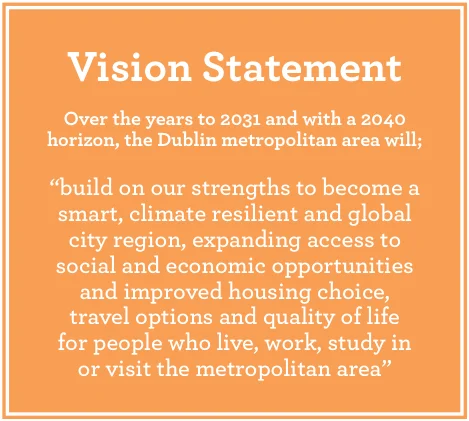
Figure from page 100
Over this horizon the MASP needs to be flexible enough to adapt and respond to external risks such as climate change, technology disruption, demographic and cultural change and economic shocks and to support a future transition to low carbon, for sustainable and electric mobility, increased access to online services and an ability to respond to and benefit from smart technologies.
Vision Statement
Over the years to 2031 and with a 2040 horizon, the Dublin metropolitan area will;
“build on our strengths to become a
smart, climate resilient and global
The Dublin Metropolitan Area is young, diverse and multicultural and is performing well at an international level. However, there is a need to better manage the sustainable and compact growth of the city, and to address key challenges related to housing supply, affordability, transport, sustainability and liveability to ensure Dublin can sustain its competitiveness, provide good quality of life for residents and continue to attract and retain talent and investment as a global city region.
city region, expanding access to social and economic opportunities
and improved housing choice, travel options and quality of life for people who live, work, study in
or visit the metropolitan area”
Key assets are Dublin’s vibrancy, welcoming people and unique character, culture and heritage assets along with access to Dublin Bay and the coastline, the Phoenix Park and the Dublin and Wicklow Mountains. The friendliness and diversity of its people and the concentration of amenities, social and economic opportunities and access to public transport networks are also key to Dublin’s success.
This high-level vision is underpinned by a spatial framework that supports the overall Settlement Strategy in Chapter 4 People and Place and sets out an integrated land use and transportation strategy for the sequential development of the metropolitan area, focussed on:
• Consolidation of Dublin City and suburbs
There is a need to enable regeneration and employment opportunities for established communities where redevelopment and re-intensification occurs, particularly in areas of on-going deprivation. Changing demographics and increasing urbanisation will also require a long-term planning response to meet existing and future needs translating into demand for regeneration, housing and employment.
• Key Towns of Swords, Maynooth and Bray
• Planned development of strategic development areas in Donabate, Dunboyne, Leixlip and Greystones

Figure from page 101
Dublin Metropolitan Area Strategic Plan (MASP)
Pages 100–101 · View in original PDF