5.1 Introduction and Context
5.1 Introduction and Context
Increasingly city regions are the focal point for internationally mobile investment and high skilled jobs. While Dublin performs well on an international scale, it has significant challenges in areas such as transport, housing, amenities, sustainability and liveability. Therefore, it is imperative that Dublin should have a clear ambition and vision to build on its strengths as a global metropolitan region.
The MASP is an integrated land use and transportation strategy for the Dublin Metropolitan Area that sets out;
The requirement for a Metropolitan Area Strategic Plan (MASP) to be prepared for Dublin as part of the Regional Spatial and Economic Strategy is set out in Project Ireland 2040 – National Planning Framework (NPF). The MASP provides, for the first time, a 12 to 20 year strategic planning and investment framework for the Dublin metropolitan area.
• A Vision for the future growth of the metropolitan area and key growth enablers, identifying strategic corridors based on their capacity to achieve compact sustainable and sequential growth along key public transport corridors, existing and planned
The MASP is aligned with a number of Regional Strategic Outcomes in the RSES which include managing the sustainable and compact growth of Dublin, the regeneration of cities and better use of under-used land, integrated transport and land use and the promotion of Dublin as a global city region.
• Large scale strategic residential, employment and regeneration development opportunities and any infrastructure deficits or constraints that need to be addressed
• A sequence of infrastructure priorities to promote greater co-ordination between local authorities, public transport and infrastructure providers for the phased delivery of sites.
Figure from page 99
The Dublin Metropolitan Area (DMA)
The boundary of the Dublin Metropolitan Area (DMA) was established in the Regional Planning Guidelines (RPGs) for the Greater Dublin Area (GDA) 2010- 2022 and the NTA Strategy for the Greater Dublin Area (GDA) 2016 – 2035. There are seven local authorities in the metropolitan area including all of Dublin City, South Dublin and Dún Laoghaire-Rathdown and parts of Fingal, Meath, Kildare and Wicklow.
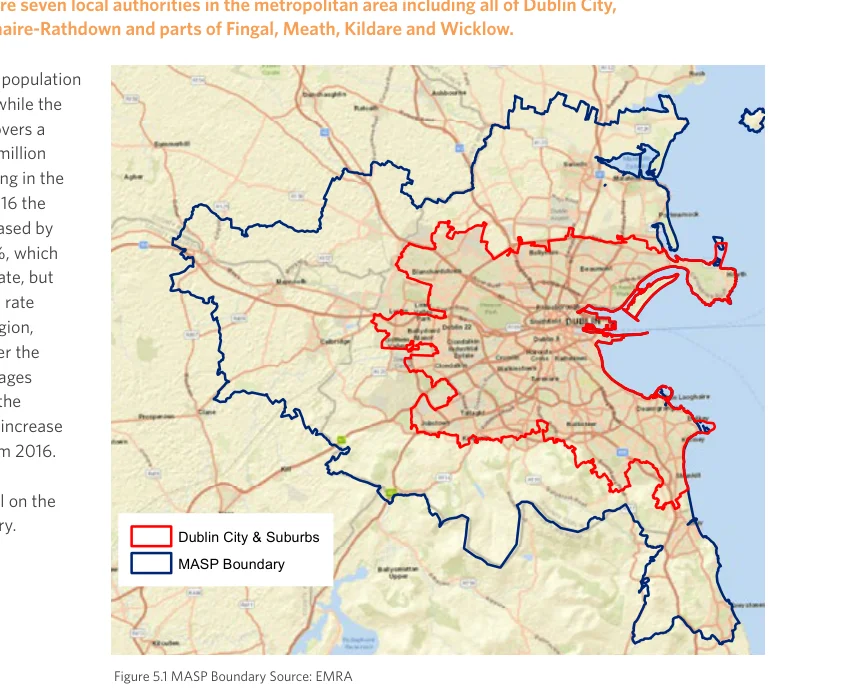
Figure from page 99
Dublin City and suburbs has a population of 1.2 million people, in 2016, while the metropolitan area of Dublin covers a wider area and is home to 1.4 million people or 3 out of 5 people living in the Region. Between 2006 and 2016 the metropolitan population increased by around 160,000 people or 13%, which was slightly higher than the state, but lower than the average growth rate in the Eastern and Midland Region, which grew by around 15% over the same period. The MASP envisages a population of 1.65 million in the metropolitan area by 2031, an increase of 250,000 people or 18% from 2016.
See Appendix E for more detail on the definition of the DMA boundary.

Figure from page 100
Regional Spatial & Economic Strategy
Pages 98–100 · View in original PDF