4.8 Rural Places: Towns, Villages and the Countryside
4.8 Rural Places: Towns, Villages and the Countryside
The RSES recognises the major contribution that rural places make towards regional and national development in economic, social and environmental terms. Rural areas in the Region, including the Gaeltacht area, contribute to Ireland’s unique culture and identity, and provide significant natural resources, biodiversity, environmental qualities and landscape features.
Challenges Facing Rural Places
Physically, the rural parts of the region are characterised by a diverse range of natural amenities and landscapes, including rich agricultural lands, bog lands, mountains and uplands, lakes, rivers and streams and coastal areas. The Region is home to many vibrant rural communities, in towns, villages and the countryside. There are visible differences between the many types of rural areas and rural communities, including scale, accessibility, the influence of neighbouring urban centres, natural resource assets and access to infrastructure and services. These differences ought to be recognised in planning for rural places.
Rural areas are facing many challenges, ranging from urban generated pressures in some areas to a declining and ageing population in other areas, changes to economic structure, and lack of access to infrastructure and new technologies. The Government’s Action Plan for Rural Development, Realising Our Rural Potential, provides the framework for a co-ordinated approach across Government to the economic and social development of rural communities. The Plan focuses on both the economic and social development of rural Ireland and the regions. It sets out measures which will directly benefit rural places, as well as the enterprises which operate within them, with over 270 specific actions to be delivered over a three-year period to 2020.
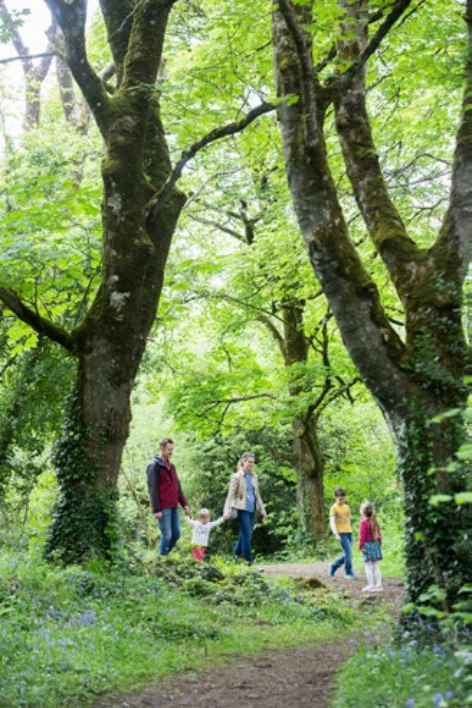
Figure from page 94
A key challenge is to ensure that in planning for rural places, responses are uniquely tailored to recognise the balance required between managing urban generated demand in the most accessible rural areas, typically in proximity to Dublin and other towns, whilst supporting the sustainable growth of rural communities and economies, including those facing decline. In general, those rural places in proximity to large urban centres have experienced significant growth and urban generated pressures and require levels of growth to be managed in order to ensure that there is a requisite service level for the existing population. Those in more peripheral locations have experienced decline in population and marked vacancy, requiring support for the existing population and regeneration of existing cores. The development strategy for these rural places is to be set out in the core strategies of county development plans.

Figure from page 95
People & Place
Planning for Future Growth in Rural Places
Housing
Regeneration, Renewal and Funding Opportunities
Facilitating housing is paramount to ensuring the sustainability, vitality and viability of the rural places of the Region. Support for housing and population growth within rural towns and villages will help to act as a viable alternative to rural one-off housing, contributing to the principle of compact growth. The availability of serviced sites, in tandem with schemes such as the Irish Water Scheme for Small Towns and Villages, will help to enable this.
The NPF identifies the need to strengthen and diversify rural towns to be a focus for local housing and employment growth. Rural towns can act as a focus for development in their areas through the provision of services across economic, social and administrative areas. The countryside within the Region provides for rural economies and rural communities, based on agriculture, forestry, tourism and rural enterprise. This should be facilitated while avoiding over-spill development from urban areas and urban generated housing.
In terms of population distribution within the Region, 94% of the EMRA’s total population lives within areas under urban influence. Within the Eastern SPA, 91% of the population lives in areas under urban influence whilst in the Midlands SPA this figure is 72.9%. Local authorities’ rural housing planning policy should be evidence based and accommodate rural generated housing consistent with the settlement framework contained in this Strategy and the DEHLG Sustainable Rural Housing Guidelines, 2005, or any successor thereof, and should be accommodated within the Housing Needs Demand Assessment, reflecting the housing needs of the county as a whole.
For some rural areas, urban and commuter generated development has undesirably affected the character and cohesion of these locations. Simultaneously, in less accessible rural locations, population levels have declined and it has been difficult to sustain basic services and community facilities at these locations.
As part of Project Ireland 2040, the Government has committed to providing an additional €1 billion for a new Rural Regeneration and Development Fund10 over the period 2019 to 2027. The Fund will provide investment to support rural renewal for suitable projects in towns and villages with a population of less than 10,000, and outlying areas. It will be administered by the Department of Rural and Community Development. This fund provides an opportunity to support the revitalisation of rural Ireland, to make a significant and sustainable impact on rural communities, and to address depopulation in small rural towns, villages and rural areas. It will be a key instrument to support the objectives of the NPF, and in particular to achieve Strengthened Rural Economies and Communities – one of the National Strategic Outcomes of the NPF. The RIAI’s Toolkit for Towns and Villages offers useful advice for local authorities in relation to rural regeneration.
The NPF and RSES make a distinction between areas under urban influence, i.e. within the commuter catchment of cities and large towns and centres of employment, and rural areas outside these catchments. In such areas a more flexible approach based primarily on siting and design will apply.
Core strategies for county development plans shall identify areas under strong urban influence in the hinterlands of settlements and set the appropriate rural housing policy response to avoid ribbon and over spill development from urban areas, support revitalised towns and villages, achieve sustainable compact growth targets, sustainably address rural decline and protect the rural resource for rural communities.
10 https://drcd.gov.ie/about/rural/rural-regeneration-development-fund/

Figure from page 96
Regional Spatial & Economic Strategy
Enabling and Sustaining the Rural Economy
CASE STUDY:
This Section should be read in conjunction with the Rural Economy section at Chapter 6 Economy and Employment of this document.
Rural Regeneration and Development Fund
A key objective of the NPF is to enable all parts of the Country – both urban and rural – to achieve their full potential. The RSES reflects this core objective and aims to strengthen the fabric of rural Ireland, supporting rural towns and communities as well as the open countryside, improving connectivity, and supporting job creation, particularly in a more diverse range of sectors.
The rejuvenation of rural towns and villages requires that appropriate job creation can be supported in rural areas. Traditional sectors such as agriculture, tourism, extractive industries and forestry are complemented by diversification in sectors such as food, renewable energy and opportunities provided from improved digital connectivity. The agri-food sector plays a significant role in Ireland’s rural economy and this sector is supported through the implementation of Food Wise 2025. The forestry sector is another significant contributor to the economy as is tourism and the development of greenways, blueways and peatways to provide an alternative visitor experience. Energy production, including renewable energy in the form of wind, solar and biomass have to date largely been provided in rural areas and the location of future renewable energy production is likely to be met in rural areas. (For further details in relation to rural economy refer to Chapter 6 Economy and Employment and in relation to digital connectivity Chapter 8 Connectivity).
Under the Rural Regeneration and Development Fund (RRDF) approximately €2.9m has been allocated to the Historic Granard Motte Project, to develop a major tourism and amenity attraction at the site of Granard Motte, a national monument at Granard, Co. Longford. The project will develop a heritage park on 15 acres of land and will recreate a living Norman Village and children’s amenities. It will complement previous successful funding applications on the site that saw the development of a ‘Knights and Conquests’ Heritage Centre and an onsite café as part of the REDZ scheme and Town and Village Renewal scheme. The Knights and Conquests Centre11 is an interpretative centre telling the story of the Norman Knights in Ireland, allowing visitors an opportunity to walk through time and learn about life in Norman Ireland.
The RRDF funds will be used to bring additionality to the overall project, allowing for a tourism product of national and international scale to be opened on the site. This will be a living history village, which will result in an immersive visitor experience on Norman life 800 years ago, where visitors will be transported back to Norman Ireland through a series of innovative living history displays and activities, supported by audiovisual presentations, augmented reality, VR and print. It will link into the Granard Motte, bringing it back into playing a pivotal role in the development of the town.
The RSES supports tourism development and promotional branding to ensure that areas associated with Ireland’s Hidden Heatlands and Ireland’s Ancient East are developed and promoted to tap into the economic potential of rural areas (see Chapter 6 Economy and Employment in relation to the development of tourism in the Region).
This project is a collaboration between Longford County Council, the local community and Fáilte Ireland. The RRDF allowed this project to be significantly scaled up to that of a tourism product that would encourage people to visit, enhancing the visitor experience and therefore the long term sustainability of the project. This means that this project will have a significant economic impact on the town of Granard and the wider region. It is anticipated that in excess of 40 jobs will be created as a result of this project and 15,000 visitors projected to visit the site yearly, once fully operational. This will benefit existing and new businesses in Granard.
11 https://www.knightsandconquests.ie/

Figure from page 97
People & Place
| REGIONAL POLICY OBJECTIVES: | |
|---|---|
| Rural Areas | |
| RPO 4.77: In development plan policy local authorities | RPO 4.81: In rural areas outside the Rural Areas Under |
| shall prioritise the regeneration of rural towns and villages through identification of significant regeneration projects for rural villages and rural areas which could harness untapped assets with community and wider private and public sector support and investment including the Rural Regeneration and Development Fund. | Strong Urban Influence local authorities shall encourage sustainable growth in areas that have experienced decline or stagnation, facilitate the provision of single houses in the countryside based on siting and design criteria for rural housing in statutory guidelines and plans, having regard to the viability of smaller towns and rural settlements. |
| RPO 4.78: Development plans should support the | RPO 4.82: Local authorities shall ensure that |
| development of a ‘New Homes in Small Towns and Villages’ initiative which would augment the delivery of actions by local authorities, Irish Water, communities and other stakeholders in the provision of services and serviced sites to create ‘build your own home’ opportunities within the existing footprint of rural settlements to provide new homes to meet housing demand. | economic development that is urban in nature should be in the first instance located in urban areas. |
| RPO 4.83: Support the consolidation of the town and village | |
| network to ensure that development proceeds sustainably and at an appropriate scale, level and pace in line with the core strategies of the county development plans. | |
| RPO 4.79: Local authorities shall identify and provide | RPO 4.84: Support the rural economy and initiatives in |
| policies that recognise the contribution that small towns, villages and rural areas contribute to social and economic wellbeing. As part of this policy provision that seeks to support and protect existing rural economies such as valuable agricultural lands to ensure sustainable food supply, to protect the value and character of open countryside and to support the diversification of rural economies to create additional jobs and maximise opportunities in emerging sectors, such as agri-business, renewable energy, tourism and forestry enterprise is supported. | relation to diversification, agri business, rural tourism and renewable energy so as to sustain the employment opportunities in rural areas. In keeping with the NPF, the Eastern and Midland Regional Assembly will support the longer term strategic planning for industrial peatland areas. This may include support, where appropriate, for a Transition Team in place and preparation of a comprehensive afteruse framework plan for the peatlands and related infrastructure, which addresses environmental, economic and social issues, including employment and |
| RPO 4.80: Local authorities shall manage urban | replacement enterprise reflecting the current transition from employment based around peat extraction. |
| generated growth in Rural Areas Under Strong Urban Influence (i.e. the commuter catchment of Dublin, large towns and centres of employment) and Stronger Rural Areas by ensuring that in these areas the provision of single houses in the open countryside is based on the core consideration of demonstrable economic or social need to live in a rural area, and compliance with statutory guidelines and plans, having regard to the viability of smaller towns and rural settlements. | |
Figure from page 98
Regional Spatial & Economic Strategy
5
Dublin Metropolitan Area Strategic Plan (MASP)
Pages 94–98 · View in original PDF